
Formation temperature is a key process parameter in lithium-ion cell manufacturing that directly controls both the chemical composition of the SEI film (solid electrolyte interphase) on the negative electrode and the timing and magnitude of cell volume expansion during formation. Using the IEST GVM2200 in-situ gassing volume analyzer on NCM523/graphite cells across five formation temperatures (25°C, 45°C, 55°C, 65°C, 85°C), this study shows that higher formation temperature causes earlier onset and larger magnitude of cell swelling, sharper phase-transition peaks in differential capacity above 55°C, and a compositional shift in the SEI toward inorganic-rich phases (LiF, Li₂CO₃, RCO₂Li) that are less mechanically compliant. A practical formation temperature window of 45°C–70°C balances reduced cell polarization against preservation of SEI mechanical integrity for NCM523/graphite chemistry.
Formation is a critical manufacturing step for lithium-ion cells: its primary purpose is to generate a stable SEI film on the negative electrode that electronically isolates the electrode from the electrolyte while still allowing lithium-ion transport.1,2 The quality of the SEI film formed during this step strongly influences subsequent cycle performance and cell lifetime. Formation reactions also generate gas and induce electrode volume changes; formation temperature is therefore a key process parameter that couples electrochemistry, interphase chemistry, and cell swelling behavior.
This article uses the In-Situ Gassing Volume Monitor Analyzer (GVM) to perform in-situ volume measurements on NCM523/graphite cells at different formation temperatures, and explains how formation temperature influences SEI film composition, SEI mechanical properties, and the timing and magnitude of cell volume swelling during the formation step.
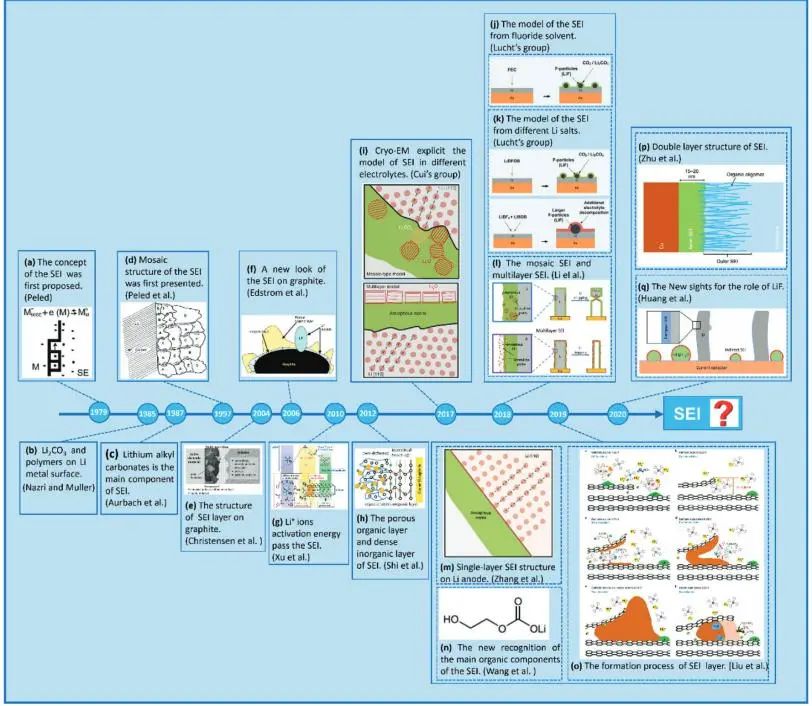
Figure 1. Research progress and timeline of SEI film formation on graphite and lithium metal surfaces1
Testing used the IEST GVM2200 In-Situ Battery Gassing Volume Analyzer, with a test temperature range of 20°C–85°C and dual-channel capability for simultaneous testing of two cells (Figure 2).
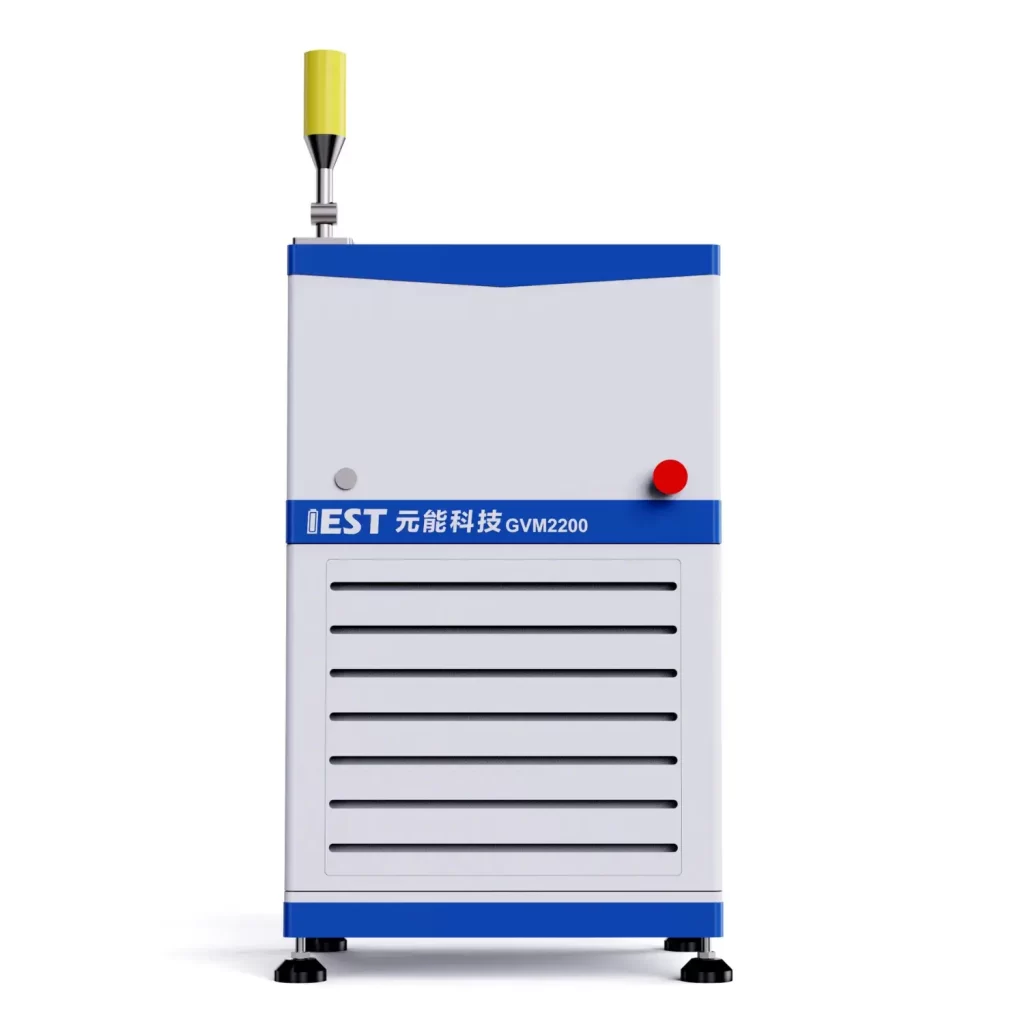
Figure 2. IEST GVM2200 In-Situ Battery Gassing Volume Analyzer — 20°C–85°C test range, dual-channel simultaneous cell testing
Cells with an NCM523/graphite system were used, charged at 0.5C constant current to 4.2 V, with a theoretical capacity of 2,400 mAh.

Figure 3. Test cells — NCM523/graphite system, 2,400 mAh theoretical capacity
Cells were initially weighed (m₀), placed into the instrument channels, and the MISG software was initiated. The software was configured with the corresponding cell ID and sampling frequency parameters, automatically recording data for volume change, temperature, current, voltage, and capacity throughout formation.
Five formation temperatures were compared: 25°C, 45°C, 55°C, 65°C, and 85°C, following the process shown in Figure 4(a). For each temperature point, five parallel cells were run using the same formation procedure to produce comparable volume-expansion and differential capacity (dQ/dV) data sets, shown in Figures 4(b) and 4(c). The resulting volume and dQ/dV profiles were used to assess gas evolution, phase-transition behavior, and SEI film evolution as a function of formation temperature.
As formation temperature increased, the onset of measurable cell expansion occurred earlier in the charge profile. Volume growth accelerated and reached a near-stable maximum as cell voltage approached approximately 3.7 V, followed by slight contraction during the constant-voltage stage. Higher temperatures produced larger total gas evolution and earlier expansion onset, indicating that elevated formation temperature both shifts and accelerates the reactions contributing to cell swelling.
Notably, when formation temperature exceeded 55°C, the first phase-transition peak in the differential capacity (dQ/dV) curves became noticeably sharper. This sharpening is consistent with more abrupt electrochemical events and indicates that high-temperature formation drives more intense SEI-related reactions— for example, faster reduction of solvent components and more rapid decomposition pathways at the graphite/electrolyte interface.
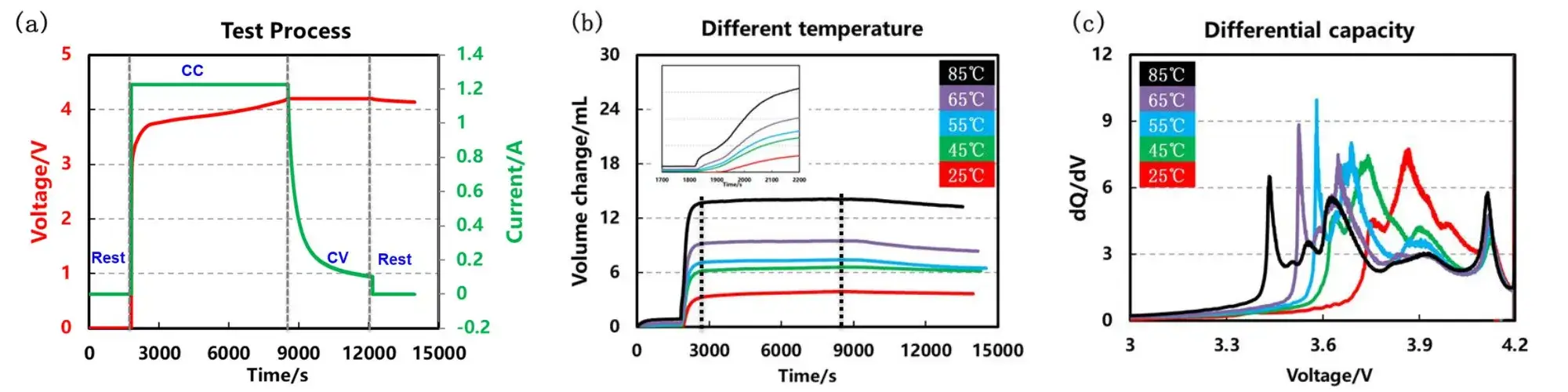
Figure 4. Cell formation process: (a) formation protocol, (b) volume swelling curves, (c) differential capacity (dQ/dV) curves at 25°C, 45°C, 55°C, 65°C, 85°C — higher temperature produces earlier, larger volume expansion and sharper phase-transition peaks above 55°C
SEI film formation is governed by two opposing processes: SEI growth (net formation) and SEI dissolution (loss of SEI components into the electrolyte). Experimental evidence shows SEI growth is largely tied to electrochemically induced solvent reduction and is relatively less sensitive to temperature. In contrast, higher temperatures accelerate dissolution of the initially formed SEI components into the electrolyte. As a result, SEI films produced at different formation temperatures possess distinct compositions and morphologies.
At elevated temperatures, organic SEI components dissolve more readily in the organic electrolyte, favoring an SEI film enriched in inorganic species—including LiF, Li₂CO₃, RCO₂Li, and other carbonates—that are less soluble. This compositional shift reduces the mechanical compliance of the SEI film and decreases the electrode’s ability to accommodate volume changes, exacerbating measurable cell swelling and interface instability under high-temperature formation conditions.
Conversely, SEI film formed at lower temperatures tends to be denser and more compact. While a compact SEI may reduce gas-producing side reactions, it can also exhibit lower ionic conductivity and higher polarization; at very low formation temperatures this can limit lithium transport and increase the risk of localized lithium plating. There is therefore a clear trade-off in SEI film formation conditions: low temperature produces a dense but less ionically conductive SEI, while high temperature produces a more inorganic, less mechanically compliant SEI with greater gas evolution.
Formation temperature alters several coupled physical properties that together determine SEI film outcome and cell swelling behavior:
Electrolyte viscosity and ionic conductivity: Higher temperature reduces electrolyte viscosity and increases ionic conductivity, increasing Li⁺ transport rates and reducing cell polarization during formation.
Electrode diffusion kinetics: Elevated temperature increases lithium diffusion within active materials, shifting phase boundaries and causing phase-transition peaks to shift to lower voltage (a left shift in the dQ/dV curve).
Interfacial chemical kinetics: Higher temperatures accelerate side reactions and SEI dissolution, increasing gas production and shifting SEI composition toward inorganic-rich layers that are mechanically stiffer and less able to accommodate electrode volume change.
Together, these effects explain why higher formation temperature generally reduces polarization and can improve some formation-step metrics, yet beyond an optimal range it degrades SEI mechanical integrity and increases both cell swelling and irreversible side reactions.
The in-situ volume data show a clear trend: higher formation temperature leads to earlier and larger volume increases. Excessive formation temperature also correlates with stronger gas evolution and sharper early phase-transition peaks in the dQ/dV curves, particularly above 55°C. Because overly high formation temperature accelerates volatile electrolyte component loss and damages SEI film structure, the industry commonly adopts 45°C–70°C as a practical formation temperature window that balances ionic transport, SEI film quality, and gas evolution control for NCM523/graphite and similar cell chemistries.
Target a balanced formation temperature: Based on the measured trends, select a formation temperature within 45°C–70°C for NCM523/graphite cells as a starting point, then fine-tune within this window according to electrolyte formulation and electrode porosity.
Monitor in-situ volume and gas evolution during pilot runs: Real-time volume monitoring (e.g., IEST GVM2200) helps detect excessive gas generation or abrupt SEI-related events, providing direct, quantitative feedback on whether formation temperature adjustments are needed.
Consider SEI chemistry when adjusting temperature: Higher temperature favors an inorganic-rich SEI film; if a more elastic, organic-rich SEI is desired (for example, for high-expansion anode chemistries such as silicon-containing anodes), moderate formation temperatures combined with electrolyte additive strategies may be preferable.
Account for volatile electrolyte loss at high temperature: Formation temperatures near the high end of the tested range (e.g., 85°C) can accelerate loss of low-boiling-point electrolyte components and trigger secondary reactions; limit exposure time at high temperature or revise electrolyte formulation accordingly.
Formation temperature strongly controls two intertwined outcomes: the chemical and mechanical character of the SEI film, and the timing and magnitude of cell volume expansion during the formation step. This study, using a controllable dual-channel in-situ gas volume monitor, shows that higher formation temperatures accelerate cell expansion and gas evolution and shift electrochemical phase transitions, while also changing SEI film composition toward inorganic-rich, less mechanically compliant films—particularly above 55°C. For the NCM523/graphite cells tested here, an industry-typical formation temperature window of 45°C–70°C provides a reasonable compromise between reduced polarization and preserved SEI film integrity. These quantitative, in-situ measurements can guide process engineers in optimizing formation temperature together with formation rate, applied pressure, and electrolyte/additive selection.
[1] Jian Tan, John Matz, Pei Dong, Jianfeng Shen, and Mingxin Ye. A Growing Appreciation for the Role of LiF in the Solid Electrolyte Interphase. Adv. Energy Mater. 2021.DOI:10.1002/aenm.202100046
[2] Wei Wenfei, Zhong Kuan, Jiang Shiyong. Effect of the formation temperature on lithium-ion battery performance[J]. Energy Storage Science and Technology, 2018, 7(5): 908-912.
Formation temperature is the temperature at which a lithium-ion cell undergoes its first charge cycles (the “formation” step) during manufacturing. This step builds the initial SEI (solid electrolyte interphase) film on the negative electrode surface, which is essential for long-term cycling stability. Formation temperature directly affects SEI film composition, electrolyte viscosity and ionic conductivity, electrode diffusion kinetics, and the rate of gas-generating side reactions. In this study on NCM523/graphite cells, formation temperatures from 25°C to 85°C were compared, with 45°C–70°C identified as a practical working window that balances reduced cell polarization against SEI film mechanical integrity.
SEI decomposition in lithium-ion batteries typically becomes significant in the range of approximately 80–120°C during abusive heating (e.g., thermal runaway analysis), which is distinct from but related to the SEI film’s compositional sensitivity to formation temperature. During the formation step itself (typically conducted at 25–85°C), higher formation temperature does not decompose existing SEI but instead changes its growth chemistry: it accelerates dissolution of initially formed organic SEI components into the electrolyte, shifting the final SEI composition toward inorganic-rich species (LiF, Li₂CO₃, RCO₂Li) that have different thermal stability characteristics than organic-rich SEI formed at lower temperature. This connection between formation temperature and SEI composition is one reason formation conditions are considered relevant to a cell’s later thermal stability margin, though formation temperature itself remains well below SEI breakdown/decomposition thresholds.
Higher formation temperature causes both earlier onset and larger magnitude of cell volume expansion during formation, as measured by in-situ gassing volume analysis. In this study, volume growth accelerated and approached a near-stable maximum as cell voltage neared 3.7 V, with higher-temperature cells reaching this point earlier and with greater total expansion. The mechanism is temperature-accelerated SEI dissolution and side-reaction kinetics: as temperature rises, more solvent decomposition and gas-generating reactions occur per unit time, and the resulting SEI is enriched in inorganic components that are less able to mechanically buffer subsequent volume changes. Formation temperatures above 55°C in this study showed a clear inflection toward stronger gas evolution and sharper differential-capacity phase-transition peaks.
There is no single formation temperature that is universally “most stable”— SEI film formation conditions involve a trade-off. Low formation temperature (e.g., 25°C) produces a denser, more compact SEI film with lower gas evolution, but this SEI can exhibit lower ionic conductivity and higher polarization, increasing the risk of localized lithium plating at very low temperatures. High formation temperature (e.g., 85°C) reduces polarization and improves ionic transport during formation, but produces an inorganic-rich, less mechanically compliant SEI with greater gas evolution and earlier, larger cell swelling. Based on the quantitative trends in this study, a formation temperature window of 45°C–70°C is recommended for NCM523/graphite cells as a practical compromise, to be fine-tuned according to specific electrolyte formulation and electrode porosity.
Cell volume expansion during formation is measured using an in-situ gassing volume analyzer, such as the IEST GVM2200, which monitors a cell’s volume change in real time throughout the formation charge-discharge protocol without disassembling the cell. The cell is weighed, placed into a temperature- controlled instrument channel, and cycled according to a defined formation protocol while the instrument simultaneously records volume change, temperature, current, voltage, and capacity. This in-situ approach is essential for formation-temperature studies because it captures the precise voltage and time at which volume expansion onset occurs and how expansion magnitude evolves throughout the charge profile—data that cannot be obtained from post-formation (ex-situ) thickness or density measurements alone.