IEST Automatic Coin Cell Assembly Machine(CAAS)

IEST CAAS1200G/M automatic coin cell assembly macine, 200-cell batch capacity, ±0.2mm accuracy

High-Throughput Automated Battery Cell Fabrication & Coin Cell Assembly Machine

Next-Gen Button Cell Assembly Solutions for Advanced Battery R&D & QC

产品规格卡片 | IEST
The Automated Coin Cell Assembly Machine (CAAS) is an industrial-grade, high-throughput platform engineered for for high-precision, high-consistency assembly of lithium-ion, sodium-ion, and solid-state coin cells in battery R&D. It replaces manual coin cell assembly with high-precision robotic arm, AI vision inspection, automatic sealing device, high-throughput assembly and full-process traceability. The system achieves an industry-leading assembly concentricity of ±0.2mm, resolving data discrepancies caused by manual stacking errors and electrode curling. Ideal for universities, high-throughput electrolyte screening, and industrial QC & R&D lab.
200 ea High Throughput Assembly
±0.2 mm Assembly Concentricity
60 cells/h Assembly Speed
90 % Reduce the Assembly Time

Looking for a more compact setup or working with a limited lab space or budget?

The Future of Coin Cell Assembly

Currently, the consistency of coin cell test data meets the standards of leading lithium battery enterprises.

Battery Capacity Comparison Table
Specific Capacity Range Comparison of Coin Cells During Charge/Discharge Cycling
Materials NCM LFP Graphite Silicon-based Anode
Charging Specific Capacity Range Value (mAh/g) < 1.5 < 1.5 < 1.5 < 20
Discharging Specific Capacity Range Value (mAh/g) < 1.5 < 1.5 < 2.0 < 20

1. Automatic Assembly of the NCM

For NCM cathode materials, the charge/discharge specific capacity range of <1.5mAh/g and σ standard deviation fluctuation below 0.4.

NCM cathode charge-discharge specific capacity range comparison, automatic coin cell assembly
NCM cathode specific capacity standard deviation (σ) fluctuation across automatic assembly batches

2. Automatic Assembly of the LFP

For LFP materials, the charge/discharge specific capacity range of <1.5mAh/g and σ standard deviation fluctuation below 0.4.

LFP cathode charge-discharge specific capacity range comparison, automatic coin cell assembly
LFP cathode specific capacity standard deviation (σ) fluctuation across automatic assembly batches

3. Automatic Assembly of the Graphite

For graphite anode materials, the charge/discharge specific capacity ranges <1.5mAh/g and 2mAh/g respectively.

Graphite anode charge-discharge specific capacity range comparison, automatic coin cell assembly
Graphite anode specific capacity standard deviation (σ) fluctuation across automatic assembly batches

4. Automatic Assembly of the Silicon-based Anode

For silicon-based anode materials the charge/discharge specific capacity ranges both <20mAh/g.

Silicon-based anode charge-discharge specific capacity range comparison, automatic coin cell assembly
Silicon-based anode specific capacity standard deviation (σ) fluctuation across automatic assembly batches
High-precision robotic arm achieving ±0.2mm coin cell assembly concentricity for curled electrode handling

High-precision Robotic Arms for Precise Grasping

Precise gripping of curled electrodes achieves assembly concentricity within ±0.2mm.

Automatic electrolyte switching and washing system preventing cross-contamination across up to 100 electrolyte recipes

Electrolyte Automated Switching/Washing

Specialized fixtures for different material types, along with automated electrolyte switching and washing functions, effectively prevent cross-contamination.

Automatic coin cell sealing module with precision pressure and thickness control for improved seal integrity

Automatic Sealing Module

The sealing module ensures precise control over pressure and thickness, significantly improving sealing integrity.

200-unit material rack enabling high-throughput automatic coin cell assembly at 1–1.5 minutes per cell

Save Time With High Throughput Assembly

Equipped with a 200-unit material rack, CAAS supports high throughput rapid auto-assembly while minimizing repetitive mechanical operations.

Dual CCD vision monitoring system providing real-time, traceable coin cell assembly process data

Full-process Intelligent Monitoring

A dual CCD vision system provides real-time monitoring of material status throughout the process, making battery data traceable and transparent.

CAAS automatic coin cell assembly machine reducing operator skill threshold versus manual assembly

Reduce the Skill Threshold for Operators

The CAAS system significantly lowers the skill threshold for operators, allowing staff to master coin cell assembly without intensive training.

System Features

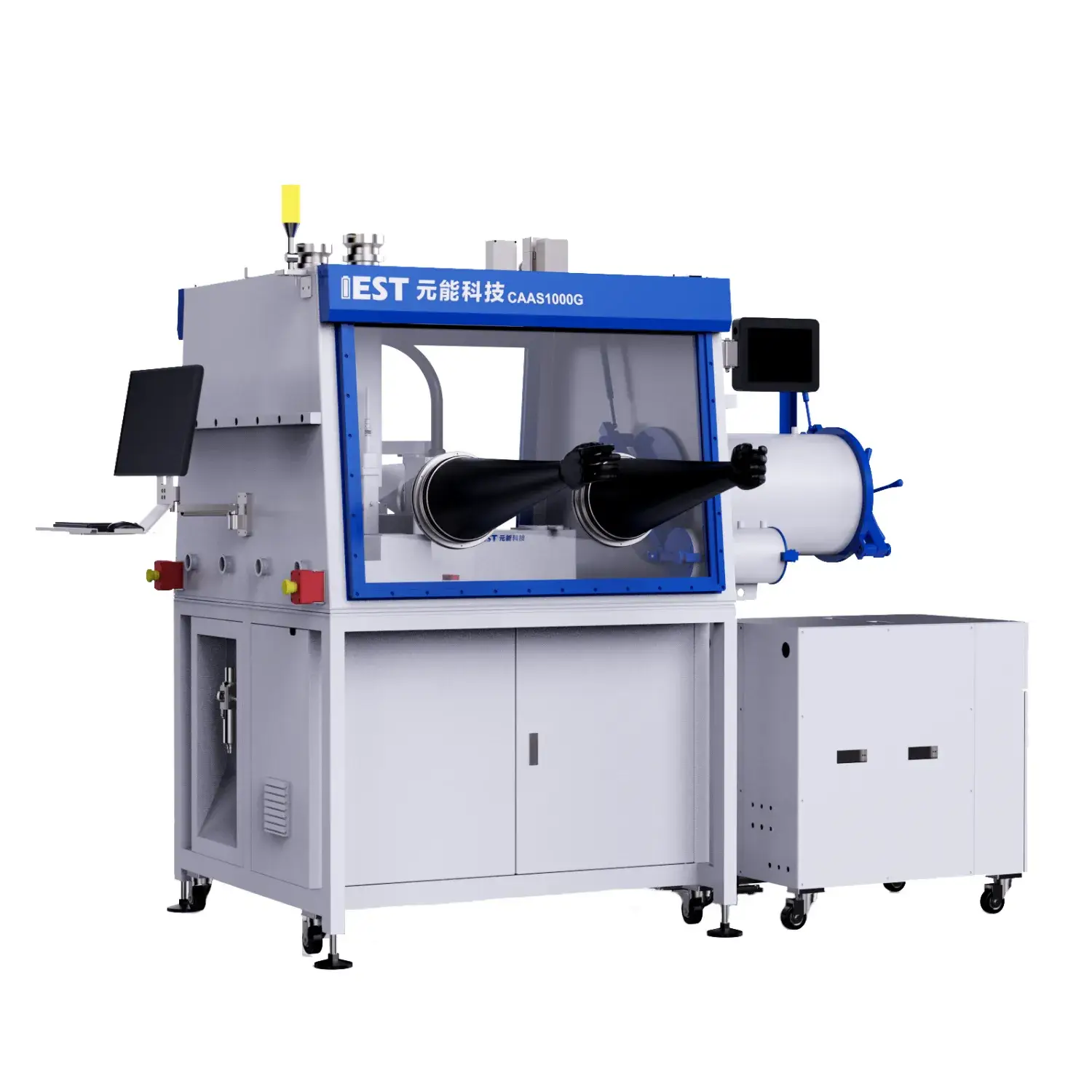
Integrated glovebox providing controlled anhydrous, oxygen-free atmosphere for coin cell assembly

Glove Box Integration

Integrated glovebox provides controlled anhydrous/oxygen-free assembly atmosphere ensuring coin cell performance.

High-speed robotic coin cell assembly achieving approximately 1 cell per minute throughput

High-speed Robot Assembly

High-speed robotic material handling with optimized layout achieves ~1cell/min, enabling high-throughput coin cell assembly.

Coin cell assembly positioning system achieving ±0.2mm concentricity tolerance

High-precision Assembly

±0.2mm concentricity tolerance guaranteed by precision positioning system for consistent coin cell stacking.

AI vision-based defect inspection and process traceability system for coin cell assembly (optional module)

Cell Assembly Process Traceability

(Optional) Process traceability system with HD imaging and AI-based inspection for defect material rejection.

High-throughput Assembly

High-throughput Assembly

Batch loading capacity: 200 cells enabling continuous high-throughput assembly.

Barcode scanning and inkjet marking system for coin cell electrode batch traceability

Batch Association

Electrode materials traceable via barcode scanning; In-chamber inkjet marking enables batch association.

Automated electrolyte injection system with online electrolyte switching and inline rinsing

Auto Electrolyte Injection

Automated electrolyte injection with online switching between chemistries + inline system rinsing.

Online OCV voltage testing module for coin cell survival rate and equipment stability monitoring

Online Voltage Test

Online OCV testing monitors cell survival rate and equipment stability.

Centralized electrode, separator, and lithium foil material tray feeding system with batch traceability

Material Tray Test

Centralized feeding system: Electrode/separator/lithium foil trays with material traceability.

Automated lithium foil brushing module improving surface quality and stacking uniformity (optional)

Automated Lithium Foil Brushing Function

(Optional) Automated lithium foil brushing module enhances surface quality and stacking uniformity.

Top-mounted HD camera system for real-time coin cell assembly process monitoring

Sentinel Management

Top-mounted diagonal HD cameras enable real-time process monitoring and management.

Modular coin cell assembly architecture supporting flexible, customer-specific configuration

Functional Modularity

Modular architecture allows flexible configuration and providing customized services.

Cleanroom-grade particle control system with dust removal glovebox and non-metallic material trays

Particle Control

Glove box with dedicated dust removal, cleanroom-grade 4-axis robots, shielded drive components, non-metallic trays with material-specific vacuum grippers.

Proprietary data management software aggregating coin cell assembly process parameters

Data Process Software

Proprietary data management software automatically aggregates process parameters for user-friendly access and archiving.

Equipment Expansion​

方案 B - 左图右 Tab 切换 | IEST
High-Throughput Automatic Electrolyte Switching System
  • Equipment Features: Can interface with an automatic electrolyte formulation platform. Enables automatic switching between 100 different electrolyte recipes, supports continuous assembly of 400 battery cells.
  • Application Scenario: Suitable for coin cell assembly for electrolyte formulation verification and high-throughput battery assembly.
Liquid Injection Module
  • High-precision liquid injection with accuracy of ±1 μL. Injection volume continuously adjustable from 0 to 200 μL.
  • Injection tips automatically switched to prevent cross-contamination of electrolytes.
  • Automatic electrolyte transfer & short-term storage. Single transfer: 25 bottles (60 mL/bottle). Max capacity: 200 bottles.

1. Case 1: Manual Assembly VS Auto Assembly

Assembly Comparison Manual Assembly Automatic Assembly
Item Charge
capacity
(mAh/g)
Discharge
capacity
(mAh/g)
Efficiency
(%)
Charge
capacity
(mAh/g)
Discharge
capacity
(mAh/g)
Efficiency
(%)
NCM-1 Range value 1.1 1.3 0.22% 0.7 0.7 0.26%
Average 225.525 211.142 93.62% 225.325 211.05 93.66%
σ 0.384 0.396 0.001 0.226 0.198 0.001
COV 0.17% 0.19% 0.07% 0.10% 0.09% 0.08%
NCM-2 Range value 1.8 2 0.23% 0.6 0.9 0.23%
Average 225.467 211.7833 93.93% 225.292 211.6083 93.93%
σ 0.44 0.465 0.001 0.178 0.231 0.001
COV 0.20% 0.22% 0.07% 0.08% 0.11% 0.07%
Assembly Comparison Manual Assembly Automatic Assembly
Item Charge
capacity
(mAh/g)
Discharge
capacity
(mAh/g)
Efficiency
(%)
Charge
capacity
(mAh/g)
Discharge
capacity
(mAh/g)
Efficiency
(%)
Silicon
base-1
Range value 20.6 12.6 0.55% 17 16.8 0.25%
Average 1908.4 2046.9083 93.24% 1907.592 2044.9083 93.28%
σ 6.948 4.391 0.002 4.553 4.678 0.001
COV 0.36% 0.21% 0.18% 0.24% 0.23% 0.07%
Silicon
base-2
Range value 39.7 22.4 1.46% 19.9 22.2 0.38%
Average 1897.85 2039.7833 93.02% 1903.992 2041.5667 93.26%
σ 11.669 6.954 0.005 5.211 6.322 0.001
COV 0.61% 0.34% 0.49% 0.27% 0.31% 0.11%
NCM and silicon-based anode charge-discharge capacity comparison: manual assembly versus CAAS1000 automatic assembly

For NCM materials:

  • The range of charge/discharge specific capacity for NCM with automatic assembly is 0.6~0.9 mAh/g (σ ≈ 0.25), while with manual assembly it is 1~2 mAh/g (σ ≈ 0.4).

For Silicon-based anode materials:

  • The range of charge/discharge specific capacity for Si-based materials​ with automatic assembly is 15~20 mAh/g (σ ≈ 4~6), while with manual assembly it is 20~40 mAh/g (σ ≈ 5~10).
文字描述卡片 | 左侧蓝线样式
Conclusion: While the average specific capacity values obtained from automated and manual assembly methods were comparable for both material types, automated assembly demonstrated superior stability compared to manual assembly.

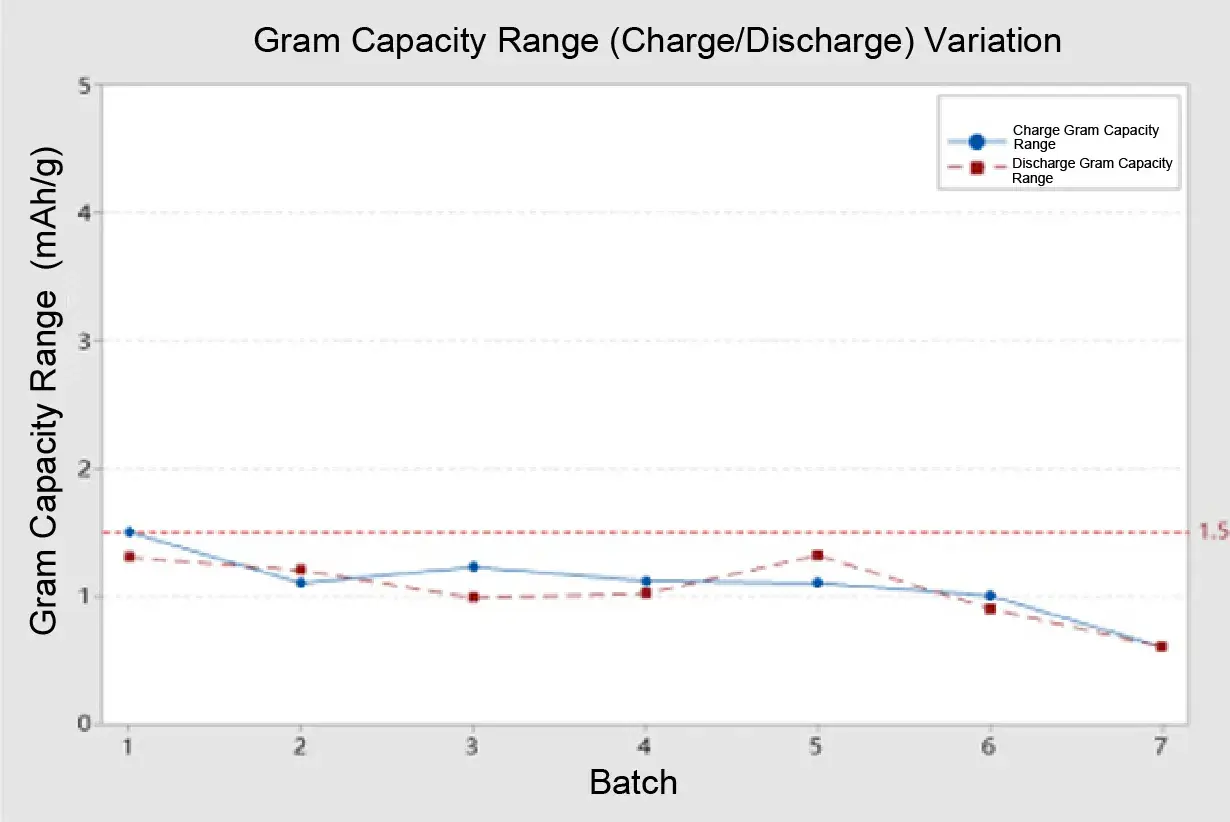
2. Case 2: Automatic Coin Cell Assembly of LFP Cathodes

Category Item Group 1 Group 2 Group 3 Group 4 Group 5 Group 6 Group 7
Range Charge capacity (mAh/g) 1.5 1.1 1.2 1.1 1 0.6 0.4
Discharge capacity (mAh/g) 1.3 1.2 1 1.3 0.9 0.6 0.5
Coulombic Effi (%) 0.8 0.4 0.3 1.3 0.4 0.5 0.6
Average Charge capacity (mAh/g) 161 160.7 160.7 161.3 161.1 161.1 161.1
Discharge capacity (mAh/g) 156.9 156.7 156.6 157 156.9 156.9 156.9
Coulombic Effi (%) 97.4 97.5 97.5 97.4 97.4 97.4 97.4
σ Charge capacity (mAh/g) 0.37 0.32 0.33 0.38 0.24 0.2 0.12
Discharge capacity (mAh/g) 0.31 0.36 0.29 0.3 0.25 0.16 0.12
Coulombic Effi (%) 0.18 0.12 0.09 0.3 0.11 0.12 0.12
COV Charge capacity (mAh/g) 0.23% 0.20% 0.21% 0.24% 0.15% 0.12% 0.10%
Discharge capacity (mAh/g) 0.20% 0.23% 0.18% 0.19% 0.16% 0.10% 0.10%
Coulombic Effi (%) 0.18% 0.12% 0.09% 0.31% 0.11% 0.12% 0.12%
LFP cathode charge-discharge specific capacity range comparison across 7 assembly batches, CAAS1000 lab-scale assembly
文字描述卡片 | 左侧蓝线样式
Conclusion:
  • The standard deviation (σ) for the charge/discharge specific capacity of each group is less than 0.4.
  • The range for the charge/discharge specific capacity of each group is less than 1.5 mAh/g.
  • The coefficient of variation (COV) for the charge/discharge specific capacity of each group is less than 0.3%.

3. Case 3: Automatic Coin Cell Assembly of Graphite Anodes

Category Item Group 1 Group 2 Group 3 Group 4 Group 5 Group 6 Group 7
Range Charge capacity (mAh/g) 1.1 1.2 1.1 1.2 1.3 1.2 1.5
Discharge capacity (mAh/g) 1.8 1.8 1.8 1.9 2.1 2.1 2.1
Coulombic Effi (%) 0.4 0.5 0.5 0.4 0.5 0.7 0.6
Average Charge capacity (mAh/g) 347.9 347.8 347.7 347.3 345.4 346.2 346.1
Discharge capacity (mAh/g) 367.8 368.4 368.2 368.2 367.7 368.2 368.8
Coulombic Effi (%) 94.6 94.4 94.4 94.3 93.9 94 93.8
σ Charge capacity (mAh/g) 0.28 0.38 0.31 0.34 0.45 0.35 0.44
Discharge capacity (mAh/g) 0.57 0.62 0.6 0.53 0.51 0.65 0.69
Coulombic Effi (%) 0.13 0.15 0.14 0.13 0.13 0.17 0.15
COV Charge capacity (mAh/g) 0.08% 0.11% 0.09% 0.10% 0.13% 0.10% 0.13%
Discharge capacity (mAh/g) 0.16% 0.17% 0.16% 0.14% 0.14% 0.18% 0.19%
Coulombic Effi (%) 0.14% 0.16% 0.15% 0.13% 0.14% 0.18% 0.16%
Graphite anode charge-discharge specific capacity variation chart, CAAS1000 automatic coin cell assembly
文字描述卡片 | 左侧蓝线样式
Conclusion:
  • The standard deviation (σ) for the discharge specific capacity in each group is less than 0.8, and for the chargespecific capacity, it is less than 0.5.
  • The range for the discharge specific capacity in each group is less than 2.1 mAh/g, and for the charge specificcapacity, it is less than 1.5mAh/g.
  • The coefficient of variation (COV) for both charge and discharge specific capacity in each group is less than 0.2%.

4. Case 4: Curling Issue of Single-Sided Electrodes after Calendering and Punching

Curled single-sided electrode flattening process using CAAS1000 specialized suction and visual positioning system
文字描述卡片 | 左侧蓝线样式
Conclusion:
  • Our specially designed suction cup can ensure that the curled electrodes are sucked evenly and flatly.
  • Our visual positioning system can avoid the placement position deviation caused by the curling of the electrodes.
  • The positive electrode shell is pressed down horizontally to flatten the curled electrode that contacts the electrolyte.
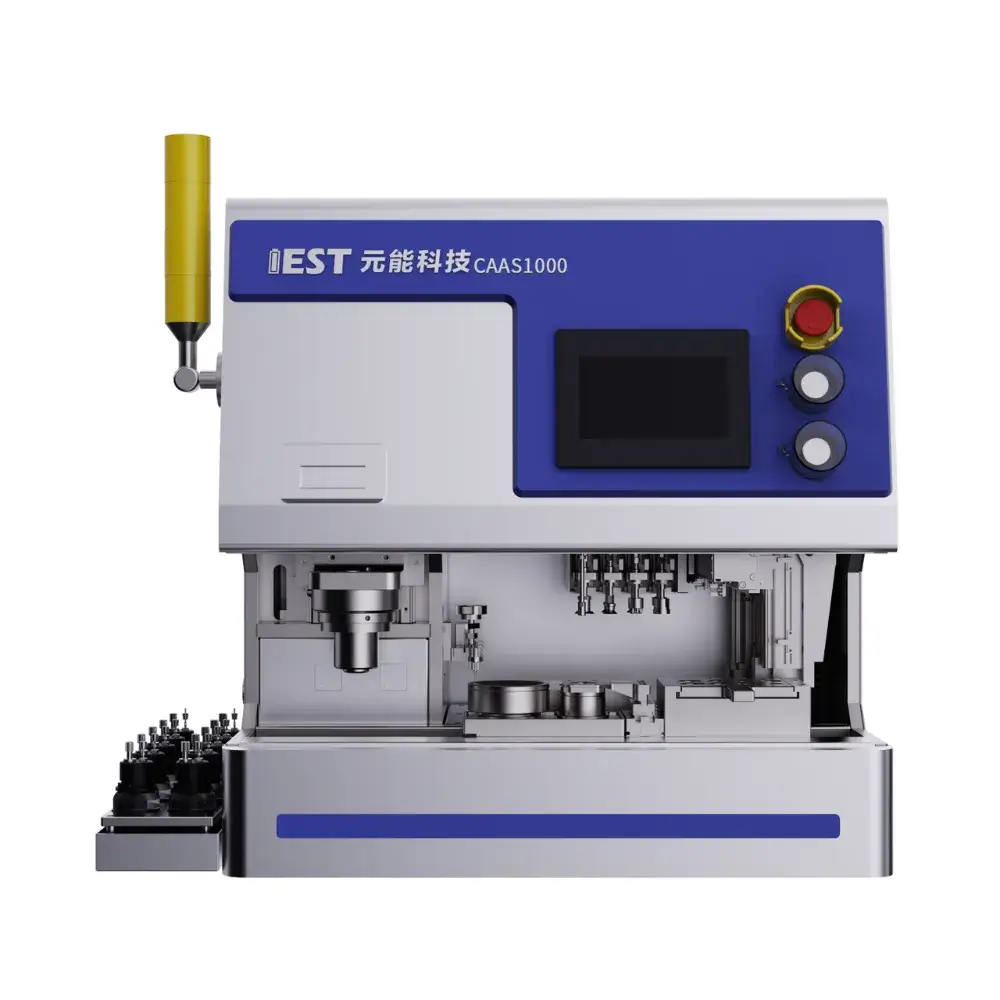
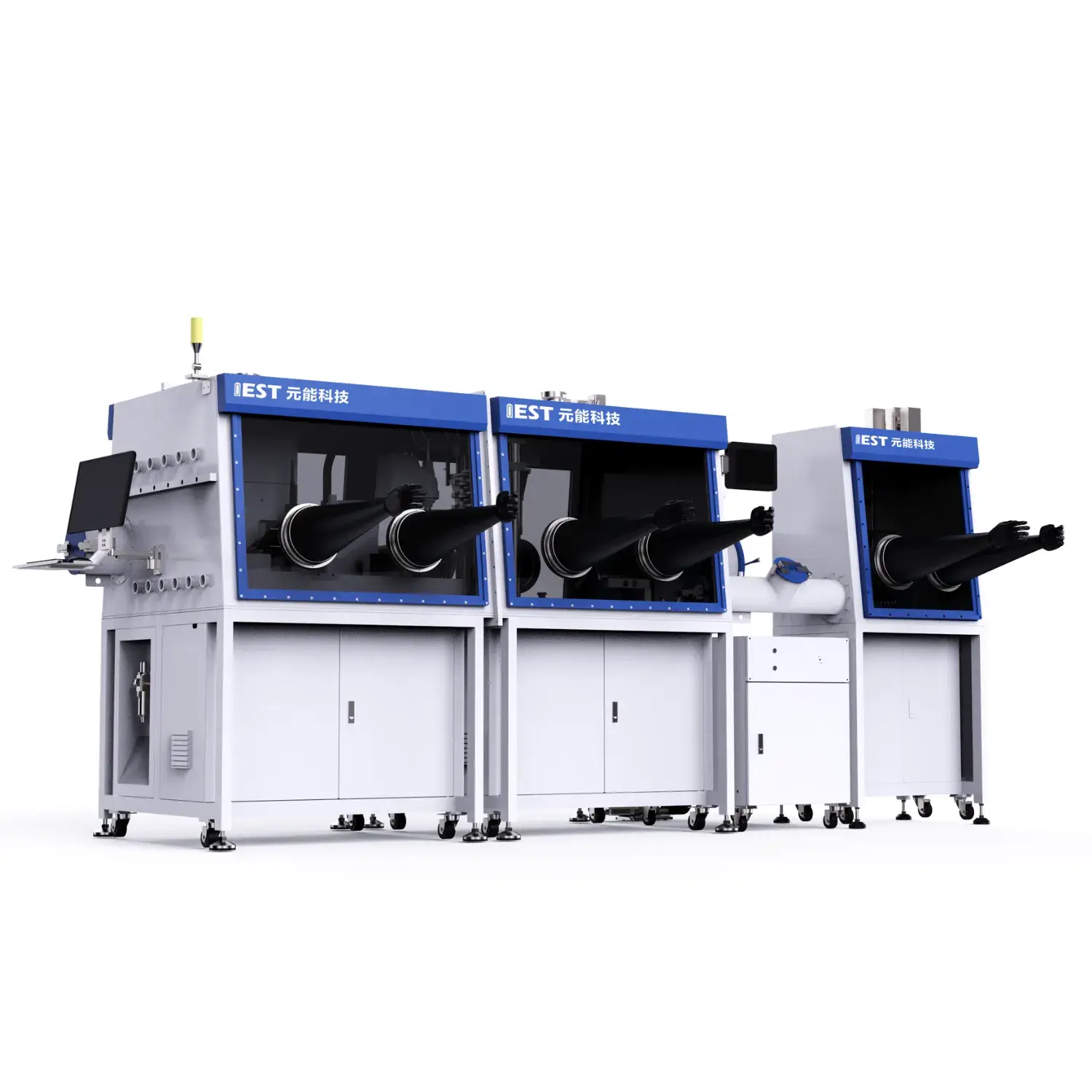
Model CAAS1000 CAAS1000G/M CAAS1100G/M CAAS1200G/M
Photo IEST CAAS1000 automatic coin cell assembly machine, 1–10 cell batch capacity, ±0.4mm assembly accuracy IEST CAAS1000G/M glovebox-integrated coin cell assembly system, 1–10 cell batch capacity, ±0.4mm accuracy IEST CAAS1100G/M automatic coin cell assembly system, 40-cell batch capacity, ±0.2mm accuracy
Assembly Feature 1 ~ 10ea 1 ~ 10ea 40ea 200ea
Assembly Accuracy ±0.4mm ±0.2mm
Assembly Efficiency 2min/ea 1 ~ 1.5 min/ea
Function
  1. Compatible with customer standard glove boxes.
  2. Modular robotic arm.
  3. Vision detection and positioning system.
  4. Automatic sealing machine.
  5. Automatic Electrolyte dispensing.
  1. Compatible with customer standard glove boxes.
  2. Modular robotic arm.
  3. Vision detection and positioning system.
  4. Automatic sealing machine.
  5. Automatic Electrolyte dispensing.
  1. Integrated double-sided four-station glove box.
  2. High-precision robotic arm.
  3. High-throughput assembly.
  4. Vision detection and positioning system.
  5. Automatic sealing machine.
  6. Automatic Electrolyte dispensing.
  7. Multi-module function options.
产品手册下载 | IEST
IEST Coin Cell Automatic Assembly System (CAAS)
Next-Gen Coin Cell Assembly Solutions For Lab & Industrial-scale

FAQs

Only material loading requires manual operation. The fully automated process allows extended unattended operation, enabling continuous autonomous production

  • Coin-type half-cells / full cells
  • Coin-type symmetric cells
  • Coin-type Li-Cu cells
  • Coin-type Li-Li cells

The key distinction is that the CAAS1200 is an upgraded version of the CAAS1100. It adds 200-unit material rack while maintaining identical optional functions, with enhanced program capabilities.

The electrolyte dispensing pump enables in-line switching between 3 electrolyte types (standard configuration). Support for additional types requires customization.

Our CAAS system employs dual-parameter monitoring (sealing pressure + thickness) with subsequent open-circuit voltage (OCV) testing and automated visual inspection of sealed cells.

For CR20-series coin cells, model switching requires no complex reconfiguration. If the coin cell is different diameter, sealing mold, material trays, and fixtures must be replaced.

Material handling trays can be programmed with customizable depletion thresholds, enabling proactive low-material alerts.

The material's center positioning uses the negative electrode shell's center as the reference datum. After the robotic arm places the negative electrode shell onto the assembly station, its position is captured by imaging. This establishes the benchmark center point for subsequent battery assembly. Each subsequent component is first imaged by a positioning CCD camera to locate its center. This position is compared with the negative electrode shell's center, and the robotic arm then places the component into position through algorithmic adjustments.

Yes, the CAAS system features a C++ based API. This facilitates seamless integration with Laboratory Information Management Systems (LIMS).

Specialized fixtures for different material types, along with automated electrolyte switching and washing functions, effectively prevent cross-contamination.

Contact Us

Can’t find what you’re looking for? We provide customized solutions to meet your needs.

Contact Us

Please fill out the form below and we will contact you asap!

IEST Wechat QR code