-
iestinstrument

Abstract
1. Why Does Silicon Anode Volume Expansion Limit Si-C Battery Cycle Life?
Rising energy density demands in electric vehicles are pushing battery anode development beyond the practical limits of graphite, whose theoretical capacity ceiling of 372 mAh/g has largely been reached by commercial cell designs. Silicon offers a compelling alternative — with a theoretical capacity of 4,200 mAh/g and a low lithiation potential of approximately 0.4 V — but its deployment at scale is constrained by one fundamental problem: silicon anode volume expansion of approximately 300% during lithiation and delithiation.
This silicon anode swelling drives a destructive cycle at the particle level. As silicon expands and contracts with each charge–discharge cycle, the SEI film on the particle surface cracks and reforms continuously. Each reformation consumes active lithium and electrolyte, accumulates irreversible side reaction products inside the cell, and progressively increases internal resistance and polarization. Particle pulverization further reduces the active surface area available for lithium intercalation, accelerating capacity fade.
Silicon-carbon composite anodes address these issues by embedding silicon within a carbon matrix that buffers volume change, maintains electronic conductivity, and partially stabilizes the SEI. However, the degree of swelling suppression depends critically on silicon content — a relationship that requires direct, in-situ quantification rather than inference from electrochemical data alone. This study uses the IEST SWE2110 in-situ swelling analyzer to directly measure and compare silicon carbon anode swelling percentage in Si-C pouch cells with 3 wt.% and 5 wt.% silicon content across 50 full charge–discharge cycles.
2. Experimental Equipment and Test Methods
2.1 Test Equipment
All swelling measurements were performed using the SWE2110 In-Situ Cell Swelling Testing System (IEST) in constant pressure mode at 5.0 kg, continuously monitoring cell thickness throughout 50 charge–discharge cycles. The MISS software package automatically records thickness, thickness variation, temperature, current, voltage, and capacity at each sampling interval for subsequent analysis.
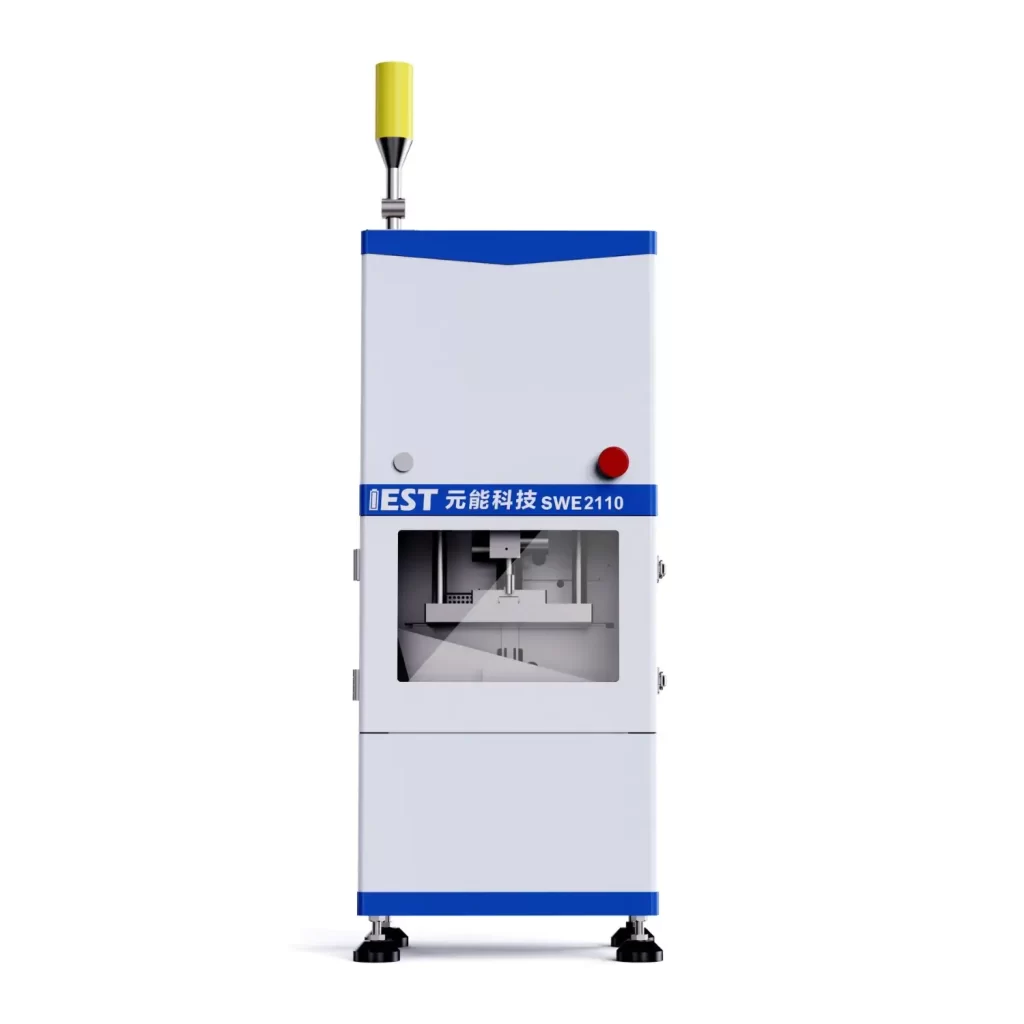
Figure 1. IEST SWE2110 In-Situ Cell Swelling Testing System used for silicon carbon anode swelling percentage measurement.
2.2 Test Cell Specifications and Charge–Discharge Protocol
Two silicon-carbon composite anode pouch cell formulations were tested — one with 3 wt.% silicon content and one with 5 wt.% silicon content — prepared by the same process to isolate the effect of silicon loading on swelling behavior. Cell specifications and the charge–discharge protocol are summarized in Tables 1 and 2.
| Information of cell | |
|---|---|
| Cathode | LCO |
| Anode | Si/C |
| Capacity | 1500mAh |
| Size | 60mm*90mm |
| No. | Step | Stop Condition | Sampling Frequency |
|---|---|---|---|
| 1 | Rest | 60 min | 10s |
| 2 | 0.5C CC | Cut-off Voltage 4.2 V | 10s |
| 3 | 4.2V CV | Cut-off Current 0.05C | 10s |
| 4 | Rest | 20 min | 10s |
| 5 | 1C DC | Cut-off Voltage 2.75 V | 10s |
2.3 Cell Thickness Swelling Test Process
Put the cell to be tested into the corresponding channel of SWE2110, open the MISS software, set the cell number and sampling frequency and other parameters corresponding to each channel, the software will automatically read the thickness of the cell, thickness variation, and test temperature during the charging and discharging process , current, voltage, capacity and other data for subsequent comparative analysis.
3. How Does Silicon Content Affect Anode Swelling Percentage Over 50 Cycles?
Set the in-situ swelling analyzer (SWE2110) to the constant pressure mode (the pressure value is 5.0kg), and monitor the thickness change of different proportion of silicon-carbon system (silicon content is 3 wt.% and 5 wt.% respectively) soft core under long cycle (50 cycle), the results are shown in Figure 2. Through the initial thickness normalization, it can be found that with the increase of the number of cycles, the thickness swelling curves of both are also rising, and the higher the silicon content, the more obvious the swelling growth.
3.1 Total Silicon Carbon Anode Swelling: 8.8% vs 11.2% After 50 Cycles
Compared with the initial state, 3wt.% after 50 cycles And 5 wt.% The thickness swelling percentage of the silicon content cell is 8.8% and 11.2% respectively, indicating that both of them have accumulated a lot of side reaction products after long cycle, resulting in the continuous increase of the total volume of the cell. Due to the serious volume swelling of the silicon particles in the cathode during the lithium intercalation process, the active material particles will be broken and pulverized, and the existing SEI film on the particle surface will be destroyed, while the exposed new silicon particle surface will further react with the electrolyte to form a new SEI film. This repeated rupture and regeneration of the SEI film will not only accumulate many side reaction products and make the total volume of the cell expand continuously, but also easily cause the internal resistance and polarization of the cell to increase continuously, and finally aggravate the capacity attenuation of the cell [2,3].
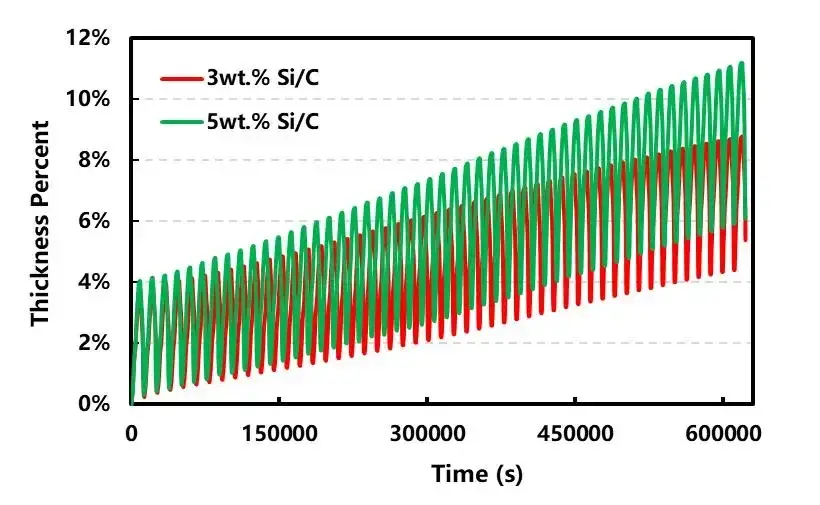
Figure 2. Normalized thickness swelling curves for 3 wt.% and 5 wt.% Si-C anode cells over 50 charge–discharge cycles. Total silicon carbon anode swelling after 50 cycles: 8.8% (3 wt.%) and 11.2% (5 wt.%).
| Parameter | 3 wt.% Si-C Cell | 5 wt.% Si-C Cell |
|---|---|---|
| Total thickness swelling (50 cycles) | 8.8% | 11.2% |
| Irreversible swelling divergence onset | After cycle 35 | After cycle 35 (more severe) |
| Swelling curve trend (late cycles) | Flattens after cycle 35 | Continues rising after cycle 35 |
| Capacity retention trend | Moderate decay | Accelerated decay |
| dQ/dV right-shift at cycle 50 | Present | More pronounced |
| Silicon anode volume expansion (theoretical) | ~300% per silicon particle | |
| Constant pressure during test | 5.0 kg (SWE2110) | |
3.2 Irreversible Swelling Thickness Diverges After Cycle 35
Beyond the total swelling curves, each cycle’s irreversible swelling thickness was extracted by subtracting the discharge-phase thickness contraction from the charge-phase swelling — a quantity that approaches zero in a fully reversible system but accumulates as the SEI grows and silicon particles fragment. Figure 3 shows this parameter for both cell groups across 50 cycles.
Before cycle 35, the irreversible swelling accumulation rates of both groups are nearly identical, indicating that at low cycle numbers, the 2 wt.% difference in silicon loading does not yet produce distinguishable degradation signatures. After cycle 35, however, the 5 wt.% Si cell shows markedly accelerated irreversible swelling growth — consistent with a threshold effect in which a critical fraction of silicon particles have fractured sufficiently to expose fresh silicon surfaces at a rate that overwhelms the electrolyte’s capacity to form stable SEI. This late-cycle acceleration of silicon anode swelling at higher silicon content directly foreshadows the capacity fade pattern observed in Section 4.
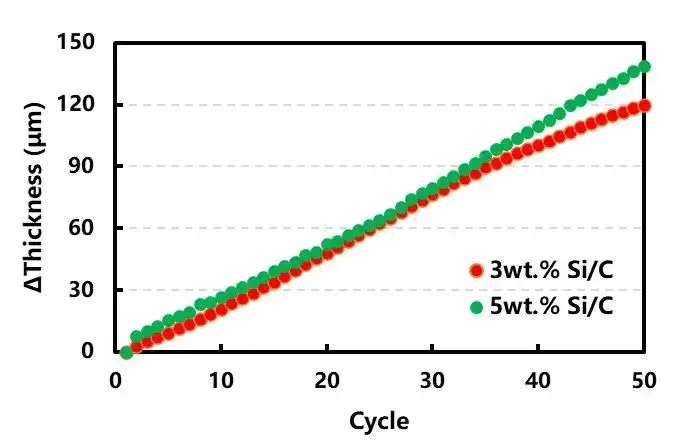
Figure 3. Irreversible swelling thickness as a function of cycle number for 3 wt.% and 5 wt.% Si-C anode cells. The two groups track closely until cycle 35, after which the 5 wt.% cell shows significantly accelerated irreversible swelling accumulation.
4. Correlation Between Silicon Carbon Anode Swelling and Capacity Decay
Swelling thickness and capacity retention data extracted cycle-by-cycle reveal a mechanistically linked co-evolution pattern that differs in detail between the two silicon content levels.
4.1 Swelling–Capacity Relationship Across the Cycle Life
Figure 4 plots the per-cycle swelling thickness alongside the capacity retention rate for both cell groups. In the early cycle regime (cycles 1–35), total swelling thickness rises while capacity retention falls — both driven by ongoing SEI accumulation, active lithium consumption, and progressive reduction of active silicon surface area. In the late cycle regime (after cycle 35), the thickness swelling curve flattens for both groups, reflecting the fact that particle pulverization, electrolyte depletion, and reduced active lithium concentration collectively limit how much lithium intercalation — and therefore volume change — can still occur. Critically, capacity fade continues during this late-cycle period even as swelling stabilizes, demonstrating that the two metrics are correlated but not proportional: structural damage accumulated in early cycles continues to degrade electrochemical performance after macroscopic swelling has plateaued.
The 5 wt.% Si cell shows greater swelling magnitude and more severe capacity decay than the 3 wt.% cell throughout, confirming that silicon carbon anode swelling percentage is a quantitative predictor of long-cycle degradation severity — and that silicon content is the primary lever controlling both.
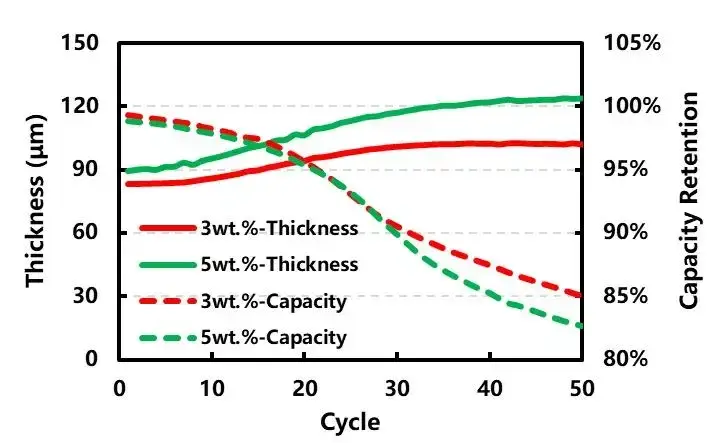
Figure 4. Correlation between silicon carbon anode swelling thickness and capacity retention rate for 3 wt.% and 5 wt.% Si-C cells over 50 cycles. Swelling plateaus after cycle 35; capacity fade continues.
4.2 dQ/dV Analysis: Increased Polarization and Phase Transition Suppression
Differential capacity (dQ/dV) curves before and after the 50-cycle test provide complementary electrochemical evidence for the structural changes driving capacity decay. Figure 5 compares the 1st-cycle and 50th-cycle dQ/dV curves for both cell groups.
In both the 3 wt.% and 5 wt.% Si-C cells, the entire dQ/dV profile shifts to the right after 50 cycles — a characteristic signature of increased internal polarization consistent with thickened SEI films, reduced ionic conductivity, and elevated charge transfer resistance. The characteristic peaks at 3.72 V and 3.81 V — associated with specific phase transformation reactions — are substantially reduced in intensity and area at cycle 50, indicating that these reactions no longer contribute their full capacity at the end of life. Several minor characteristic peaks present in the 1st-cycle curve are absent entirely at cycle 50, reflecting the irreversible suppression of specific phase change reactions as electrode microstructure degrades. Both effects are more pronounced in the 5 wt.% Si cell, consistent with its higher silicon anode swelling percentage and faster SEI accumulation rate.
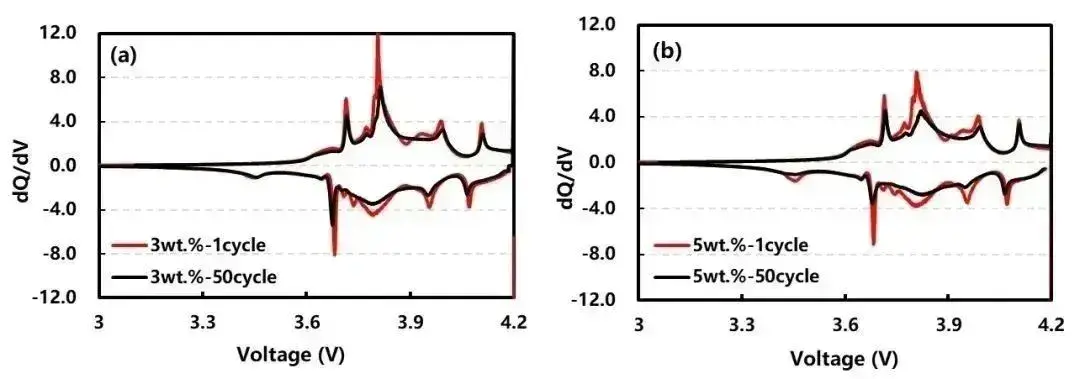
Figure 5. dQ/dV curves at cycle 1 (red) and cycle 50 (black) for (a) 3 wt.% and (b) 5 wt.% Si-C anode cells. Right-shift of the full curve indicates increased polarization; reduced peak intensity at 3.72 V and 3.81 V indicates suppressed phase transformation capacity.
5. Degradation Mechanisms in Silicon Carbon Composite Anodes
The combined swelling and electrochemical data are consistent with four interconnected degradation pathways that collectively govern silicon carbon battery swelling and capacity fade, as illustrated schematically in Figure 6[4]:
- Particle cracking and active material isolation: The ~300% silicon anode volume expansion per particle generates mechanical stress that fractures silicon particles over repeated cycles. Fractured fragments may lose electronic contact with the carbon matrix, permanently removing that material from electrochemical participation.
- Continuous SEI formation and active lithium loss: Each fracture event exposes fresh silicon surface that immediately reacts with electrolyte to form new SEI. This process consumes both active lithium and electrolyte irreversibly, reducing the lithium inventory available for capacity and contributing to the cumulative thickness increase observed in Figure 2.
- Impedance growth and increased polarization: SEI thickening at the silicon particle surface raises electrode impedance and slows lithium-ion transport across the interface — reflected directly in the dQ/dV right-shift observed at cycle 50. The progressive impedance increase alters the electron and ion transport characteristics of the electrode layer and is a primary driver of voltage polarization loss.
- Electrode porosity changes: The combination of electrode volume swelling and continuous SEI formation alters the pore structure of the electrode, reducing electrolyte access to interior active material and further degrading rate capability and capacity utilization in later cycles.
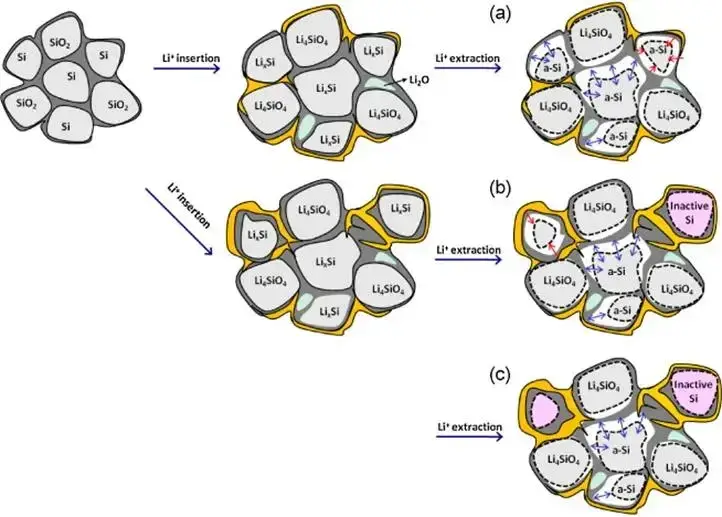
Figure 6. Schematic of the four primary degradation mechanisms in silicon-based anodes: particle cracking, SEI rupture–regeneration, impedance growth, and porosity change.[4]
Strategies to address silicon anode volume expansion and improve Si-C composite cycling performance include: (1) reducing silicon particle size to nano-scale to lower absolute expansion per particle; (2) synthesizing nanostructured silicon electrodes (e.g., hollow or porous silicon architectures) that accommodate volume change internally; (3) controlling the charge potential window to avoid formation of crystalline Li–Si alloys, which generate larger volume excursions than amorphous lithiation products; (4) using self-healing binders that maintain contact between active material and conductive network through volume changes; and (5) substituting silicon oxide (SiOₓ) for crystalline silicon, since SiOₓ undergoes a smaller specific volume change during lithiation/delithiation.
6. Summary
In-situ swelling measurements using the IEST SWE2110 swelling analyzer over 50 charge–discharge cycles establish a quantitative relationship between silicon anode swelling percentage, irreversible thickness accumulation, and capacity decay in silicon-carbon composite anode pouch cells. Key findings:
- Total silicon carbon anode swelling after 50 cycles: 8.8% at 3 wt.% Si vs 11.2% at 5 wt.% Si — a 27% relative difference driven by the ~300% silicon anode volume expansion per particle and its associated SEI rupture–regeneration cycle.
- Irreversible swelling thickness accumulates similarly in both groups until cycle 35, after which the 5 wt.% Si cell diverges significantly — indicating a threshold effect in late-cycle silicon particle fragmentation.
- Capacity fade is directly correlated with cumulative swelling, but continues even after the swelling curve plateaus in late cycles, reflecting structural damage that outlasts the macroscopic expansion signature.
- dQ/dV analysis confirms increased internal polarization and suppressed phase transformation reactions at cycle 50 in both formulations, with more severe effects in the higher silicon content cell.
These results confirm that silicon content is the primary controllable variable governing silicon carbon battery swelling and long-cycle capacity retention, and that in-situ swelling characterization provides essential input for Si-C composite anode optimization and material selection.
7. References
[1] M. Ashuri, Q.R. He and L.L. Shaw, Silicon as a potential anode material for Li-ion batteries: where size, geometry and structure matter. Nanoscale 8 (2016) 74–103.
[2] S. Chae, M. Ko, K. Kim, K. Ahn and J. Cho, Confronting issues of the practical implementation of Si anode in high-energy lithium-ion batteries. Joule 1 (2017) 47-60.
[3] X.H. Shen, R.J. Rui, Z.Y. Tian, D.P. Zhang, G.L. Cao and L. Shao, Development on silicon/carbon composite anode materials for lithium-ion battery. J. Chin. Cream. Soc. 45 (2017) 1530-1538.
[4] I. Choi, J.L. Min, S.M. Oh and J.J. Kim, Fading mechanisms of carbon-coated and disproportionated Si/SiOx negative electrode (Si/SiOx/C) in Li-ion secondary batteries: Dynamics and component analysis by TEM. Electrochim. Acta 85 (2012) 369-376.
8. FAQs
8.1 What is the silicon anode swelling percentage in lithium-ion batteries?
Silicon anodes undergo approximately 300% volume expansion during full lithiation — compared to roughly 10% for graphite — because silicon alloys with lithium to form Li₃.₇₅Si at full charge. In silicon-carbon composite anodes, the carbon matrix buffers this expansion, but cumulative silicon anode swelling percentage at the cell level still reaches 8.8% to 11.2% total thickness increase after 50 cycles at 3 wt.% and 5 wt.% silicon loading, respectively, as measured by in-situ swelling analysis.
8.2 How does silicon content affect the silicon carbon anode volume expansion percentage?
Higher silicon content directly increases silicon carbon anode volume expansion percentage. In-situ swelling measurements on 3 wt.% and 5 wt.% Si-C composite cells under identical cycling conditions show that after 50 cycles, the 3 wt.% Si cell accumulates 8.8% total thickness swelling while the 5 wt.% Si cell reaches 11.2% — a 27% relative increase. The divergence is most pronounced in the irreversible swelling component after cycle 35, where the higher silicon content cell shows accelerated SEI accumulation consistent with a critical fraction of fractured silicon particles exposing reactive fresh surface.
8.3 Why does silicon carbon anode swelling increase with cycle number?
Silicon carbon anode swelling increases with cycle number primarily because silicon particle volume expansion (~300%) fractures particles repeatedly, exposing fresh silicon surface that reacts with electrolyte to form new SEI film. Each SEI formation event consumes active lithium and electrolyte irreversibly, accumulating solid side-reaction products inside the cell that increase total thickness. This cycle of SEI rupture and regeneration is self-reinforcing: more fractures produce more fresh surface, accelerating both swelling accumulation and active lithium loss.
8.4 Is there a direct correlation between silicon anode swelling percentage and capacity decay?
Yes, silicon anode swelling percentage and capacity decay are directly correlated but not proportionally so throughout the cycle life. In the first 35 cycles, both swelling accumulation and capacity fade advance together as SEI growth consumes active lithium. After cycle 35, the swelling curve flattens as particle fragmentation and electrolyte depletion limit further expansion, but capacity fade continues — reflecting structural damage that outlasts its macroscopic swelling signature. The higher silicon content cell shows greater swelling and faster capacity decay at every stage, confirming silicon loading as the primary variable governing both.
8.5 How can silicon carbon battery swelling be reduced to improve cycle life?
Reducing silicon carbon battery swelling requires addressing the root cause — the ~300% silicon anode volume expansion per particle. Proven strategies include: reducing silicon particle size to nano-scale (lower absolute expansion); using porous or hollow nanostructured silicon architectures that accommodate expansion internally; substituting silicon oxide (SiOₓ) which has smaller volume change than crystalline silicon during lithiation; controlling the charge potential window to prevent crystalline Li–Si alloy formation; and using self-healing binders to maintain electronic contact through volume changes. Lower silicon content formulations (e.g., 3 wt.% vs 5 wt.%) also show measurably lower swelling accumulation and better capacity retention over 50 cycles.