-
iestinstrument

Abstract
In-situ EIS and ex-situ EIS are the two primary approaches for battery impedance characterization, but their data reliability differs substantially. This comparative study on 100 mAh pouch cells demonstrates that in-situ EIS achieves a coefficient of variation (cov) of ≤1% for both Rs and Rct across five consecutive cycles, while ex-situ EIS — requiring manual battery transfer between instruments — produces cov of 2.3% (Rs) and 2.9% (Rct). The integrated architecture of in-situ EIS eliminates connection variability and state relaxation errors inherent to ex-situ workflows, delivering more repeatable and physically meaningful impedance data for battery SOH assessment, failure analysis, and model parameterization.
1. Why EIS Testing Method Choice Matters for Battery Data Reliability
Battery EIS (electrochemical impedance spectroscopy) is a core electrochemical characterization technique that can non-destructively analyze complex kinetic processes inside batteries, such as lithium-ion migration, charge transfer, and solid-phase diffusion. Key parameters obtained by fitting battery EIS data, like charge transfer resistance, SEI film resistance, and diffusion coefficient, are irreplaceable for accurately assessing battery state of health (SOH), cycle life, failure mechanisms, and performance. Therefore, the accuracy of EIS data directly determines the reliability of subsequent battery state diagnosis and model construction.
Currently, mainstream EIS testing methods are primarily divided into ex-situ and in-situ. Ex-situ testing involves removing the battery from the test equipment and measuring it with a potentiostat under specific conditions, which can easily introduce additional errors due to battery state relaxation (e.g., open-circuit voltage drift, temperature changes). In contrast, in-situ testing involves real-time monitoring during ongoing charge-discharge cycles or rest periods, more accurately reflecting the dynamic impedance information of the battery under actual operating conditions, yielding more authentic EIS data. The practical question for researchers and QC engineers is: how much does this methodological choice affect data quality?
This article compares EIS data obtained from both in-situ and ex-situ testing methods, analyzes the differences in characterizing battery electrochemical behavior, and thereby argues which method offers superior reliability in ensuring data authenticity and consistency.
2. Experimental Setup: In-Situ vs Ex-Suit EIS Comparison
2.1 In-Situ EIS Testing
In-situ EIS is characterized by an integrated testing architecture, which combines the charge-discharge module and the EIS module on a unified platform, sharing the same signal acquisition system and control unit. This structure ensures consistent baseline current/voltage measurements and eliminates system errors between devices. Impedance measurements are directly conducted during the charge-discharge process, achieving true “online” monitoring.
In this experiment, a 100mAh pouch cell was tested using IEST ERT high-precision battery testing system (as shown in Figure 1a), which integrates the functions of charge-discharge and electrochemical workstations for testing. The test involved charging the battery at 0.2C for 10 minutes, followed by 10 minutes of rest, then discharging at 0.2C for 10 minutes, another 10 minutes of rest, and EIS testing, repeated for 5 cycles as illustrated in Figure 1b. Since the battery had good performance and used low current for short charging and discharging durations, the EIS data from the five cycles are expected to be consistent.
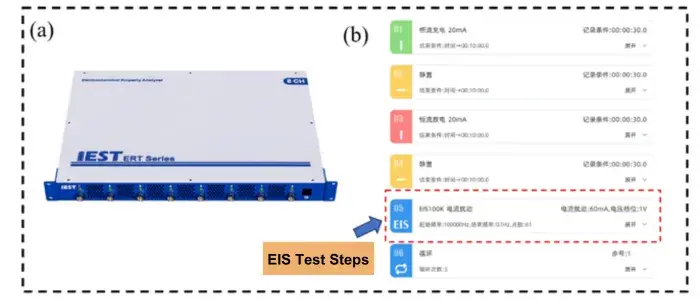
Figure 1. In-situ EIS test equipment (a) ERT Series (b) Test procedure
2.2 Ex-Situ EIS Testing
The core issue of ex-situ EIS testing lies in the discrete and discontinuous nature of the process (Figure 2). Specifically, this method requires researchers to manually transfer the battery from the charge-discharge device to a dedicated EIS testing platform after completing a specific test. This process is cumbersome and prone to contact resistance errors and battery state errors. The same 100 mAh cell type and test procedure were used.
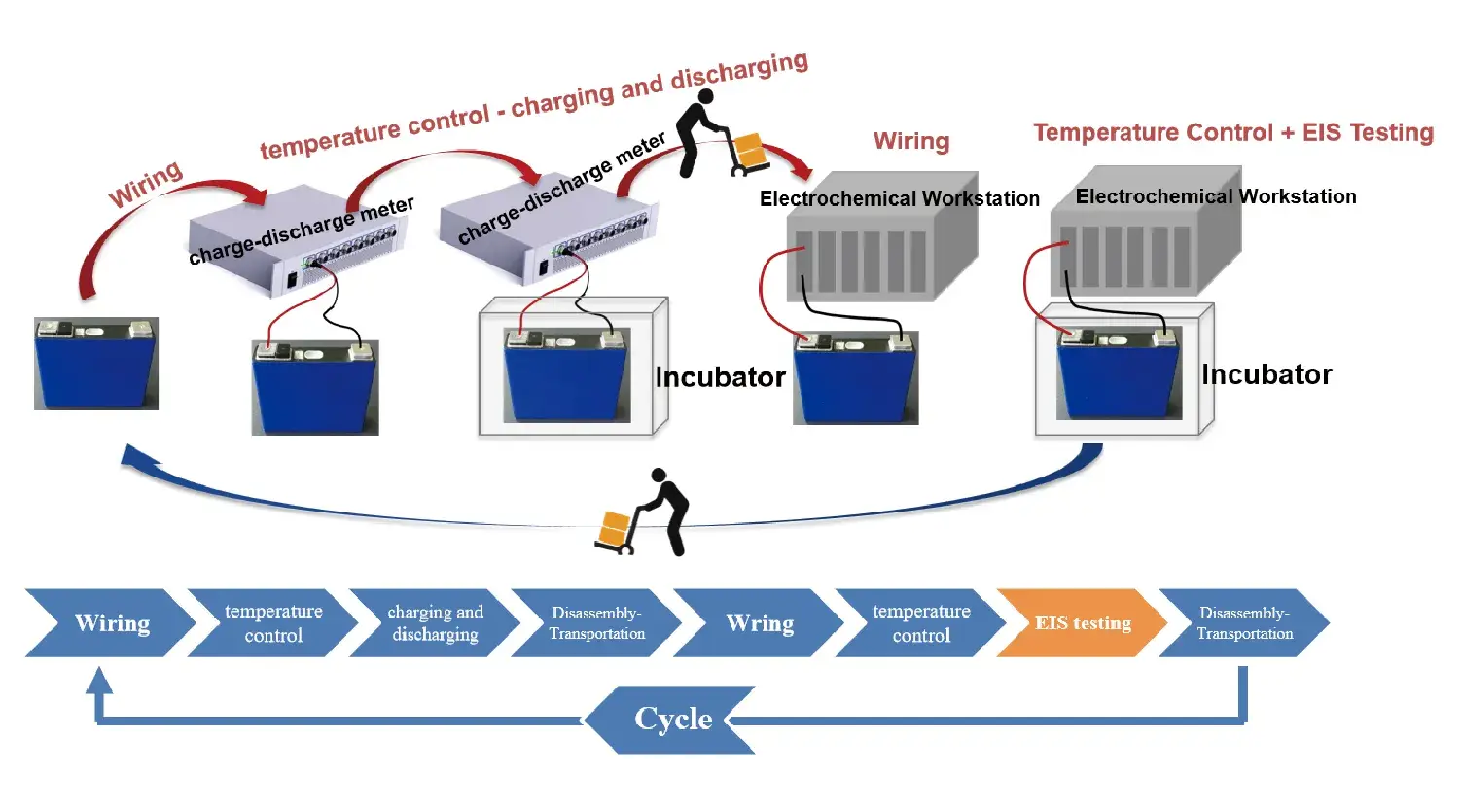
Figure 2. Ex-situ EIS testing workflow — manual cell transfer per cycle.
3. Results: In-Situ EIS Achieves ≤1% Cov vs Ex-Situ’s 2.3–2.9%
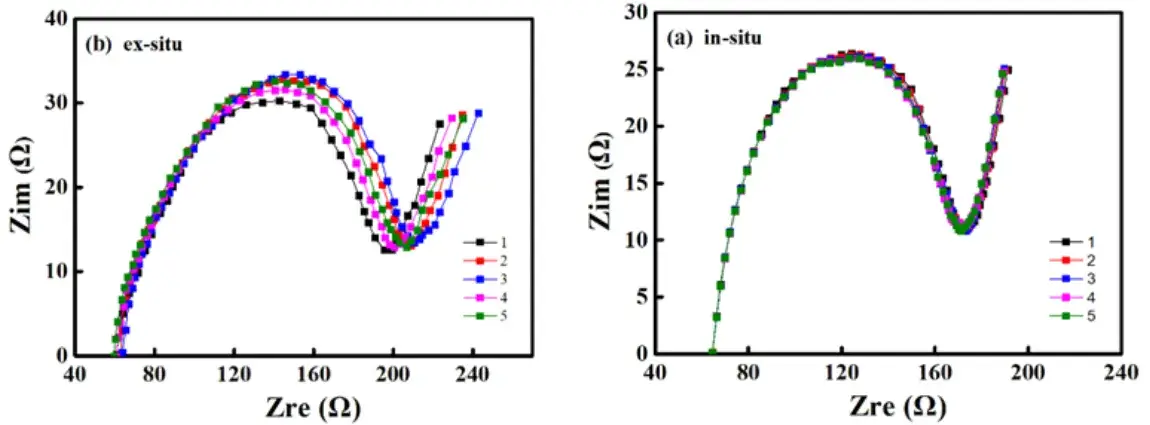
Figure 3. Cyclic EIS spectra: (a) in-situ — highly repeatable; (b) ex-situ — significant dispersion.
By performing in-situ and ex-situ EIS tests on the same battery model type, analysis of the cyclic EIS data revealed that the EIS curves obtained from in-situ testing were highly overlapping. The fitted Ohmic resistance (\(R_s\)) and charge transfer resistance (\(R_{ct}\)) values showed minimal fluctuation, with \(cov \leq 1\%\), demonstrating excellent repeatability. In contrast, the EIS curves from ex-situ testing showed significant dispersion, with variations in \(R_s\) and \(R_{ct}\) values. This indicates that frequent battery disassembly and reassembly lead to inconsistent contact resistance, and battery state relaxation introduces systematic errors. The experimental results show that in-situ EIS testing, by avoiding manual operation interference, can provide more reliable and accurate impedance data, enhancing data comparability and analytical value.
| Test Method | Cycle | \(R_s\) (mΩ) | \(R_{ct}\)(mΩ) |
|---|---|---|---|
| In-Situ EIS | 1 | 64.6 | 107.5 |
| 2 | 64.5 | 109.3 | |
| 3 | 64.5 | 108.8 | |
| 4 | 64.5 | 109.3 | |
| 5 | 64.4 | 106.8 | |
| Cov | 0.1% | 1.0% | |
| Ex-Situ EIS | 1 | 60.8 | 138.5 |
| 2 | 62.9 | 146.0 | |
| 3 | 63.7 | 146.7 | |
| 4 | 61.5 | 139.1 | |
| 5 | 60.2 | 146.5 | |
| Cov | 2.3% | 2.9% |
4. Systematic Comparison: In-Situ vs Ex-Situ EIS
| Dimension | In-Situ EIS | Ex-Situ EIS | Impact on Mechanism Analysis |
|---|---|---|---|
| Connection Consistency | Excellent. Single fixed connection. | Poor. Repeated disassembly varies contact resistance. | Ex-situ Rs fluctuations dominated by connection noise, masking real electrolyte resistance changes. |
| State Consistency | Excellent. Automated EIS at precise SOC. | Poor. Transfer causes self-discharge and SOC drift. | Ex-situ cannot guarantee identical conditions — Rct and Zw data may be distorted. |
| Efficiency | High. EIS at every cycle. | Low. Limited to cycle intervals. | In-situ captures non-linear transitions (SEI fracture, lithium plating); ex-situ misses critical inflection points. |
5. Summary
This comparative experimental study demonstrates that in-situ EIS testing provides significantly more accurate and repeatable impedance data than ex-situ EIS. By eliminating connection variability, state relaxation errors, and manual handling artifacts, in-situ EIS achieves ≤1% cov in both Rs and Rct — compared to 2.3–2.9% cov for ex-situ. For researchers and QC engineers requiring reliable impedance data for SOH assessment, failure mechanism analysis, model parameterization, and lifetime prediction, in-situ battery EIS represents the methodologically superior approach.
6. FAQs
6.1 What is in-situ EIS testing for batteries?
In-situ EIS integrates the EIS measurement module into the charge-discharge test platform, enabling automated impedance measurement at programmed SOC points without removing the cell from the test system. This avoids connection variability and state relaxation errors inherent to ex-situ methods.
6.2 What is the difference between in-situ and ex-situ EIS?
In-situ EIS measures impedance during or immediately after cycling within a single integrated instrument. Ex-situ EIS requires manually transferring the cell to a separate potentiostat, introducing connection variability, SOC drift, and temperature changes. In-situ achieves ≤1% cov; ex-situ shows 2.3–2.9% cov.
6.3 Why is in-situ EIS more reliable than ex-situ EIS?
In-situ EIS eliminates three sources of error: variable contact resistance from repeated reconnection, state relaxation from battery self-discharge during transfer, and temperature drift between environments. The result is lower coefficient of variation — 0.1% (Rs) and 1.0% (Rct) for in-situ vs 2.3% and 2.9% for ex-situ in this study.
6.4 What is EIS testing used for in battery research?
Battery EIS is used to characterize ohmic resistance (Rs), SEI film resistance, charge transfer resistance (Rct), and Warburg diffusion impedance (Zw). These parameters are essential for SOH estimation, failure mechanism analysis, model parameter fitting, and cycle life prediction.
6.5 Which battery testers support in-situ EIS?
Systems with integrated charge-discharge and EIS functions, such as the IEST ERT series, support true in-situ EIS testing. These instruments share a single signal acquisition and control platform, eliminating system errors between separate devices.