
Solid-State Battery Testing Solutions
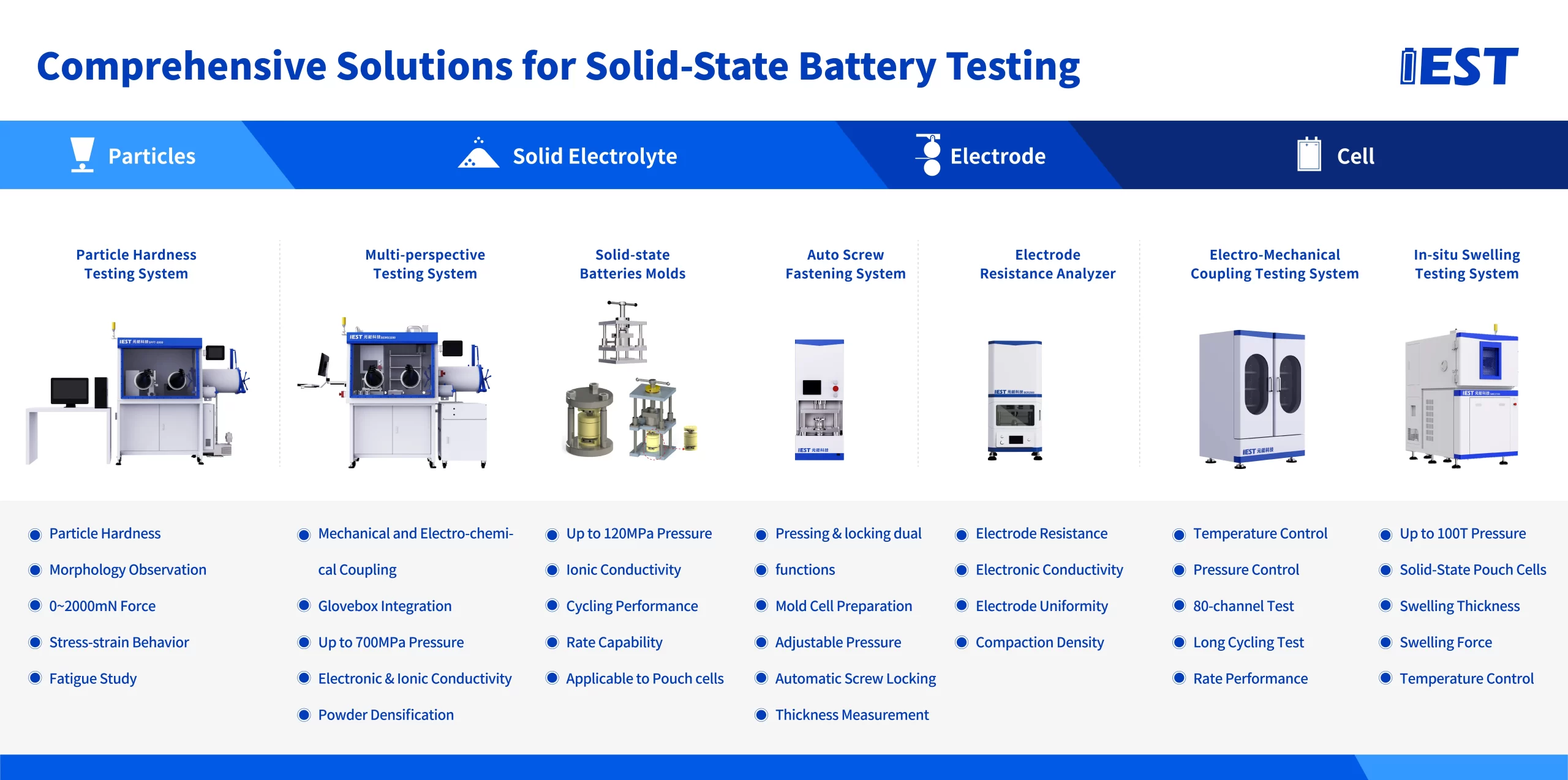
SPFT Series — Single Particle Crushing Force Tester
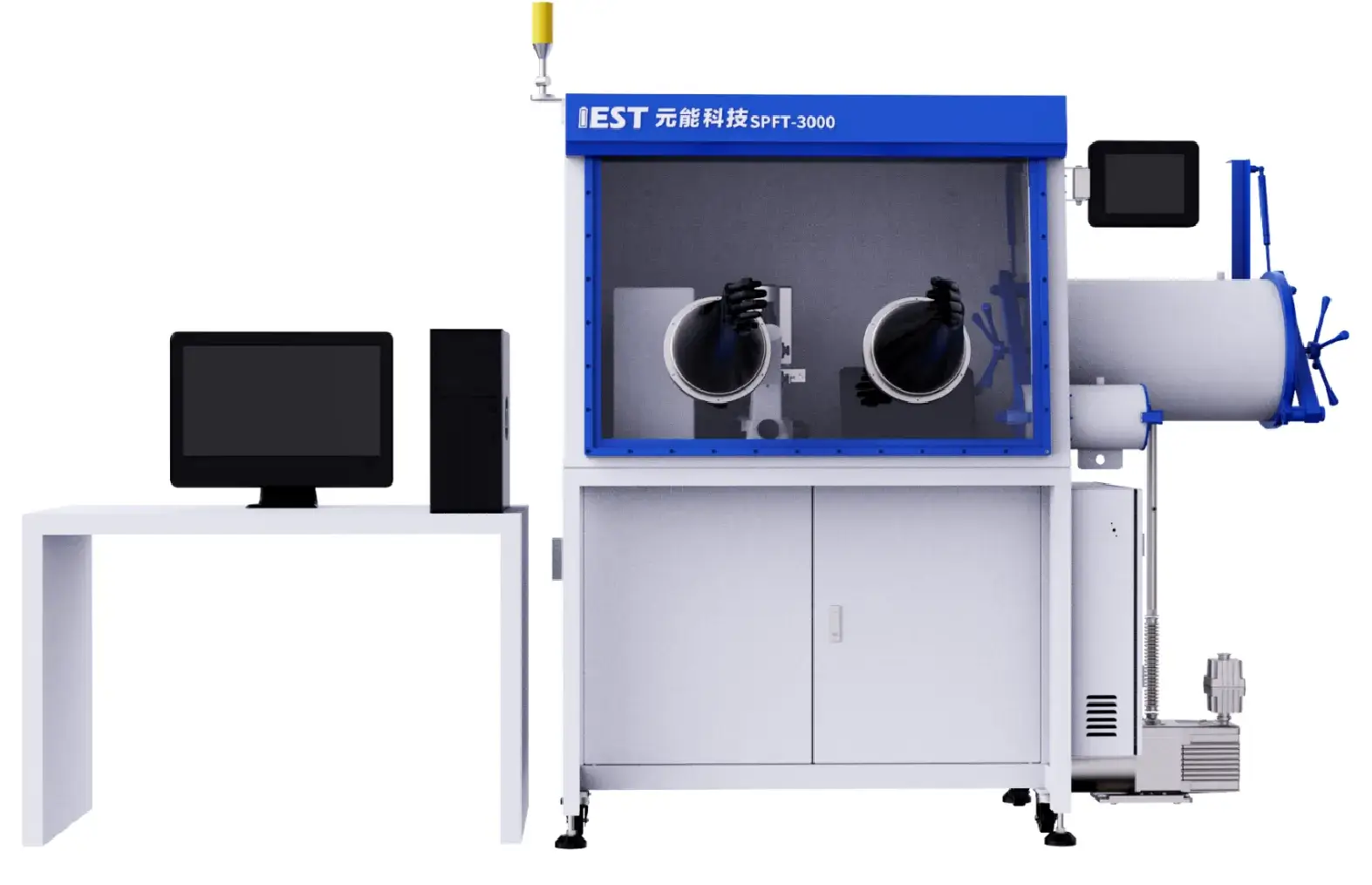
WHAT DOES IT MEASURE?
Measures the crushing force, yield point and compression behavior of single cathode, anode and solid electrolyte particles (5–50 µm) under inert atmosphere.
- Crushing force
- Yield point
- Force–displacement curve
AT A GLANCE
- Sample
- Single particles, 5 – 50 µm
- Displacement
- 0 – 75 µm (10 nm increment)
- Force
- 0 – 180 mN (±0.5 mN)
- Atmosphere
- Glovebox-integrated
APPLICATIONS
Crushing-force threshold and yield-point evaluation of solid-state active materials and air-sensitive electrolyte particles, simulating calendering and cycling stress.
KEY FEATURES
Full Specifications
| Model | SPFT3000 |
| Test Parameters | Displacement, force, microscope imaging |
| Displacement Range | 0 – 75 µm (min. increment 10 nm) |
| Force Range | 0 – 180 mN (±0.5 mN) |
| Automation | Auto XY stage, auto focus, indenter auto-cleaning |
| Dimensions / Weight / Power | 950 × 450 × 700 mm / 90 kg / 600 W |
SEMS Series — Multi-Dimensional Solid-State Electrolyte Testing System
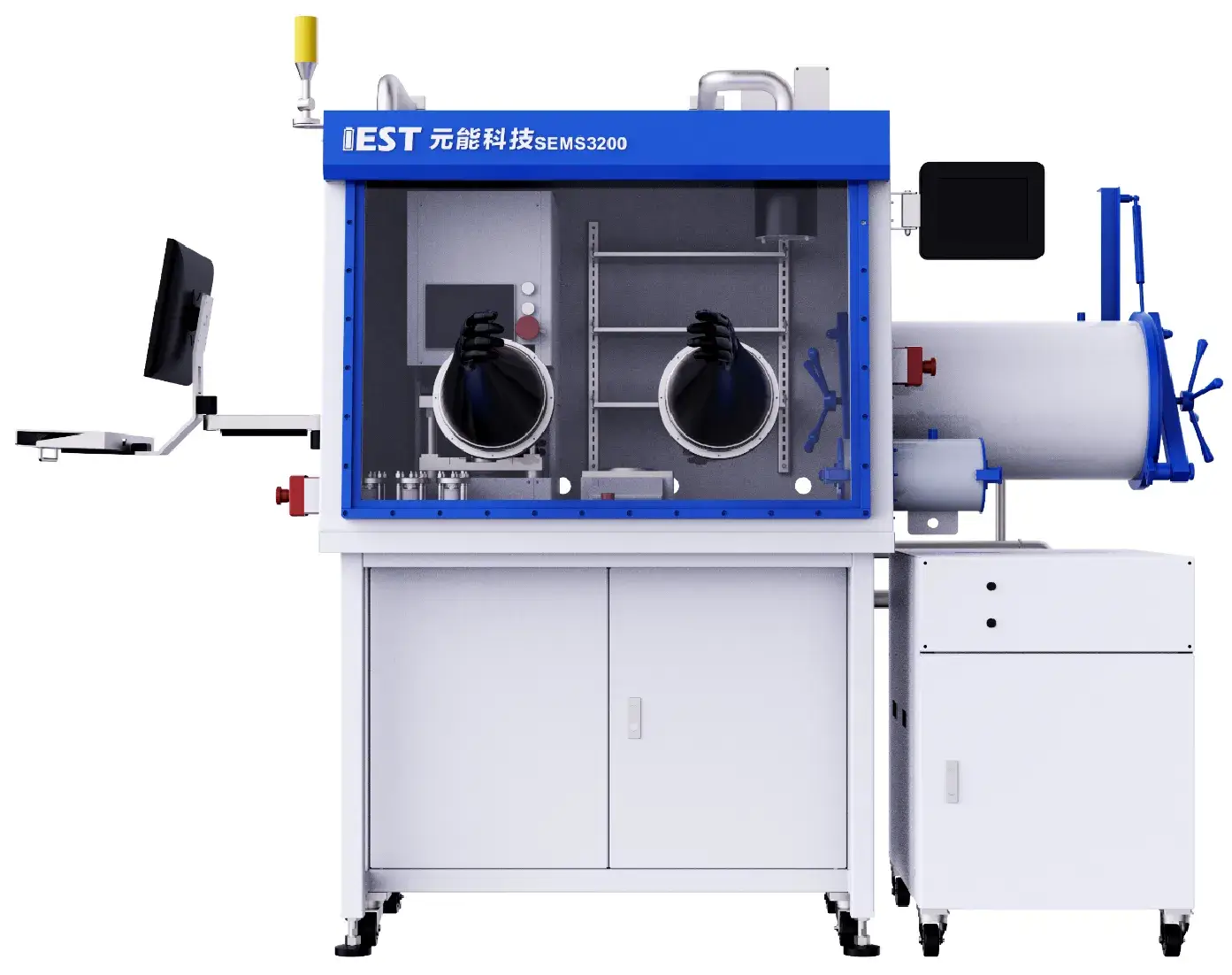
WHAT DOES IT MEASURE?
Measures ionic conductivity and compaction behavior of solid electrolyte powders under adjustable pressure, with in-situ EIS, optionally inside a glovebox.
- Ionic conductivity
- Compaction
- EIS
AT A GLANCE
- Sample
- Solid electrolyte powders (sulfide, oxide, halide)
- Pressure Range
- 0.05 – 6T (up to 600 MPa, 0.3% F.S.)
- EIS Frequency
- 10 µHz – 7 MHz (BioLogic workstation)
- Atmosphere
- Glovebox-integrated (SEMS3200) / Standalone
APPLICATIONS
In-situ ionic conductivity measurement, compaction density curve profiling, and EIS impedance spectroscopy for air-sensitive sulfide, oxide, and halide solid electrolytes under dynamic high-pressure environments.
KEY FEATURES
Full Specifications
| Parameters | SEMS3200 | SEMS3100 |
|---|---|---|
| Pressurization Method | Servo Motor | Servo Motor |
| Electrochemical Test System | Standard BioLogic, customizable for other brands | |
| Glove Box | Yes | No |
| Max. Pressure | 0.05 ~ 6T (600 MPa) | |
| Pressure Stability | 0.3% F.S. | |
| Thickness Measurement Accuracy | 0.5 µm / 10 µm | |
| EIS Test Frequency | 10 µHz ~ 7 MHz | |
| Sealing Mold | MP1000 | |
| Screw Tightening | Equipped with automatic screw-tightening function | |
| Test Software | Interconnected with workstation for one-click ionic conductivity output | Imports workstation data to calculate ionic conductivity |
| Equipment Form | Glove Box + Integrated Pressurized Testing Device | Integrated Pressurized Testing Device |
| Operation Convenience | One-click automatic pressurization testing, highly integrated | Separate software operation |
| Dimensions, Weight & Power |
805 × 2000 × 1880 mm (W×D×H) Weight: 500 kg | Power: 6500 W |
650 × 550 × 1700 mm (W×D×H) Weight: 250 kg | Power: 1500 W |
MP & MPC Series — Solid-State Battery Test Mold & Fixture Systems

WHAT DOES IT MEASURE?
Provides mold cells for measuring the ionic conductivity and electrochemical performance of solid electrolyte and electrode materials under controlled stack pressure.
- Ionic conductivity
- Pressure-controlled cycling
- Swelling force (MPC)
AT A GLANCE
- Sample
- Solid electrolyte & electrode materials (Ø10 / Ø13 mm)
- Max. Load
- 6000 kg (MP1000) / up to 3000 kg (MPC1000)
- Pressure Control
- Real-time data acquisition (±0.3% F.S., MPC)
- Atmosphere / Temp
- Glovebox-compatible, -10 ~ 60°C
APPLICATIONS
Ionic conductivity evaluation, mold-cell pressure-controlled electrochemical performance testing, and in-situ swelling force monitoring for selected stacked/pouch cell configurations.
KEY FEATURES
Full Specifications
| Parameters | MP1000 | MPC1000 |
|---|---|---|
| Fixture Dimensions | Outer Diameter 70 mm, Height 95 mm | 130 × 120 × 235 mm |
| Standard Mold Dimensions | Diameter 10 mm | Diameter 10 mm / 13 mm |
| Max. Load Capacity | 6000 kg | 500 kg / 3000 kg |
| Operating Temperature | -10 ~ 60°C | -10 ~ 60°C |
| Weight | < 500 g | < 2000 g |
| Standard Configuration | Fixture, Gas-tight Mold | Fixture, Gas-tight Mold, Acquisition Box, etc. |
| Application Scenarios | Ionic / electronic conductivity and performance test fixture |
1. Ionic conductivity test fixture 2. Mold cell pressure-controlled electrochemical test 3. Swelling force test for selected stacked cells |
| Max. Preload Pressure | — | 400 kg / 2000 kg |
| Pressure Accuracy / Resolution | — | ±0.3% F.S., 0.1 kg |
APLM Series — Mold Cell Automatic Pressing & Lock Equipment

WHAT DOES IT MEASURE?
Automates high-precision pressurization, continuous pressure holding, and uniform triaxial nut locking/loosening for all-solid-state battery mold cells.
- Automated pressing
- Triaxial nut locking
- Continuous pressure holding
AT A GLANCE
- Sample
- All-solid-state mold cells (custom sizes)
- Pressure Range
- 25 kg – 5,000 kg (0.5% F.S. accuracy)
- Locking Torque
- Simultaneous 3-axis, up to 40 N·m/screw
- Atmosphere / Extra
- Glovebox-compatible, in-situ thickness (2000T)
APPLICATIONS
Automated high-precision pressurization, pressure holding, and uniform triaxial nut locking/loosening for all-solid-state battery mold cells and solid electrolyte characterization.
KEY FEATURES
Full Specifications
| Parameters | APLM2000 | APLM2000T |
|---|---|---|
| Pressure Range | 25 kg ~ 5000 kg | 25 kg ~ 5000 kg |
| Pressurization Type | Stepper Motor | Stepper Motor |
| Pressure Control Accuracy | 0.5% F.S. | 0.5% F.S. |
| In-Situ Thickness Measurement | — | Yes |
| Continuous Pressurization & Holding | — | Yes |
| Glovebox Integration | Yes | Yes |
| Locking Pressure Control | Motor Control | |
| Locking Method | Simultaneous Triaxial Tightening | |
| Nut Tightening Function | Yes | Yes |
| Nut Removal Function | Yes | Yes |
| Platen Parallelism | OK | |
| Dimensions, Weight & Power |
Dimensions (W×D×H): 601 × 362 × 825 mm Weight: 120 kg Power: 2000 W |
|
BER Series — Battery Electrode Resistance Analyzer
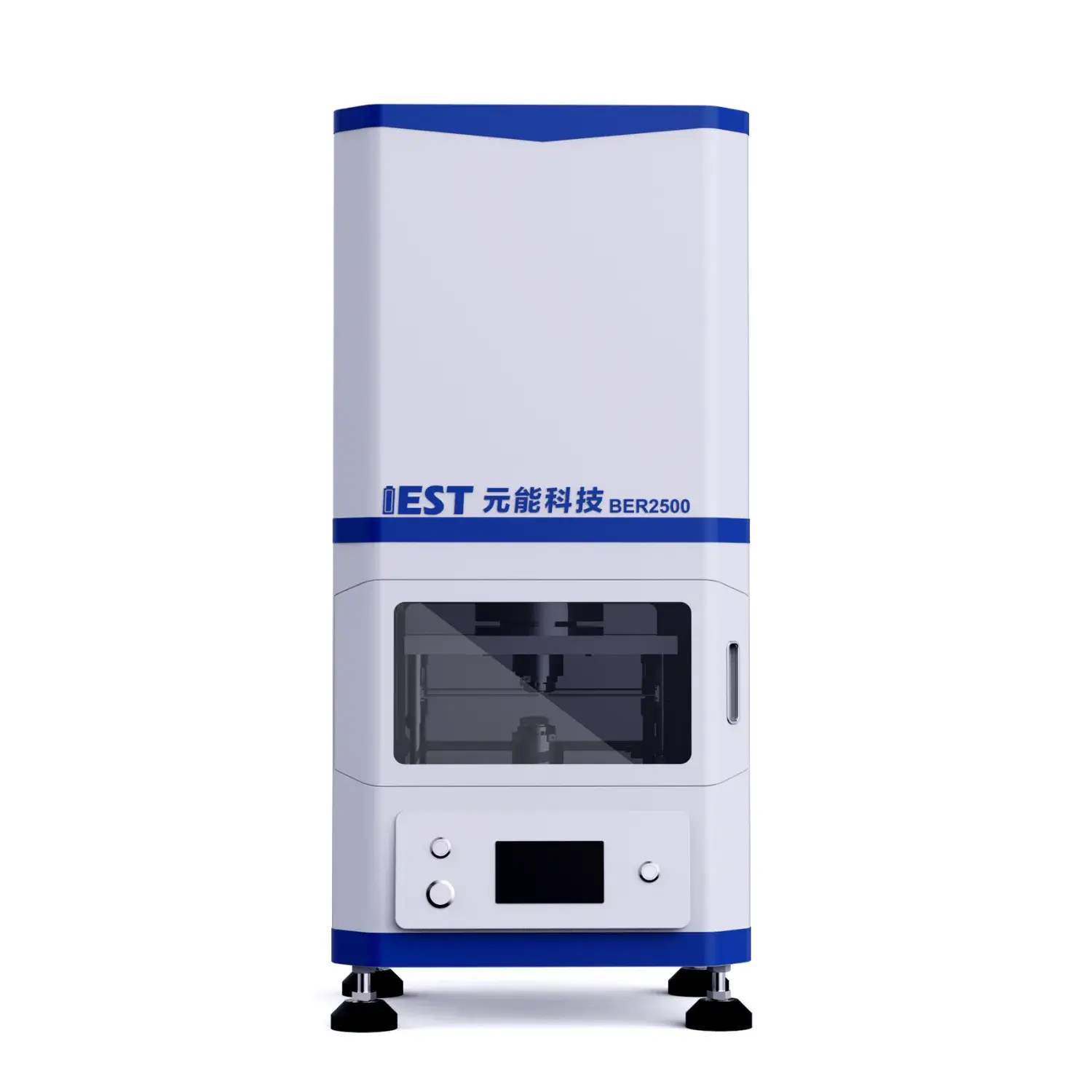
WHAT DOES IT MEASURE?
Measures the true through-thickness resistivity of electrode sheets, including coating, contact and current-collector resistance, and the uniformity of the conductive network.
- Resistivity
- Conductivity
- Compaction density
AT A GLANCE
- Sample
- Dry & wet battery electrode sheets, coated foils
- Pressure Range
- 5 – 35 MPa (Pneumatic) / 5 – 60 MPa (Servo)
- Thickness Sensor
- 0 – 5 mm range (0.1 µm res, ±1 µm accuracy)
- Output
- Resistance, resistivity, conductivity & compaction curves
APPLICATIONS
Resistivity and conductive network uniformity testing of dry and wet electrodes under different roll pressing pressures and compaction states.
KEY FEATURES
Full Specifications
| Parameters | BER2100 | BER2200 | BER2300 | BER2500 |
|---|---|---|---|---|
| Pressurization Method | Pneumatic cylinder (Pressure range: 5 ~ 35 MPa) | Servo motor (Pressure range: 5 ~ 60 MPa) | ||
| Testable Parameters | Resistance, resistivity, conductivity, pressure, temperature, humidity, thickness, compaction density | |||
| Single Point Test | ● | ● | ● | ● |
| Continuous Test | ● | ● | ● | ● |
| Variable Pressure Mode | / | ● | ● | ● |
| Automatic Function | / | / | ● | ● |
| Function Software | Resistance, pressure, temp, humidity | Resistance, resistivity, conductivity, force, pressure, temp, humidity | ||
| Thickness Measurement | Test Range: 0 ~ 5 mm | Resolution/Accuracy: 0.1 µm / ±1 µm | |||
| Specification (Dim/Wt/Pwr) | 355 × 321 × 560 mm | 70 kg | 100 W | 355 × 321 × 795 mm | 83 kg | 450 W | ||
| Compaction Density Curves | Curves of electrode resistance, resistivity, conductivity, and compaction density | |||
| Optional Modules | In-situ AB-surface testing module, automatic sample loading module, temperature control module, electrode ionic conductivity testing module | |||
MSST Series — Multi-Channel Mechanical-Electrical Coupling Integrated Tester

WHAT DOES IT MEASURE?
Runs multi-channel charge–discharge, rate and optional EIS tests on solid-state mold cells at controlled temperature (0–100 °C).
- Cycling
- Rate performance
- EIS
AT A GLANCE
- Sample
- Solid-state mold cells (MP1000 / MPC1000 fixtures)
- Temperature
- 0 ~ 100°C (±2°C uniformity, 0.1°C resolution)
- Capacity / Space
- 16 ch (90 L rack) / 120 ch (500 L 5-tier drawer)
- Cycler Accuracy
- 0.02% F.S. (Voltage & Current)
APPLICATIONS
High-throughput electrochemical cycling, rate performance evaluation, and in-situ pressure/swelling monitoring for solid-state mold cells under programmable coupled thermal and mechanical boundary conditions.
KEY FEATURES
Full Specifications
| Parameters | MSST5016-5V100mA | MSST5120-5V100mA |
|---|---|---|
| Equipment Dimensions | W 725 × D 627 × H 1000 mm | W 840 × D 1470 × H 1880 mm |
| Temperature Range | 0 ~ 100°C | |
| Temperature Accuracy / Resolution | ±2°C / 0.1°C | |
| Temperature Fluctuation | Heating: ±0.5°C | Cooling: ±1°C | |
| Temperature Uniformity | ±2°C | |
| Chamber Space | 90 L | 500 L |
| Sample Carrier / Holder | Dual-layer Rack | 5-layer Drawer Design |
AST Series — Air Stability Testing System for Sulfide / Halide Solid Electrolytes

WHAT DOES IT MEASURE?
Measures how quickly sulfide and halide solid electrolytes degrade in air by tracking H2S release under controlled humidity and dew point.
- H2S release
- Decomposition kinetics
- Humidity stability
AT A GLANCE
- Sample
- Sulfide & halide solid electrolytes
- Dew Point / Temp
- 0 ~ -60°C | RT ~ 150°C
- Gas Flow Rate
- 0 ~ 1000 mL/min (dynamic regulation)
- H2S Detection
- 0 ~ 100 ppm (real-time tracking)
APPLICATIONS
Real-time tracking of decomposition kinetics, toxic gas emission (e.g., H2S release), and physicochemical stability of moisture-sensitive sulfide and halide solid electrolytes exposed to simulated ambient environments.
KEY FEATURES
Full Specifications
| Model | IEST-AST-L200 |
| Operating Power | 2 kW |
| Sample Temperature Control | RT ~ 150°C |
| Dew Point Control Range | 0 ~ -60°C |
| Dynamic Gas Flow Rate | 0 ~ 1000 mL/min |
| H2S Gas Detection Range | 0 ~ 100 ppm |
| Sample Crucible | Customizable |
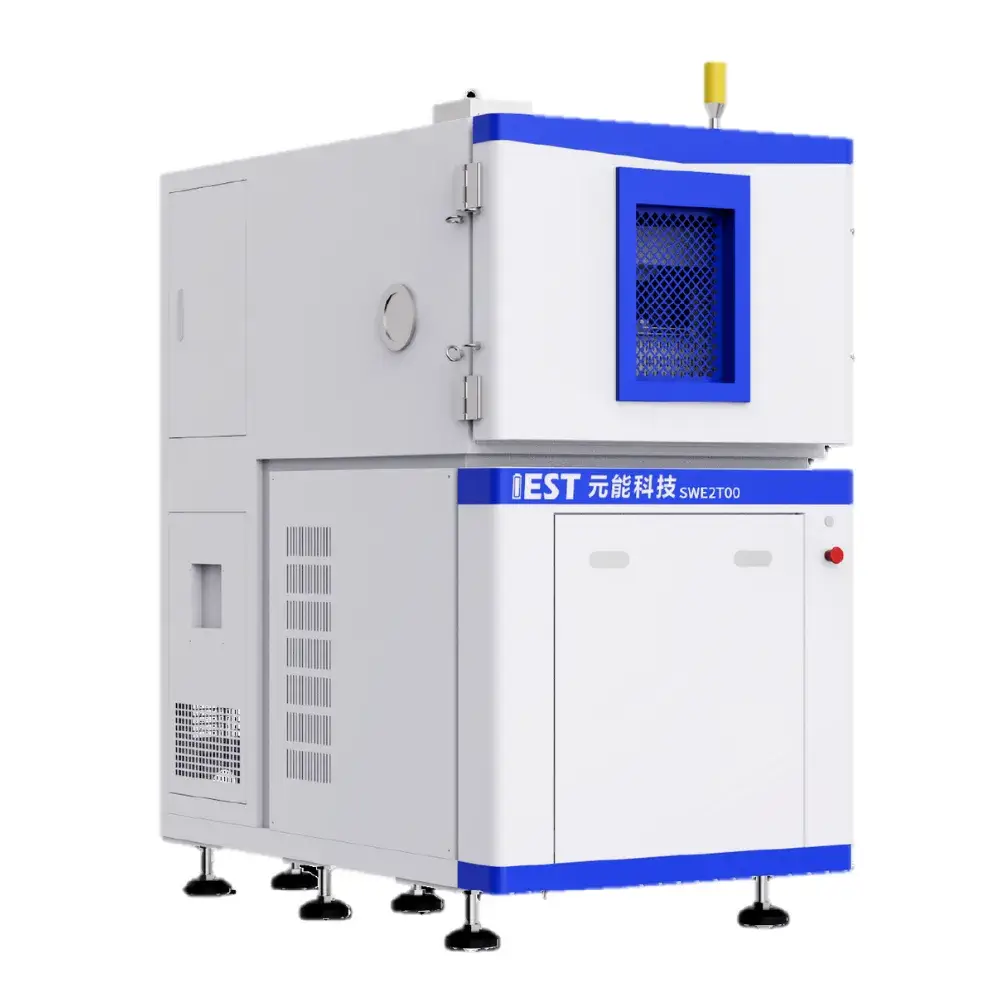
SWE Series — In-Situ Cell Swelling Analyzer 20T
WHAT DOES IT MEASURE?
Measures in-situ swelling force and thickness change of solid-state pouch cells during charge–discharge under controlled pressure.
- Swelling force
- Thickness change
- Temperature effect
AT A GLANCE
- Sample
- Solid-state pouch cells (up to 400 × 300 mm)
- Pressure Range
- 200 kg – 20T (Servo motor, stepless)
- Temperature
- -20°C ~ 85°C (synchronized control)
- Thickness Sensor
- 0.1 – 100 mm (0.1 µm res, ±1 µm accuracy)
APPLICATIONS
In-situ dynamic swelling force and expansion thickness monitoring of solid-state pouch cells under continuous charge and discharge cycling.
KEY FEATURES
Full Specifications
| Model | SWE2T00 |
| Cell Size | 400 × 300 mm |
| Equipment Dimensions | W 1110 × D 1670 × H 2250 mm |
| Weight | 1400 kg |
| Temperature Range | -20°C ~ 85°C |
| Temperature Control Precision | ±2°C (No-Load) |
| Test Mode | Constant pressure, Constant Gap, Steady/Transient State |
| Cell Thickness | 0.1 ~ 100 mm |
| Thickness Sensor Resolution/Accuracy | 0.1 µm / 1 µm |
| Pressurization Method | Servo Motor |
| Pressure Range | 200 kg ~ 20T |
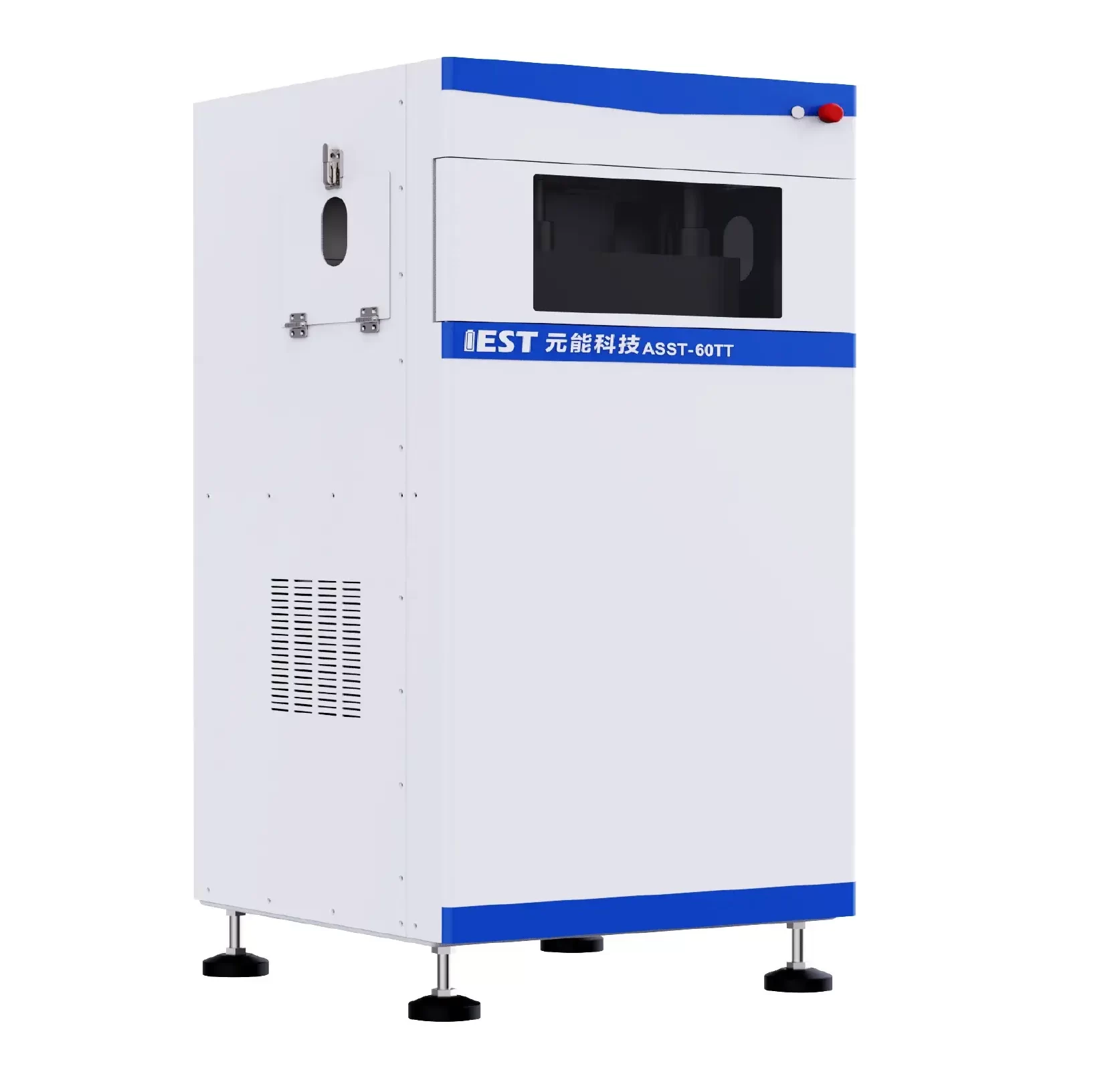
ASST Series — In-Situ Cell Swelling Analyzer 60T
WHAT DOES IT MEASURE?
Measures swelling force and thickness of high-capacity solid-state pouch cells under heavy-tonnage pressure (up to 60 T) and elevated temperature.
- Heavy-load swelling
- Constant pressure / gap modes
- Thickness
AT A GLANCE
- Sample
- Solid-state pouch cells (up to 180 × 300 mm)
- Pressure Range
- 1T – 60T (Hydraulic regulation)
- Temperature
- 35°C ~ 85°C (High-temp testing)
- Thickness Sensor
- 0 – 15 mm (0.1 µm res, 3 µm accuracy)
APPLICATIONS
High-temperature swelling test and heavy-tonnage expansion dynamics evaluation of high-capacity solid-state pouch cells under ultra-high mechanical stress.
KEY FEATURES
Full Specifications
| Model | ASST-60TT |
| Cell Size | 180 × 300 mm |
| Equipment Dimensions | W 550 × D 610 × H 1325 mm |
| Weight | 420 kg |
| Temperature Range | 35°C ~ 85°C |
| Temperature Control Precision | ±2°C (No-Load) |
| Test Mode | Constant Pressure, Constant Gap |
| Cell Thickness Range | 0 ~ 15 mm |
| Thickness Sensor Resolution/Accuracy | 0.1 µm / 3 µm |
| Pressurization Method | Hydraulic |
| Pressure Range | 1T ~ 60T |