-
iestinstrument

Abstract
Anode particle size and crushing strength are inversely correlated: smaller particles consistently achieve higher crushing strength (MPa, resistance per unit area) while larger particles generate higher absolute crushing force (N, total force to fracture). This counter-intuitive relationship holds across silicon-carbon (SiC), hard carbon (HC), and resin carbon (RC) anode materials prepared by the same process, and was quantified using the IEST SPFT2000 single particle mechanical testing system in accordance with GB/T 43091-2023. The mechanism: smaller particles densify more completely during granulation and sintering, leaving fewer internal micropores, primary cracks, and structural defects — resulting in higher intrinsic crushing strength and greater resistance to fracture under calendar pressure and during lithiation/de-lithiation cycling. At the same particle size (8.5 µm), intrinsic microstructure determines the absolute crushing strength ceiling: SC2 achieves 1,632 MPa, resin carbon RC reaches 968 MPa, while SC1 shows only 339 MPa — confirming that particle size modulates strength within the material’s fixed microstructure-defined range.
1. Introduction
To simultaneously optimize electrode compaction density, slurry processability, conductive network continuity, electrode sheet resistance, electrolyte pore distribution, and the balance between cycle life and fast-charging performance, battery material manufacturers typically prepare silicon-carbon particles across multiple particle size grades — combining large and small particles, or blending silicon-carbon materials with graphite of different particle sizes. The differences in bulk compressive resistance among different particle size grades directly affect roll-press fracture rate and charge/discharge pulverization degree during cycling. This study uses the IEST SPFT2000 Single Particle Force Tester to systematically measure single-particle compression tests across multiple particle size grades for silicon-carbon samples prepared by the same process, establishing the intrinsic relationship between particle size, crushing force, and crushing strength. Simultaneously, hard carbon and resin carbon were tested to establish the particle size — mechanical property relationship across three anode material types, providing experimental data for anode powder granulation, particle size grading control, and formulation blending design.
2. Equipment and Method
2.1 Test Equipment: IEST SPFT2000 Single Particle Force Tester
All single particle mechanical property tests were performed using the IEST SPFT2000 Single Particle Force Tester (Figure 1a), a dedicated instrument for single particle mechanical testing of battery active materials in accordance with Chinese national standard GB/T 43091-2023. The system integrates a high-precision load cell, motorized compression stage, and optical bottom-view imaging system that enables particle centering and diameter verification before each test.
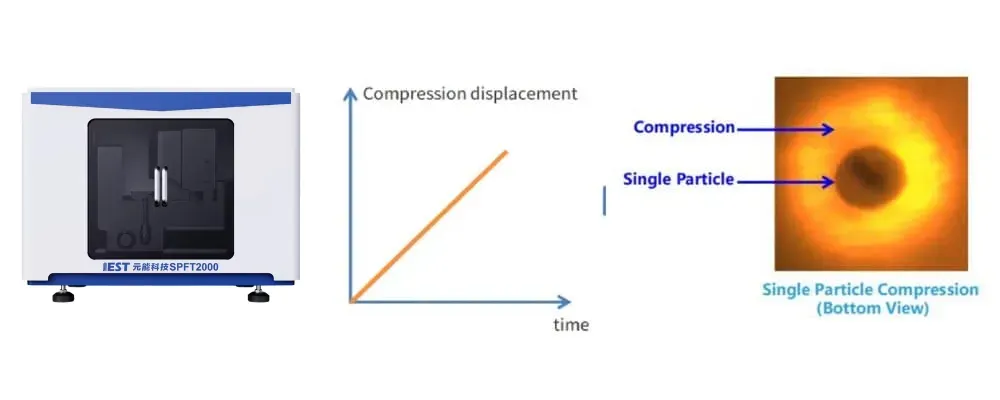
Figure 1. IEST SPFT2000 Single Particle Force Tester: (a) instrument; (b) compression test mode — particle positioned between indenters, load and displacement recorded simultaneously to derive crushing force and crushing strength; (c) optical bottom-view imaging for particle centering and size verification before each test.
2.2 Test Samples
- Silicon-carbon materials: two silicon-carbon samples prepared by the same process, designated SC1 and SC2. Each material was separated into two particle size grades: 4.5 ± 0.5 µm and 8.5 ± 0.5 µm.
- Hard carbon materials: two hard carbon samples prepared by the same process, designated HC1 and HC2. Each separated into 4.5 ± 0.5 µm and 8.5 ± 0.5 µm grades.
- Resin carbon: one resin carbon sample designated RC, separated into 8.5 ± 0.5 µm and 15 ± 0.5 µm grades.
2.3 Test Procedure
Sample solutions were dispersed uniformly and individually dropcast onto glass slides. Five particles were tested per particle size grade for each material. The optical imaging system confirmed particle diameter and centering before each compression test. Crushing force (N) and crushing strength (MPa) were calculated according to the formula in Equation (1).
The compressive strength of the powder is calculated according to Equation (1):
\[p_c = \alpha \times 1000 \times \frac{F_k}{\pi \cdot d^2}\]
where:
\( p_c \) — compressive strength, in MPa;
\( \alpha \) — calculation coefficient, taken as 2.48;
\( F_k \) — crushing force, in mN;
\( d \) — particle size (diameter), in \(\mu\)m.
Key Definitions
Crushing force (N): the minimum external compressive load required to fracture a single particle. Increases with particle size because larger particles have greater load-bearing cross-sectional area and volume.
Crushing strength (MPa): crushing force normalized by the projected cross-sectional area of the particle — a size-independent measure of intrinsic per-unit-area compressive resistance. Allows meaningful comparison of mechanical performance across different particle sizes and material types.
2.1 For the Same Material: Crushing Force Increases with Particle Size
Figure 3 shows the crushing force comparison across three anode material types at different particle sizes. The result is consistent across all materials: crushing force increases with increasing particle size for silicon-carbon SC and hard carbon HC (8.5 µm particles show significantly higher crushing force than 4.5 µm), and for resin carbon RC (15 µm particles show significantly higher crushing force than 8.5 µm).

Figure 2. Crushing force vs. particle size for SC1, SC2 (silicon-carbon), HC1, HC2 (hard carbon), and RC (resin carbon). Crushing force increases with particle size across all three material types: larger particles require significantly higher total force to fracture, because larger cross-sectional area and volume increase effective load-bearing capacity.
Mechanical mechanism: as particle size increases, the particle’s effective load-bearing cross-sectional area and total volume both increase. The critical external force needed to initiate fracture therefore rises proportionally. This explains why large-particle anode materials can withstand higher total roll-press forces during calendering — though this does not imply they are intrinsically stronger per unit area (see Section 2.2).
| Material | Particle Size (µm) | Crushing Force Trend | Crushing Strength (MPa) Trend |
|---|---|---|---|
| SC1 (Silicon-carbon) | 4.5 → 8.5 | ↑ Increases | ↓ Decreases |
| SC2 (Silicon-carbon) | 4.5 → 8.5 | ↑ Increases | ↓ Decreases |
| HC1 (Hard carbon) | 4.5 → 8.5 | ↑ Increases | ↓ Decreases |
| HC2 (Hard carbon) | 4.5 → 8.5 | ↑ Increases | ↓ Decreases |
| RC (Resin carbon) | 8.5 → 15 | ↑ Increases | ↓ Decreases |
| At 8.5 µm (same particle size): RC = 968 MPa; SC2 = 1,632 MPa; SC1 = 339 MPa — intrinsic microstructure determines absolute crushing strength ceiling regardless of particle size | |||
2.2 For the Same Material: Crushing Strength Decreases with Increasing Particle Size
Crushing strength represents compressive resistance per unit cross-sectional area — a size-normalized, intrinsic measure of particle mechanical performance. Figure 4 shows that crushing strength follows the opposite trend from crushing force: for all three anode material types, larger particle size corresponds to lower crushing strength. Silicon-carbon SC and hard carbon HC both show higher mean crushing strength at 4.5 µm compared to 8.5 µm; resin carbon RC shows higher crushing strength at 8.5 µm compared to 15 µm.
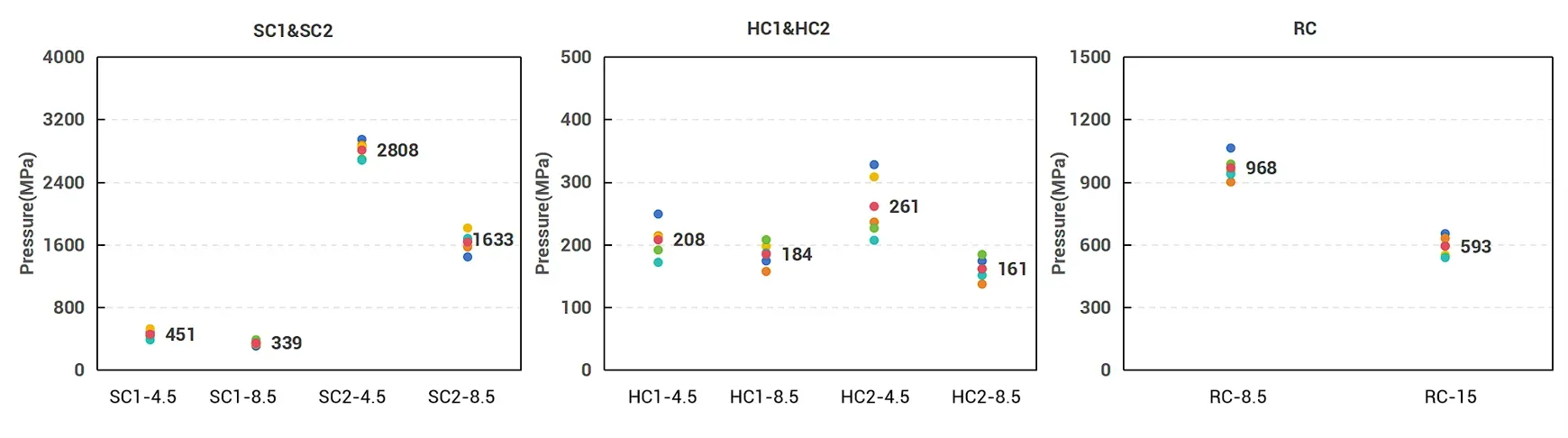
Figure 3. Crushing strength vs. particle size for SC1, SC2, HC1, HC2, and RC. Crushing strength decreases with increasing particle size across all material types. At 8.5 µm: SC2 = 1,632 MPa; RC = 968 MPa; SC1 = 339 MPa — confirming that intrinsic microstructure (carbonization quality, defect density) sets the absolute crushing strength ceiling, with particle size modulating performance within that range.
Why do smaller particles have higher crushing strength? During granulation and sintering of anode materials, smaller particles achieve higher densification. Smaller particle volume means shorter diffusion distances during sintering, more complete pore elimination, fewer residual internal micropores, fewer primary cracks, and lower structural defect density overall. Because crack propagation and fracture initiation in ceramic-like particles originate at internal defects, a particle with fewer and smaller defects requires higher stress to initiate fracture — resulting in higher crushing strength per unit area.
This relationship has a direct practical implication for long-cycle battery formulation design: small-particle anode materials buffer the internal stress generated by lithiation volume expansion more effectively, and are more resistant to the particle fracture and pulverization that causes capacity fade during cycling. This is precisely why long-cycle power battery formulations preferentially incorporate small-particle-grade materials — not because they withstand higher total force, but because they have higher intrinsic per-unit-area compressive resistance that preserves particle integrity during repeated lithiation stress.
2.3 At Equal Particle Size, Intrinsic Material Microstructure Determines the Crushing Strength Ceiling
Comparing crushing strength at the same particle size (8.5 µm) across the three material types reveals that intrinsic microstructure — not particle size — is the dominant factor setting the upper limit of particle mechanical performance:
- SC2 (silicon-carbon): 1,632 MPa — the highest among all tested materials at 8.5 µm, exceeding both hard carbon grades.
- Resin carbon (RC): 968 MPa — intermediate strength at 8.5 µm.
- SC1 (silicon-carbon): 339 MPa — substantially lower than SC2 despite identical particle size and the same stated process, indicating that the specific carbonization conditions, silicon dispersion state, or precursor quality within the “same process” range produce significantly different microstructural outcomes.
- HC1 and HC2 (hard carbon): both fall between RC and SC1 in crushing strength at 8.5 µm.
The SC1 vs. SC2 comparison at the same particle size is particularly instructive: two silicon-carbon materials described as “same process” differ in crushing strength by nearly 5× (339 MPa vs. 1,632 MPa). This confirms that particle size is a secondary modulator of crushing strength — the primary determinant is the intrinsic microstructure established during material synthesis, including carbonization degree, carbon shell continuity, internal porosity, and primary defect density. Particle size can only adjust crushing strength within the range defined by the material’s fixed microstructural properties; it cannot overcome a fundamentally weak microstructure.
This finding has direct relevance to anode particle size optimization for cycling stability: selecting a smaller particle size grade of a microstructurally inferior material may improve its crushing strength relative to its own larger grade, but will not match the performance of a microstructurally superior material at the same particle size. Effective formulation design must address both dimensions — material microstructure and particle size grading — rather than optimizing either in isolation.
3. Conclusions
Using the IEST SPFT2000 Single Particle Force Tester (GB/T 43091-2023), this study systematically establishes the particle size — mechanical property relationships for silicon-carbon, hard carbon, and resin carbon anode materials:
- Crushing force increases with particle size (positive correlation): larger particles have greater effective load-bearing cross-sectional area and volume, requiring higher total external force for fracture. This trend is consistent across silicon-carbon (4.5 µm vs. 8.5 µm), hard carbon (4.5 µm vs. 8.5 µm), and resin carbon (8.5 µm vs. 15 µm).
- Crushing strength decreases with particle size (inverse correlation): smaller particles densify more completely during sintering, leaving fewer internal defects and microcracks, resulting in higher per-unit-area compressive resistance. Small-particle anode materials better resist lithiation-induced internal stress and particle pulverization during cycling — explaining why long-cycle power battery formulations preferentially use small-particle-grade materials.
- Intrinsic material microstructure sets the crushing strength ceiling: at equal particle size (8.5 µm), SC2 achieves 1,632 MPa, resin carbon RC 968 MPa, and SC1 only 339 MPa — confirming that carbonization quality and microstructural density are the primary determinants of particle mechanical performance, with particle size modulating strength within material-defined limits.
Single particle mechanical testing using the SPFT2000 provides a quantitative, standardized method to characterize the particle size — mechanical property relationship in anode powders. This data directly guides anode powder granulation process control, particle size grading classification, and multi-grade formulation blending design — offering a low-cost route to simultaneously improving anode material processability and long-cycle stability. Note: the trends reported here apply to materials prepared by the same process; special formulations or atypical manufacturing processes may produce deviations from these general rules.
4. References
[1] GB/T 43091-2023. Powder Crushing Strength Test Method [S]. China National Standard, 2023.
5. FAQs: Anode Particle Size and Mechanical Properties
5.1 What is the relationship between particle size and crushing strength in battery anode materials?
For battery anode materials (silicon-carbon, hard carbon, resin carbon) prepared by the same process, particle size and crushing strength show an inverse correlation: smaller particles achieve higher crushing strength (MPa, per unit area), while larger particles show lower crushing strength but higher absolute crushing force (N, total fracture load). This inverse relationship holds consistently across all three material types tested in this study: silicon-carbon at 4.5 µm vs. 8.5 µm, hard carbon at 4.5 µm vs. 8.5 µm, and resin carbon at 8.5 µm vs. 15 µm. The opposite applies to crushing force: larger particles require greater total external force to fracture because their larger cross-sectional area and volume provide more effective load-bearing capacity. The two metrics — crushing force and crushing strength — measure different aspects of mechanical performance and must both be considered in anode formulation design.
5.2 Why do smaller anode particles have higher crushing strength than larger particles?
Smaller anode particles achieve higher crushing strength because of their more complete densification during sintering. In granulation and sintering of anode materials such as silicon-carbon and hard carbon, smaller particle volume means shorter diffusion distances, allowing pores to be eliminated more completely during high-temperature processing. The result is a particle with fewer residual internal micropores, fewer primary cracks, and lower overall structural defect density. Since crack propagation and fracture initiation in ceramic-like particles originate at internal defects, particles with fewer and smaller defects require higher stress to initiate fracture — producing higher crushing strength per unit cross-sectional area. This mechanism explains the general rule that smaller-particle anode materials are more resistant to fracture from both external compression during electrode calendering and from internal stress generated by lithiation volume expansion during cycling.
5.3 How does anode particle size selection affect battery cycling stability?
Smaller particle sizes improve battery cycling stability through two mechanisms: (1) higher crushing strength per unit area means individual anode particles better withstand the internal stress generated by lithium-ion intercalation volume expansion — particularly important for silicon-carbon anodes where silicon undergoes up to 300% volume change during lithiation; particles that fracture under this stress expose fresh surfaces, consume electrolyte in SEI reformation, and cause progressive capacity fade; (2) smaller particles have shorter solid-state lithium-ion diffusion distances, improving rate capability at high current densities. This explains why long-cycle power battery formulations preferentially incorporate small-particle-grade anode materials: the higher crushing strength resists particle pulverization over hundreds or thousands of cycles, maintaining electrode integrity and limiting capacity fade. However, small-particle anodes also typically have higher specific surface area (more electrolyte consumption in initial SEI formation, lower first-cycle Coulombic efficiency) and lower compaction density — so practical formulation design uses multi-grade blending that combines the cycling stability benefits of small particles with the compaction density advantage of large particles.
5.4 How does particle size affect anode material compaction density and electrode processing?
Anode particle size directly influences electrode compaction density and slurry processability in opposite directions — which is why multi-grade particle blending is standard practice. Larger particles achieve higher compaction density under equivalent calendering pressure, because their lower specific surface area reduces inter-particle friction and allows more efficient packing. Smaller particles provide superior cycling stability (higher crushing strength) but lower compaction density and higher specific surface area (greater binder demand, higher first-cycle electrolyte consumption). Multi-grade blending — combining large particles (for compaction density and processability) with small particles (for mechanical stability and cycling performance) — allows electrode designers to simultaneously meet compaction density targets, maintain adequate porosity for electrolyte infiltration, build a continuous conductive network, and achieve target cycle life. Single particle crushing strength data from SPFT testing for each particle size grade provides the mechanical performance baseline needed to rationally select which size grades to blend and in what ratio.
5.5 What is single particle mechanical testing and how is it used for anode material characterization?
Single particle mechanical testing is a characterization technique in which individual particles of battery active material are compressed between two flat indenters until fracture, recording the force-displacement curve throughout. The critical fracture force is the crushing force (N); divided by the projected cross-sectional area of the particle (π × d² / 4), it gives the crushing strength (MPa) — a size-normalized metric for intrinsic particle compressive resistance. This measurement is standardized in China under GB/T 43091-2023 (Powder Crushing Strength Test Method) and is performed using instruments such as the IEST SPFT2000. Single particle mechanical testing enables direct comparison of mechanical performance between different particle size grades of the same material, between different materials at the same particle size, and between incoming material batches from different suppliers — providing quantitative data that guides anode powder granulation process control, particle size grading classification, roll-press pressure optimization, and multi-grade formulation blending design. It is particularly valuable for silicon-carbon anode qualification, where crushing strength directly predicts resistance to pulverization during lithiation cycling.