
Battery self-discharge is the spontaneous capacity and voltage loss of a lithium-ion battery under open-circuit conditions — a critical performance parameter for cell quality, consistency screening, and long-term storage reliability. The three conventional self-discharge measurement methods — direct capacity loss measurement, open-circuit voltage decay rate, and capacity retention — all require days to weeks of testing and suffer from poor precision. A more accurate and practical alternative is leakage current measurement under constant voltage: the battery is held at a fixed voltage equal to its open-circuit voltage, a precision current source supplies microampere-level compensation current to maintain that voltage, and the stabilized compensation current directly represents the battery self-discharge current. Using a 100 Ah prismatic power cell at 40°C, measured leakage current at 20% SOC = 553 µA versus 1,287 µA at 100% SOC — confirming that higher SOC accelerates self-discharge. Temperature has an even larger effect: at 20% SOC, leakage current rises from 142 µA at 20°C to 620 µA at 50°C.
Battery self-discharge refers to the spontaneous reduction in open-circuit voltage and stored capacity that occurs in a lithium-ion battery without any external load connected. It is one of the primary parameters used to characterize battery performance, quality consistency, and long-term storage suitability.
Self-discharge mechanisms are classified into two fundamental types:
Abnormally high self-discharge in a single cell causes rapid voltage depression, which weakens the charge retention capability of the entire battery pack. In multi-cell packs, cells with disparate self-discharge rates cause progressive imbalance — reducing usable pack capacity over time and potentially triggering safety management system interventions. Accurate self-discharge measurement is therefore essential at both the cell development and production quality control stages.
The three conventional self-discharge measurement methods each carry significant limitations:
| Method | Principle | Limitations |
|---|---|---|
| Direct capacity loss measurement | Charge to full → rest for defined period → discharge to measure remaining capacity → compare to initial | Takes weeks; poor precision for small self-discharge; confounds self-discharge with charge/discharge inefficiency |
| Open-circuit voltage (OCV) decay rate | Monitor voltage drop over a rest period; infer self-discharge from OCV-SOC relationship | Requires long rest periods; OCV-SOC curve must be precisely known; confounds polarization relaxation with true self-discharge |
| Capacity retention method | Charge → rest → discharge; express retained capacity as percentage of initial | Process is complex and time-consuming; insufficient precision for high-quality cell screening |
| Leakage current under constant voltage | Hold cell at OCV; measure stabilized compensation current required to maintain constant voltage — this is the self-discharge leakage current | Requires high-precision instrumentation (nA-level); initial relaxation current must be waited out; not all instruments support |
To address these limitations, IEST Instrument developed a low-cost, high-precision online self-discharge test method based on real-time monitoring of the cell’s dynamic current response under constant voltage. The instrument maintains a fixed voltage across the cell terminals equal to its open-circuit voltage, supplies microampere-level compensation current to hold this voltage constant, and directly measures the stabilized compensation current — the leakage current — which quantitatively represents the self-discharge rate.
The IEST high-precision self-discharge tester (Figure 1) was used for all measurements. Key specifications enabling accurate leakage current measurement:
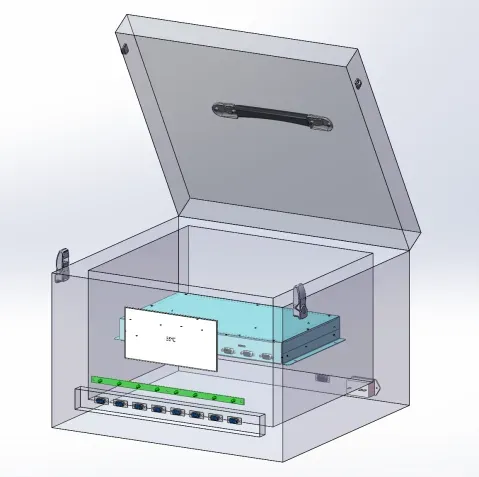
Figure 1. IEST High-Precision Self-Discharge Tester — 1 µV voltage resolution, 37.5 nA minimum current, automatic range switching for coin cell through large-format power cell self-discharge and leakage current measurement.
A 100 Ah prismatic power battery cell (Figure 2) was used for both experiments. This cell format is representative of EV traction battery applications, where self-discharge consistency across cells directly impacts pack-level charge retention and SOC estimation accuracy.
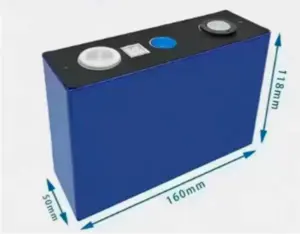
Figure 2. 100 Ah prismatic power battery cell used in self-discharge leakage current experiments.
Two controlled experiments were conducted using the constant-voltage leakage current measurement method:
The fundamental principle of the constant-voltage self-discharge measurement method: when the cell is first connected to the constant-voltage source, residual concentration polarization and electrochemical polarization at the electrode interfaces cause the double-layer charge distribution to deviate from its equilibrium state, producing a relatively large initial relaxation current. As polarization dissipates over time, the current decays. Once the interfaces reach thermodynamic equilibrium, the remaining current is maintained only by irreversible parasitic reactions inside the cell (SEI layer repair, impurity reactions, etc.) and stabilizes at a small, constant value — the leakage current — which directly quantifies the self-discharge rate.
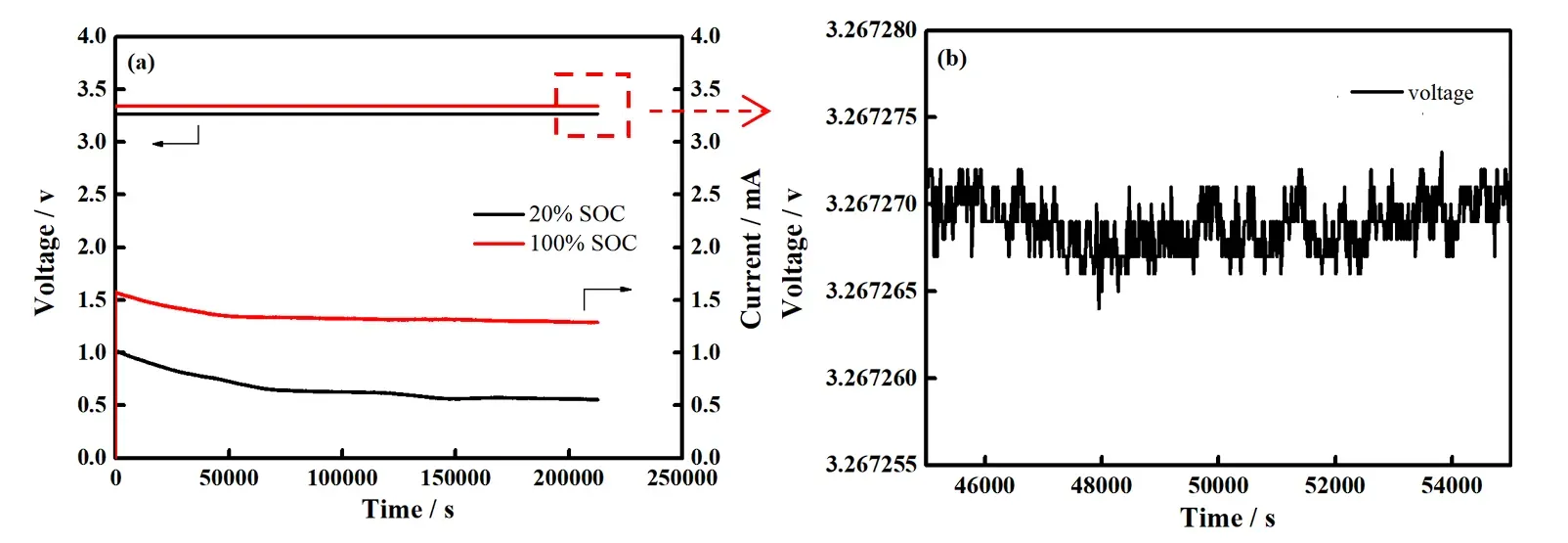
Figure 3. Leakage current comparison for 100 Ah power cell at 20% SOC vs. 100% SOC (40°C, 65 h constant voltage hold): (a) full leakage current curves — stabilized values: 20% SOC LC = 553 µA; 100% SOC LC = 1,287 µA; (b) voltage detail showing µV-level stability under constant voltage control.
Figure 3 shows the leakage current curves for the 100 Ah cell at two SOC levels under identical 40°C, 65-hour constant voltage conditions. The stabilized leakage currents are:
| SOC | Leakage Current (LC) | Interpretation |
|---|---|---|
| 20% SOC | 553 μA | Lower electrode-electrolyte interface polarization; fewer mobile Li⁺ at anode surface → slower self-discharge |
| 100% SOC | 1,287 μA | Higher interface polarization; abundant mobile Li⁺ at anode-electrolyte interface → accelerated parasitic reactions → faster self-discharge |
Interpretation: at high SOC, the anode–electrolyte interface potential cannot reach equilibrium because there are more mobile lithium ions at the anode surface. These ions more readily migrate to the interface and participate in parasitic side reactions.[2] Additionally, electron–ion–electrolyte complex species form more readily at high SOC, increasing reversible self-discharge. The result is that self-discharge at 100% SOC is more than 2× greater than at 20% SOC under identical temperature conditions.
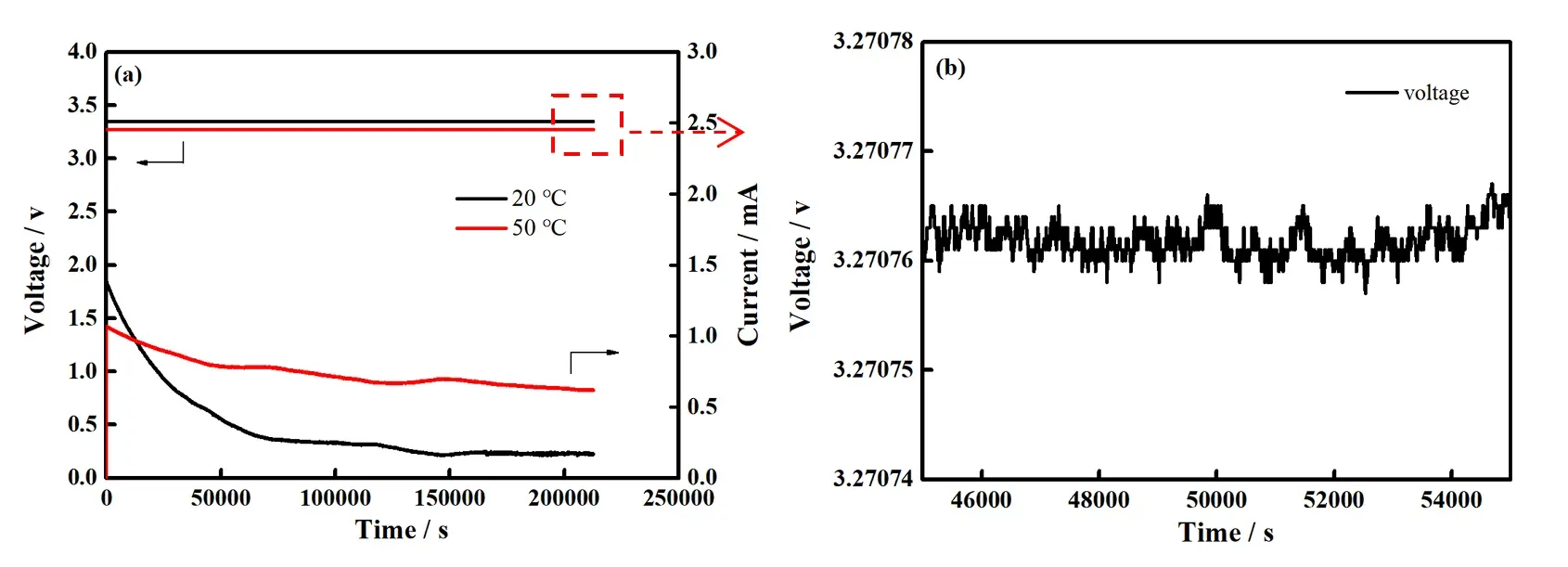
Figure 4. Leakage current comparison for 100 Ah power cell at 20°C vs. 50°C (65 h constant voltage hold): (a) leakage current curves — stabilized values: 20°C LC = 142 µA; 50°C LC = 620 µA; (b) voltage detail confirming constant voltage stability throughout measurement.
Figure 4 compares leakage current at two operating temperatures at the same SOC condition. The stabilized leakage currents are:
| Temperature | Leakage Current (LC) | Interpretation |
|---|---|---|
| 20°C | 142 μA | Lower electrochemical reaction rates; stable SEI; slow diffusion of reactive species |
| 50°C | 620 μA | Accelerated parasitic reactions via three concurrent mechanisms (see below) |
The effect of temperature on self-discharge is larger than the effect of SOC.[3] Three concurrent mechanisms explain the 4.4× increase in leakage current from 20°C to 50°C:
Critical practical note: cells that have been stored at elevated temperatures exhibit persistently higher self-discharge even after returning to ambient temperature — because high-temperature storage produces irreversible changes to the SEI layer and anode surface chemistry that permanently elevate the parasitic reaction rate.
This study measured self-discharge via leakage current under constant voltage for a 100 Ah prismatic power cell under varying SOC and temperature conditions. Key quantitative findings:
The constant-voltage leakage current measurement method provides a direct, quantitative, and time-efficient means of determining the self-discharge rate — eliminating the weeks-long waiting period of conventional capacity retention methods. Beyond individual cell characterization, this method is directly applicable to: power battery self-discharge consistency screening (identifying outlier cells with abnormally high leakage current before module assembly); evaluation of new anode and cathode materials for self-discharge performance; and comparative testing of electrolyte formulations and separator materials for their effect on SEI stability and parasitic reaction rates. The IEST high-precision self-discharge tester, with its 37.5 nA minimum current resolution and 1 µV voltage accuracy, enables these measurements across all standard lithium-ion cell formats.
[1] Jiang Yuanyuan, Liu Zhu, Luo Hui, et al. ELM indirect prediction method for remaining useful life of lithium batteries. Journal of Electronic Measurement and Instrumentation, 2016, 30(2): 179–185.
[2] Liu Yu, Wang Baofeng, Xie Jingying, Yang Jun, Chen Jian. Electrochemical Characteristic of SEI in Secondary Lithium Batteries. Journal of Inorganic Materials, 2003 (02): 307–312.
[3] Anthony Barré, Deguilhem B, Sébastien Grolleau, et al. A review on lithium-ion battery ageing mechanisms and estimations for automotive applications. Journal of Power Sources, 2013.
The most accurate method for measuring self-discharge is the constant-voltage leakage current method: hold the cell at its open-circuit voltage using a high-precision voltage source, supply a small compensation current to maintain this voltage exactly constant, and measure the stabilized compensation current after the initial relaxation period subsides. This stabilized current is the self-discharge leakage current, directly and quantitatively representing the self-discharge rate. The method requires instrumentation with sub-µA current resolution (the IEST tester achieves 37.5 nA minimum) and µV-level voltage control (1 µV resolution). The initial 10–30 hours of the test show a decaying relaxation current as polarization dissipates; only the fully stabilized current value at the end of the test is the true self-discharge leakage current. This approach is significantly faster and more precise than the conventional 28-day open-circuit voltage decay or capacity retention methods.
Leakage current measurement for self-discharge is performed by holding the cell under constant voltage (CV) at its open-circuit voltage and measuring the steady-state compensation current required to maintain that voltage. The test proceeds in three phases: (1) initial connection — a large relaxation current flows as residual concentration and electrochemical polarization at the electrode interfaces dissipates; (2) decay phase — the current decreases over 10–30+ hours as the electrode-electrolyte interfaces approach thermodynamic equilibrium; (3) stabilized phase — the remaining current, maintained only by irreversible parasitic reactions (SEI reformation, trace impurity reactions, micro-short circuits), is the leakage current representing self-discharge. The test requires: voltage control accuracy of µV level, current measurement resolution of nA level, hermetically sealed test environment to prevent humidity-induced leakage artifacts, and sufficient hold time for full polarization relaxation before reading the leakage current value.
Self-discharge increases with state of charge (SOC). At higher SOC, the anode–electrolyte interface potential cannot reach equilibrium because more lithium ions are intercalated in the anode and readily migrate to the surface. This elevated interfacial Li⁺ activity promotes parasitic side reactions, and electron–ion–electrolyte complex species form more readily — both increasing the reversible self-discharge component. Experimental data: a 100 Ah prismatic power cell at 40°C shows leakage current of 553 µA at 20% SOC versus 1,287 µA at 100% SOC — a 2.3× difference under identical conditions. This SOC dependence means that cells stored at high SOC (>80%) will self-discharge significantly faster than cells stored at low SOC (20–40%), which is why battery storage guidelines universally recommend partial charge (40–60% SOC) for long-term storage.
Temperature has a greater effect on self-discharge than SOC does. Three concurrent mechanisms explain the strong temperature dependence: (1) at elevated temperature, electrons have higher thermal energy and penetrate the SEI layer more readily, participating as reactants in parasitic electrochemical reactions that consume lithium; (2) the SEI layer becomes thermally unstable above ~45°C, partially dissolving and reforming, with each reformation cycle consuming lithium ions irreversibly; (3) high temperature promotes transition-metal dissolution from the cathode, increases electrolyte reactivity, and accelerates redox reactions throughout the cell. Experimental data: a 100 Ah prismatic power cell shows leakage current of 142 µA at 20°C versus 620 µA at 50°C — a 4.4× increase for a 30°C temperature rise. Critically, cells that have been exposed to elevated temperatures retain permanently elevated self-discharge even after cooling to ambient temperature, because high-temperature storage produces irreversible SEI and surface chemistry changes.
Self-discharge rate is judged from the stabilized leakage current value after the initial relaxation period in a constant-voltage hold test. The stabilized leakage current (µA) directly represents the rate at which the battery loses charge under open-circuit conditions. To convert to a self-discharge rate: self-discharge rate (% per month) = (leakage current × time) / cell capacity × 100. For a 100 Ah cell with 1,287 µA leakage current: monthly self-discharge = (1,287×10⁻⁶ A × 30 × 24 × 3600 s) / (100 × 3600 As) × 100 ≈ 3.3% per month. Higher stabilized leakage current indicates faster self-discharge. When comparing cells for consistency screening, the ranking criterion is the stabilized leakage current value after a defined hold period (typically 24–65 hours). Cells with leakage current significantly above the batch median (typically >2–3× median) are flagged as abnormal self-discharge candidates requiring investigation.
Power battery self-discharge consistency screening using leakage current testing identifies cells with abnormally high self-discharge before they are assembled into battery modules or packs — where a single high-self-discharge cell would continuously drain adjacent cells and cause progressive pack imbalance. The screening process: (1) charge all cells in a batch to a defined SOC (typically 50% for storage optimization) under standardized conditions; (2) hold all cells at constant voltage simultaneously using a multi-channel self-discharge tester; (3) after the relaxation period (typically 24–48 hours), record stabilized leakage current for each cell; (4) rank cells by leakage current and reject outliers that exceed a defined acceptance threshold. The IEST multi-channel self-discharge tester supports this high-throughput screening workflow for production-line quality control. Cells with high leakage current from physical self-discharge (micro-short circuits) will show an elevated and relatively constant leakage current throughout the test; cells with high chemical self-discharge will show a slowly decaying but elevated baseline compared to normal cells.