
Powder material compaction density for battery electrode materials is defined as the mass of powder after compression divided by the compressed volume. It differs from true density (no pores), particle density (intraparticle pores only), loose-fill density (no applied pressure), and vibration density (vibration only) by the presence of external compressive load: compaction density > vibration density > loose-fill density. Electrode compacted density = areal coating mass ÷ (calendered electrode thickness − current collector thickness). Key factors affecting measured compaction density are particle size and distribution, particle morphology, true density, mold diameter, applied pressure, hold time, and whether thickness is measured under load or after unloading. Automated battery powder compaction tooling such as the IEST PRCD series integrates pressing, thickness measurement, and calculation in one system, improving repeatability over manual tablet-press methods and supporting multi-pressure profiling, unloading (rebound) tests, and continuous compression (Heckel analysis) in a single instrument.
The performance and safety of lithium-ion batteries are fundamentally governed by the properties of their constituent electrode materials. Among these, the characteristics of cathode and anode active powders are paramount. A key metric linking powder properties to cell performance is electrode compaction density—the density achieved after the electrode coating is calendered under a defined pressure. This parameter directly influences energy density (how much active material fits per unit volume), internal resistance (porosity controls electrolyte access and ion transport), and cycle life (excessive compaction collapses electrolyte pores; insufficient compaction wastes volumetric capacity).
Accurately assessing powder compaction density and understanding the underlying powder compression behavior are therefore critical for material selection, process optimization, and quality control throughout battery manufacturing. This article provides a systematic analysis of powder compression fundamentals—including density definitions, compression stages, the Heckel equation, and testing protocols—and offers practical guidance for reliable compaction density evaluation of cathode and anode battery powder materials.
In lithium-ion battery manufacturing, the calendering process densifies the coated electrode—essentially compacting a layer of active powder mixed with binder and conductive additives into a defined volume. Understanding powder compression requires a clear hierarchy of density definitions:[1]
The density hierarchy is: True density > Particle density > Compaction density > Vibration density > Loose-fill density. Electrode compaction density is calculated as:
Electrode compaction density = coating areal mass ÷ (calendered electrode thickness − current collector thickness)
At the powder-testing level, compaction density = mass of powder after compression ÷ volume of compressed powder compact. Monitoring this value during materials R&D and incoming quality control provides an effective, fast assessment of batch-to-batch consistency and the impact of process modifications on packing behavior.
Powder compression under external load proceeds through sequential, overlapping stages that reflect different deformation mechanisms:[1]
In practice, powder compression is a complex, simultaneous composite of all these mechanisms. The proportion of elastic versus plastic deformation—quantified by the ratio of recovered (rebound) thickness to total compression—is a material fingerprint that reflects particle mechanical properties and informs safe calendering pressure ranges.
Figure 1 illustrates the microstructural evolution of electrode coatings during the roll-pressing (calendering) process, showing how inter-particle voids collapse and the coating densifies under load:
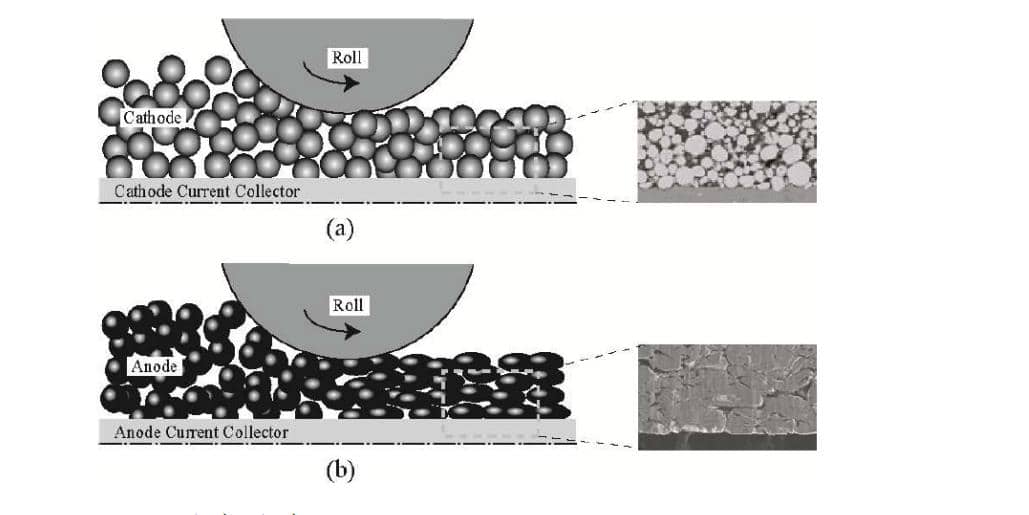
Figure 1. Schematic of microstructure evolution during electrode roll-pressing (calendering): (a) cathode electrode; (b) anode electrode — inter-particle voids collapse and coating densifies as powder compaction density increases [2]
The IEST PRCD series powder resistivity and compaction density testers serve over 300 customers in the lithium battery industry and provide three complementary test modes to characterize these behaviors (Figure 2):
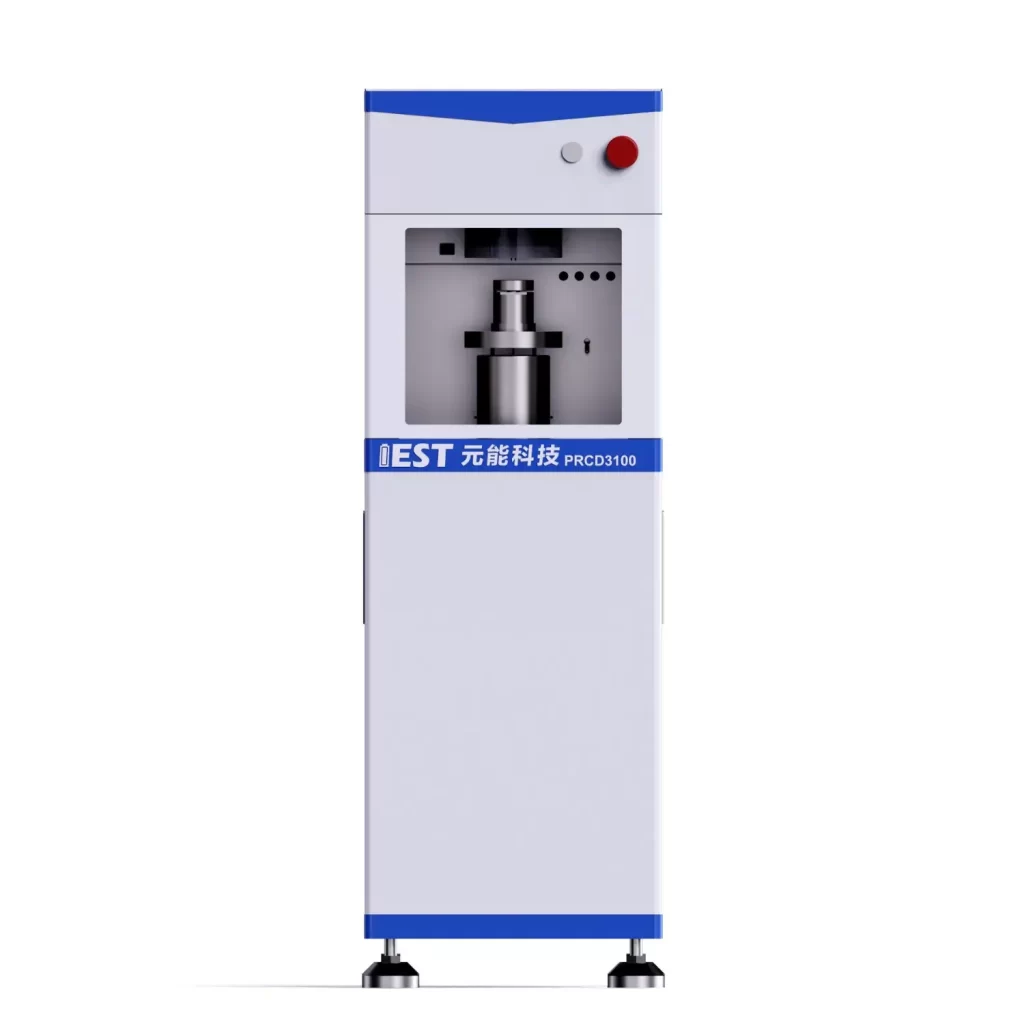
Figure 2. IEST PRCD3100 Powder Resistivity & Compaction Density Measurement System — integrated battery powder compaction tooling for cathode and anode powder testing; measures resistivity, compaction density, and compression behavior
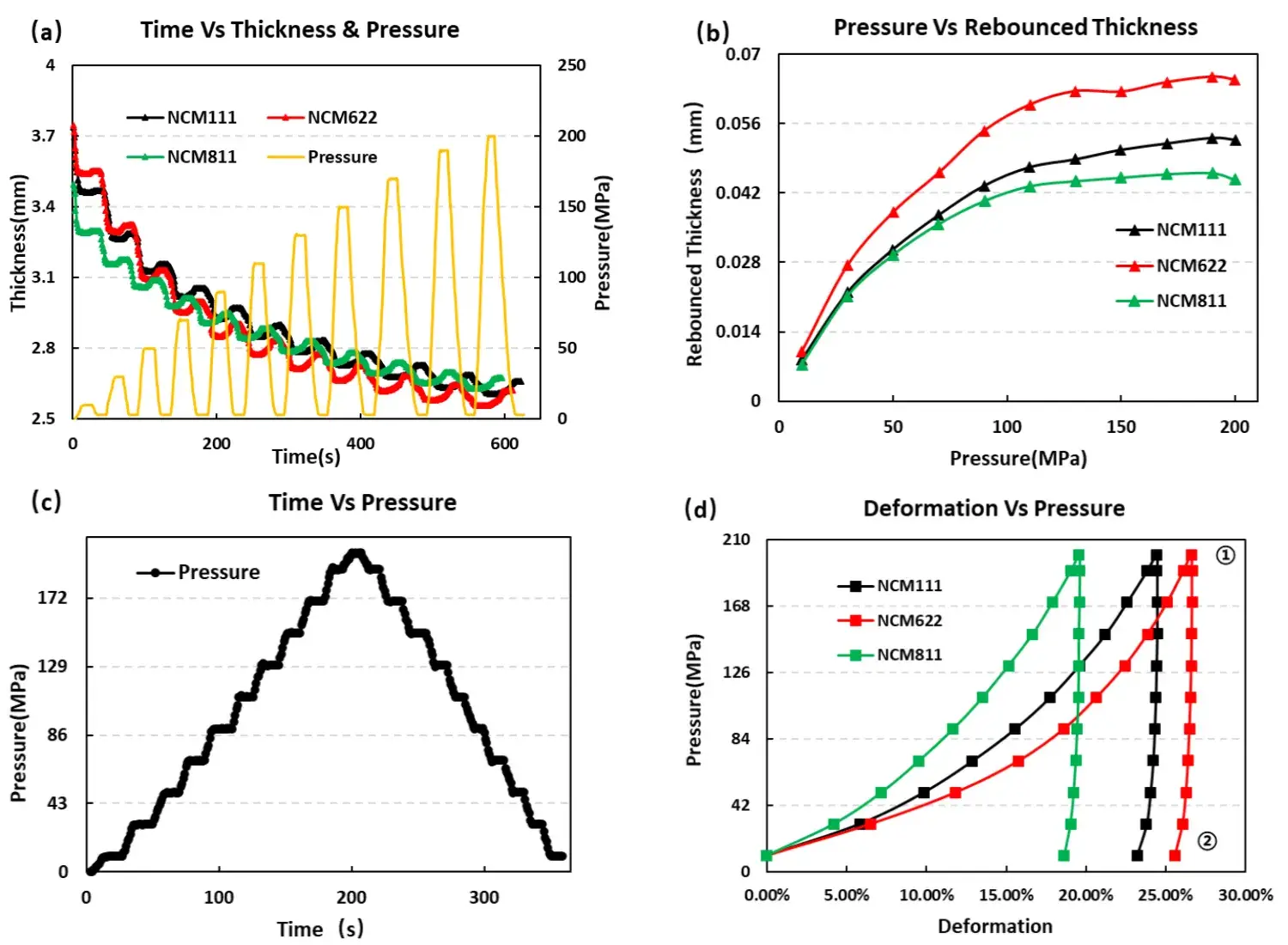
Figure 3. (a–b) Unloading test method and rebound thickness results — characterizes elastic recovery and particle fracture onset. (c–d) Steady-state compression test and representative stress-deformation curve — point ① maximum deformation; point ② irreversible deformation; ①−② reversible (elastic) component
The unloading test (Figures 3a–b) applies pressure then fully releases it, measuring the rebound thickness. As pressure increases, rebound thickness initially grows (more elastic deformation stored) then stabilizes—the point where rebound ceases to increase indicates the onset of dominant plastic deformation or particle fracture. This inflection point defines the practical upper pressure limit for calendering without particle damage.
The steady-state compression test (Figures 3c–d) provides the full stress-deformation curve, decomposing total deformation into reversible (elastic) and irreversible (plastic + fracture) components — the standard input for advanced Heckel analysis.
The Heckel equation is the most widely used semi-empirical model relating applied pressure to the compaction density (relative density) of a powder compact. It was originally developed in pharmaceutical powder research but is directly applicable to battery electrode powders. The void ratio and Heckel equation are expressed as follows:[4]
\[\varepsilon = 1 – \frac{\rho_{bulk}}{\rho_{true}} \tag{1}\]
\[\ln \frac{1}{1-D} = kp + A \tag{2}\]
Where:
The Heckel equation is most reliably applied in the high-pressure, low-void-ratio regime where the log-linear relationship holds. Deviations from linearity at low pressure reflect the rearrangement stage; deviations at very high pressure may reflect particle fracture changing the compaction mechanism. For battery electrode powders, generating a complete Heckel plot from PRCD3100 continuous compression data provides direct insight into the pressure range where each deformation mechanism dominates — informing calendering process design.
Compaction density is not a fixed intrinsic property — it is a measurement-condition-dependent outcome. The main variables are:
Benchmarking note: when comparing compaction density data between laboratories, instruments, or publications, always verify mold diameter, measurement point (under load vs. unloaded), hold time, and sample mass — these variables alone can produce apparent differences of 5–15% between identical materials on different equipment.
Three test protocols are available on the PRCD series, each suited to a different characterization goal:
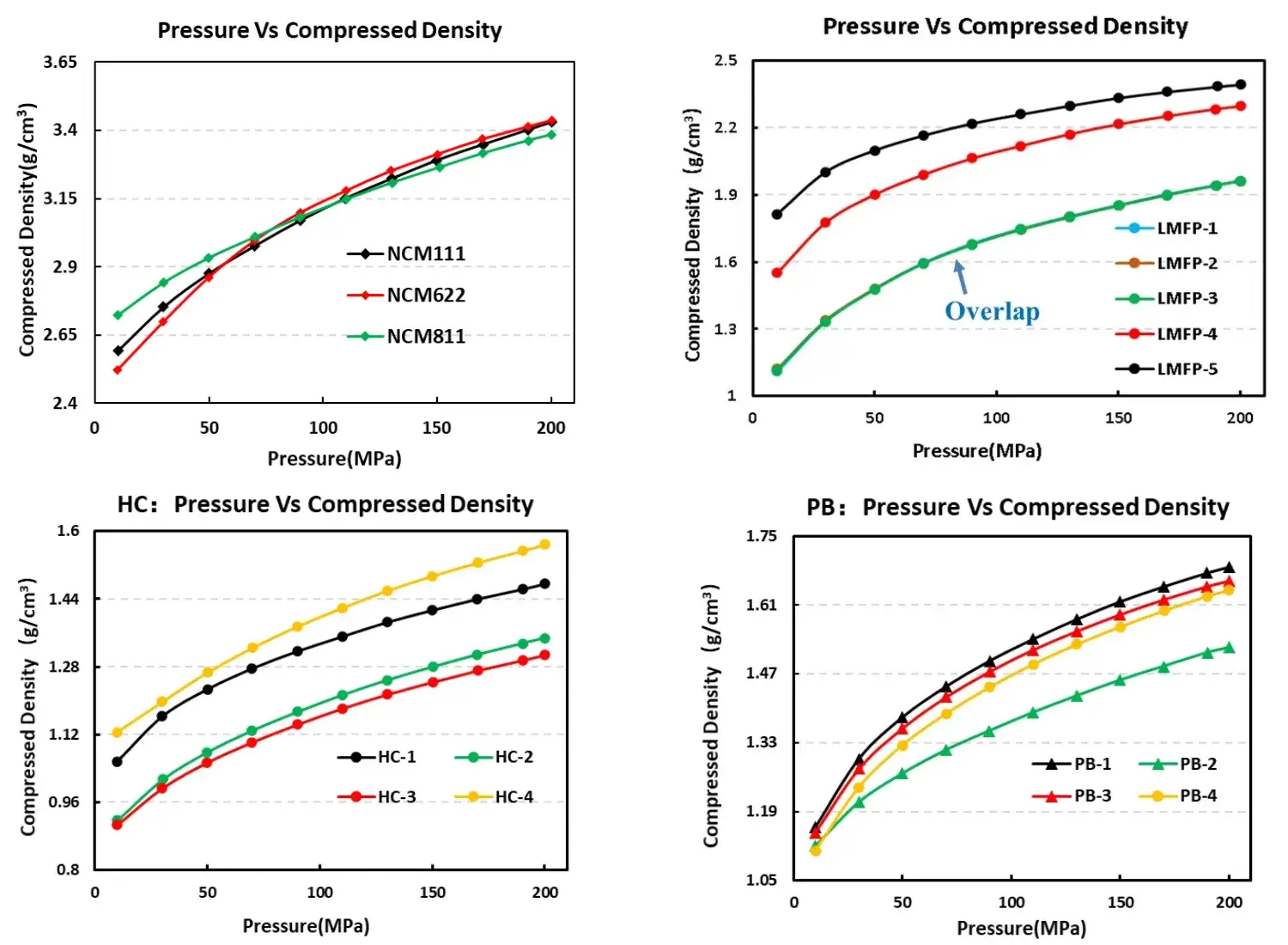
Figure 4. Compaction density vs pressure profiles for different battery powder materials (PRCD3100 multi-point test) — compaction density increases with pressure at different rates depending on particle morphology and true density
Powder compaction density is not a single number — it is the outcome of the material’s intrinsic true density, particle morphology and size distribution, and its mechanical response to applied pressure (elastic rebound, plastic deformation, and fracture). A deep understanding of powder compression behavior, supported by the Heckel equation and automated battery powder compaction tooling such as the IEST PRCD series, enables battery engineers to make informed decisions about material selection, electrode formulation, and calendering process design. Rigorous, repeatable powder-level testing — covering resistivity, compaction density, and compression behavior in a single instrument — is an effective front-end screen that reduces waste and accelerates development timelines for both cathode and anode battery electrode materials.
[1] Yang Shaobin, Liang Zheng. Lithium-ion Battery Manufacturing Process Principles and Applications.
[2] mikoWoo@Ideal Life. Theory and Process Basis of Lithium-ion Battery Polar Cells.
[3] B K K A , A S A , A H N , et al. Internal resistance mapping preparation to optimize electrode thickness and density using symmetric cell for high performance lithium-ion batteries and capacitors[J]. Journal of Power Sources, 2018, 396:207-212.
[4] SI Guo-ning, HUANG Wan-ting, LI Gen-sheng, XU Fei, CHU Meng-qiu. Application Research of Different Compression Model on Four Powder Excipients Compression[J]. Chinese Pharmaceutical Journal, 2018, 53(23): 2021-2028 https://doi.org/10.11669/cpj.2018.23.009
Compaction density (also called “compact density” or “press density”) is the mass of a powder sample divided by the volume it occupies after being compressed under a defined uniaxial pressure. It differs from loose-fill density (no applied pressure) and vibration/tap density (vibration only) by the presence of an external compressive load: compaction density > vibration density > loose-fill density. For battery electrode design, electrode compaction density = areal coating mass ÷ (calendered electrode thickness − current collector thickness), and it directly determines volumetric energy density, electrolyte porosity, ionic transport resistance, and cycle life. The China national standard GB/T 24533-2019 defines the manual measurement method; automated systems such as the IEST PRCD series improve repeatability and enable multi-pressure profiling.
The Heckel equation is a semi-empirical model that describes how powder compaction density (expressed as relative density D = bulk density / true density) changes with applied pressure P: ln(1/(1−D)) = kP + A. In this equation, k (the slope of the linear region of a Heckel plot) is a plasticity parameter — a larger k indicates more plastic (permanently deformable) powder, where a given pressure increment produces a larger density increase. A (the intercept) is related to DA, the maximum relative density achievable by particle rearrangement before deformation begins, which is closely related to tap density. The Heckel equation is most reliable at high pressure and low void ratio. For battery electrode powders, fitting PRCD continuous compression data to the Heckel equation identifies the dominant deformation mechanism at each pressure range and informs safe calendering pressure selection.
Battery powder compaction density can be measured with a dedicated integrated powder compaction and measurement system such as the IEST PRCD series. These instruments combine a precision press, a high-resolution in-situ thickness sensor, and automated data acquisition into a single platform, replacing the manual tablet-press approach specified in GB/T 24533-2019. The PRCD series supports three test modes: single-point (mimicking standard methods), multi-point pressure sweep (generating the full pressure-density profile from e.g. 10 to 350 MPa), and continuous compression (for Heckel analysis and unloading/rebound testing). It also measures powder resistivity and conductivity simultaneously, making it a single-instrument solution for cathode and anode powder characterization in materials R&D, process development, and incoming batch quality control.
Powder compression proceeds through four overlapping stages: particle rearrangement (low pressure, reversible), elastic deformation (reversible particle shape change), plastic deformation (permanent, irreversible), and brittle fracture (irreversible particle cracking). In compaction testing, elastic rebound (or “spring-back”) refers to the thickness increase that occurs when the applied pressure is released — the elastic deformation component recovers, while the plastic and fracture components do not. Rebound thickness is measured by the unloading test mode on instruments like the PRCD series: thickness under maximum pressure versus thickness after full unloading. As pressure increases, rebound thickness first grows then stabilizes — the stabilization pressure indicates that elastic particle deformation has reached a plateau and further compression mainly drives plastic deformation or fracture. This rebound analysis is directly relevant to electrode calendering: materials with high elastic rebound spring back after the calender nip, reducing the final electrode density relative to the in-nip density.
The most relevant powder-level characterization tests for battery electrode materials are: compaction density measurement (how densely the powder packs under calendering-representative pressure), powder resistivity/conductivity measurement (electronic conductivity of the active material, which determines conductive additive requirements), compression behavior testing (elastic and plastic deformation components, rebound thickness, fracture onset — from stress- strain curves and Heckel analysis), particle size distribution (D₁₀/D₅₀/D₉₀ by laser diffraction), and morphology imaging (SEM). Automated integrated instruments such as the IEST PRCD series combine the first three of these in a single instrument, while particle size and SEM are conducted with separate equipment. Together these tests provide the material property data needed for electrode formulation design, calendering process optimization, and batch incoming quality control without requiring full electrode or cell fabrication.