-
iestinstrument

Abstract
NCM cathode material (also written NMC — the two abbreviations refer to the same material family, see Section 1.1) is a layered oxide cathode with the general formula LiNixCoyMnzO₂ (x + y + z = 1), where nickel content controls energy density and capacity, cobalt governs electronic conductivity and rate capability, and manganese provides structural stability. The NCM structure is the O3-type layered rock-salt lattice (R3̄m space group) in which Li⁺ and transition-metal ions alternate in distinct octahedral sites between close-packed oxygen layers. The three most widely used NCM compositions are NCM111 (LiNi₁/₃Co₁/₃Mn₁/₃O₂), NCM622 (LiNi₀.₆Co₀.₂Mn₀.₂O₂), and NCM811 (LiNi₀.₈Co₀.₁Mn₀.₁O₂). Key battery material electrical properties — conductivity, compaction density, and mechanical rebound — follow a clear composition dependence: conductivity ranking is NCM811 > NCM622 > NCM111, while compaction density is highest for NCM622 above ~80 MPa.
1. Introduction
The cathode is one of the most critical components in lithium-ion batteries, determining energy density, cycle stability, and rate capability. Common cathode families include layered lithium cobalt oxide (LCO), olivine LiFePO₄ (LFP), spinel LiMn₂O₄ (LMO), and layered nickel–cobalt–manganese ternary materials — collectively known as NCM materials (or NMC, see Section 1.1 below). The NCM structure — LiNixCoyMnzO₂ (x+y+z=1) — combines the strengths of three transition metals: nickel increases capacity and lowers cost, cobalt improves electronic conductivity and rate capability, and manganese stabilizes the layered lattice and reduces expense. High nickel content increases capacity but can destabilize the structure; optimizing the Ni:Co:Mn ratio is therefore the central challenge in NCM cathode material design.
1.1 NCM vs NMC: Are They the Same Material?
NCM and NMC refer to the same cathode material — they are not different chemistries. The two abbreviations are simply different orderings of the same three elements: Nickel, Cobalt, Manganese. “NMC” (Nickel-Manganese-Cobalt) is the naming convention commonly used in Europe and North America; “NCM” (Nickel-Cobalt-Manganese) is standard in China and much of Asia. Both follow the same formula LiNixCoyMnzO₂ and share the same layered oxide crystal structure. When you see NCM622 and NMC622 used in different publications, they describe the same material: LiNi₀.₆Co₀.₂Mn₀.₂O₂. This naming ambiguity is entirely a regional convention difference, not a chemical distinction.
| Parameter | NCM111 (NMC111) | NCM622 (NMC622) | NCM811 (NMC811) |
|---|---|---|---|
| Full formula | LiNi1/3Co1/3Mn1/3O2 | LiNi0.6Co0.2Mn0.2O2 | LiNi0.8Co0.1Mn0.1O2 |
| Nickel percentage | 33% | 60% | 80% |
| Typical specific capacity | 155–160 mAh/g | 170–180 mAh/g | 190–200 mAh/g |
| Electrical conductivity (this study) | Lowest | Intermediate | Highest |
| Compaction density (>80 MPa) | Intermediate | Highest | Intermediate |
| Structural stability | Best (balanced Ni/Co/Mn) | Good | Lower (high Ni lattice distortion) |
| SEM morphology (this study) | Plate-like layered particles, lower packing density | Layered features, moderate packing | Spherical polycrystalline agglomerates, denser packing |
| Compression modulus | Intermediate | Lowest (easiest to compact) | Intermediate |
This study compares NCM111, NCM622, and NCM811 polycrystalline powders to evaluate how NCM material composition and NCM structure affect morphology, electrical conductivity, compaction density, and mechanical rebound — key battery material electrical properties that influence electrode processing and final cell performance.

Figure 1. NCM crystal structure — layered O3-type LiCoxMnyNi1-x-yO₂ (R3̄m space group). Li⁺ and transition-metal ions occupy alternating octahedral sites between close-packed oxygen layers. This fundamental NCM structure is shared by NCM111, NCM622, and NCM811; the Ni:Co:Mn ratio modifies lattice parameter, conductivity, and stability without changing the basic framework.[4]
2. Experimental Methods
2.1 Materials
Three NCM cathode material powders with differing nickel contents were selected: NCM111 (LiNi₁/₃Co₁/₃Mn₁/₃O₂), NCM622 (LiNi₀.₆Co₀.₂Mn₀.₂O₂), and NCM811 (LiNi₀.₈Co₀.₁Mn₀.₁O₂). All samples were prepared with identical mass and handling to ensure comparability across characterization methods.
2.2 SEM Morphology Characterization
Surface morphology and primary particle structure were examined by scanning electron microscopy (SEM) to visualize the NCM structure and polycrystalline agglomerate characteristics that affect inter-particle contact resistance and packing behavior.
2.3 Electrical and Mechanical Property Testing
Battery material electrical properties (powder conductivity) and compaction density were measured using the PRCD3100 (IEST) powder resistivity and compaction density system. The PRCD3100 applies controlled pressure while simultaneously recording powder resistivity, thickness, and compaction density in real time.
- Test parameters: 10–200 MPa pressure range, 20 MPa intervals, 10 s hold time per step.
- Equipment: Figure 2 shows the PRCD3100 system — (a) external appearance; (b) internal structure diagram.
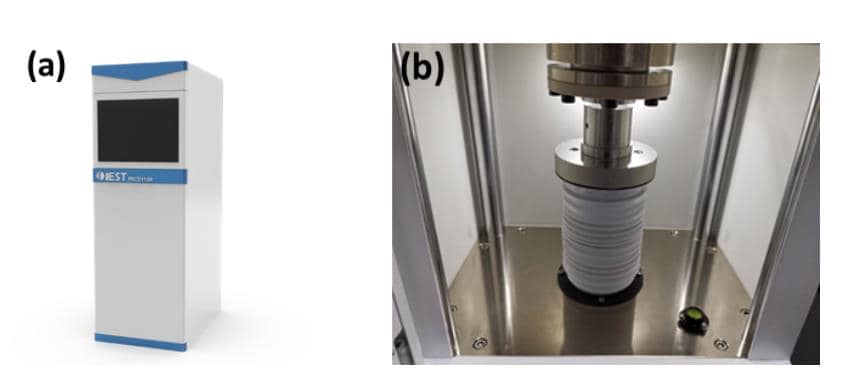
Figure 2. IEST PRCD3100 for NCM material battery material electrical properties testing: (a) equipment appearance; (b) internal structure — pressure mechanism, four-probe conductivity measurement, and real-time thickness/density monitoring.
3. Results
3.1 SEM Morphology — NCM Structure Observations
SEM imaging (Figure 3) reveals clear morphological differences among the three NCM materials:
- NCM811: Higher surface packing density, more spherical polycrystalline agglomerates — a morphology that favors inter-particle contact and intrinsic conductivity. The denser, more isotropic packing geometry of NCM811 particles explains its superior electrical conductivity among the three NCM cathode material variants studied.
- NCM622 and NCM111: More pronounced layered primary particles and lower apparent surface packing density; grain boundaries and plate-like features are more distinct. These morphological differences reflect the lower Ni content and the stronger expression of the layered NCM structure at lower Ni levels.
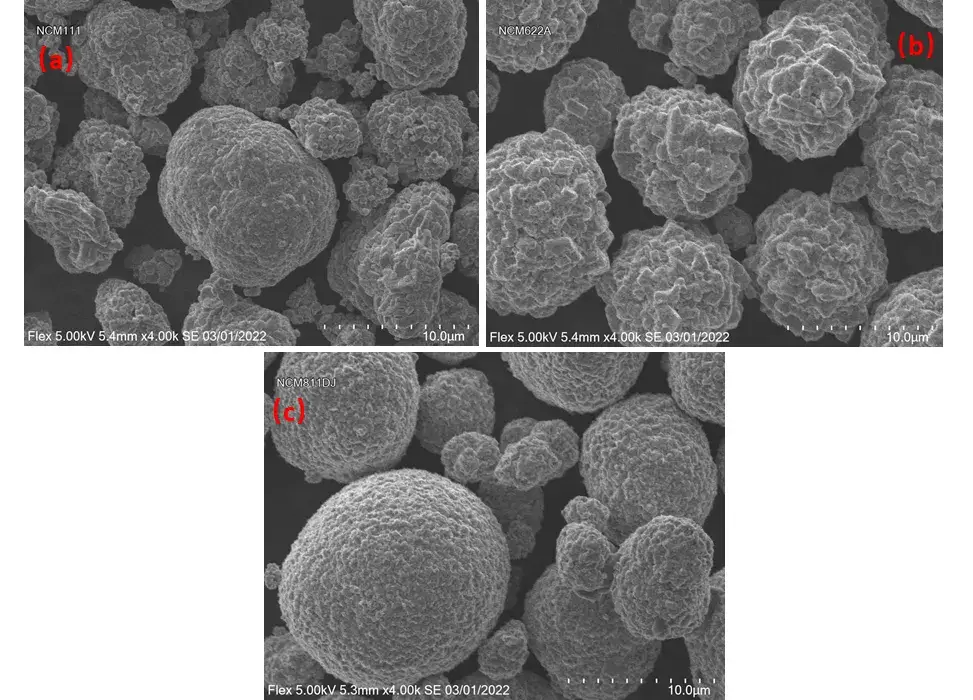
Figure 3. SEM morphology of the three NCM materials: (a) NCM111 — plate-like layered primary particles, lower packing density; (b) NCM622 — mixed morphology; (c) NCM811 — spherical polycrystalline agglomerates, denser packing. Higher Ni content shifts NCM structure from plate-like toward more isotropic agglomerates.
3.2 Electrical Conductivity and Compaction Density
The battery material electrical properties — specifically powder conductivity and compaction density — differ systematically with NCM composition:
- Conductivity ranking: NCM811 > NCM622 > NCM111 (Figure 4a). This trend is directly correlated with increasing Ni and Co content — both elements improve electronic conduction through the layered oxide lattice. NCM811’s denser, more spherical agglomerates also create more inter-particle contact paths at the powder level, amplifying the intrinsic composition advantage.
- Compaction density: above ~80 MPa, NCM622 achieves slightly higher compaction density than NCM111 and NCM811 (Figure 4b), though the overall differences are modest. Compaction density is governed by particle shape, size distribution, and mechanical strength — factors that interact with the specific NCM structure of each composition.
Energy density context — NCM811 vs NCM622: While this study focuses on powder-level electrical and mechanical properties, the conductivity trend (NCM811 > NCM622 > NCM111) aligns with the well-established energy density hierarchy of these NCM cathode materials. NCM811 delivers the highest gravimetric capacity (~190–200 mAh/g) and therefore the highest energy density among the three, making it the preferred cathode for high-energy-density applications such as EV battery packs. NCM622 offers a practical intermediate — lower capacity (~170–180 mAh/g) than NCM811 but significantly better structural stability and simpler manufacturing requirements. NCM111 (~155–160 mAh/g) provides the most balanced stability but at the cost of energy density. The compaction density advantage of NCM622 above 80 MPa also contributes to favorable volumetric energy density at the electrode level, partially compensating for its lower intrinsic gravimetric capacity compared to NCM811.
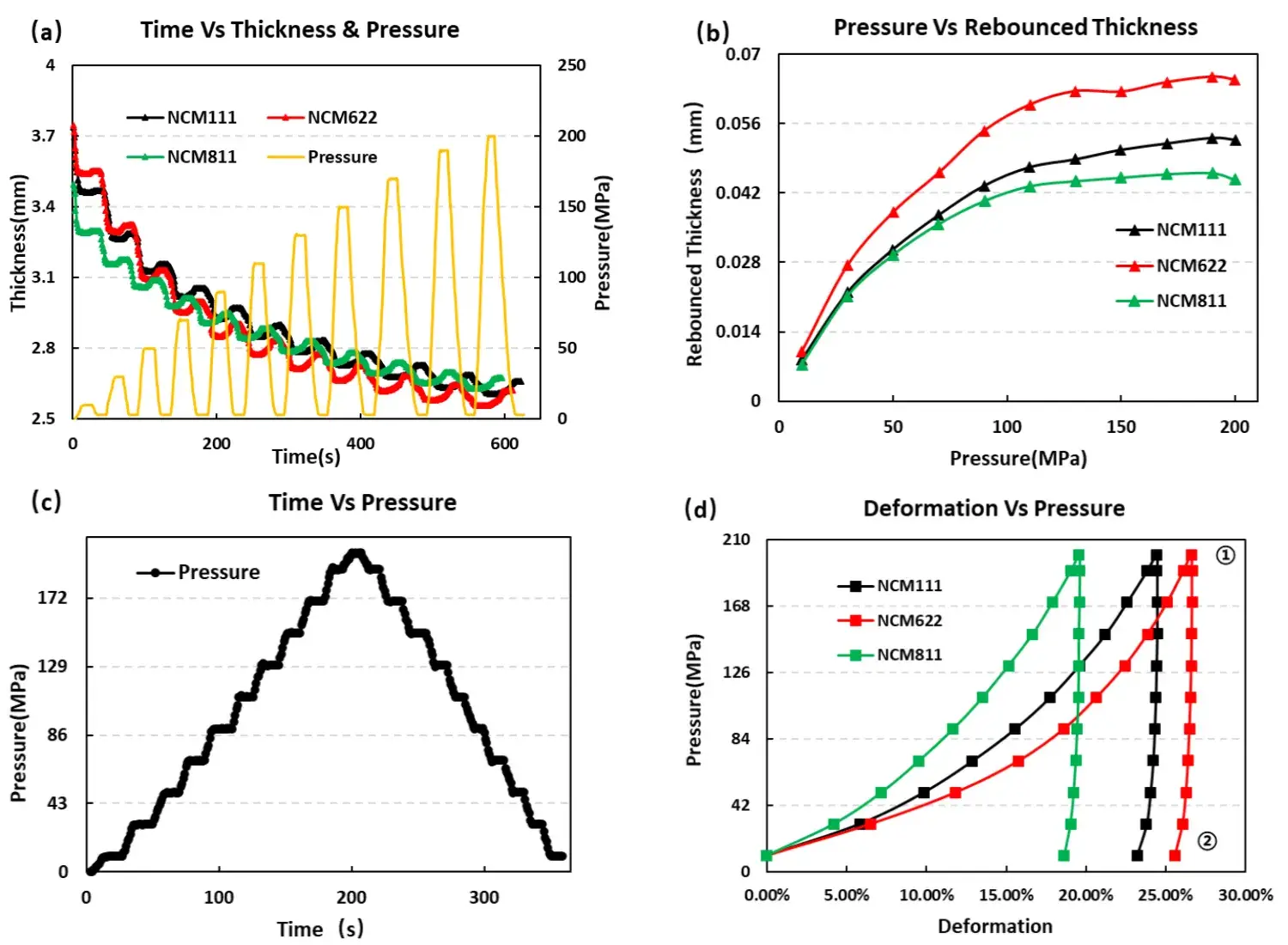
Figure 4. Battery material electrical properties of NCM111, NCM622, and NCM811: (a) electrical conductivity vs. pressure — ranking NCM811 > NCM622 > NCM111; (b) compaction density vs. pressure — NCM622 achieves slightly higher density above ~80 MPa.
3.3 Deformation and Rebound Behavior
Pressure release and rebound tests characterize the mechanical behavior of each NCM powder after compaction — critical information for electrode calendering process design:
- NCM622 exhibits greater thickness rebound upon pressure release, indicating significant elastic recovery. This suggests the NCM622 particles store more elastic strain energy during compression.
- At approximately 110 MPa, rebound stabilizes for all three compositions — indicating that inter-particle void space is largely eliminated and further rebound is due to the inherent particle elasticity rather than pore collapse.
- NCM111 shows slightly more reversible deformation, but differences across the three NCM materials are modest. NCM622’s lower compression modulus (steeper stress-strain curve slope) confirms it is most easily compacted under applied force — consistent with its higher compaction density above 80 MPa.
These results demonstrate that the specific NCM structure and morphology of NCM622 allow it to achieve a favorable combination of high compaction density and manageable elastic rebound, which is critical for manufacturing dense, stable electrodes.
Figure 5. Stress-strain curves during pressurization and pressure relief for NCM111, NCM622, and NCM811.
| Name | Reversible Deformation | Irreversible Deformation | Max Deformation |
|---|---|---|---|
| NCM611 | 1.27% | 23.19% | 24.46% |
| NCM622 | 1.08% | 25.58% | 26.66% |
| NCM811 | 0.98% | 18.64% | 19.62% |
4. Discussion — Linking NCM Structure to Battery Material Electrical Properties
- Microstructure vs. conductivity: NCM811’s higher electrical conductivity is directly linked to its denser spherical polycrystalline agglomerates and better inter-particle contact networks after compaction. This improves electron percolation through the electrode, benefiting rate performance — and is consistent with the higher nickel and cobalt content that raises the intrinsic electronic conductivity of the NCM lattice.
- Compaction trade-offs: Higher nickel content raises capacity and intrinsic conductivity but also increases lattice distortion during deep delithiation and brittleness under mechanical stress. Careful control of calendering pressure and electrode formulation is needed for high-Ni NCM materials to avoid particle fracture and contact resistance increases during electrode manufacture.
- NCM622 as a practical optimum: NCM622’s favorable compaction density above 80 MPa and lower compression modulus make it easier to achieve high electrode packing density, partially compensating for its lower intrinsic capacity versus NCM811. This mechanical advantage contributes to competitive volumetric energy density at the electrode level.
- Electrode manufacture implications: Each NCM composition requires tailored electrode processing — slurry formulation, coating weight, and calendering parameters — to maximize volumetric energy while minimizing contact resistance and particle breakage. The PRCD3100 powder-level measurements in this study provide the material property data needed to anchor these process parameter choices before full electrode fabrication.
5. Conclusions
This study used the PRCD3100 to characterize battery material electrical properties and mechanical behavior of NCM111, NCM622, and NCM811 cathode powders. Key findings:
- NCM and NMC are identical materials — the two abbreviations reflect regional naming conventions (NMC in Europe/North America; NCM in Asia) for the same LiNixCoyMnzO₂ layered oxide family.
- NCM structure strongly influences morphology, compaction, and electrical conductivity: increasing Ni content shifts particle geometry from plate-like to spherical and raises conductivity.
- Conductivity ranking: NCM811 > NCM622 > NCM111 — directly correlated with Ni+Co content and particle packing geometry.
- NCM622 achieves the highest compaction density above ~80 MPa and the lowest compression modulus — practical advantages for electrode calendering, partially compensating for its lower gravimetric capacity versus NCM811.
Key quantitative relationships: for polycrystalline NCM cathode materials, electrical conductivity scales with Ni content — NCM811 (80% Ni) > NCM622 (60% Ni) > NCM111 (33% Ni) — consistent with the known role of Ni and Co in providing electronic conduction pathways in the layered O3 structure. NCM622 achieves the highest compaction density above ~80 MPa and the lowest compression modulus among the three NCM materials studied, making it the most mechanically favorable composition for electrode calendering. NCM811 delivers the highest energy density (~190–200 mAh/g) and conductivity but requires the most careful process control to manage lattice instability at high delithiation and mechanical brittleness during calendering.
6. References
[1] Zhang R, Meng Z, Ma X, et al. Understanding fundamental effects of Cu impurity in different forms for recovered LiNi0.6Co0.2Mn0.2O2 cathode materials[J].Nano Energy, 2020:105214.
[2] Guangshun Xiao. Recent Development on Ni-Co-Mn Ternary Cathode Material for Lithium-Ion Batteries[J].Material Sciences, 2020, 10(4):201-215.
[3] Zhaoguo Wu. Synthesis, characterization and modification of high nickel ternary cathode materials for lithium-ion batteries [D]: [Doctoral dissertation]. Hefei: University of Science and Technology of China, 2018.
[4] Meng Y S, Arroyo-De Dompablo M E. Recent advances in first principles computational research of cathode materials for lithium-ion batteries[J].Accounts of Chemical Research, 2013, 46(5):1171-80.
7. FAQ: NCM Cathode Material — Structure, Formula, and Properties
7.1 What is NCM cathode material and what is the NCM structure?
NCM cathode material (also called NMC cathode) is a layered oxide lithium-ion battery cathode with the general formula LiNixCoyMnzO₂ (x+y+z=1). The NCM structure is the O3-type layered rock-salt lattice (R3̄m space group), in which Li⁺ ions and transition-metal (Ni, Co, Mn) ions occupy alternating octahedral sites between close-packed oxygen layers. This layered NCM structure allows reversible Li⁺ insertion and extraction without collapsing the framework — enabling the high capacity and cycle stability that make NCM cathode materials dominant in EV batteries. The three most common NCM compositions are NCM111, NCM622, and NCM811, differing only in the Ni:Co:Mn ratio and preserving the same fundamental layered structure. Higher nickel content increases capacity but reduces structural stability at high delithiation depths.
7.2 Are NCM and NMC the same battery cathode material?
Yes — NCM and NMC are exactly the same cathode material. The two abbreviations stand for the same three elements (Nickel, Cobalt, Manganese) in different letter orders: NMC = Nickel-Manganese-Cobalt (convention used in Europe and North America); NCM = Nickel-Cobalt-Manganese (convention used in China and much of Asia). Both refer to the layered oxide LiNixCoyMnzO₂, and both NCM622 and NMC622 (for example) describe precisely the same material: LiNi₀.₆Co₀.₂Mn₀.₂O₂. When reading research papers, datasheets, or supplier documents from different regions, NCM and NMC can be used interchangeably — there is no chemical difference between them.
7.3 What are the NCM formulas for NCM111, NCM622, and NCM811?
The three most widely used NCM cathode compositions have the following chemical formulas: NCM111 (NMC111): LiNi₁/₃Co₁/₃Mn₁/₃O₂ — equal Ni, Co, and Mn ratios (33:33:33); NCM622 (NMC622): LiNi₀.₆Co₀.₂Mn₀.₂O₂ — 60% Ni, 20% Co, 20% Mn; NCM811 (NMC811): LiNi₀.₈Co₀.₁Mn₀.₁O₂ — 80% Ni, 10% Co, 10% Mn. The naming convention uses the Ni:Co:Mn ratio directly: “811” means 8 parts Ni, 1 part Co, 1 part Mn. All three share the general formula LiNixCoyMnzO₂ (x+y+z=1) and the same layered O3 crystal structure; the ratio controls capacity (higher Ni = higher capacity), conductivity (higher Ni+Co = better conductivity), and structural stability (lower Ni = more stable).
7.4 How do NCM111, NCM622, and NCM811 compare in electrical conductivity and compaction density?
Electrical conductivity of NCM cathode material powders increases with Ni content: NCM811 > NCM622 > NCM111. This ranking reflects the role of Ni and Co in providing electronic conduction pathways through the layered oxide lattice, and is amplified at the powder level by NCM811’s denser, more spherical agglomerates that create better inter-particle contact. Compaction density shows a different trend: NCM622 achieves slightly higher compaction density above ~80 MPa compared to both NCM111 and NCM811, explained by its lower compression modulus (NCM622 deforms more easily under pressure). For electrode manufacturing, NCM622 is the easiest to calendar to high density; NCM811 provides the best conductivity but requires more careful pressure control to avoid particle fracture. Both properties are measured simultaneously by the IEST PRCD3100 powder resistivity and compaction density system.
7.5 How does NCM811 compare to NCM622 in energy density?
NCM811 has higher gravimetric energy density than NCM622 due to its higher nickel content (80% vs 60%) enabling more lithium to be reversibly extracted per gram of cathode material: NCM811 typical specific capacity ~190–200 mAh/g vs NCM622 ~170–180 mAh/g — approximately 10–15% higher. This capacity advantage translates directly to higher gravimetric energy density in a full cell. However, NCM811 also requires more stringent manufacturing conditions (dry room humidity control), has lower structural stability at high charge voltage, and is more sensitive to mechanical stress during electrode calendering. NCM622’s slightly better compaction density above 80 MPa provides a volumetric energy density advantage at the electrode level that partially offsets its lower gravimetric capacity — making NCM622 a practical choice when manufacturing simplicity and long-term stability are prioritized over maximum energy density.