-
iestinstrument

Abstract
1. Background: Why EIS Testing is Central to Battery Failure Analysis
Battery failure analysis refers to the systematic identification of the electrochemical, mechanical, and chemical degradation mechanisms that cause lithium-ion batteries to lose capacity, increase internal resistance, or reach thermal runaway. In investigations of energy storage station explosions or electric vehicle fires, battery failure consistently emerges as the root cause — driven by multiscale electrochemical degradation processes that are difficult to observe with conventional static measurements.
Lithium-ion batteries fail through interconnected mechanisms: electrode material collapse, lithium dendrite growth, SEI film thickening, and electrolyte decomposition. These microscopic changes manifest macroscopically as capacity fade, internal resistance increase, and — in extreme cases — thermal runaway. Traditional failure analysis methods face a fundamental limitation: most are destructive, preventing reuse of samples and making it impossible to track the dynamic evolution of degradation processes over cycling.
EIS diagnostic testing addresses this gap by providing a non-destructive “electrochemical CT scan” of battery health. By applying small-amplitude sinusoidal perturbations across a broad frequency range, EIS separates electrochemical processes by their characteristic time constants — resolving overlapping degradation modes that appear as a single aggregate signal in simpler measurement techniques.
2. EIS Diagnostic Testing: A Multi-Layered Approach to Battery Health Assessment
Electrochemical impedance spectroscopy battery testing uses small-amplitude perturbations across a broad frequency range to separate processes by their time constants. Each frequency region of the EIS spectrum maps to a distinct electrochemical process and its associated failure mode:
- High-frequency region (10,000–100 Hz): identifies contact impedance at current collector/electrode interfaces, revealing mechanical defects such as poor tab welding, electrode layer separation, or current collector corrosion.
- Mid-frequency region (1,000–10 Hz): characterizes charge transfer impedance (Rct), diagnosing reaction kinetics degradation in active materials — including electrolyte depletion, active material loss, and surface passivation.
- Low-frequency region (10–0.01 Hz): detects Warburg impedance changes, exposing lithium-ion diffusion blockage within electrode particles — including graphite layer collapse and pore structure clogging in high-energy cathodes.
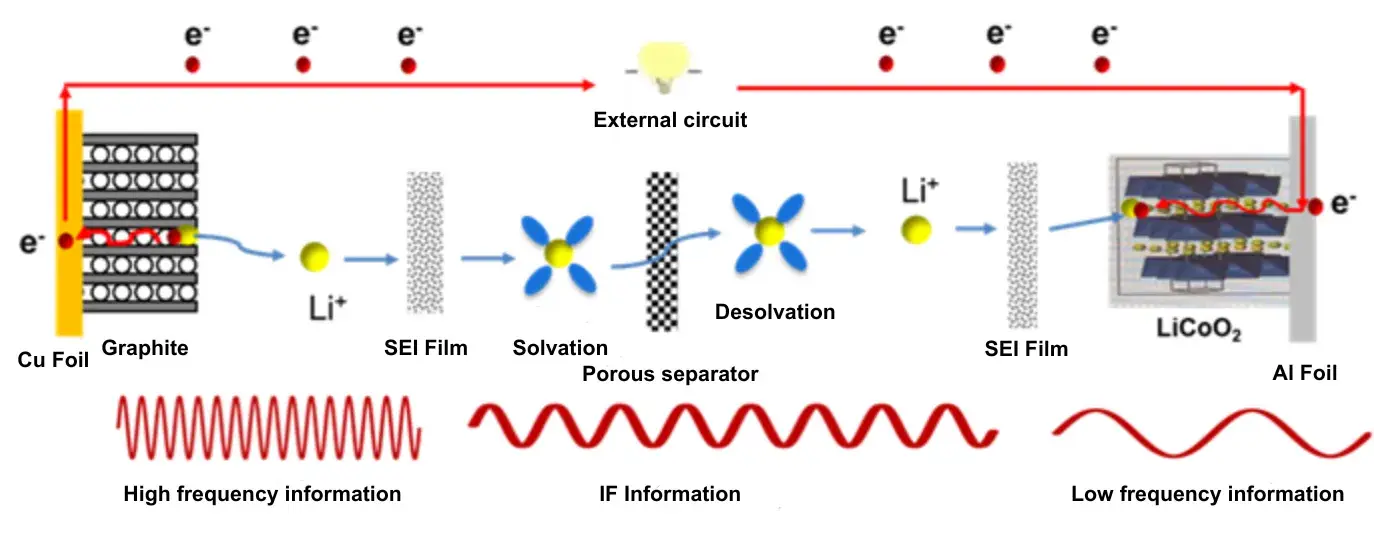
Figure 1. Electrochemical processes with different time constants — mapped to EIS frequency regions
By fitting Nyquist data to equivalent circuits and applying Distribution of Relaxation Times (DRT) analysis, EIS diagnostic testing converts semicircles and Warburg slopes into meaningful parameters such as RSEI (SEI resistance) and Rct (charge transfer resistance). These electrochemical “fingerprints” enable targeted battery failure analysis — for example, identifying when a widening mid-frequency semicircle signals active material degradation, or when a diffusion-limited slope indicates graphite layer collapse.
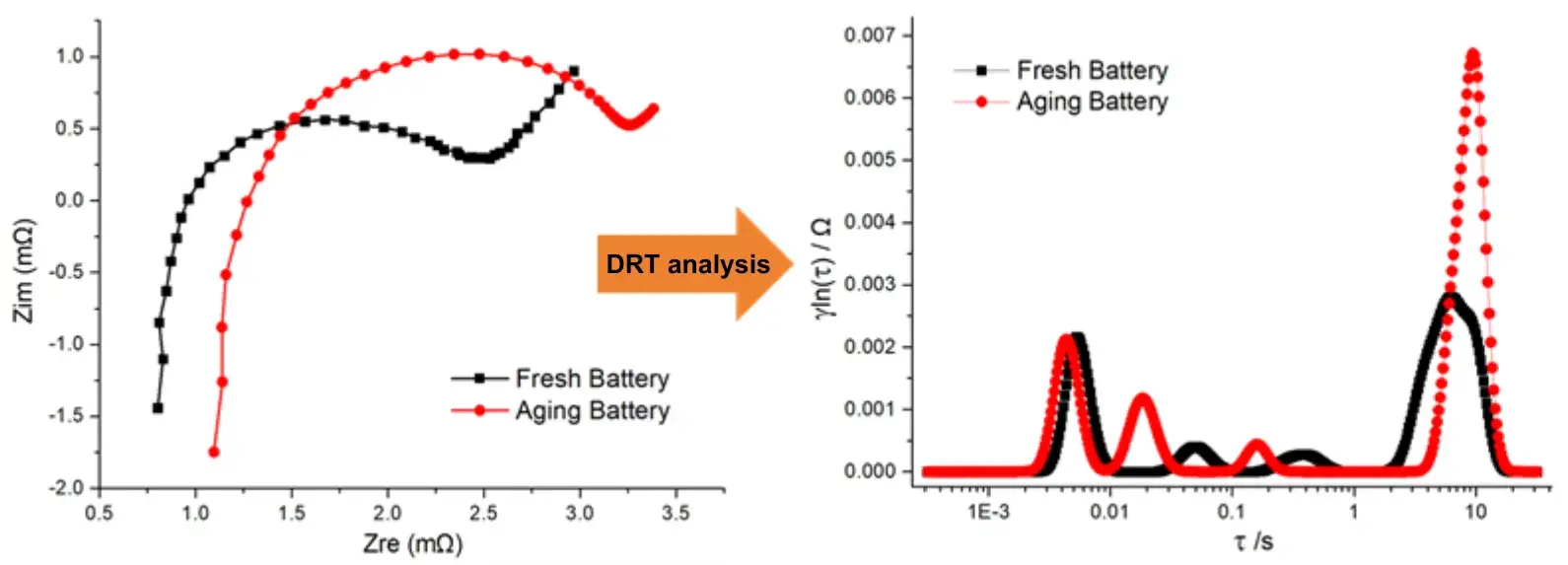
Figure 2. Distribution of Relaxation Times (DRT) Analysis — separating overlapping EIS processes.
| Frequency Region | EIS Feature | Failure Mode Indicated | Equivalent Circuit Element |
|---|---|---|---|
| Ultrahigh (>10 kHz) | Real-axis intercept (ohmic resistance RΩ) | Electrolyte depletion; current collector corrosion; connection resistance increase | RS |
| High (100–10,000 Hz) | First semicircle (SEI resistance) | SEI layer thickening; interfacial film growth; poor tab welding; electrode delamination | RSEI ‖ CSEI |
| Mid (10–1,000 Hz) | Second semicircle (charge transfer resistance) | Active material degradation; electrolyte depletion at interface; surface passivation; lithium plating | Rct ‖ Cdl |
| Low (0.01–10 Hz) | 45° Warburg slope | Lithium-ion diffusion blockage; graphite layer collapse; pore structure clogging; electrode cracking | Zw (Warburg) |
3. Battery Cell Failure Analysis: Common EIS Signatures
Battery cell failure analysis using EIS testing identifies characteristic impedance signatures that distinguish between different failure mechanisms at the single-cell level. Understanding these signatures is essential for triage decisions — whether to replace cells, adjust operating protocols, or escalate to post-mortem analysis. The table below summarizes the most diagnostically significant EIS patterns for common lithium-ion cell failure modes:
| Failure Mode | Primary EIS Signature | Affected Parameter | Typical Cause |
|---|---|---|---|
| SEI growth / thickening | Expanding high-frequency semicircle | RSEI increase | Overcharge, high temperature, electrolyte oxidation |
| Lithium plating / dendrite | Asymmetric mid-frequency semicircle; inductive loop at low frequency | Rct distortion | Fast charging, low temperature, high SOC |
| Active material loss | Increasing mid-frequency semicircle diameter | Rct increase | Particle cracking, structural collapse, cycling fatigue |
| Graphite layer collapse | Steepening low-frequency Warburg slope | Zw increase | Mechanical stress, deep cycling, co-intercalation |
| Electrolyte depletion | Rising real-axis intercept (Rs); all semicircles shift right | Rs increase | Gas evolution, electrolyte oxidation, seal failure |
| Poor tab welding / contact defect | Elevated Rs; asymmetric contact impedance at ultrahigh frequency | Rs + contact resistance | Manufacturing defect, mechanical stress on terminals |
4. From Laboratory to Industrial Application: Overcoming EIS Implementation Barriers
Despite extensive research (10,000+ publications on EIS battery testing), industrial implementation has historically faced two significant barriers:
- Equipment limitations: traditional potentiostats were designed for small laboratory cells and cannot handle the current levels required for large-capacity battery cells (>100 Ah) used in EV packs and grid storage systems.
- Data complexity: impedance spectra interpretation requires specialized electrochemistry expertise — a skill set typically unavailable to production-line quality engineers who need rapid pass/fail decisions.
The IEST BIT6000 series industrial-grade EIS battery testing system has overcome these barriers through three key technical developments:
- High-current EIS capability: extends the test current range to accommodate EIS testing of large-capacity cells (>100 Ah) — directly enabling battery cell failure analysis on production-format cells without modification or scaling.
- Multi-frequency superposition (composite excitation): applies multiple frequencies simultaneously rather than sequentially, compressing EIS acquisition time by more than 50% — critical for production-line throughput.
- Integrated AI data processing: machine learning algorithms trained on large impedance spectrum databases perform automated DRT analysis, equivalent circuit fitting, and fault classification — enabling production engineers to obtain actionable failure diagnoses without electrochemistry expertise.
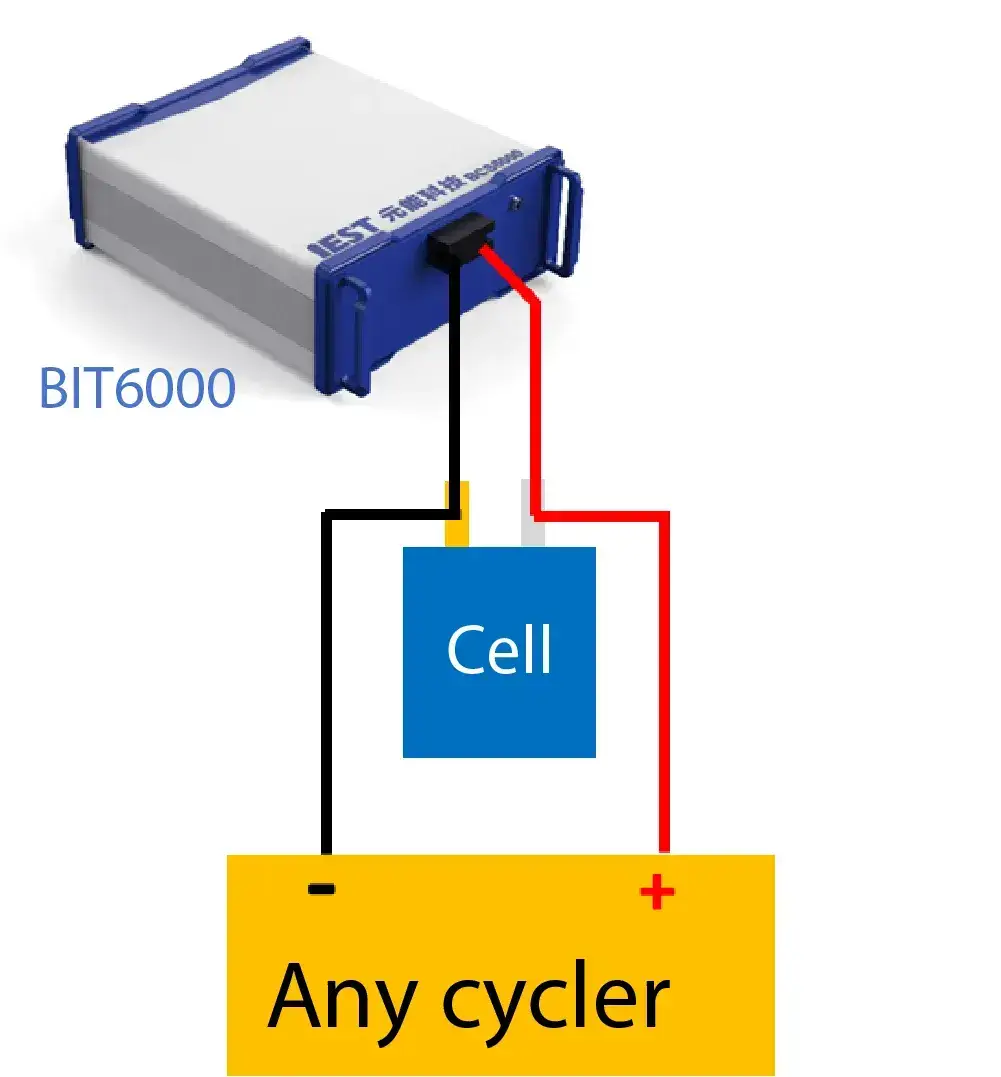
Fgiure 3. IEST BIT6000 series industrial-grade EIS battery testing system
5. EIS+ Integrated Diagnostic Approaches for Comprehensive Battery Failure Analysis
Advanced EIS battery testing now integrates with complementary characterization techniques, creating multi-modal diagnostic workflows that resolve failure mechanisms beyond the reach of impedance spectroscopy alone:
- EIS + in-situ XRD: simultaneously observes the correlation between impedance changes and crystal structure evolution in NMC cathode materials — directly linking Rct changes to phase transformations during cycling.
- EIS + ultrasonic scanning: localizes lithium deposition hot spots inside cells through spatial mapping of acoustic impedance alongside electrical impedance — enabling three-dimensional battery failure analysis without destructive cross-sectioning.
- EIS + AI/machine learning: AI models trained on million-spectrum impedance databases predict remaining useful life (SOH) with error <3% and classify failure modes automatically — transforming EIS testing from a diagnostic measurement into a predictive maintenance tool.
5.1 EIS Testing in Electric Vehicle Battery Failure Analysis
Electric vehicle battery failure analysis presents unique EIS testing challenges: EV cells operate at high current densities and temperatures, undergo partial charge-discharge cycles rather than full cycles, and are mechanically constrained within module structures. EIS diagnostic testing for EV battery failure analysis typically focuses on three scenarios:
- Field return diagnosis: rapid EIS testing on returned cells to triage whether failure is due to SEI growth (overcharge/temperature abuse), lithium plating (fast charging at low temperature), or mechanical damage (Rs increase from connection deterioration) — enabling root cause determination without full disassembly.
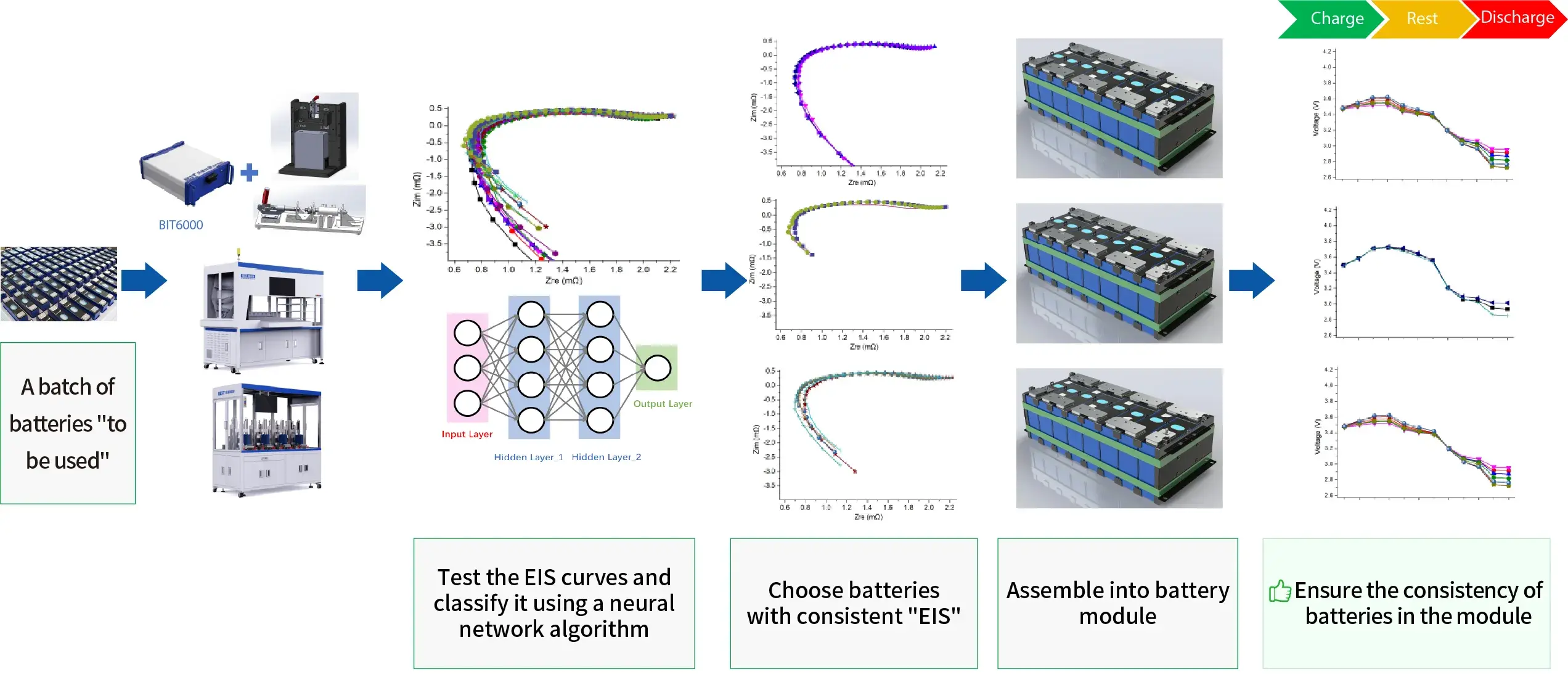
- Pack-level SOH assessment: multi-channel EIS screening of all cells in a returned pack identifies outliers — cells with Rct or RSEI significantly above the batch mean — for targeted replacement rather than whole-pack refurbishment.
- Thermal runaway precursor detection: abnormal impedance evolution patterns — particularly asymmetric Nyquist features or inductive loops indicating lithium plating — can be detected by EIS testing before thermal runaway initiation, enabling early intervention.
These technology combinations are building a “digital twin” framework for battery failure analysis, enabling simulation of failure evolution under different stress conditions and providing a theoretical foundation for preventive design — where failure mechanisms are identified and eliminated during development rather than diagnosed in the field.
6. Practical Implementation: EIS Testing Best Practices
- Standardize test conditions: always report cell state-of-charge (SOC), temperature, and rest time before EIS measurement — impedance parameters are highly sensitive to these variables, and non-standardized conditions make cross-batch battery failure analysis unreliable.
- Apply DRT alongside equivalent circuit fitting: avoid over-reliance on a single equivalent circuit topology. DRT visualization reveals overlapping processes that a simple Randles circuit misses — particularly important for differentiating SEI and charge transfer contributions when both RSEI and Rct increase simultaneously.
- Integrate EIS testing into production QC: use rapid EIS screening to triage cells before final assembly. Cells with Rct or Rs outside specification limits are identified non-destructively before they enter modules — reducing field failure rates.
- Build and maintain a labeled spectral database: annotated EIS spectra from known failure modes — with confirmed post-mortem validation — accelerate AI-driven diagnostics and improve fault classification accuracy over time.
7. Summary
Electrochemical impedance spectroscopy is evolving from an academic research tool into a robust industrial diagnostic system for battery failure analysis. As EIS battery testing scales into factories and field diagnostics, its non-destructive, multi-process insights — especially when enhanced with DRT analysis and AI-driven classification — provide the most comprehensive single-measurement assessment of lithium battery health available today.
Key principles for EIS diagnostic testing in battery failure analysis: (1) high-frequency impedance (>100 Hz) diagnoses SEI and contact defects; mid-frequency semicircle (10–1,000 Hz) quantifies charge transfer degradation; low-frequency Warburg (0.01–10 Hz) identifies diffusion limitations; (2) DRT analysis is required to separate overlapping contributions that merge into a single feature in simple Nyquist plots; (3) industrial EIS battery testing requires high-current capability (>100 A) for large-format cells, multi-frequency excitation for speed, and integrated AI for automated fault classification without specialist interpretation.
8. IEST BIT6000: Industrial EIS Battery Testing Equipment
IEST Instrument’s R&D team specializes in electrochemistry, materials science, and automation, with a portfolio of over 100 granted patents in battery testing technology. IEST battery testing instruments are deployed in power battery production testing, scientific research institutions, and universities across more than 45 countries and regions — including China, Europe, North America, and Southeast Asia — serving over 1300 global customers.
9. FAQ: EIS Testing for Battery Failure Analysis
9.1 What is battery failure analysis and how does EIS testing support it?
Battery failure analysis is the systematic identification of the electrochemical and mechanical mechanisms causing a lithium-ion cell to lose performance — including capacity fade, internal resistance rise, and thermal runaway. EIS (electrochemical impedance spectroscopy) battery testing supports failure analysis by measuring impedance across a frequency range of 0.01 Hz to 100 kHz, separating distinct degradation processes by their time constants. High-frequency data identifies contact resistance and SEI thickening; mid-frequency semicircles quantify charge transfer degradation; low-frequency slopes reveal diffusion limitations. Unlike destructive post-mortem methods, EIS battery testing performs this analysis non-destructively and can track failure evolution in real time across cycling.
9.2 How is EIS used for battery cell failure analysis at the single-cell level?
EIS battery cell failure analysis at the single-cell level identifies which specific degradation mechanism is responsible for performance loss, enabling targeted corrective action. The key EIS signatures are: an expanding high-frequency semicircle (RSEI increase) indicates SEI layer thickening from temperature abuse or overcharge; an increasing mid-frequency semicircle (Rct increase) signals active material degradation or lithium plating; a steepening low-frequency Warburg slope indicates graphite layer collapse or pore structure clogging; and an elevated real-axis intercept (Rs) points to electrolyte depletion or connection resistance increase. Distribution of Relaxation Times (DRT) analysis is typically applied alongside equivalent circuit fitting to separate overlapping contributions when multiple failure modes co-exist.
9.3 What is EIS testing and what does it measure?
EIS testing (electrochemical impedance spectroscopy testing) measures the electrical impedance of a battery or electrochemical system across a range of frequencies — typically 0.01 Hz to 100 kHz. A small-amplitude sinusoidal voltage (usually 5–10 mV) is applied at each frequency, and the current response is recorded. The ratio of voltage to current at each frequency gives the complex impedance Z(ω), which is plotted as a Nyquist plot (−ZIm vs. ZRe) or Bode plot. Different frequency regions correspond to different internal processes: the real-axis intercept gives ohmic resistance; semicircles represent SEI and charge transfer resistances; the 45° slope at low frequency represents Warburg diffusion. EIS testing is non-destructive and can be performed in situ during battery cycling.
9.4 What is EIS battery testing used for in production and R&D?
EIS battery testing serves different purposes in R&D versus production environments. In R&D, EIS testing is used to characterize new electrode materials and electrolytes, track aging mechanisms during cycle life studies, and validate the effectiveness of cell design changes. In production QC, EIS battery testing screens cells for manufacturing defects — including poor tab welding (elevated Rs), electrolyte under-filling (high Rct), and abnormal SEI formation — before module assembly. Industrial EIS battery testing systems require high-current capability for large-format cells (>100 Ah), fast multi-frequency acquisition for production throughput, and automated data analysis for non-specialist operators.
9.5 What are the main failure modes detected by EIS in lithium battery failure analysis?
Lithium battery failure analysis using EIS identifies six primary failure modes from the impedance spectrum: (1) SEI layer thickening — expanding RSEI from temperature abuse, overcharge, or electrolyte instability; (2) lithium plating and dendrite formation — asymmetric mid-frequency features or inductive loops at low frequency; (3) active material cracking and loss — progressive Rct increase with cycling; (4) graphite layer collapse — steepening Warburg slope indicating diffusion limitation; (5) electrolyte depletion — overall rightward shift of all impedance features as ionic resistance increases; (6) contact and tab defects — elevated Rs and asymmetric high-frequency response. DRT analysis separates overlapping contributions when multiple failure modes occur simultaneously.
9.6 How do I select an EIS tester for battery failure analysis?
Selecting an EIS tester for battery failure analysis requires matching five specifications to your application: (1) frequency range — 0.01 Hz to 100 kHz covers all relevant battery processes from SEI to diffusion; (2) current capability — small laboratory cells (<5 Ah) require µA to mA ranges; production-format EV cells (>100 Ah) require high-current EIS capability not available in standard potentiostats; (3) acquisition speed — multi-frequency superposition technology reduces acquisition time by >50% vs. sequential single-frequency methods, essential for production-line QC; (4) data analysis software — DRT capability, equivalent circuit fitting, and AI-driven fault classification reduce the specialist expertise required for results interpretation; (5) cell size compatibility — fixture design must accommodate the electrode geometry without introducing parasitic contact resistance. The IEST BIT6000 series is designed specifically for large-format battery cell failure analysis in production and field diagnostic environments.