-
iestinstrument

Abstract
External pressure exerts a non-linear effect on battery cycle life in silicon-carbon anode cells: moderate compression reduces capacity fading by improving interfacial contact, while excessive pressure accelerates degradation by restricting Li+ transport pathways. In-situ swelling analysis using the IEST SWE2110 on LCO/silicon-carbon pouch cells across six pressure levels (5–200 kg) identified a 50–100 kg optimal pressure window that minimized both irreversible thickness expansion and capacity fade rate. Outside this range, insufficient contact at low pressure accelerates electrode delamination, while over-constraint at high pressure increases porosity-dependent concentration polarization.
1. How Does External Pressure Affect Silicon-Carbon Anode Cycle Life?
Lithium-ion battery charge-discharge cycling involves complex physicochemical reactions influenced by both intrinsic cell properties — material chemistry, electrode design, manufacturing parameters — and external mechanical conditions. For cells containing silicon-carbon anode materials, the mechanical boundary condition is particularly significant because silicon’s high volumetric strain (~300% during lithiation) makes the electrode stack’s mechanical response a first-order factor in battery cycle life determination.
The practical question for module and pack engineers is: given a specific cell chemistry, what external pressure window minimizes capacity fading while preserving structural and electrochemical stability? The study presented here addresses this question for a commercial LCO/silicon-carbon pouch cell across a six-level pressure sweep from 5 kg to 200 kg.
The charge-discharge cycling of lithium-ion batteries involves complex physicochemical reactions, with battery cycle life influenced by numerous factors. These include intrinsic cell properties—such as material characteristics, electrode design, and manufacturing processes—as well as external conditions during use. Our goal is to identify a practical external-pressure window that minimizes capacity fading while preserving mechanical and electrochemical stability for longer battery cycle life. The findings offer practical guidance for both cell usage and module/pack design, particularly for systems utilizing high-expansion electrodes.
2. Experimental Setup: SWE2110 In-Situ Swelling Analysis
2.1 Equipment
The IEST SWE2110 In-situ Swelling Analyzer (Figure 1) was used to apply controlled constant external pressure while simultaneously monitoring cell thickness variation, temperature, current, voltage, and capacity. The system employs a high-precision servo motor with adaptive feedback control to maintain constant force throughout the charge-discharge cycle.
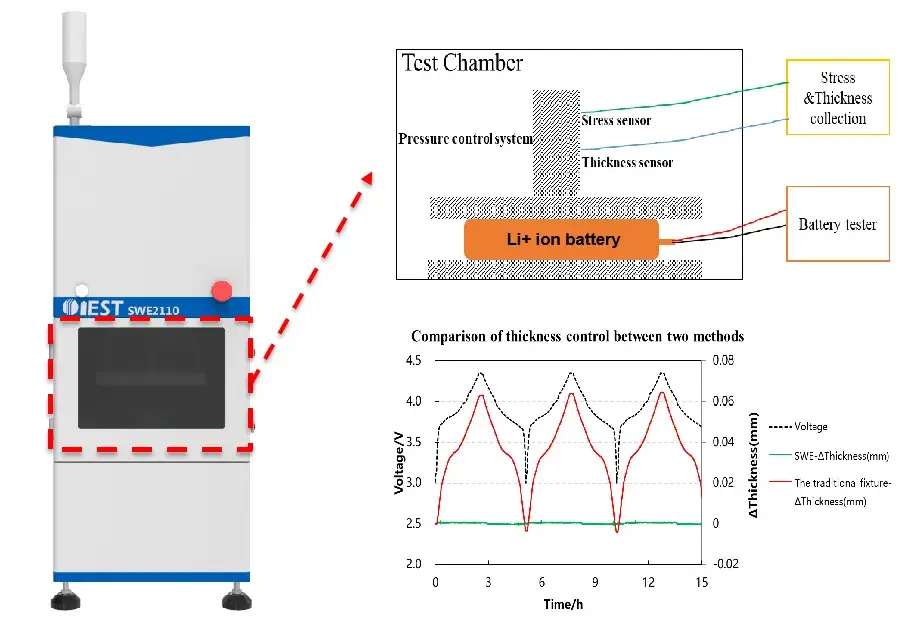
Figure 1. IEST SWE2110 in-situ swelling analyzer.
2.2 Test Cell and Procedure
A commercial LCO/silicon-carbon anode pouch cell was tested (specifications in Table 1). The cell was placed in the SWE2110, and constant pressures of 5.0, 10, 25, 50, 100, and 200 kg were sequentially applied. Each pressure level was held for one hour before initiating a standard 0.5C charge-discharge cycle (protocol shown in Table 2).
| Item | Parameter |
|---|---|
| Nominal capacity | 1500 mAh |
| Cathode material | LCO |
| Anode material | Si/C |
| Size | 60 mm × 90 mm |
| No. | Step | Stop Condition | Sampling Frequency |
|---|---|---|---|
| 1 | Rest | 60 min | 10 s |
| 2 | 0.5C CC | Cut-off Voltage 4.2 V | 10 s |
| 3 | 4.2V CV | Cut-off Current 0.05C | 10 s |
| 4 | Rest | 20 min | 10 s |
| 5 | 0.5C DC | Cut-off Voltage 2.75 V | 10 s |
3. Results: Pressure-Dependent Thickness Evolution and Irreversible Expansion
Under constant pressure mode, the SWE2110 tracked real-time thickness changes throughout each cycle at each pressure level. The cell exhibited charge-induced expansion and discharge-induced contraction — characteristic of reversible volume changes in the silicon-carbon anode during lithiation and delithiation (Figure 2).
A critical observation: the cell’s maximum expansion per cycle continuously increased under each fixed pressure, indicating cumulative irreversible expansion. This permanent thickness gain — calculated from the difference between initial charge thickness and final discharge thickness per cycle — arises from mechanical and electrochemical degradation, primarily anode particle cracking and continuous SEI layer growth in the silicon-carbon composite.
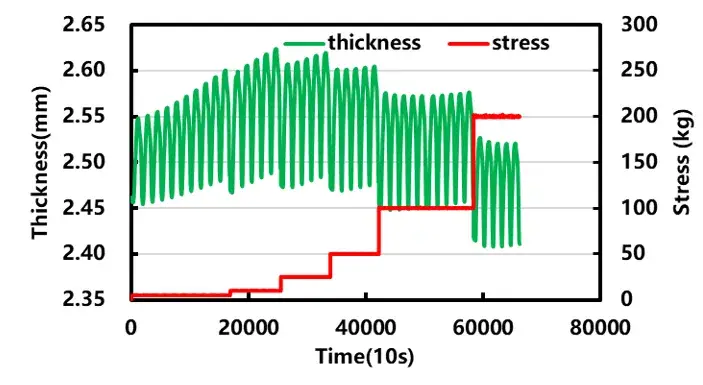
Figure 2. Thickness variation curves under six external pressure levels (5–200 kg).
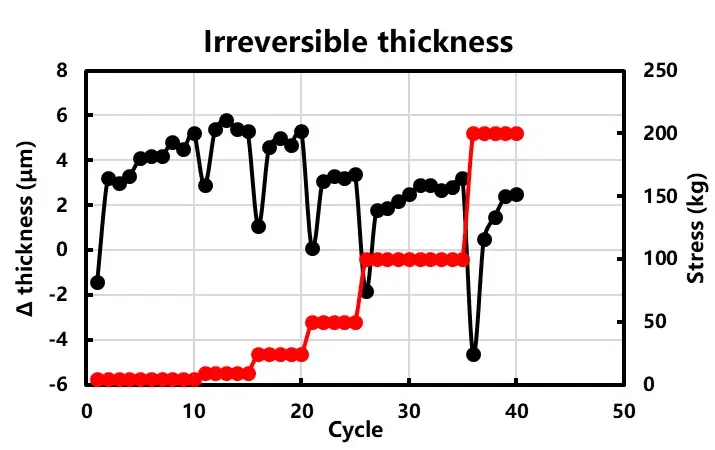
Figure 3. Irreversible thickness variation as a function of applied external pressure.
4. Identifying the Optimal External Pressure for Minimizing Capacity Fading
Appropriate external stress can increase interfacial contact, reduce the loss of active lithium during cycling, and slow down the decay of battery capacity. At the same time, the positive and negative electrodes and the diaphragm of lithium-ion batteries are porous structures, and with the increase of pressure, the porosity of the electrodes and the diaphragm, as well as the tortuosity and other parameters will be changed to affect the diffusion of Li+, from causing the capacity fading[1].
To quantify the effect of external pressure on silicon-carbon battery cycle life, the discharge capacity at each pressure level was plotted against cycle number and fitted linearly (Figure 4). The slope of each linear fit represents the capacity fading rate at that pressure.
The results confirm a non-monotonic relationship: the capacity fade rate first decreases and then increases with rising pressure. The minimum capacity fading occurred within the 50–100 kg external pressure window, which is consistent with the irreversible expansion data (Figure 3). Below 50 kg, insufficient mechanical constraint permits electrode delamination and uneven SEI growth. Above 100 kg, over-compression restricts Li+ transport through the porous electrode and separator structure.
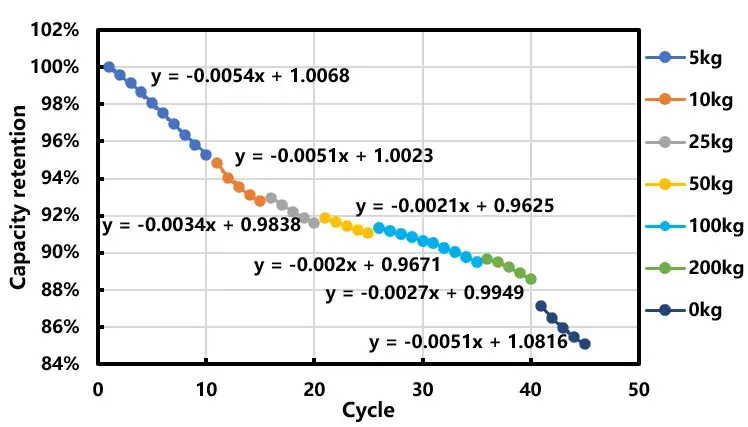
Figure 4. Capacity decay curves under six external pressure levels — minimum fade rate observed at 50–100 kg.
Silicon-carbon battery cycle life optimization therefore requires identifying a pressure window — not a single value — that balances interfacial contact improvement against transport pathway restriction. The width of this window depends on cell chemistry, electrode porosity, and separator properties, but the experimental protocol demonstrated here provides a generalizable methodology applicable to any cell format.
5. Mechanistic Interpretation: Why Moderate Pressure Preserves Cycle Life
The measured trends align with established degradation pathways in silicon-containing anodes:
- Improved interfacial contact under moderate pressure (50–100 kg) reduces local current hotspots and contact resistance, limiting mechanical delamination and uneven SEI growth — both primary drivers of irreversible expansion and capacity fading.
- Excessive compression (>100 kg) reduces electrode and separator porosity and increases tortuosity, slowing Li+ diffusion and exacerbating concentration polarization, which in turn accelerates silicon carbon battery cycle life degradation.
- Insufficient constraint (<50 kg) permits anisotropic expansion of the silicon-carbon composite, increasing particle-to-particle contact loss and creating paths for continued SEI growth and electrolyte consumption.
6. Practical Implications for Silicon-Carbon Anode Module and Pack Design
For engineers and scientists working on silicon-carbon anode formulations and pack designs, the data imply the following actionable points:
-
Target the 50–100 kg optimal pressure window for LCO/silicon-carbon pouch cells of similar format and capacity. This range produced the lowest capacity fade rate and the smallest irreversible swelling.
-
Avoid over-constraining cells during module assembly. Excessive compression may not manifest immediately in capacity loss but accumulates as transport-limited degradation over extended cycling.
-
Combine mechanical optimization with materials strategies — engineered binders, graded porosity electrodes, and compliant current-collector interfaces — to address both mechanical and chemical contributors to silicon carbon battery degradation.
- Validate the optimal pressure window with long-term cycling data. The non-monotonic relationship between pressure and fade rate implies that small assembly errors (e.g., ±10 kg variance across cells in a module) can shift cells into suboptimal mechanical conditions.
7. Summary
External static compressive stress exerts a significant, non-linear influence on silicon-carbon anode cycle life. Using the IEST SWE2110 in-situ swelling analyzer, a 50–100 kg optimal external pressure window was identified for LCO/silicon-carbon pouch cells — producing the lowest measured capacity fading rates and minimal irreversible thickness expansion. This approach provides a tangible, instrument-driven strategy for improving battery cycle life in systems utilizing high-expansion silicon-based anodes, with direct applicability to module and pack design.
8. References
[1] A.S. Mussa,M. Klett,G. Lindbergh, and R.W. Lindstrom, Effects of external pressure on the performance and ageing of single-layer lithium-ion pouch cells. J. Power Sources 385 (2018) 18-26.
[2] D.J. Li, D.L. Danilov, J. Xie, L. Raijmakers, L. Gao, Y. Yang and P.H.L. Notten, Degradation Mechanisms of C6/LiFePO4 Batteries: Experimental Analyses of Calendar Aging. Electrochim. Acta 190 (2016) 1124-1133.
9. FAQs
9.1 How does external pressure affect silicon-carbon anode battery cycle life?
External pressure has a non-monotonic effect. Moderate pressure (50–100 kg for the LCO/Si-C pouch cell tested) improves interfacial contact and reduces capacity fading. Insufficient pressure permits delamination; excessive pressure restricts Li+ transport and accelerates degradation.
9.2 What is the optimal external pressure for minimizing capacity fading in silicon-carbon cells?
For the LCO/silicon-carbon pouch cell tested, the optimal pressure window was 50–100 kg, producing the lowest measured capacity fade rate. Outside this range — below 50 kg or above 100 kg — capacity fading accelerates due to poor interfacial contact (low pressure) or restricted ion transport (high pressure).
9.3 What causes irreversible expansion in silicon-carbon anodes during cycling?
Irreversible expansion arises from cumulative mechanical and electrochemical degradation: silicon particle cracking, continuous SEI layer growth and reorganization, and plastic deformation of the electrode stack. External pressure modulates the rate of these processes, with moderate pressure suppressing crack propagation and uneven SEI growth.
9.4 How is in-situ swelling analysis used to evaluate battery cycle life?
In-situ swelling analysis — using instruments such as the IEST SWE2110 — applies controlled external pressure while monitoring real-time thickness changes during charge-discharge cycling. By tracking irreversible thickness growth as a function of applied pressure, the optimal mechanical boundary condition for maximizing cycle life can be identified experimentally.
9.5 What is the typical cycle life of a silicon-carbon battery?
Silicon-carbon battery cycle life depends on silicon content, anode architecture, binder chemistry, and mechanical boundary conditions. While specific cycle counts vary across cell designs, the primary degradation mechanisms — particle fracture, SEI growth, and contact loss — can be mitigated through a combination of optimized external pressure and materials engineering strategies.