-
iestinstrument

Abstract
Battery electrolyte viscosity—the resistance of a liquid electrolyte to flow—is the primary physical parameter controlling capillary wettability of electrode sheets during lithium-ion cell manufacturing. Lower electrolyte viscosity accelerates infiltration of the electrode pore network, reducing dry spots and improving wetting uniformity during cell filling. Electrolyte viscosity is jointly determined by the battery solvent and the dissolved lithium salt: solvents with higher viscosity wet electrodes more slowly, and adding lithium salts (e.g., 1 M LiPF₆) increases viscosity and further slows infiltration. This study uses the IEST EWS1100 Electrolyte Wetting System to quantify capillary infiltration for four pure battery solvents (PC, DEC, EMC, DMC) and four LiPF₆-based electrolyte formulas (L01–L04) on identical negative electrode sheets. Results confirm a wettability rank of PC < DEC < EMC < DMC for pure solvents and L01 < L04 < L02 < L03 for the four electrolyte formulas, directly reflecting their relative viscosities. Adding 1 M LiPF₆ to DMC reduces infiltration from ~100% in 20 s (pure DMC) to only 34.8% in 50 s (L03), demonstrating the substantial viscosity penalty of salt addition.
1. Background: Electrolyte Viscosity, Battery Solvents, and Cell Performance
Electrolytes for lithium-ion batteries are organic solvent mixtures that dissolve lithium salts to form conductive ions. Electrolyte solvent selection and salt concentration directly determine ionic conductivity, battery electrolyte viscosity, wettability, and ultimately cell performance. Figure 1 provides an overview of electrolyte research scope and cost structure: solvents represent approximately 85% of electrolyte mass and ~30% of electrolyte cost; the electrolyte itself accounts for roughly 6–8% of a power battery’s total cost. Since power batteries represent ~40% of a new energy vehicle’s cost, solvent choices have measurable downstream economic consequences.
Current electrolyte systems use a “mixed solvent” approach in which ~95% of the solvent volume is carbonate-based. Cyclic carbonates—ethylene carbonate (EC) and propylene carbonate (PC)—provide high dielectric constants for lithium salt dissociation. Chain carbonates—dimethyl carbonate (DMC), diethyl carbonate (DEC), and ethyl methyl carbonate (EMC)—contribute low viscosity to improve ionic mobility and electrode wetting. Lithium hexafluorophosphate (LiPF₆) is the dominant lithium salt in commercial cells, but its dissolution substantially increases salt battery viscosity relative to pure solvents, creating a formulation trade-off between ionic conductivity and wettability.
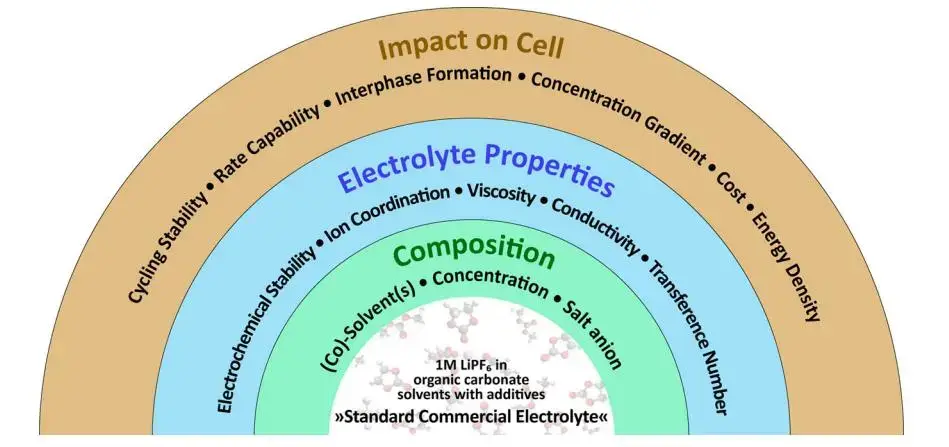
Figure 1. Overview of electrolyte research scope and cost breakdown — solvents represent ~85% of electrolyte mass and ~30% of electrolyte cost in lithium-ion batteries
This study uses the IEST Electrolyte Wetting System (EWS1100) to quantify how different battery solvents and lithium salt concentrations affect capillary wettability at the electrode level, providing a reproducible screening method for electrolyte formulation and cell filling process development.
2. Objective and Test Overview
This work evaluates the effect of salt battery viscosity and battery electrolyte viscosity on electrode wetting using a capillary infiltration method. Four pure solvents (PC, DEC, DMC, EMC) and four electrolyte formulas (L01–L04, each containing 1 M LiPF₆) are compared on identical negative electrode sheets at controlled compaction density. The objective is to provide a reproducible test solution for screening solvent/salt systems and to guide electrolyte formulation and cell filling process optimization.
3. Experimental Equipment and Testing Methods
3.1 Instrument
Testing was performed with the IEST Electrolyte Wetting Testing System (EWS1100). The EWS1100 automates capillary suction, monitors liquid level via machine vision, and records dynamic infiltration volume in real time—eliminating the operator variability inherent in manual contact-angle or weight-gain methods.
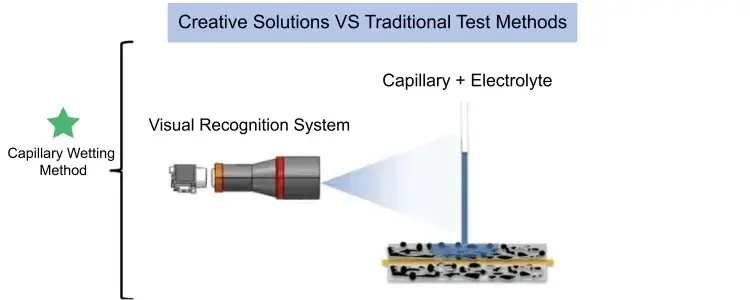
Figure 2. IEST EWS1100 Electrolyte Wetting Testing System — automated capillary level monitoring with machine vision for real-time electrolyte wetting quantification
3.2 Sample Preparation
-
Solvents tested: PC, DEC, DMC, EMC (physical properties summarized in Table 1).
-
Electrolytes: four solvent blends (L01–L04) each containing 1 M LiPF₆ (formulations in Table 3).
-
Electrode: same anode electrode sheet, with controlled compaction density.
3.3 Test Procedure (Automated)
-
Sample pretreatment and standardized fixation.
-
Software parameter setup.
-
Automatic capillary suction and capillary pressure test.
-
Real-time visual monitoring of capillary liquid level.
-
Data collection, normalization, and export.
3.4 Test Principle
The EWS1100 can quantitatively evaluate the difference in infiltration of electrolyte between different positive and negative electrode plates and separators, providing an effective method for electrolyte infiltration evaluation. Figure 3 is a schematic diagram of the test principle of the capillary infiltration method. The capillary glass tube is in contact with the surface of the pole piece, and electrolyte is injected into the capillary. As the electrolyte continues to infiltrate the coating, the capillary liquid level continues to decrease. The visual recognition system records the liquid level height of the capillary in real time. The dynamic evolution process of the liquid level is the real-time process of electrolyte infiltration. The height change is the amount of electrolyte infiltration.
Figure 3. Capillary infiltration test principle — the EWS1100 tracks liquid level drop in a 10 µL capillary as electrolyte infiltrates the electrode surface; faster drop indicates lower viscosity and better wettability
4. Results — How Battery Solvent Viscosity Governs Electrode Wetting
Lithium-ion battery solvents generally use organic solvents with high dielectric constant and small viscosity. The higher the dielectric constant, the easier it is for lithium salts to dissolve and dissociate; the lower the viscosity, the faster the ions move. However, solvents with high dielectric constants usually have high viscosity, and solvents with low viscosity have low dielectric constants. Therefore, in practical applications, multiple solvents are usually mixed to obtain the optimal electrolyte system. Compared with the study of mixed systems, the performance evaluation of a single system is the basis for systematic research and development of electrolytes. In this experiment, four solvents with different properties (for example, Table 1 shows the physical property indicators of the four solvents) were first selected to conduct capillary infiltration characterization at the pole piece level to evaluate the infiltration differences of different solvents under this method.
| Solvent | Melting Point (°C) | Boiling Point (°C) | Viscosity (cP) | Permittivity (25°C) | Density (g/cm³) (25°C) |
|---|---|---|---|---|---|
| PC | -48.8 | 242 | 2.53 | 64.92 | 1.200 |
| DEC | -74.3 | 126 | 0.75 | 2.805 | 0.969 |
| EMC | -53 | 110 | 0.65 | 2.958 | 1.006 |
| DMC | 4.6 | 91 | 0.59 (20°C) | 3.107 | 1.063 |
Using the EWS1100 with a 10 µL capillary, normalized infiltration data were recorded for each pure solvent on the same negative electrode sheet. Table 2 and Figure 4 present the results.
| Sample Name | 10μl Capillary-10g Stress-Infiltration Results (mm) | ||||||
|---|---|---|---|---|---|---|---|
| Initial Liquid Level | Liquid Level Height-10s | Liquid Level Height-20s | Liquid Level Height-40s | Infiltration Amount-10s | Infiltration Amount-20s | Infiltration Amount-40s | |
| PC | 7 | 6.533 | 6.186 | 5.500 | 0.467 | 0.814 | 1.500 |
| DEC | 5.802 | 4.718 | 2.417 | 1.198 | 2.282 | 4.583 | |
| EMC | 5.494 | 4.073 | 1.171 | 1.506 | 2.927 | 5.829 | |
| DMC | 5.182 | 3.262 | 0.000 | 1.818 | 3.738 | / | |
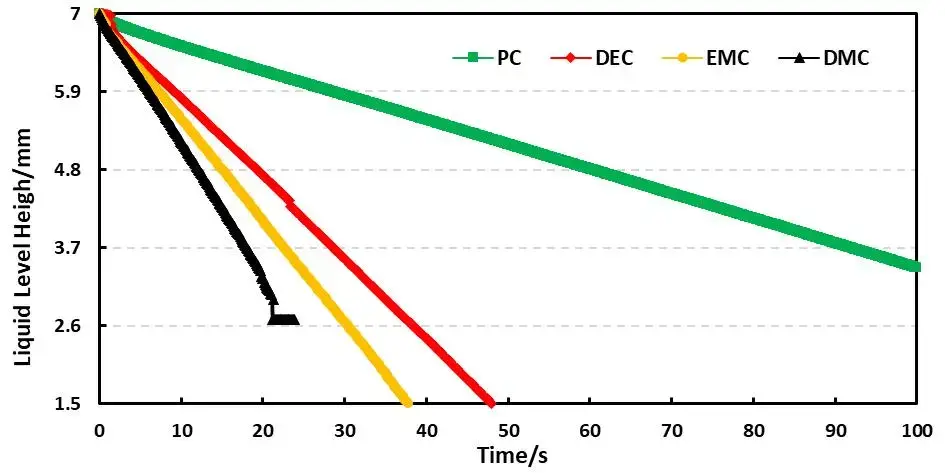
Figure 4. Capillary wetting curves for PC, DEC, EMC, and DMC on identical negative electrode sheets — DMC achieves complete infiltration in ~20 s; rank PC < DEC < EMC < DMC mirrors the inverse viscosity relationship
DMC completed full infiltration of the 10 µL capillary in approximately 20 seconds. Both 10 s and 20 s infiltration volumes confirm the rank PC < DEC < EMC < DMC, directly reflecting each solvent’s viscosity. This confirms that, for pure-solvent infiltration, battery solvent viscosity is the dominant factor controlling capillary wettability at the electrode level—outweighing the dielectric constant effect, which governs salt dissociation rather than wetting kinetics.
Practical implication: Lowering electrolyte viscosity—by choosing lower-viscosity battery solvents or by raising injection temperature during cell filling—improves infiltration speed and uniformity, reducing the risk of dry zones and non-uniform wetting that harm cycle life.
5. Results — Effect of Lithium Salt on Electrolyte Viscosity and Wetting
The electrolyte lithium salt is the basis for the conduction of lithium ions. A suitable lithium salt must have good thermal stability and not easy to decompose, high ion conductivity, good chemical and electrochemical stability, and low cost; Although there are many types of lithium salts, those suitable for lithium-ion batteries are very limited. Currently, lithium salts commonly used in laboratories and industrial production generally choose lithium salts with larger anion radius and stable oxidation and reduction, among them, lithium hexafluorophosphate (LiPF6) is currently the most used lithium salt in lithium-ion batteries. This experiment combines different solvents to carry out electrolyte ratios with a fixed lithium salt concentration, and prepares electrolytes with four ratios as shown in Table 3. The main components are based on PC, EMC, DMC and DEC with the addition of 1M LiPF6 , combined with these four electrolytes, the wettability test under the capillary principle was performed.
| Sample | Lithium salt concentration | Solvent |
|---|---|---|
| L01 | 1M LiPF6 | PC |
| L02 | 1M LiPF6 | EMC |
| L03 | 1M LiPF6 | DMC |
| L04 | 1M LiPF6 | DEC |
| Sample Name | 10μl Capillary-10g Stress-Infiltration Results (mm) | ||||||
|---|---|---|---|---|---|---|---|
| Initial Liquid Level | Liquid Level Height-50s | Liquid Level Height-60s | Liquid Level Height-100s | Infiltration Amount-50s | Infiltration Amount-60s | Infiltration Amount-100s | |
| L01 | 8 | 6.749 | 6.546 | 5.765 | 1.251 | 1.454 | 2.235 |
| L02 | 5.922 | 5.488 | 3.486 | 2.078 | 2.512 | 4.514 | |
| L03 | 5.215 | 4.738 | 2.792 | 2.785 | 3.262 | 5.208 | |
| L04 | 6.330 | 5.963 | 4.305 | 1.670 | 2.037 | 3.695 | |
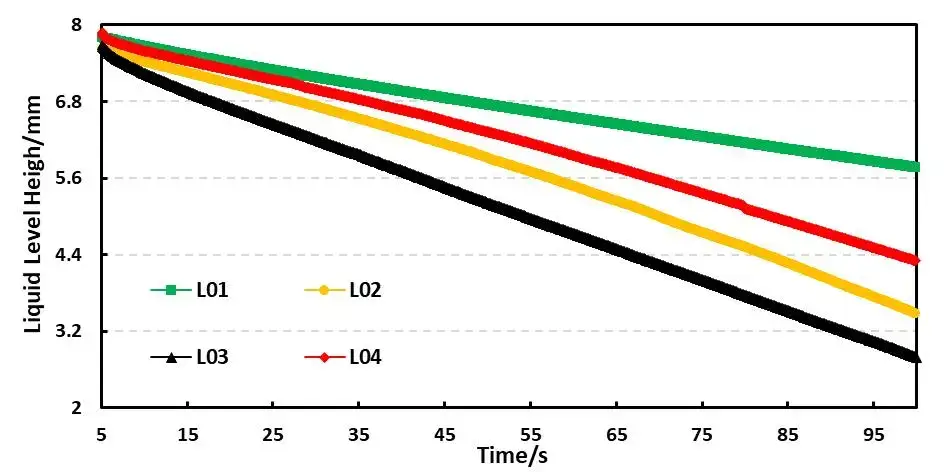
Figure 5. Capillary wetting curves for L01–L04 (1 M LiPF₆) — salt addition raises viscosity; rank: L01 < L04 < L02 < L03
For example, Table 4 shows the comparison results of the infiltration amount data of four electrolyte systems based on different solvent ratios. Figure 5 shows the comparison curves of capillary infiltration of different electrolytes. From the curve slope, there are obvious differences in the infiltration conditions of the four electrolytes; From the infiltration amount table, the infiltration trend L01<L04<L02<L03 can be further clarified. This order mirrors the pure solvent rank but with uniformly slower kinetics after salt addition. Thus, salt battery viscosity (viscosity after lithium salt dissolution) is a key metric when choosing practical electrolyte formulas. Comparing DMC with L03 with 1M lithium salt added to it, DMC completed all the initial liquid infiltration in about 20 seconds, while L03 only completed 34.8% of the initial liquid volume in 50 seconds (infiltration volume in 50 seconds/initial liquid level height) ); this result mainly considers that the addition of lithium salt to the solvent increases the viscosity of the liquid, and the change in viscosity directly leads to the decrease in the wettability of the electrolyte.
6. Discussion — Why Electrolyte Viscosity Matters for Cell Manufacturing
-
Filling efficiency and homogeneity: Higher battery electrolyte viscosity slows capillary infiltration during cell filling, increasing the risk of dry spots, gas entrapment, and non-uniform wetting. These defects reduce capacity, increase impedance, and accelerate degradation over the cell’s service life.
-
Ionic transport: While low viscosity improves ion mobility and wetting kinetics, the dielectric constant of the solvent mixture must still be sufficient to ensure complete LiPF₆ dissociation. This creates the fundamental compromise that drives mixed-solvent formulation design.
-
Temperature dependence: Raising filling temperature reduces electrolyte viscosity and accelerates infiltration—a standard practice in large-scale cell manufacturing. However, the usable temperature window is constrained by solvent volatility, material compatibility, and process safety.
-
Formulation trade-offs: Electrolyte additives (e.g., SEI-forming agents, flame retardants) and higher LiPF₆ concentration generally increase viscosity. An optimized balance between electrochemical stability and wettability must be established for each specific cell chemistry and filling process.
7. Practical Recommendations for Electrolyte Development and Cell Filling
- Measure salt battery viscosity directly — determine viscosity of each candidate electrolyte (including all additives and at target filling temperature) rather than estimating from pure-solvent data.
- Prefer lower-viscosity solvent blends compatible with required dielectric properties; chain carbonates (DMC, EMC) combined with cyclic carbonates (EC) provide practical viscosity/dielectric balance.
- Control filling temperature within safe operating limits to reduce viscosity during injection and improve electrolyte wetting uniformity.
- Screen electrolyte formulas early using capillary infiltration testing (e.g., EWS1100) before committing to cell prototyping — capillary rank order correlates directly with filling efficiency.
- Minimize additive loading to avoid excessive viscosity increases; compensate via solvent ratio adjustment if required dielectric properties are maintained.
8. Conclusion
Electrolyte solvent selection and lithium salt concentration jointly control battery electrolyte viscosity, which directly governs capillary wettability at the electrode level. Capillary infiltration tests with the EWS1100 show that (1) lower-viscosity solvents wet electrodes faster (pure DMC completes infiltration in ~20 s vs. much longer for PC), and (2) adding 1 M LiPF₆ substantially increases viscosity and reduces wettability across all four electrolyte formulas tested. For reliable cell manufacturing and peak performance, electrolyte developers should explicitly measure salt battery viscosity, use capillary wetting tests for formulation screening, and optimize solvent/salt ratios with the cell filling temperature and process window in mind.
9. References
[1] Sheng Y. Investigation of electrolyte wetting in lithium-ion batteries: Effects of electrode pore structures and solution[J]. Dissertations & Theses – Gradworks, 2015.
[2] Yao N, Yu L, Fu Z H, et al. Probing the origin of viscosity of liquid electrolytes for lithium batteries[J]. Angewandte Chemie International Edition, 2023: e202305331.
[3] Compiled by Zheng Honghe et al. Lithium-ion battery electrolytes. Beijing: Chemical Industry Press, 2007.01
[4] Weydanz W J , Reisenweber H , Gottschalk A ,et al.Visualization of electrolyte filling process and influence of vacuum during filling for hard case prismatic lithium-ion cells by neutron imaging to optimize the production process[J].Journal of Power Sources, 2018, 380(mar.15):126-134.DOI:10.1016/j.jpowsour.2018.01.081.
[5] Wu M S , Liao T L , Wang Y Y ,et al. Assessment of the Wettability of Porous Electrodes for Lithium-Ion Batteries[J]. Journal of Applied Electrochemistry, 2004, 34(8):797-805. DOI:10. 1023/B:JACH.0000035599.56679.15.
10. FAQs
10.1 What is electrolyte viscosity and why does it matter for lithium-ion batteries?
Electrolyte viscosity is the resistance of the liquid electrolyte to flow, measured in mPa·s at a given temperature. In lithium-ion batteries, it controls two critical processes. During manufacturing, lower electrolyte viscosity enables faster, more uniform infiltration of the electrode pore network during cell filling—reducing dry zones and gas entrapment that degrade capacity and cycle life. During operation, viscosity governs ion mobility: lower viscosity allows Li⁺ ions to diffuse more rapidly through the electrolyte, improving rate capability and power density. Battery electrolyte viscosity is set by the choice and ratio of battery solvents and by the dissolved lithium salt concentration; both must be optimized simultaneously for a given cell chemistry and manufacturing process.
10.2 What is the viscosity of common Li-ion battery solvents?
Among common carbonate battery solvents, DMC (dimethyl carbonate) has the lowest viscosity and the fastest electrode infiltration rate—completing full capillary infiltration of a 10 µL sample in approximately 20 seconds in this study. EMC (ethyl methyl carbonate) ranks second, followed by DEC (diethyl carbonate), with PC (propylene carbonate) having the highest viscosity and slowest infiltration. The wettability rank is PC < DEC < EMC < DMC. Li-ion viscosity increases substantially when lithium salts such as LiPF₆ are dissolved: even the lowest-viscosity formulas tested (L03, DMC-dominant with 1 M LiPF₆) achieved only 34.8% infiltration in 50 seconds compared with near-complete infiltration for pure DMC in 20 seconds.
10.3 What is the electrolyte in a lithium-ion battery?
The electrolyte in a lithium-ion battery is a lithium salt dissolved in an organic solvent mixture. The most common formulation uses LiPF₆ as the lithium salt at concentrations of 1–1.2 M, dissolved in a blend of cyclic carbonates (EC, PC—high dielectric constant, higher viscosity) and chain carbonates (DMC, EMC, DEC—low viscosity, lower dielectric constant). The solvent blend accounts for ~95% of the electrolyte volume and ~85% of its mass. Additives such as vinylene carbonate (VC) or fluoroethylene carbonate (FEC) are included at 1–5% to control SEI formation, but they typically increase viscosity and must be balanced against wettability requirements.
10.4 What solvents are used in lithium-ion battery electrolytes?
Lithium-ion battery electrolytes use carbonate solvents in mixed systems. Cyclic carbonates—ethylene carbonate (EC) and propylene carbonate (PC)—have high dielectric constants (89.6 and 64.9, respectively) that promote complete LiPF₆ dissociation, but their high viscosity limits electrode wetting. Chain carbonates —DMC, DEC, and EMC—have low viscosity, improving ion mobility and infiltration speed, but lower dielectric constants. Commercial electrolytes typically blend EC with one or two chain carbonates (e.g., EC/DMC, EC/EMC, or EC/DMC/EMC) to balance ionic conductivity, battery electrolyte viscosity, and electrochemical stability window. The exact ratios are cell-chemistry specific and must be validated by infiltration testing before scale-up.
10.5 How is electrolyte wetting measured in battery manufacturing?
Electrolyte wetting in battery electrode sheets is measured by the capillary infiltration method. An instrument such as the IEST EWS1100 places a small capillary tube (typically 10 µL) in contact with the electrode surface and monitors the liquid level drop as electrolyte infiltrates the porous coating. Machine vision records the level height in real time; the slope of the level-drop curve and the infiltration volume at defined time intervals (e.g., 10 s, 20 s, 50 s) quantify wettability. This method is more sensitive than contact-angle measurement for porous electrodes and more reproducible than weight-gain methods, because it measures dynamic infiltration under a fixed capillary pressure rather than relying on static contact angles that do not capture pore-filling kinetics.