-
iestinstrument

Abstract
1. Introduction: The Bottleneck in Mixing and Dispersion
Performance improvements in power batteries and all-solid-state batteries often hit a bottleneck in mixing processes — including slurry preparation, powder coating, and solid electrolyte manufacturing. The industry has long relied on stirring, ball milling, ultrasonic, and defoaming equipment. However, as high-solid-content slurries, carbon nanotube conductive agents, and sulfide solid electrolytes gradually enter industrialization, traditional mixing solutions that rely on local strong shear are increasingly exposing pain points: material stratification, nanoparticle agglomeration, impurity introduction from media, and lengthy processing cycles.
Acoustic resonance mixing technology breaks away from the inherent framework of contact-based mixing — such as impellers, grinding balls, and ultrasonic probes. By leveraging 60 Hz low-frequency resonance and up to 100g global acceleration, it builds a new multi-scale mixing system with a fundamentally different underlying mechanism, positioning itself as an important new process candidate for both R&D and mass production of lithium battery materials.
2. Inherent Limitations of Conventional Mixing and Dispersion Processes
In lithium battery slurry preparation, traditional processes such as planetary stirring, ultrasonic dispersion, and centrifugal defoaming are all constrained by their inherent energy application forms and spatial boundaries. They either rely on local contact shear or impact for dispersion — resulting in uneven energy distribution, mixing dead zones, local overheating, and impurity introduction from wear — or they can only perform a single function such as defoaming, without the ability to break down microscopic hard agglomerates, and are prone to inducing slurry sedimentation and stratification. It is difficult for conventional equipment to simultaneously balance multiple mutually constraining process objectives — global homogenization, gentle powder deagglomeration, bubble removal, system temperature control, and low impurity contamination — in a single process.
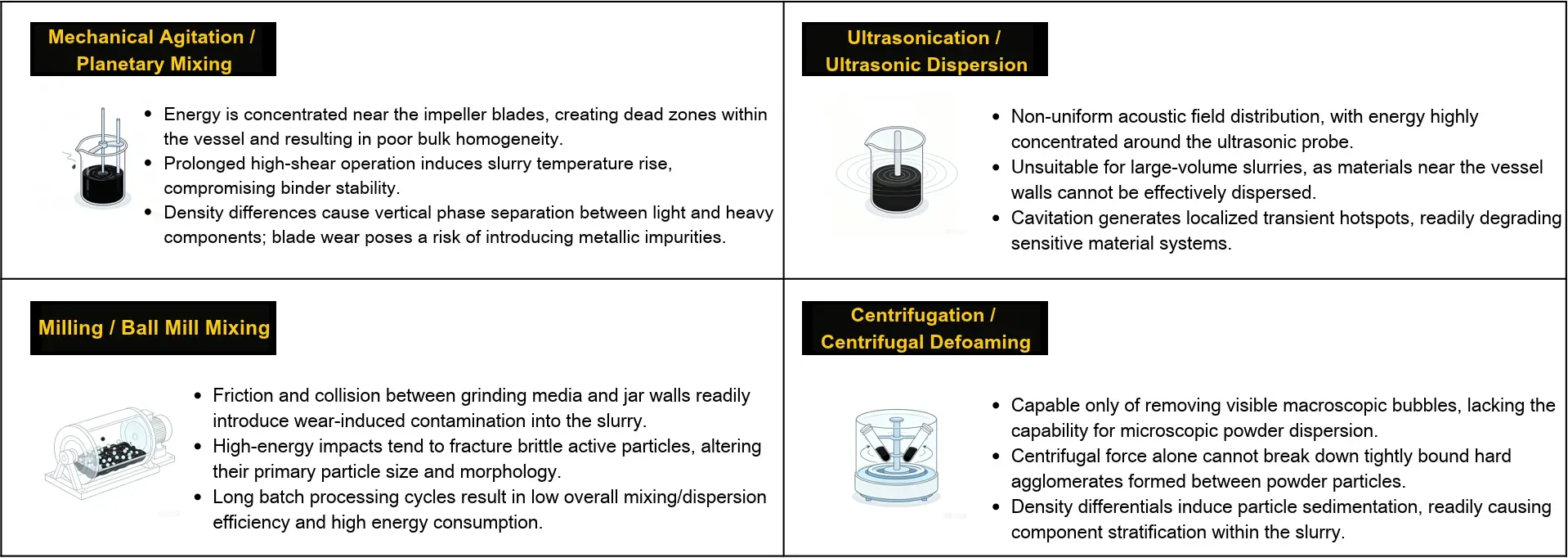
Figure 1. Inherent Limitations of Conventional Battery Mixing and Dispersion Technologies.
| Mixing Method | Traditional Method: Energy Input and Documented Limitations | IEST Acoustic Resonance Mixer | Scientific Value / Improvement |
|---|---|---|---|
| Stirring / planetary stirring | Energy concentrates near the paddle; mixing dead zones in the vessel; poor global uniformity; long high-shear operation raises slurry temperature and affects binder stability; light and heavy components stratify; paddle wear carries a metallic-impurity risk. | About 60 Hz vertical resonance of the whole container; no paddle in the material. | All material takes part in the flow at once, so stirring-element dead zones and paddle-wear impurities are absent from the mechanism. |
| Ultrasonic dispersion | Non-uniform ultrasonic field with energy concentrated around the probe; unsuitable for large slurry volumes; material at the container edge is hard to disperse; cavitation creates local transient high temperature that can damage sensitive systems. | No probe; energy is released through container-level resonance rather than a localized field. | Energy distribution is set by whole-container resonance instead of distance from a probe. |
| Grinding / ball milling | Friction and collision between balls and jar introduce wear impurities; high-intensity impact can fracture brittle active particles and change primary particle size and morphology; long batch cycle, low efficiency, high energy consumption. | No grinding media; shear adjustable from weak to controllable strong through acceleration and time. | Shear intensity is tunable, and grinding-media wear is absent from the mechanism. |
| Centrifugal / centrifugal degassing | Removes only macroscopic bubbles; no micro-scale powder dispersion; centrifugal force cannot break tight hard agglomerates; density differences induce particle sedimentation and component stratification. | Acoustic streaming and particle-to-particle slip, friction, and collision act at the microscopic scale, and 100 g reciprocating motion weakens gravity-driven settling. | Targets micro-scale dispersion rather than macroscopic bubble removal only. |
3. 100g Acceleration Acoustic Resonance
Most readers have only a vague sense of g-level, so everyday reference points help. A family car in rapid acceleration reaches only 0.2–0.6 g, airliner takeoff is about 3 g, the extreme load factor of a fighter jet is 6 g, and rocket launch peaks at no more than 23 g. The IEST acoustic resonance mixer delivers vibration acceleration of up to 100 g.
\(a = 100 g_0 \approx 980 \text{ m/s}^2, \quad F = m a = 1 \text{ kg} \times 100 g_0 \approx 980 \text{ N}\)
From a mechanical standpoint, 1 kg of material under 100 g experiences a reciprocating resonant load equivalent to continuously carrying a 100 kg weight. Microscopic particles move rapidly and irregularly inside the container, and the sedimentation and stratification caused by gravity are greatly weakened. Figure 2 stresses that the value reflects sustained resonant energy from high-frequency, small-amplitude reciprocating vibration rather than high travel speed.
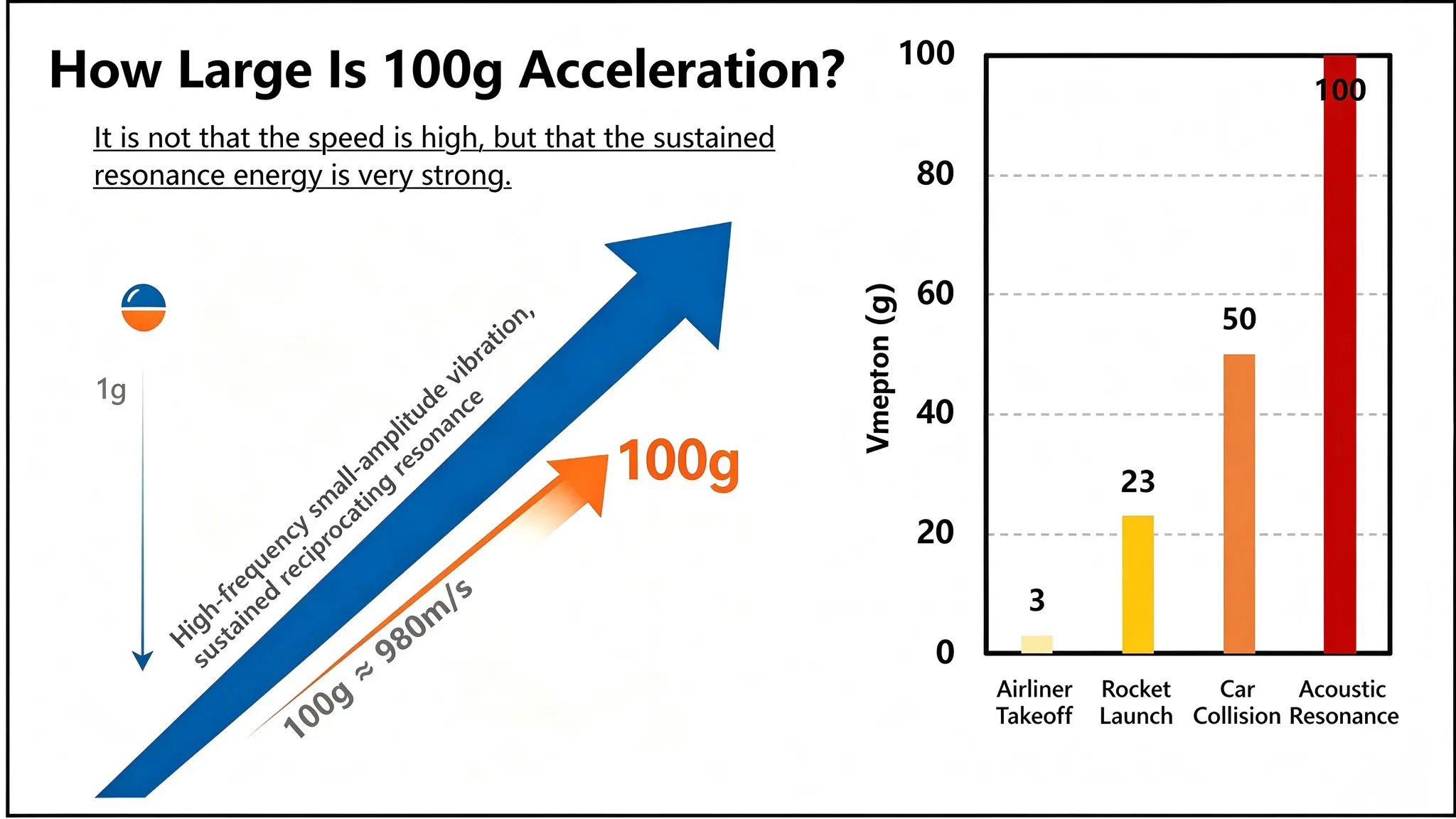
Figure 2. Vibration acceleration of the acoustic resonance mixer compared with aircraft takeoff, rocket launch, and car crash.
4. How Does Acoustic Resonance Mixing Work?
Acoustic resonance technology uses a resonance platform to drive the container to produce low-frequency vertical macro resonance in the 60 Hz range, exciting longitudinal sound waves within the powder or slurry. This forms a unique flow field system where macro overall circulation and micro acoustic streaming coexist (Figure 3). Under rapid vertical reciprocating excitation, the material inside the container simultaneously generates a large-scale macro mixing flow; longitudinal sound waves further induce numerous micro strong mixing vortices within the slurry. Materials continuously undergo relative slip, friction, and collision with each other, with the container wall, and with internal strengthening units, significantly enhancing internal mass transfer and heat exchange, and accelerating various physical dispersion or mixing processes.
Acoustic resonance mixing releases energy uniformly through large-displacement, low-frequency resonance. Non-contact mixing for battery electrode manufacturing means that no paddles, grinding balls, ultrasonic probes, or other contact stirring components enter the container at any stage. Because all material in the container takes part in the flow at once, the process has no mixing dead zone.
Three consequences follow from this mechanism:
- Energy is distributed across the entire load instead of concentrating near a paddle, probe, or ball-jar interface.
- Wear of contact components is not a source of impurities in the mechanism, which addresses the paddle-wear and grinding-media risks listed in Table 1.
- Gravity-driven sedimentation and stratification are weakened by the 100 g reciprocating motion.
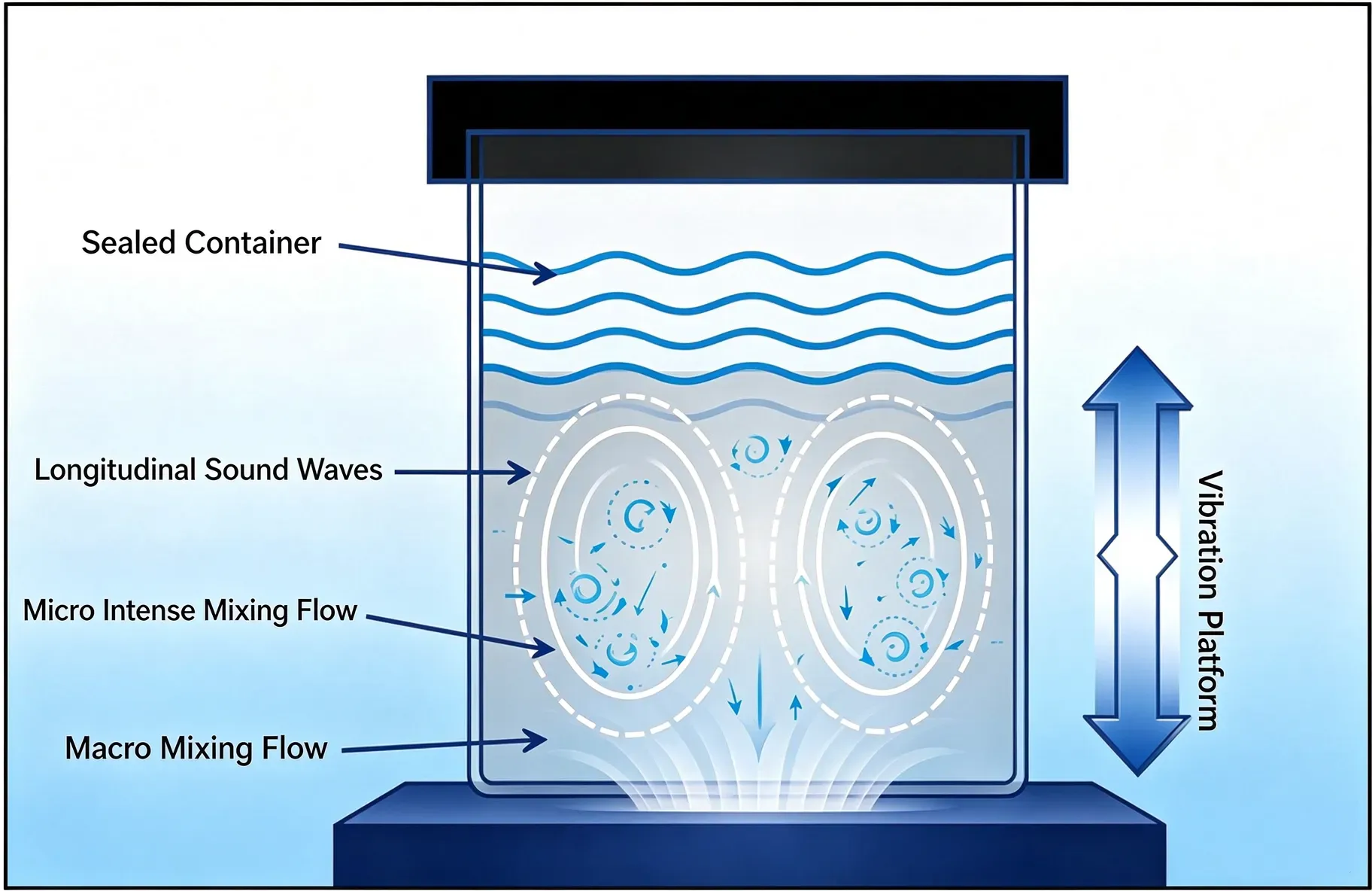
Figure 3. Schematic of acoustic resonance coupled global flow field: sealed container, longitudinal sound waves, micro strong mixing flow, and macro mixing flow.
Complete Dry, Wet & Hybrid Solid-State Battery Process Pilot Line
From resonant acoustic powder mixing (MDE Series) and solvent-free binder fibrillation to calendering, lamination, and pouch-cell vacuum sealing, IEST provides an integrated workflow covering both dry and wet electrode processing for solid-state batteries.
5. Acoustic Resonance Technology for Lithium Battery Applications
The IEST MDE600 acoustic resonance mixer (Figure 4) uses low-frequency acoustic resonance mixing technology, generating high-intensity acoustic vibration at a precisely controlled specific frequency (typically in the 55–65 Hz range, with different systems requiring different frequencies). The equipment allows selection of different container types and capacities, flexible adjustment of resonance acceleration and time, and switching between weak and strong shear ranges — adapting to both wet and dry process scenarios, and strengthening the following process steps:
- Powder dispersion
- Particle coating
- Liquid-phase emulsification
- Particle refinement
- Mechanochemical reactions
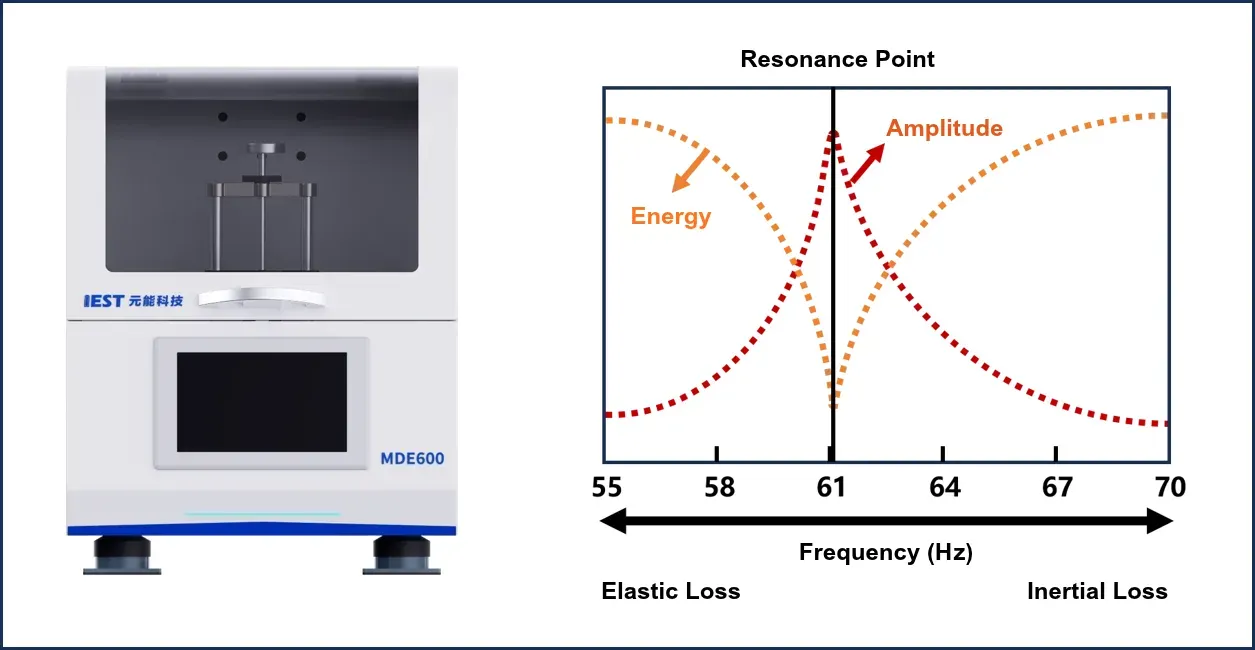
Figure 4. IEST MDE600 acoustic resonance mixer and resonance point diagram.
| Scenario | Process Objective | Mixing Mode | Key Functions Listed |
|---|---|---|---|
| Conductive slurry and binder solution preparation | Deagglomeration and dispersion of conductive agent; swelling and dissolution of binder | Wet | Conductive-agent dispersion, binder dissolution |
| Cathode and anode slurry preparation | Homogeneous dispersion of all components; stable slurry viscosity and rheology | Wet | Full-domain component dispersion |
| Particle surface attachment and surface physical coating | Attachment of material to particle surfaces; physical dry coating | Dry | Particle coating |
| Solid electrolyte composite cathode and anode preparation | Dry premixing of solid powders; reduced breakage of electrolyte particle gradation | Dry | Solid powder premixing |
6. Outlook
Overall, IEST Instrument‘s acoustic resonance equipment relies on global high-intensity reciprocating acoustic action to form unique differentiated advantages in material phase mixing and dispersion scenarios, providing a new mixing solution for next-generation high-performance lithium batteries. Currently, this technology has begun application scenario testing and validation within the industry, and with the development of dry electrode and all-solid-state battery technologies, its application scenarios are expected to further expand.
Objectively, while this technology has been applied and validated in some material systems within the lithium battery industry, it has not yet formed a systematic, standardized process system. A comprehensive standardized process database still needs to be built for various material systems. Overall, the technology remains in the industrial incubation stage, with stage-specific application constraints in laboratory equipment scale-up and mass production line-scale promotion. IEST Instrument sincerely invites upstream and downstream enterprises and research institutes to join hands in collaborative process development, jointly improving the acoustic resonance mixing process system, accelerating the implementation of this new mixing technology into mass production, and contributing to the upgrade and innovation of lithium battery and all-solid-state battery manufacturing processes.
Upgrade Your Battery Slurry Mixing with Acoustic Resonance
IEST Instrument’s MDE600 acoustic resonance mixer delivers 60 Hz low-frequency resonance and up to 100g acceleration for global fluidization, solving agglomeration and mixing dead zones in battery slurry, solid-state electrolyte, and dry electrode processing. Contact us to explore collaborative process development.
7. FAQs
What is acoustic resonance mixing in lithium battery manufacturing?
Acoustic resonance mixing is a non-contact mixing method that vibrates a sealed container at about 60 Hz with up to 100 g acceleration. The vibration creates macroscopic circulation and microscopic acoustic streaming inside powders or slurries. Acoustic resonance mixing therefore disperses battery materials without paddles, grinding media, or ultrasonic probes.
What are the advantages of acoustic resonance mixing over traditional ball milling or ultrasonic dispersion?
Acoustic resonance mixing provides uniform energy distribution throughout the entire container, avoiding the dead zones, local overheating, and impurity introduction common in ball milling and ultrasonic dispersion. It also performs deagglomeration, homogenization, and bubble removal in a single process without contact media.
How does acoustic resonance mixing benefit solid-state electrolyte and dry electrode processing?
Acoustic resonance mixing is non-contact and can gently deagglomerate brittle solid electrolyte particles without grinding damage. For dry electrodes, it homogenizes PTFE binder fibrillation without shear-induced overheating or particle breakage, preserving material structure and improving film uniformity.
How do I choose a mixing method for carbon nanotube dispersion, high-solid-content slurry, or sulfide solid electrolyte powder?
Selection depends on agglomerate hardness, heat sensitivity, tolerance for wear impurities, and wet or dry format. Probes, paddles, and grinding balls risk heating, impurities, or fractured brittle particles. IEST Instrument’s MDE600 acoustic resonance mixer offers non-contact mixing at a typical 55–65 Hz with adjustable acceleration and time, covering both wet and dry processes.
What is the IEST MDE600 acoustic resonance mixer used for?
The IEST MDE600 is used for deagglomeration, mixing, dispersion, and coating of lithium battery materials — including conductive slurry, binder solution, cathode/anode slurry, particle surface coating, and solid-state electrolyte composite electrodes. It supports wet and dry processes with adjustable frequency, acceleration, and container options.
How does acoustic resonance mixing work for dry electrode and solid-state electrolyte powders?
A resonance platform drives the container vertically at about 60 Hz and excites longitudinal acoustic waves in the powder. Particles then slip, rub, and collide with one another and with the container wall, which premixes solid powders without contact stirring components.