
Battery cell swelling — the volumetric expansion of lithium-ion cells during charge and discharge from lithium-ion intercalation, gas evolution, and temperature changes — is directly coupled to the mechanical behavior of buffer foam when foam is present between cells or between cells and the module housing. This coupling makes it impossible to measure the cell’s true expansion from combined force measurements alone. This article presents a mechanical decoupling method using IEST SWE2100: Constant Gap mode measures combined swelling force, while the foam’s stress-strain curve is obtained via transient compression. Results from a 2,400 mAh ternary/graphite pouch cell demonstrate that buffer foam reduces peak swelling force from 0.43 MPa to 0.11 MPa — a 74% reduction — while the decoupling method recovers the true cell expansion curve that the foam would otherwise obscure.
As lithium-ion batteries become the dominant technology for electric vehicles and grid energy storage, the mechanical behavior of cells during cycling — specifically battery cell swelling — has emerged as a critical factor governing module structural integrity, cycle life, and safety.
Battery cell swelling refers to the reversible and irreversible volumetric expansion of a lithium-ion battery cell during charge and discharge cycles, driven by three physical mechanisms: lithium-ion intercalation and de-intercalation in electrode materials, internal gas evolution, and thermal expansion from ohmic heating. Reversible swelling recovers each cycle; irreversible swelling accumulates progressively with cycling, generating cumulative mechanical stress that degrades electrode contact, compresses separator pores, and — in extreme cases — compromises cell structural integrity.
In real battery modules, buffer foam for battery applications is routinely installed between adjacent cells or between cells and the module housing. Buffer foam is defined here as a compliant elastic material — typically polyurethane, silicone, or closed-cell foam — whose primary mechanical function is to absorb swelling-induced mechanical energy, distribute compressive stress uniformly across the cell face, and maintain module assembly integrity throughout the cell’s life cycle.
| Function | Mechanism | Benefit |
|---|---|---|
| Swelling force absorption | Foam compresses to accommodate cell expansion, converting cell swelling force to stored elastic energy | Reduces peak force transmitted to module housing; protects electrode stack from excessive compressive stress |
| Stress distribution | Foam’s low elastic modulus allows it to conform to cell surface topology, distributing load uniformly | Eliminates localized pressure concentrations that cause separator puncture or electrode delamination |
| Vibration and shock isolation | Elastic foam decouples mechanical vibration between cells and between cells and housing | Reduces mechanical fatigue at connection points and weld interfaces during vehicle operation |
| Cell fixation | Precompressed foam maintains consistent contact pressure even as cells expand irreversibly | Maintains electrical contact quality at tabs and busbars throughout life cycle |
The engineering challenge is this: the elastic moduli of cells and buffer foam differ by orders of magnitude. Battery cells — as rigid composite structures — have a high elastic modulus; buffer foam has a much lower elastic modulus as a compliant elastic material. When constrained together in a module assembly, their deformation behaviors are mechanically coupled: foam deformation is constrained by the cell, preventing the foam from expressing its full cushioning capacity; and cell expansion is resisted by the foam’s reaction force, which modifies the cell’s actual swelling behavior from what it would be in an unconstrained state. Standard swelling measurements performed on the combined cell–foam stack cannot separate these contributions — the measured force and thickness change reflect the coupled system response, not the cell’s intrinsic expansion behavior. Mechanical decoupling of these two contributions is therefore essential for accurate battery cell swelling characterization and informed buffer foam selection.
Two complementary test modes of the IEST SWE2100 In-Situ Cell Swelling Testing System were used to implement the mechanical decoupling protocol.
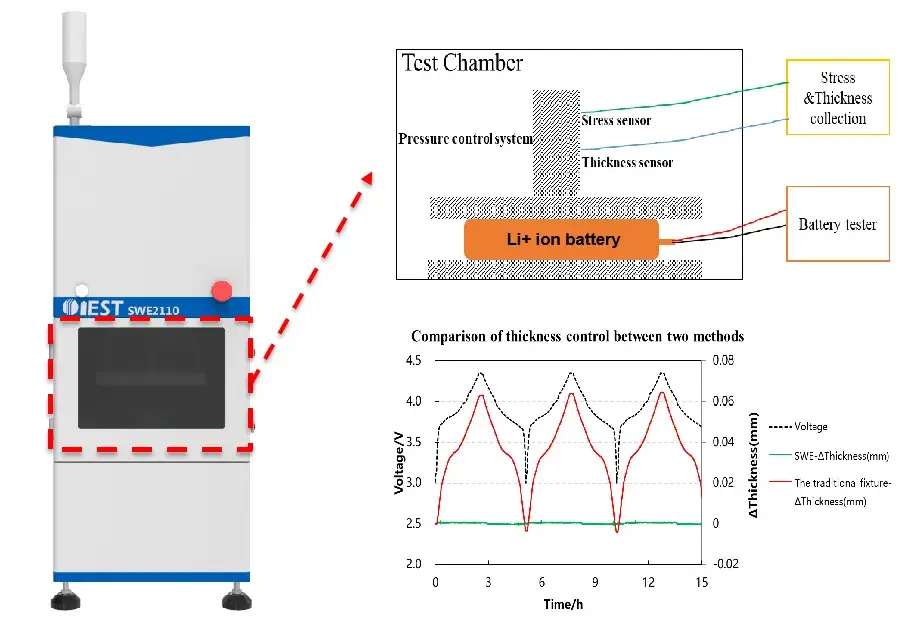
Figure 1. IEST SWE2100 In-Situ Cell Swelling Testing System — integrating controlled preload application, in-situ force measurement, and high-precision thickness monitoring for battery cell swelling characterization.
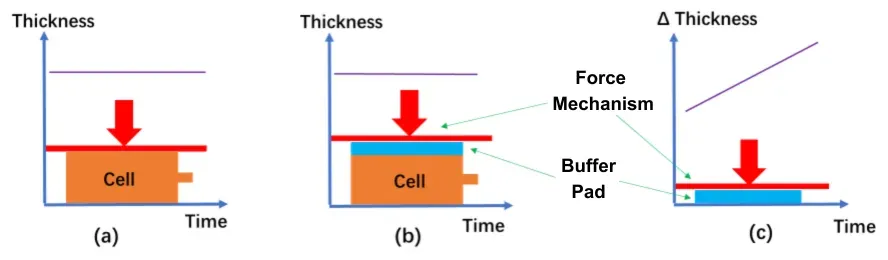
Figure 2. SWE2100 test mode configurations: (a) Constant Gap mode — cell alone; (b) Constant Gap mode — cell + buffer foam stack; (c) Transient Compression mode — buffer foam stress-strain curve measurement.
Constant Gap mode is defined as a test configuration in which the servo-motor-driven compression stage maintains the total thickness of the sample stack at a fixed value throughout the test. Under this constraint, any volumetric expansion of the cell must be accommodated entirely by compression of co-located compliant materials — or, if no compliant material is present, is registered entirely as an increase in measured force. In Constant Gap mode, the constraint equation governing the combined cell–foam system is:
Constant Gap Constraint Equation
\[
\delta_{foam} + \delta_{cell} = 0 \qquad (1)
\]
where: $\delta_{foam}$ = foam thickness change (compression, negative by convention) | $\delta_{cell}$ = cell thickness change (expansion, positive) | The total stack thickness is constant → foam compression equals cell expansion in magnitude at all times.
Transient Compression mode is defined as a test configuration in which the compression stage applies a controlled displacement or force ramp to a sample at a defined rate, recording force and displacement continuously to generate a stress-strain curve. The stress-strain curve of the buffer foam — relating compressive stress (MPa) to compressive strain (dimensionless thickness change) — provides the constitutive relationship needed to convert measured force data into foam displacement (and thus, via Equation 1, cell displacement) at every point during the cycling test.
Constant Gap mode measurements at 0.1 MPa initial preload reveal a dramatic reduction in peak swelling force when buffer foam is present between the cell face and the test fixture.
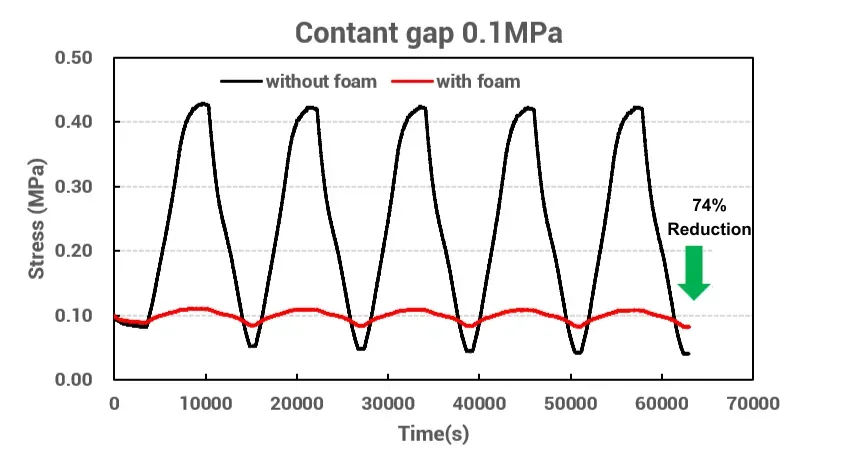
Figure 3. Swelling force comparison — cell only vs. cell + buffer foam over 5 cycles.
| Condition | Maximum Swelling Force (MPa) | Reduction vs. No Foam | Engineering Implication |
|---|---|---|---|
| Cell only (no buffer foam) | 0.43 | — | Full cell expansion force transmitted directly to module housing; high risk of electrode fracture and separator puncture |
| Cell + buffer foam | 0.11 | 74% | Foam absorbs 74% of swelling mechanical energy; significantly reduces housing structural requirements and enables module lightweighting |
The 74% reduction in peak swelling force demonstrates the effectiveness of buffer foam as a mechanical energy absorber. From a module design perspective, this reduction has two important implications. First, it substantially lowers the stress on electrodes and separator during cycling — reducing the probability of electrode fracture, delamination, and separator penetration that accelerate capacity fade. Second, it relaxes the structural strength requirements for module housings and fixing structures, providing engineering headroom for module lightweighting and cost reduction.
The combined cell–foam swelling force data in Figure 3 characterizes the system’s mechanical response, but does not directly reveal how much the cell itself is actually expanding at each point during cycling. This is the decoupling problem: the measured force reflects the coupled system — foam compression and cell expansion occurring simultaneously — not either component independently. The following three-step protocol resolves the cell’s true expansion behavior from the combined measurement.
Record the swelling force F(t) of the “cell + buffer foam” stack under Constant Gap mode throughout 5 charge/discharge cycles. This force is the same signal measured in Figure 3 for the foam-equipped condition. Under the Constant Gap constraint (Equation 1), the total stack thickness is fixed, so:
Using the same buffer foam sample (same dimensions, same foam grade), apply Transient Compression mode to record the foam’s compressive stress-strain curve \(\sigma = f(\varepsilon)\). This curve captures the foam’s constitutive mechanical behavior: how foam compressive strain (thickness change per original thickness) varies with applied compressive stress.
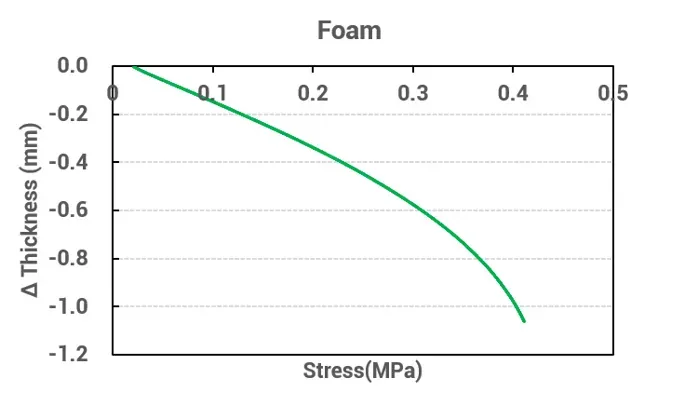
Figure 4. Buffer foam stress-strain curve measured via transient compression mode.
With the foam’s stress-strain relationship established, the cell’s true expansion at each measurement point is calculated as follows:
Mechanical Decoupling Calculation — Step by Step
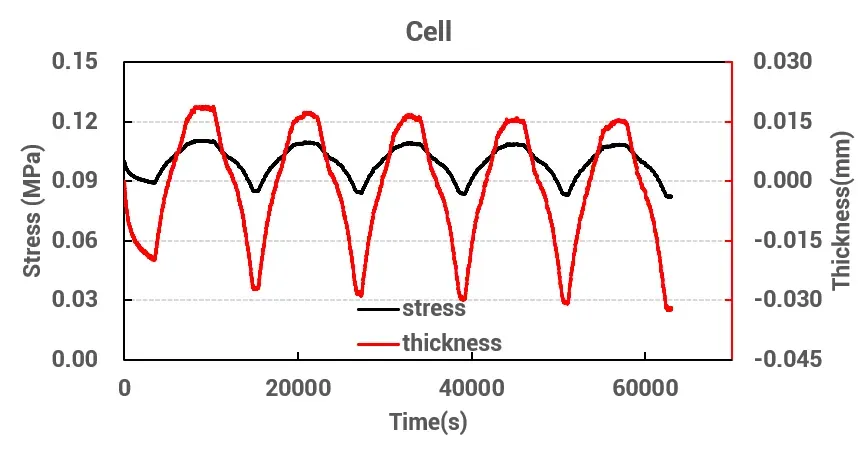
Figure 5. Decoupled battery cell swelling — true expansion thickness under buffer foam conditions.
The decoupled battery cell swelling curve in Figure 5 provides what direct measurement of the combined stack cannot: the actual thickness change of the cell at each state of charge and discharge, as it would behave within a module assembly equipped with that specific buffer foam. This information is not obtainable from the combined measurement alone, because the combined measurement conflates cell and foam contributions. The decoupled swelling curve is the physical quantity required for validating electrochemical-mechanical models, assessing separator and electrode mechanical fatigue, and selecting buffer foam materials whose compliance profile matches the cell’s swelling characteristics.
The mechanical decoupling methodology described in this study enables quantitative answers to engineering questions that were previously inaccessible from standard combined measurements:
Buffer foam reduces peak battery cell swelling force by 74% in this 2,400 mAh NMC/graphite pouch cell study — from 0.43 MPa without foam to 0.11 MPa with foam, under Constant Gap mode at 0.1 MPa preload across 5 cycles. However, standard measurements on the combined cell–foam stack cannot separate cell and foam contributions to the measured force and thickness response. Mechanical decoupling — combining Constant Gap mode data with independently measured buffer foam stress-strain curve data and the constraint equation \(\delta_{\text{foam}} + \delta_{\text{cell}} = 0\) — recovers the cell’s true expansion behavior at each point during cycling. This decoupled swelling curve provides the mechanistic data needed for buffer foam selection, module structural optimization, and electrochemical-mechanical model validation that drives next-generation battery module design.
Key quantitative results: buffer foam reduces peak battery cell swelling force by 74% (0.43 MPa \(\rightarrow\) 0.11 MPa) for a 2,400 mAh NMC/graphite pouch cell at 0.1 MPa initial preload. The mechanical decoupling protocol requires three measurements: (1) combined cell + foam swelling force in Constant Gap mode; (2) foam stress-strain curve in Transient Compression mode; (3) application of \(\delta_{\text{cell}}(t) = -\delta_{\text{foam}}(t) = -h_{\text{foam},0} \times f^{-1}[F(t)/A]\) to recover true cell expansion. The IEST SWE2100 provides both Constant Gap and Transient Compression modes in a single instrument, enabling the complete decoupling workflow without sample transfer or fixture reconfiguration.
[1] J. Cannarella and C.B. Arnold, Stress evolution and capacity fade in constricted lithium-ion pouch cells. J. Power Sources 245 (2014) 745–751.
[2] A. Barai et al., A comparison of methodologies for the non-invasive characterisation of commercial Li-ion cells. Prog. Energy Combust. Sci. 72 (2019) 1–31.
Battery cell expansion is the volumetric expansion of a lithium-ion battery cell during charge and discharge cycles, caused by three concurrent mechanisms: lithium-ion intercalation and de-intercalation in electrode active materials (reversible, 1–10% thickness change per cycle for typical anodes); internal gas evolution from electrolyte decomposition and side reactions (partially reversible); and thermal expansion from ohmic heating during high-rate operation. Irreversible swelling — from SEI layer growth, gas accumulation, and electrode structural changes — accumulates progressively with cycling. In constrained module assemblies, accumulated swelling generates mechanical stress that can fracture electrodes, compress separator pores, and eventually compromise cell structural integrity. Quantifying true cell swelling is therefore essential for predicting cycle life, designing module structures, and selecting compliant materials such as buffer foam that manage swelling forces throughout the cell’s service life.
Buffer foam for battery modules is a compliant elastic material — typically polyurethane foam, silicone foam, or closed-cell elastomer — placed between adjacent battery cells or between cells and the module housing. Its primary mechanical function is to absorb swelling-induced mechanical energy by compressing in response to cell expansion, converting cell expansion force into stored elastic energy in the foam rather than transmitting it to the housing structure or adjacent cells. This force absorption is quantified by the foam’s stress-strain curve: a stiff foam compresses less per unit force and transmits more force; a compliant foam compresses more per unit force and absorbs more. Secondary functions include: uniform pressure distribution across the cell face (preventing localized stress concentrations that damage electrodes or separators), vibration isolation between cells, and maintaining consistent cell positioning and electrical contact throughout the module life cycle.
Mechanical decoupling is the process of mathematically separating the individual force and displacement contributions of mechanically coupled components — specifically the battery cell and buffer foam — from combined system measurements. It is necessary because standard swelling measurements on a cell-plus-foam stack record the composite mechanical response of both components simultaneously; the measured force and thickness change reflect the coupled system state, not the cell’s intrinsic swelling behavior. Without decoupling, it is impossible to determine the cell’s actual expansion magnitude from force measurements alone. The decoupling protocol described here uses the Constant Gap constraint equation δfoam + δcell = 0 — total stack thickness is constant, so foam compression equals cell expansion — combined with the foam’s independently measured stress-strain curve to calculate the cell’s true expansion at each force state during cycling.
Constant Gap mode is a swelling test configuration in which a servo-motor-controlled compression stage maintains the total thickness of the cell (or cell plus foam stack) at a fixed value throughout the test. Under this constant-thickness constraint, any volumetric expansion of the cell generates a measurable increase in compressive force against the fixed stage — allowing swelling force evolution during cycling to be recorded continuously without the confound of cell displacement. Constant Gap mode simulates the mechanical environment of a battery cell in a constrained module assembly, where the module housing provides a rigid boundary that does not deflect significantly with cell expansion. The key constraint equation is δfoam + δcell = 0 when foam is present: total stack thickness is fixed, so every unit of foam compression corresponds to one unit of cell expansion — enabling the mechanical decoupling calculation that recovers true cell expansion.
The buffer foam stress-strain curve — measured separately by Transient Compression mode — provides the constitutive relationship between foam compressive stress and foam compressive strain: εfoam = f⁻¹(σfoam). During the decoupling calculation, the measured swelling force F(t) from the combined Constant Gap test is converted to foam stress (σ = F/A), then to foam strain (ε = f⁻¹(σ)), then to foam compression thickness (δfoam = ε × hfoam,0). Applying the Constant Gap constraint equation gives the cell’s true expansion: δcell = −δfoam. This calculation is performed at every time point during cycling, reconstructing the complete cell expansion curve from force data without directly measuring cell thickness under the foam. The accuracy of the recovered cell expansion curve depends on how well the independently measured foam stress-strain curve represents the foam’s behavior within the actual cell assembly — making representative foam sample preparation and controlled compression rate in Transient Compression mode essential for reliable decoupling results.