-
iestinstrument

Abstract
Distribution of Relaxation Times (DRT) analysis is a mathematical deconvolution technique that converts electrochemical impedance spectroscopy (EIS) data from the frequency domain into a time-domain distribution function \(\gamma(\tau)\)— separating overlapping electrochemical processes into distinct peaks based on their characteristic relaxation time constants \(\tau\). Unlike Equivalent Circuit Model (ECM) fitting, DRT analysis requires no prior assumption about the circuit topology: it deconvolves the full EIS spectrum into a series of peaks, where each peak corresponds to one independent electrochemical process (ohmic resistance, SEI layer, charge transfer, or solid-state diffusion), and the peak area directly represents the impedance contribution of that process. DRT is implemented numerically using regularization algorithms — most commonly Tikhonov regularization — to balance fit accuracy against spectral smoothness and suppress noise-driven artifact peaks. An electrochemical workstation equipped with integrated DRT analysis — such as the IEST ERT7008 series — enables automated impedance decomposition with peak area integration, reducing data processing time and eliminating ECM dependency.
1. Why DRT Analysis Resolves Overlapping EIS Processes That ECM Cannot Separate
Electrochemical impedance spectroscopy (EIS) is widely used in battery research and quality control to characterize internal electrochemical mechanisms. However, visual inspection of Nyquist plots alone is inherently limited: what appears as a single semicircle often comprises multiple overlapping semicircles corresponding to distinct processes with similar time constants. When SEI resistance (\(R_{SEI}\)) and charge transfer resistance \(R_{ct}\) fall within a comparable frequency range — typically 10–10,000 Hz — their Nyquist features merge into a single depressed semicircle that conventional curve-fitting may misidentify as one process.
Equivalent Circuit Model (ECM) fitting addresses this by assuming a circuit topology — for example, a second-order RQ network — and extracting parameter values through nonlinear least-squares regression. However, ECM fitting has two inherent weaknesses: (1) the circuit topology must be specified before fitting, introducing model bias; and (2) different cell chemistries and aging states produce visually distinct impedance features, making a single ECM topology inadequate across sample sets.
DRT analysis circumvents these limitations. As a pure mathematical deconvolution technique, DRT requires no prior assumption about circuit topology. It converts the frequency-domain EIS spectrum into a distribution of relaxation times \(\gamma(\tau)\), producing a DRT spectrum in which each electrochemical process appears as a discrete peak centered at its characteristic time constant \(\tau\). The Nyquist-ECM-DRT relationship is illustrated in Figure 1.
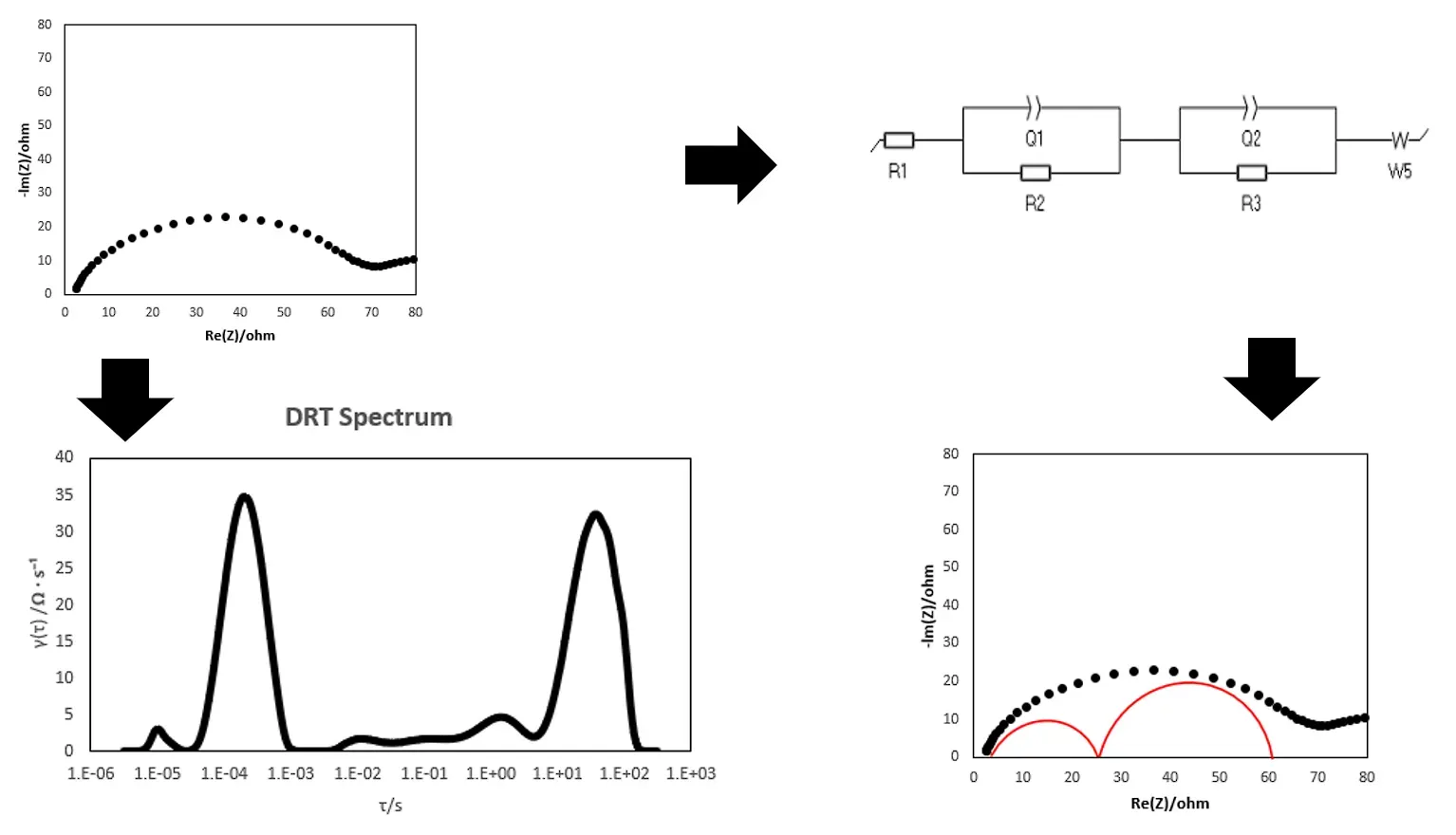
Figure 1. The Nyquist–ECM–DRT relationship: a Nyquist plot showing one apparent semicircle (left) is resolved by an Equivalent Circuit Model fit (center) into multiple overlapping arcs, and by DRT analysis (right) into distinct peaks — each representing one independent electrochemical process with a characteristic relaxation time \(\tau\).
2. What is Distribution of Relaxation Times (DRT)?
Distribution of Relaxation Times (DRT) is defined as a mathematical transformation of EIS impedance data \(Z(\omega)\) into a continuous distribution function \(\gamma(\tau)\) that represents the density of electrochemical relaxation processes as a function of the time constant τ. Each electrochemical process in a real battery system — SEI ion transport, charge transfer, solid-state diffusion — relaxes on a characteristic timescale determined by its RC product (\(\tau\) = RC). The DRT function \(\gamma(\tau)\) maps the amplitude of each relaxation contribution as a function of \(\tau\), producing a spectrum of peaks in the time domain.
The mathematical relationship between the impedance spectrum \(Z(\omega)\) and the DRT function \(\gamma(\tau)\) is:
DRT Core Equation
\[
Z(\omega) = R_\infty + \int_0^\infty \frac{y(t)}{1 + j\omega t} \, dt
\]
where: \(\gamma(\tau)\) = DRT distribution function (the target spectrum) | \(R_{\infty}\) = ohmic resistance | (\(\tau\) = RC = relaxation time constant | \(\omega\) = angular frequency
The key distinction from ECM analysis: DRT is model-free. The distribution \(\gamma(\tau)\) is recovered directly from the impedance data by numerical inversion, without assuming any particular circuit topology. Each peak in the resulting DRT spectrum corresponds to an independent electrochemical process, and the peak area equals the total impedance contribution of that process — the same quantity that ECM fitting would assign to the corresponding RC or RQ circuit element.
3. Tikhonov Regularization and DRT Deconvolution Algorithms
Computing the DRT function \(\gamma(\tau)\) from measured EIS data is an ill-posed inverse problem — meaning that small perturbations in the input data (noise, discrete sampling) can produce arbitrarily large perturbations in the recovered distribution. Three characteristics of real EIS measurements make this inversion numerically challenging:
- Discrete frequency sampling: EIS measures impedance only at a finite number of frequency points, not as a continuous spectrum — limiting the mathematical information available for inversion.
- Measurement noise: instrumental noise and cell variability introduce error into each impedance data point, which amplifies during the inversion calculation.
- Overlapping time constants: when two processes have relaxation time constants within one decade of each other, their contributions merge in the EIS spectrum, making numerical separation difficult.
Regularization algorithms address these challenges by introducing a smoothness constraint on the recovered distribution \(\gamma(\tau)\), trading some spectral resolution for stability:
| Method | Principle | Key Parameter | Advantage | Limitation |
|---|---|---|---|---|
| Tikhonov Regularization | Adds a penalty term \(\lambda \|\nabla \gamma\|^2\) to the cost function, suppressing noise amplification while penalizing sharp features in \(\gamma(\tau)\) | Regularization parameter \(\lambda\) — controls the fit/smoothness trade-off; typically selected by L-curve or cross-validation | Most widely used; effective noise suppression | \(\lambda\) selection requires judgment |
| Richardson-Lucy Deconvolution | Iterative Bayesian algorithm that maximizes the likelihood of the recovered distribution given the noisy data | Number of iterations — more iterations recover sharper peaks but amplify noise | Non-negative solution guaranteed | Slow convergence |
| Ridge Regression | L2 regularization applied to the discretized inversion problem; closely related to Tikhonov in discrete form | Ridge parameter \(\alpha\) — equivalent role to Tikhonov \(\lambda\) in continuous formulation | Simple implementation | Less effective for close peaks |
Tikhonov regularization is the most widely adopted algorithm for battery EIS deconvolution. Its regularization parameter \(\lambda\) governs the fundamental trade-off in DRT computation: a large \(\lambda\) produces a smooth, stable \(\gamma(\tau)\) spectrum at the cost of resolution — nearby processes may merge into a single broad peak. A small \(\lambda\) preserves spectral resolution but admits noise-driven artifact peaks that do not correspond to real electrochemical processes. Optimal \(\lambda\) selection — typically performed using L-curve analysis or generalized cross-validation — is critical for producing physically meaningful DRT spectra.
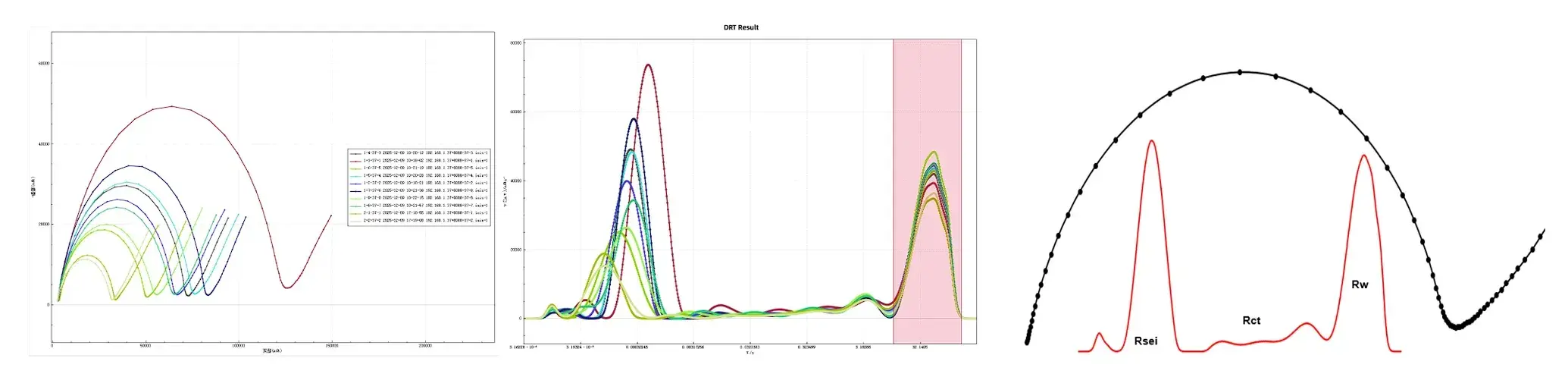
Figure 2. Effect of Tikhonov regularization parameter \(\lambda\) on DRT spectrum quality: under-regularization (small \(\lambda\)) produces artifact peaks; optimal \(\lambda\) resolves true electrochemical processes; over-regularization (large \(\lambda\)) merges nearby processes into a single broadened peak.
4. DRT Peak Interpretation: Mapping Time Constants to Electrochemical Processes
In a DRT spectrum, each peak corresponds to a distinct electrochemical relaxation process with a characteristic time constant (\(\tau\). This direct mapping between DRT peaks and physical processes is the core analytical advantage of the technique: unlike ECM fitting — which produces lumped circuit parameters — DRT analysis visualizes individual processes as separable features, enabling unambiguous identification even when processes are partially overlapping in the Nyquist representation.
| DRT Peak | Time Constant τ Range | Electrochemical Process | ECM Equivalent |
|---|---|---|---|
| High-frequency | (\(\tau\) < 10-5 s | Ohmic resistance — ionic transport in electrolyte and separator; electronic resistance in current collectors and leads | \(R_0\) |
| Mid-high frequency | 10-5–10-3 s | SEI layer — lithium-ion migration through the passivation film on anode/cathode surfaces; SEI growth increases this peak with aging | \(R_{SEI} \| CPE_{SEI}\) |
| Mid-frequency | 10-3–10-1 s | Charge transfer — electrochemical reaction kinetics at the electrode–electrolyte interface; \(R_{ct}\) increases with active material degradation | \(R_{ct} \| CPE_{dl}\) |
| Low-frequency | (\(\tau\) > 10-1 s | Solid-state diffusion — lithium-ion transport within active material particles (graphite layers, cathode crystal lattice); appears as Warburg slope in Nyquist plot | \(Z_w\) |
The correspondence between DRT peaks and ECM elements is one-to-one: each semicircle in the Nyquist plot maps to exactly one DRT peak, whose area equals the resistance of the corresponding RC or RQ element. This equivalence means that DRT analysis and ECM fitting — when the correct ECM is selected — yield the same physical information. The critical advantage of DRT is that it reveals this information before a circuit topology is specified, enabling model-free identification of how many processes are active and where their time constants lie.
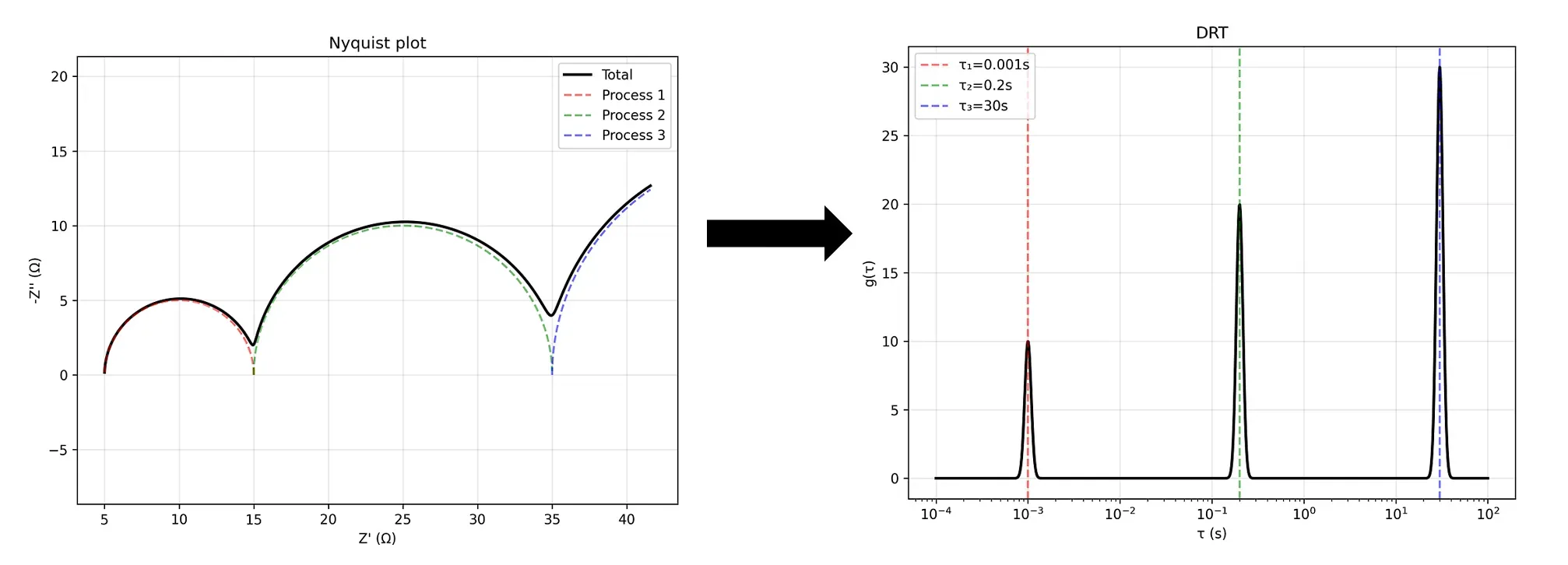
Figure 3. One-to-one correspondence between Nyquist semicircles and DRT peaks: each electrochemical process appears as one arc in the Nyquist plot and one peak in the DRT spectrum at its characteristic (\(\tau\). Peak area equals the process impedance contribution.
5. DRT Plotting Conventions: Two Representations, One Underlying Dataset
DRT spectra are commonly displayed in two equivalent formats that differ only in the x-axis treatment of the raw (\(\tau\) data. Understanding the equivalence between these representations prevents misinterpretation when comparing DRT spectra from different sources:
- Method A — Log-scaled x-axis: the raw (\(\tau\) values are plotted on the x-axis, and the axis scale is set to logarithmic (\log_{10}). The peak positions in τ are read directly from the axis values; the visual spacing between peaks reflects decade differences in time constant.
- Method B — Log-transformed x-data: the (\(\tau\) values are transformed to \(\log_{10}(\tau)\) before plotting, and the x-axis is then linear. The numerical x-axis values directly read as \(\log_{10}(\tau)\)
, so a peak at x = −3 corresponds to (\(\tau\) = 10⁻³ s.
Both methods produce visually identical spectra — the peak shapes, areas, and relative positions are unchanged. The distinction is purely in how the x-axis is labeled and scaled. Method B is more common in published literature; Method A may be preferred in software implementations where axis transformation is applied automatically.
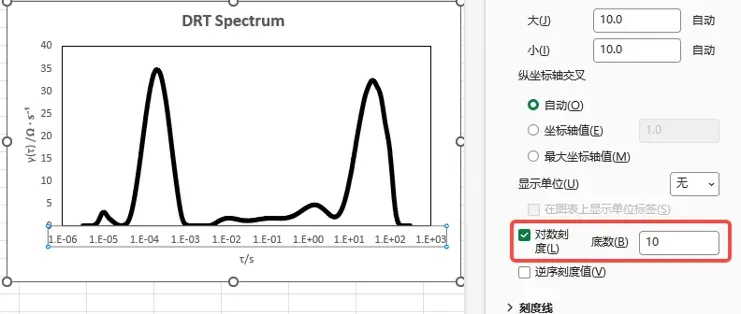
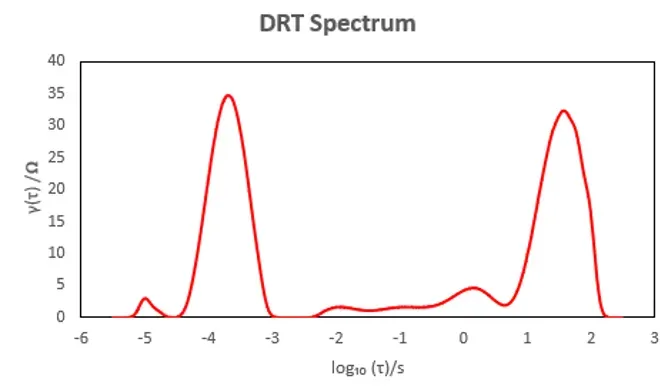
Figure 4. Two DRT plotting conventions for the same dataset: logarithmic x-axis with raw (\(\tau\) values (left) and linear x-axis with \(\log_{10}(\tau)\) transformed values (right). Both representations are mathematically equivalent; peak positions and areas are identical.
6. IEST ERT7008: Integrated EIS-DRT Analysis With an Electrochemical Workstation
The impedance contribution of each electrochemical process equals the area under its corresponding DRT peak. Mathematically, this area is the integral of \(\gamma(\tau)\) over the time constant range associated with that peak:
Peak Area = Process Impedance (Ω)
\[
R_{\text{process}} = \int_{\tau_1}^{\tau_2} \gamma(\tau) \, d(\ln \tau)
\]
where \([\tau_1, \tau_2]\) defines the time constant range of the peak of interest. Numerically approximated as a stepwise sum (SUMPRODUCT calculation over discretized \(\gamma(\tau)\) values).
This peak area calculation provides the same resistance value that ECM fitting assigns to the corresponding RC or RQ element — without requiring a circuit model. For an SEI peak: integrating \(\gamma(\tau)\) over the mid-to-high frequency range (\(\tau = 10^{-5}\) to \(10^{-3}\) s) yields \(R_{SEI}\). For a charge transfer peak: integrating over the mid-frequency range (\(\tau = 10^{-3}\) to \(10^{-1}\) s) yields \(R_{ct}\).
The IEST ERT7008 Electrochemical Performance Analyzer integrates DRT analysis directly into its analysis software, enabling the complete EIS-to-DRT workflow within the instrument’s native interface. Key capabilities:
- Automated EIS-to-DRT conversion: DRT spectra are computed from acquired EIS data without manual data export or external software — reducing analysis time from hours to minutes.
- Interactive peak selection and integration: users select the (\(\tau\) range of each peak graphically; the software computes the peak area (impedance value) by numerical integration — eliminating manual SUMPRODUCT calculations in spreadsheets.
- Tikhonov regularization with automated \(\lambda\) selection: the software applies Tikhonov regularization and assists with regularization parameter optimization, ensuring physically meaningful DRT spectra from real battery EIS data.
- Direct comparison with ECM results: peak areas from DRT integration are displayed alongside ECM-fitted resistance values for cross-validation — confirming that model-free and model-based approaches converge on the same physical parameters.
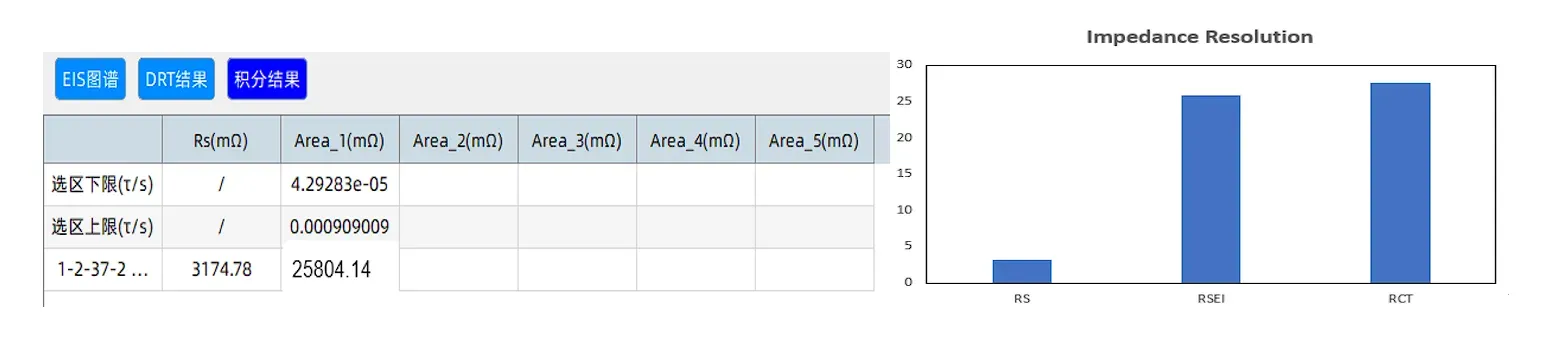
Figure 5. IEST ERT7008 DRT analysis software: integrated EIS-to-DRT conversion with interactive peak selection, automated numerical integration for impedance extraction, and Tikhonov regularization with parameter guidance.
7. DRT vs. ECM: When to Use Each Approach
DRT analysis and ECM fitting are complementary rather than competing analytical methods. Understanding when each approach is most appropriate guides experimental design and data interpretation:
- Use DRT first for exploratory analysis: when studying a new cell chemistry, aging mechanism, or degradation mode, DRT analysis reveals how many electrochemical processes are active and where their time constants lie — without committing to a circuit topology that may miss processes or introduce model artifacts. DRT-identified peak positions and counts should inform the initial ECM design.
- Use ECM for quantitative parameter tracking: once a circuit topology is validated against DRT peak assignments, ECM fitting provides robust quantitative parameters (R, C, Q, n) for statistical comparison across large datasets — charge/discharge cycles, temperature conditions, or cell populations. ECM fitting scales better than DRT for high-volume automated analysis.
- Use DRT for degradation diagnosis: tracking DRT peak areas over cycling provides model-free quantification of how each individual process (SEI, charge transfer, diffusion) evolves with aging — without the risk that a fixed ECM topology misattributes resistance growth between elements as the cell’s internal configuration changes with degradation.
8. Practical Recommendations for DRT Analysis in Battery R&D
- Select an appropriate regularization parameter \(\lambda\): For noisy EIS data (common in production-line measurements), use higher \(\lambda\) values to suppress false peaks. For high-quality laboratory spectra with dense frequency spacing, lower \(\lambda\) values preserve fine electrochemical detail.
- Validate DRT peaks against known cell chemistry: The number and position of DRT peaks should be physically interpretable. Spurious peaks at the edges of the frequency range should be treated as regularization artifacts.
- Use DRT as a complementary technique to ECM: DRT analysis reveals the number and approximate time constants without model bias, informing ECM topology selection. DRT-guided ECM fitting provides the most robust impedance analysis workflow.
- Standardize plotting conventions: Report whether DRT spectra use log-scaled axis ticks or log-transformed x-axis data to ensure reproducibility.
- Integrate DRT into production QC: An electrochemical workstation with built-in DRT analysis enables automated pass/fail classification without operator electrochemical expertise.
9. Summary
Distribution of Relaxation Times (DRT) analysis transforms EIS impedance data into a time-domain spectrum \(\gamma(\tau)\) that resolves overlapping electrochemical processes into distinct peaks — each representing one physical process at its characteristic relaxation time constant. DRT is model-free: it requires no prior assumption about equivalent circuit topology, and the area under each peak directly yields the impedance contribution of the corresponding process. Tikhonov regularization is the standard algorithm for DRT computation, controlling the trade-off between spectral resolution and stability through a single regularization parameter \(\lambda\).
Key DRT reference data for lithium-ion battery EIS analysis: ohmic resistance corresponds to \(\tau < 10^{-5}\) s; SEI layer processes to \(\tau = 10^{-5}\)–\(10^{-3}\) s; charge transfer kinetics to \(\tau = 10^{-3}\)–\(10^{-1}\) s; and solid-state diffusion to \(\tau > 10^{-1}\) s. Peak area (\(\Omega\)) is calculated by integrating \(\gamma(\tau)\) over the peak’s \(\tau\) range — equivalent to the resistance value extracted by ECM fitting for the corresponding RC or RQ element. The IEST ERT7008 electrochemical workstation integrates automated DRT computation, Tikhonov regularization, and peak-area integration into its native analysis software, enabling model-free impedance deconvolution without external data processing.
10. References
[1] T.H. Wan, M. Saccoccio, C. Chen and F. Ciucci, Influence of the discretization methods on the distribution of relaxation times deconvolution. Electrochim. Acta 184 (2015) 483–499.
[2] M. Saccoccio, T.H. Wan, C. Chen and F. Ciucci, Optimal regularization in distribution of relaxation times applied to electrochemical impedance spectroscopy. Chem. Mater. 26 (2014) 5916–5926.
[3] S. Dierickx, A. Weber and E. Ivers-Tiffée, How the distribution of relaxation times enhances complex impedance data interpretation. Electrochim. Acta 294 (2019) 355–365.
11. FAQ: Distribution of Relaxation Times (DRT) Analysis
11.1 What is Distribution of Relaxation Times (DRT) and how does it differ from Equivalent Circuit Model fitting?
Distribution of Relaxation Times (DRT) is a mathematical method that converts EIS frequency-domain data Z(ω) into a time-domain distribution function γ(τ), where each peak in γ(τ) represents one independent electrochemical process at its characteristic relaxation time constant τ. Unlike Equivalent Circuit Model (ECM) fitting, DRT analysis requires no prior assumption about circuit topology — the spectrum is recovered directly from the data by numerical inversion. This makes DRT particularly valuable for exploratory analysis of unknown systems, degradation diagnosis where the ECM topology may change with aging, and detection of processes that are invisible in the Nyquist plot because their time constants are too similar to resolve visually. The two methods are complementary: DRT reveals how many processes are active and where their time constants lie; ECM provides robust quantitative parameters once the circuit topology is known.
11.2 What is Tikhonov regularization and why is it needed for DRT analysis?
Tikhonov regularization is the most widely used algorithm for computing the DRT function γ(τ) from measured EIS data. It is needed because the mathematical inversion of Z(ω) to γ(τ) is an ill-posed problem: without constraints, small amounts of measurement noise in the EIS data produce arbitrarily large oscillations in the recovered γ(τ) spectrum, generating artifact peaks that do not correspond to real electrochemical processes. Tikhonov regularization adds a penalty term λ‖∇γ‖² to the optimization objective, which suppresses rapid variations in γ(τ) at the cost of some spectral resolution. The regularization parameter λ controls this trade-off: too large a λ merges nearby processes into one broadened peak; too small a λ retains noise-driven artifacts. Optimal λ is typically selected using L-curve analysis or generalized cross-validation.
11.3 How do you interpret DRT peaks in a lithium-ion battery EIS spectrum?
Each DRT peak identifies one electrochemical process by its position on the τ-axis and quantifies its impedance by its area. For lithium-ion batteries: peaks at τ < 10⁻⁵ s correspond to ohmic resistance (electrolyte, separator, leads); peaks at τ = 10⁻⁵–10⁻³ s correspond to SEI layer ion transport — SEI peaks grow with aging as the passivation film thickens; peaks at τ = 10⁻³–10⁻¹ s correspond to charge transfer kinetics at the electrode–electrolyte interface — these increase as active material degrades; peaks at τ > 10⁻¹ s correspond to solid-state diffusion of lithium ions within electrode particles. The area under each peak (in Ω) directly equals the resistance of the corresponding process — the same value that ECM fitting would assign to the RSEI, Rct, or equivalent circuit element.
11.4 How is the impedance of each process calculated from a DRT spectrum?
The impedance contribution of each process is the area under its DRT peak, calculated by integrating γ(τ) over the time constant range [τ₁, τ₂] associated with that peak: Rprocess = ∫ γ(τ) d(ln τ). Numerically, this is computed as a stepwise summation (SUMPRODUCT calculation) over the discretized γ(τ) values within the selected peak range. This operation yields a resistance value in ohms directly comparable to the corresponding ECM fitting parameter. The IEST ERT7008 software performs this integration automatically: users select the peak boundaries graphically, and the software returns the integrated peak area without manual spreadsheet calculations.
11.5 What electrochemical workstation features are required for DRT analysis?
Accurate DRT analysis requires three capabilities from the electrochemical workstation: (1) high-quality EIS acquisition — low noise, accurate phase measurement across the full frequency range (0.01 Hz to 100 kHz or broader), and data quality verification via Kramers–Kronig compliance testing before DRT processing; (2) sufficient frequency resolution — enough measurement points per decade (typically 6–10) to provide the data density needed for reliable inversion; (3) integrated DRT computation software with Tikhonov regularization, regularization parameter guidance, and peak integration — to perform the full EIS-to-DRT workflow without external software. The IEST ERT7008 electrochemical workstation integrates all three capabilities, enabling DRT analysis as part of standard EIS test protocols alongside charge-discharge cycling and cyclic voltammetry.