-
iestinstrument


Abstract
📄 Source Paper
Peipei Xu, Junqiu Li, Qiao Xue, Fengchun Sun.
A syncretic state-of-charge estimator for LiFePO4 batteries leveraging expansion force
DOI: 10.1016/j.est.2022.104559
| Journal: Journal of Energy Storage
| Institutions: Beijing University of Science and Technology
✓ IEST In-Situ Cell Swelling Testing System(SWE2100) used in this research
1. Introduction
Accurate state-of-charge (SOC) estimation is critical for the performance and safety of lithium-ion batteries, but LiFePO4 cells present a fundamental challenge for traditional voltage-based methods: their flat voltage curve. As this paper demonstrates, LFP cells exhibit a voltage plateau spanning 27%–94% SOC, during which the total voltage change is only 0.07 V — far too small a signal for reliable voltage-based SOC estimation across most of the cell’s usable capacity range. This is precisely the problem that motivated Dr. Peipei Xu and colleagues at Beijing University of Science and Technology to develop an alternative approach in their 2022 study: using cell expansion force, measured in-situ during cycling, as the SOC indicator instead of voltage. Their method combines a Least-Squares Support Vector Machine (LSSVM) to model the non-monotonic relationship between expansion force and SOC with an Adaptive Unscented Kalman Filter (AUKF) for real-time online correction, achieving SOC prediction errors of roughly 0.54%–1% across varied temperatures, dynamic current profiles, and mechanical preload conditions — providing a robust alternative or complement to voltage-based SOC estimation specifically in the operating window where LFP’s flat voltage curve makes voltage-based methods unreliable. This article summarizes their methodology and its implications for battery management system (BMS) design.
2. The Core Problem: LiFePO4’s Flat Voltage Plateau
LiFePO4’s olivine crystal structure produces a two-phase lithiation/delithiation reaction with a famously flat open-circuit voltage plateau — a property that underlies LFP’s excellent thermal stability and cycle life, but creates a specific practical problem: across the majority of the usable SOC range, the voltage signal that traditional BMS algorithms rely on for SOC estimation simply does not change enough to be measured reliably, especially under noisy real-world current and temperature conditions.
The novel method evaluated here estimates LiFePO4 SOC from in-situ expansion force measurements instead. Using LSSVM to model the non-monotonic relationship between expansion force and SOC, combined with AUKF for online correction, the method attains prediction errors of roughly 0.54%–1% across varied temperatures, current dynamics, and preload conditions. This technique provides a robust alternative or supplement to voltage-based SOC estimation methods for LFP cells — especially in the flat-voltage operating window where voltage-based approaches struggle most.
3. Experimental Setup and Test Scheme
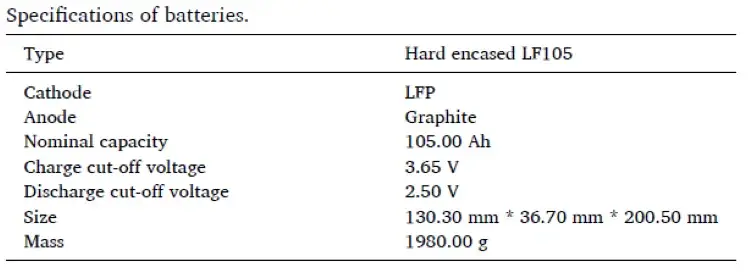
3.1 LiFePO4 Battery Specifications
Table 1. LiFePO4 batteries Information
3.2 Test Equipment
The researchers used a LiFePO4 battery and specialized equipment including:
-
Battery cycler (CT-8002-5V100A-NTFA)
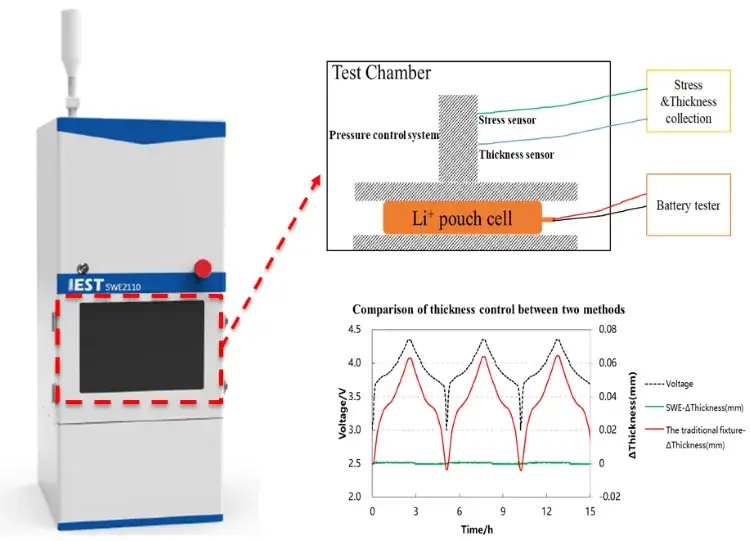
The IEST-SWE2100 accurately measured thickness and force changes during cycling under controlled temperature and mechanical constraints — the foundational measurement enabling this expansion-force-based SOC estimation approach.
3.3 Test conditions
-
Quasi-static low-rate (1/25C) charging to reveal fine expansion/voltage trends free of dynamic current artifacts.
-
Two dynamic drive cycles (NEDC, DST) at different preloads (15 kg, 30 kg) and ambient temperatures (25 °C, 45 °C).
-
Synchronized acquisition of force, current, voltage, and temperature throughout all tests.
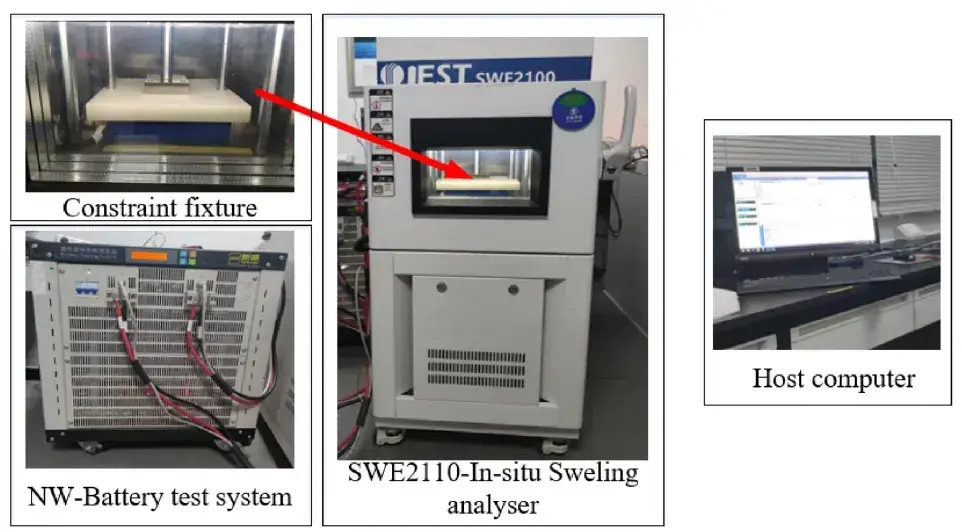
Figure 1. Expansion force test instrument: IEST SWE2100
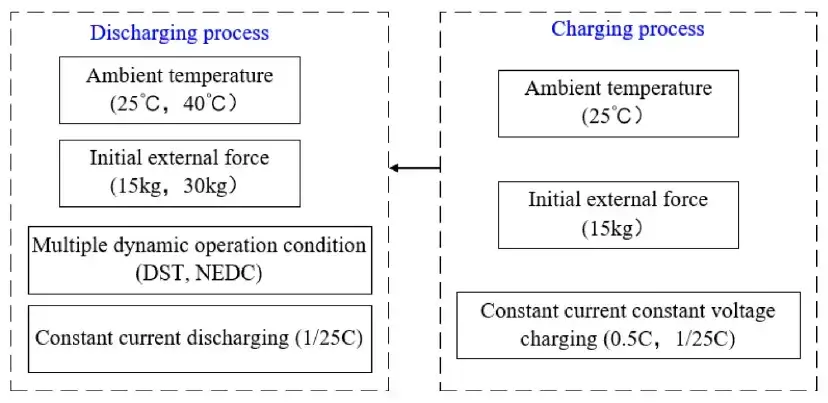
Figure 2. Battery Test Process
4. Result Analysis: Expansion Force Tracks SOC Where Voltage Cannot
Figure 3 shows the voltage curve and expansion force change curve obtained at 1/25C charge rate. It can be clearly seen from the figure that there is a voltage plateau from 27% to 94% SOC. Across this 67-percentage-point range — covering most of the cell’s usable capacity — the voltage change is only 0.07 V, far below the resolution needed for reliable voltage-based SOC estimation in real-world noisy conditions.
By contrast, expansion force changes substantially across this same range. The expansion force change in this stage is primarily caused by the phase transition of intercalated graphite from LiC₁₂ to LiC₆ at the anode — a mechanical signature of the lithiation process that remains strong even when the electrochemical voltage signal goes flat. This makes expansion force a highly promising SOC indicator precisely in the operating window where voltage fails. However, the expansion force change in this range is also non-monotonic — it does not increase or decrease smoothly with SOC — which introduces its own estimation challenge, addressed later by the LSSVM model.
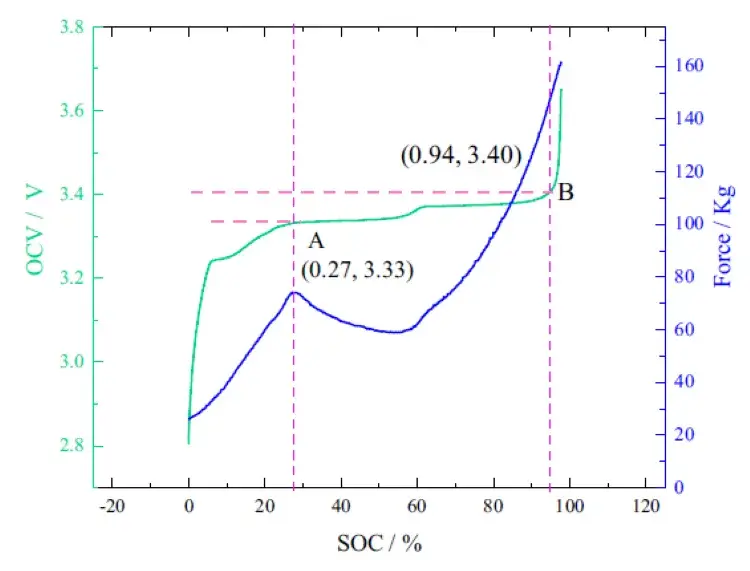
Figure 3. Voltage and expansion force vs LiFePO4 SOC under quasi-static conditions — the flat voltage plateau (27–94% SOC, only 0.07 V change) versus the substantial, SOC-sensitive expansion force change over the same range
To verify the SOC prediction model under realistic conditions, expansion force experiments were carried out under two dynamic drive cycles (NEDC and DST) with different preloads (15 kg and 30 kg) and different test temperatures (25 °C and 45 °C). As shown in Figure 4, results show that the same obvious voltage plateau persists at 20%–90% SOC under dynamic conditions, and the trend of expansion force change closely resembles that observed under constant-current (quasi-static) charging. This indicates that expansion force is not sensitive to dynamic current changes, but is strongly sensitive to SOC change — exactly the robustness property needed for a practical BMS estimation signal.
This behavioral difference has a clear physical explanation: voltage depends on the lithium-ion concentration at the electrode surface, which responds quickly (and noisily) to instantaneous current, while expansion force reflects the lithium-ion concentration throughout the electrode bulk phase, which integrates more slowly and tracks the true state of lithiation — i.e., SOC — more robustly. Additionally, the expansion force of the battery increases significantly with increasing preload, meaning that preload magnitude must be a deliberate design consideration in battery module mechanical design, not an afterthought, if expansion-force-based SOC estimation is to be deployed.
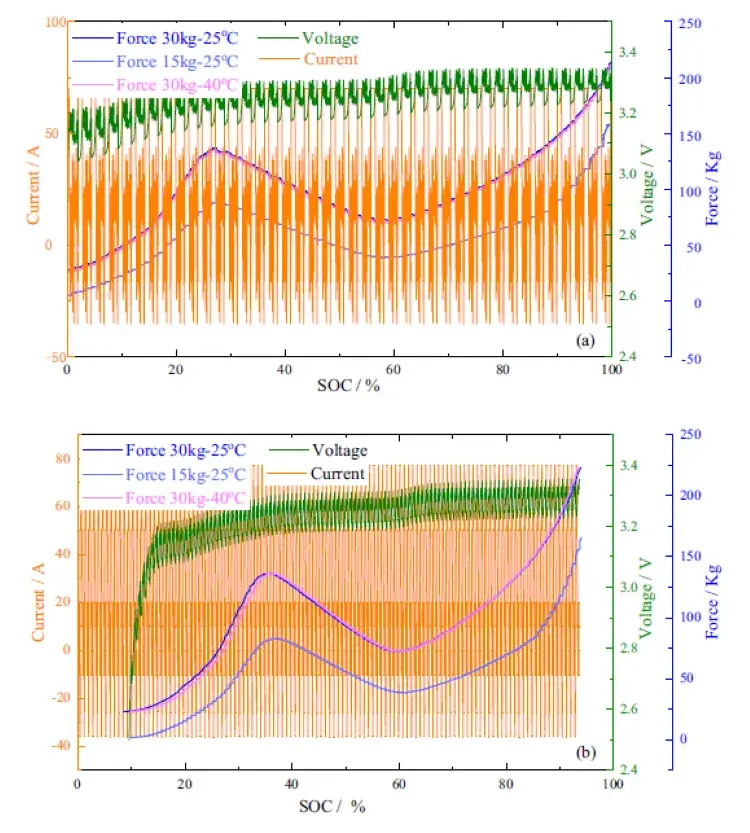
Figure 4. Swelling force and current-voltage curves under NEDC and DST dynamic drive cycle conditions — confirms expansion force remains SOC-sensitive and current-insensitive across temperature and preload variations
5. The SOC Estimation Algorithm: LSSVM + AUKF
The research team developed a machine-learning-based model using a Least-Squares Support Vector Machine (LSSVM) to capture the non-linear, non-monotonic relationship between expansion force and SOC identified in Figure 3. This was combined with an Adaptive Unscented Kalman Filter (AUKF) to improve accuracy and adaptability for real-time, online SOC estimation applications. The algorithm flow is shown in Figure 5.
This combined approach achieved estimation errors between 0.54% and 1% across temperatures, dynamic loads, and mechanical preconditions — a significant improvement over voltage-based methods specifically in the flat-voltage operating window where this study’s data shows voltage-based estimation is least reliable.
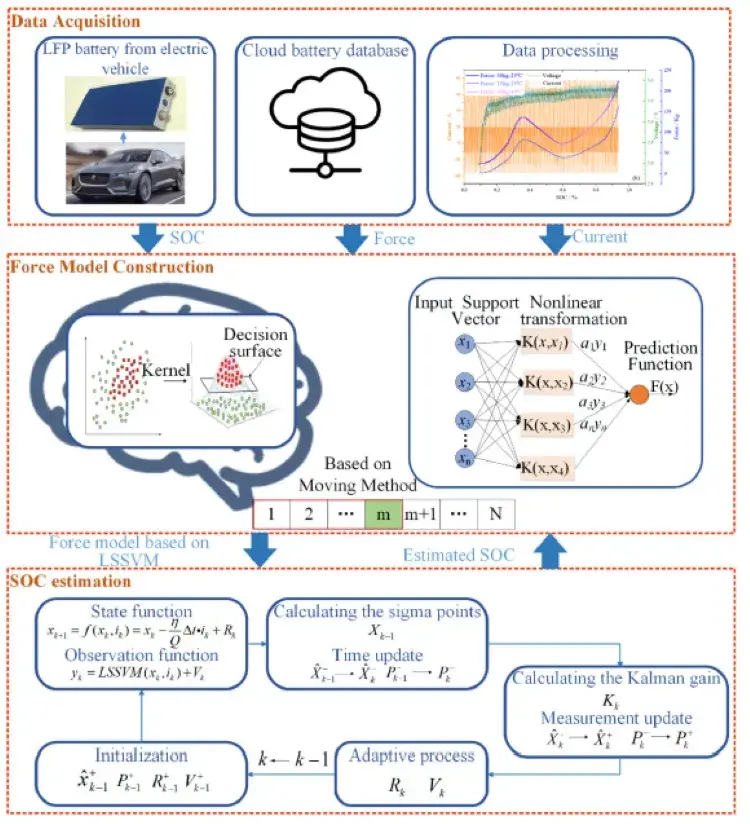
Figure 5. Flow chart of SOC estimation based on LSSVM (modeling the force-SOC relationship) and AUKF (real-time online correction)
6. Future Directions
-
Extend the method to other chemistries where mechanical strain correlates with SOC — e.g., silicon-augmented anodes, which exhibit even larger volume change signals than graphite.
-
Incorporate SOH (state-of-health) estimation jointly with SOC by augmenting the state vector in the AUKF to track aging parameters that modulate the force-SOC mapping over the cell’s lifetime.
-
Evaluate long-term drift and model transferability between cell manufacturers, formats, and pack geometries — important for practical BMS deployment beyond the specific cell tested in this study.
7. Summary
This paper introduces a method to estimate LiFePO4 SOC using expansion force instead of relying on the cell’s notoriously flat voltage curve. The LFP voltage plateau spans 27%–94% SOC with only 0.07 V of change — too small a signal for reliable voltage-based estimation across most of the usable capacity range. Expansion force, by contrast, changes substantially and predictably with SOC over this same range, reflecting the bulk-phase lithium intercalation state rather than the noisier surface-concentration signal that drives voltage. Using LSSVM (to model the non-monotonic force-SOC relationship) and AUKF (for real-time online correction), the estimation error is reduced to below 1%, and the method is applicable across different temperatures, dynamic current profiles, and mechanical preload conditions. Future work is expected to extend this approach to other battery chemistries and to jointly estimate SOC alongside SOH and under low-temperature conditions.
8. Original Paper
Peipei Xu, Junqiu Li, Qiao Xue, Fengchun Sun. A syncretic state-of-charge estimator for LiFePO4 batteries leveraging expansion force. Journal of Energy Storage, 50 (2022) 104559.
9. Recommended Test Equipment of IEST
The SWE series in-situ expansion analysis system (IEST) uses a highly stable, automated platform equipped with high-precision thickness measurement sensors. It measures the thickness change and rate of change throughout the entire charge-discharge process — the exact measurement foundation needed for expansion-force-based SOC estimation research like the study analyzed above. Key functions:
- Battery swelling thickness curve testing under constant pressure
- Battery swelling force curve testing under constant gap conditions
- Battery compression performance testing: stress-strain curve, compression modulus
- Stepwise battery expansion force testing
- Temperature control range: −20 °C to 80 °C
10. FAQs
10.1 Why does the LFP battery flat voltage curve make SOC estimation difficult?
LiFePO4 batteries have an olivine cathode structure that undergoes a two-phase lithiation/delithiation reaction with a thermodynamically flat open-circuit voltage plateau. In the study analyzed here, this plateau spans 27% to 94% SOC, during which the total voltage change is only 0.07 V — an extremely small signal relative to typical measurement noise, temperature drift, and current-induced polarization effects in a real battery management system. Because traditional SOC estimation methods (such as open-circuit voltage lookup tables or voltage-based Coulomb counting correction) rely on voltage changing measurably and monotonically with SOC, LFP’s flat voltage curve makes these methods unreliable across the majority of the cell’s usable capacity range — precisely the range where accurate SOC estimation matters most for range prediction and battery management. This is the central motivation for alternative SOC estimation approaches such as the expansion force method described in this article.
10.2 How does expansion force-based SOC estimation work for LFP batteries?
Expansion force-based SOC estimation measures the mechanical force a lithium-ion cell exerts against a fixed external constraint (constant-gap mode) as it expands and contracts during lithiation and delithiation, and uses this force signal — rather than voltage — to infer SOC. The physical basis is that cell expansion is primarily driven by graphite anode staging: as lithium intercalates into graphite, it transitions through distinct crystallographic stages (e.g., LiC₁₂ to LiC₆), each associated with a measurable volume change. Unlike voltage, which reflects lithium-ion concentration at the electrode surface and is sensitive to instantaneous current, expansion force reflects the bulk-phase lithium concentration and changes substantially even when voltage is flat. In the study analyzed here, expansion force was measured using an in-situ expansion analyzer (IEST SWE2100) under controlled preload and temperature, then converted to an SOC estimate using a Least-Squares Support Vector Machine (LSSVM) to model the non-monotonic force-SOC relationship, combined with an Adaptive Unscented Kalman Filter (AUKF) for real-time correction — achieving 0.54–1% estimation error.
10.3 What is LSSVM and AUKF, and why are both needed for SOC estimation?
LSSVM (Least-Squares Support Vector Machine) and AUKF (Adaptive Unscented Kalman Filter) serve complementary roles in this expansion-force-based SOC estimation method. LSSVM is a machine-learning regression technique well suited to modeling complex, non-linear relationships from limited training data — used here to capture the non-monotonic relationship between expansion force and SOC observed in the experimental data (Figure 3), which a simple linear or polynomial model could not accurately represent. However, a static regression model alone does not account for real-time measurement noise, model uncertainty, or drift during actual vehicle operation. AUKF addresses this by providing online, real-time correction: it recursively updates the SOC estimate as new force, voltage, current, and temperature measurements arrive, adaptively adjusting its confidence in the model prediction versus the latest measurement. The combination — LSSVM for the underlying force-SOC mapping, AUKF for robust real-time tracking — is what allows the method to achieve 0.54–1% estimation error across varying temperatures, dynamic current profiles (NEDC, DST), and preload conditions, rather than just under idealized laboratory conditions.
10.4 Why does battery preload affect expansion force SOC estimation accuracy?
Preload — the constant mechanical preload force applied to a cell or module (e.g., from clamping plates or housing constraint) — directly affects the absolute magnitude of measured expansion force, because expansion force increases significantly with increasing preload, as confirmed by this study’s comparison of 15 kg and 30 kg preload conditions. This matters for two reasons. First, for SOC estimation model accuracy: a model trained at one preload level will not directly transfer to a cell or module operating at a different preload without recalibration, since the force-SOC relationship’s absolute values shift. Second, for battery module mechanical design: because expansion force scales with preload, module designers must treat preload magnitude as a deliberate design parameter — not an incidental side effect of module clamping — if they intend to use expansion-force-based SOC estimation in a production battery management system. The study’s data across both 15 kg and 30 kg preload conditions, and 25 °C and 45 °C temperatures, demonstrates that while absolute force shifts with preload, the underlying SOC-sensitivity relationship remains usable once the model accounts for preload as an input parameter.
10.5 What equipment is needed to measure expansion force for SOC estimation research?
Expansion-force-based SOC estimation research requires an in-situ expansion analyzer capable of simultaneously measuring cell thickness or force change, voltage, current, and temperature throughout charge-discharge cycling under controlled mechanical constraint. In the study analyzed here, the researchers used the IEST SWE2100 in-situ expansion analyzer, which provides high-precision thickness and force measurement under defined preload and temperature conditions, paired with a battery cycler for the electrochemical charge-discharge protocol. For broader expansion force research and development, the IEST SWE series supports multiple test modes relevant to SOC and SOH estimation work: constant-pressure swelling thickness testing, constant-gap swelling force testing, compression stress-strain and modulus characterization, and stepwise expansion force testing across a −20 °C to 80 °C temperature range — covering the full set of mechanical test conditions needed to develop and validate expansion-force-based BMS algorithms.