-
iestinstrument

Abstract
Silicon anode swelling percentage varies widely by material and modification strategy. In this study, three commercial silicon-carbon (Si/C) anode materials with matched capacity (~5.9 mAh) showed swelling rates of 8.9% (specially modified, low-expansion Si/C, sample B), 33% (sample C, ~3.7× sample B), and 45% (sample D, ~5× sample B) over the final two charge-discharge cycles, measured by IEST In-Situ Silicon-based Anode Swelling Rapid Screening System and confirmed by SEM cross-section thickness measurement. The corresponding swelling thickness values were approximately 4.2 µm, 15.6 µm, and 21 µm. These results show that silicon anode swelling percentage is not an intrinsic, fixed property of “silicon-carbon material” as a category—it depends heavily on particle modification—and that it can be measured rapidly at the electrode level using a coin-cell-format in-situ screening system, without building full pouch or stacked cells.
1. Preface: Why Silicon Anode Swelling Percentage Matters
Silicon anode materials, with their unique advantages of high theoretical capacity (4,200 mAh/g) and abundant resources, are expected to replace widely used graphite negative electrodes as the dominant anode material for next-generation lithium-ion batteries. The most commercially promising silicon-based anodes are silicon-carbon (Si/C) anodes and silicon-oxygen anodes, both offering high specific capacity. However, the alloying/de-alloying mechanism of silicon causes significant structural swelling that damages the pre-existing solid electrolyte interface (SEI) on the silicon surface.[2] This drives continuous SEI destruction and regeneration during cycling, consuming electrolyte and ultimately causing rapid battery capacity decay. Evaluating a candidate silicon anode material’s swelling percentage—alongside specific capacity, initial efficiency, and cycle efficiency—is therefore essential, not optional, in materials screening.
Conventional swelling evaluation methods require silicon anode material to first be built into a pouch cell or stacked cell, then monitored for in-situ swelling using force structures and high-precision sensors (such as the IEST SWE swelling series). This powder-to-finished-cell pipeline requires a mature cell production line and a long evaluation cycle—a significant bottleneck for materials researchers who need to screen many candidate silicon-carbon formulations quickly.
IEST has developed a four-channel Silicon-Based Anode Swelling In-Situ Screening System (Figure 1) that, modeled on coin-cell assembly, directly measures silicon anode electrode swelling at the electrode level. This eliminates the labor, material, and time costs of building finished cells, enabling fast, low-consumption evaluation of the most important silicon anode performance indicators. The system also supports conventional swelling testing of small pouch cells and stacked cells (100×100 mm), giving it dual-purpose utility across both rapid screening and standard cell-level validation.
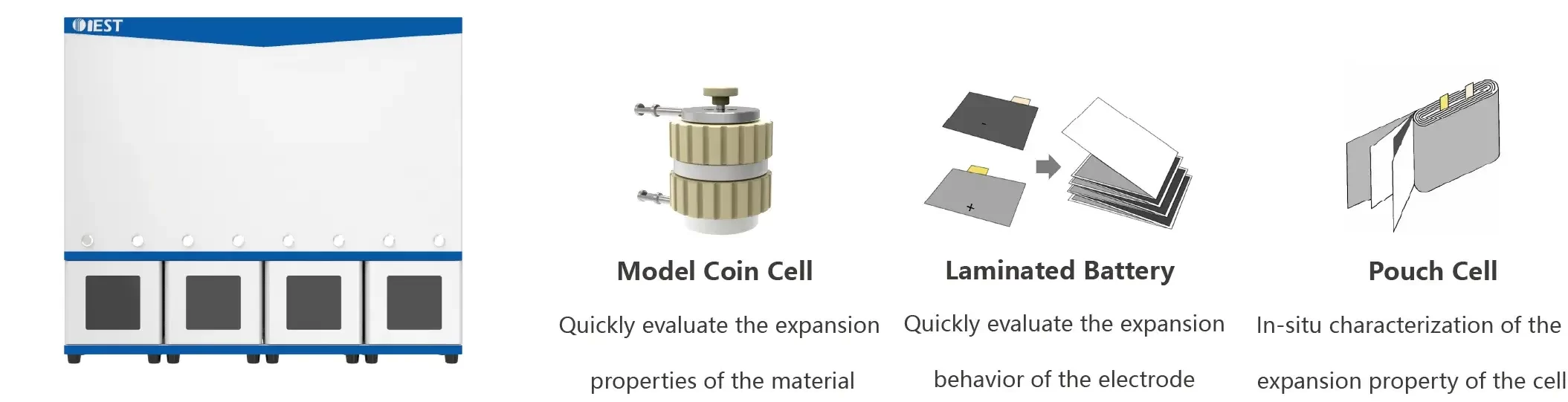
Figure 1. IEST Silicon-Based Anode Swelling In-Situ Rapid Screening System (four channels) — measures silicon anode swelling percentage directly at the coin-cell electrode level
2. Swelling Test of Three Different Silicon-Carbon Materials
2.1 Test Sample Information
- Cathode electrode: NCM811, cut into 14 mm diameter discs.
- Anode electrodes: Materials B, C, and D have matched capacity (~5.9 mAh) but different modification methods, cut into 16 mm diameter discs. Material B is a specially modified, low-expansion silicon-carbon anode material from a battery materials company in Ningbo; materials C and D are two common commercial silicon-carbon materials.
- Electrolyte: Commercial electrolyte.
- Separator: PP separator, cut into 18 mm diameter discs.
2.2 Test Information and Process
| No. | Test Steps | Cut-off Conditions | Current |
|---|---|---|---|
| 1 | Resting | 10h | \ |
| 2 | Constant current charge | 4.2V | 0.48mA |
| 3 | Resting | 10 min | \ |
| 4 | Constant current discharge | 3V | 0.48mA |
| 5 | Resting | 10 min | \ |
| 6 | Cycle | Skip to No.2 | 3 circles |
2.3 Analysis of Swelling Results
In a glove box, the three silicon-carbon materials were each assembled into a coin-cell full battery (using the same NCM811 cathode to preserve a single-variable comparison), then rapidly tested using the IEST silicon anode swelling in-situ screening system (Figure 2). All three silicon-carbon materials expand during charging and contract during discharge—consistent with anode swelling during lithium-ion intercalation on charge and anode contraction during de-intercalation on discharge. Although a full cell was assembled, overall cell swelling behavior is dominated by the negative (silicon-carbon) electrode, since cathode expansion and contraction is much smaller than anode swelling.[3] The inflection points of each material’s swelling curve align closely with the inflection points of its charge/discharge voltage curve, confirming that the swelling curve faithfully tracks lithium-ion intercalation/de-intercalation behavior.
The coin-cell swelling evaluation method also clearly resolves swelling differences between the three silicon-carbon materials. Over the same operating voltage range, material B’s overall swelling is much smaller than that of materials C and D, demonstrating that B’s specialized modification treatment substantially suppresses silicon-carbon anode swelling—reducing the side reactions swelling causes and ultimately improving cycling performance.
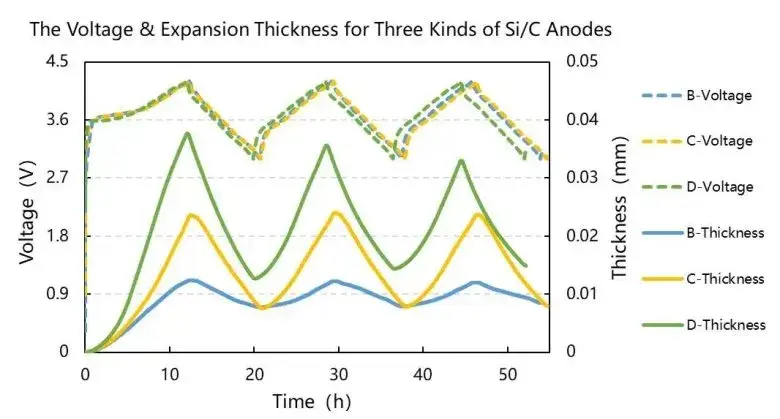
Figure 2. Coin-cell in-situ swelling thickness curves for silicon-carbon materials B, C, and D over 3 charge-discharge cycles — dotted line: voltage vs time; solid line: swelling thickness vs time. Material B (modified, low-expansion) shows substantially lower swelling than common commercial materials C and D.
| No. | 1 Cycle | 2 Cycle | 3 Cycle | |||
|---|---|---|---|---|---|---|
| Charging Expansion (µm) | Discharging Expansion (µm) | Charging Expansion (µm) | Discharging Expansion (µm) | Charging Expansion (µm) | Discharging Expansion (µm) | |
| B | 12.4 | -4.7 | 4.5 | -4.3 | 4.1 | -3.5 |
| C | 23.4 | -15.8 | 16.3 | -16.0 | 15.7 | -15.5 |
| D | 37.6 | -24.8 | 22.8 | -21.1 | 18.5 | 18.0 |
| No. | 1 Cycle | 2 Cycle | 3 Cycle | |||
|---|---|---|---|---|---|---|
| Charging Expansion | Discharging Expansion | Charging Expansion | Discharging Expansion | Charging Expansion | Discharging Expansion | |
| B | 26.38% | -10.00% | 9.57% | -9.15% | 8.72% | -7.45% |
| C | 60.00% | -40.51% | 41.79% | -41.03% | 40.26% | -39.74% |
| D | 113.94% | -75.15% | 69.09% | -63.94% | 56.06% | -54.55% |
Tables 2 and 3 quantify swelling thickness and swelling rate per cycle for all three materials. Two key patterns emerge:
- First-cycle swelling is highest: All three materials show greater swelling on the first charge than on the first discharge or on subsequent cycles, with measurable irreversible swelling in the first charge-discharge cycle. This occurs because the negative electrode forms an SEI film during the first charge—producing irreversible swelling on the active particle surface in addition to reversible lithium-intercalation swelling.
- Stabilized silicon anode swelling percentage: Comparing the last two charge-discharge cycles, modified material B shows an average swelling thickness of only ~4.2 µm and a swelling rate of ~8.9%. Material C’s average swelling is approximately 3.7× that of material B, and material D’s is approximately 5× that of material B—demonstrating that B’s modification strategy delivers a clear, quantifiable swelling-suppression effect.
3. Electron Microscope Verification of Silicon-Carbon Electrode Swelling
To validate the coin-cell swelling measurements against an independent method, the fully charged silicon-carbon electrodes were disassembled and their cross-sections measured by scanning electron microscope (Figure 3). After subtracting copper foil thickness, the type B silicon-carbon electrode coating expanded from ~50.81 µm to ~55.45 µm when fully charged—a total swelling of ~4.64 µm, closely matching the average swelling thickness measured by the coin-cell screening method. Materials C and D showed coating thickness expansion of approximately 11.98 µm and 14.65 µm respectively after full charge, consistent with the swelling data from the last two cycles in Table 2.
Whether measured by in-situ coin-cell screening or by disassembly and SEM cross-section measurement, the swelling trend across the three silicon-carbon materials is consistent: D > C > B.
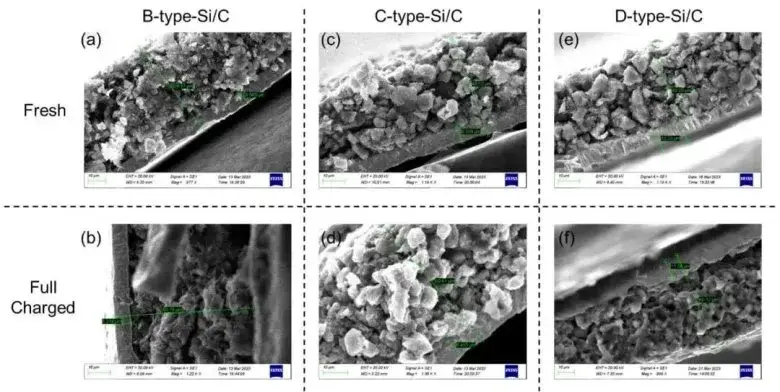
Figure 3. SEM cross-section images of three silicon-carbon electrodes before (Fresh) and after full charge (Full Charged): (a–b) material B; (c–d) material C; (e–f) material D — confirms the coin-cell swelling trend D > C > B
4. Summary
This study rapidly evaluated the swelling of three silicon-carbon materials with different modification conditions using the IEST Silicon-Based Anode Swelling In-Situ Screening System (RSS1400). None of the three silicon-carbon anodes required preparation as a pouch cell or stacked cell—each was assembled directly into a coin-cell format for in-situ swelling thickness measurement, eliminating the cumbersome finished-cell preparation step and substantially improving silicon material swelling-evaluation throughput.
The coin-cell in-situ test results show that specially modified material B’s silicon anode swelling percentage is far lower than common commercial materials C and D. Independent SEM cross-section measurement after full charge confirmed the same trend, validating that the IEST screening system enables direct, accurate evaluation of silicon anode swelling performance at the electrode level—with minimal material consumption and maximum throughput for R&D screening.
5. References
[1] M. Ashuri, Q.R. He and L.L. Shaw, Silicon as a potential anode material for Li-ion batteries: where size, geometry, and structure matter. Nanoscale 8 (2016) 74–103.
[2] X.H. Shen, R.J. Rui, Z.Y. Tian, D.P. Zhang, G.L. Cao and L. Shao, Development on silicon/carbon composite anode materials for lithium-ion battery. J. Chin. Cream. Soc. 45 (2017) 1530-1538.
[3] R. Koerver, W.B. Zhang, L. Biasi, S. Schweidler, A. Kondrakov, S. Kolling, T. Brezesinski, P. Hartmann, W. Zeier and J. Janek, Chemo-mechanical expansion of lithium electrode materials – on the route to mechanically optimized all-solid-state batteries. Energ. Environ. Sci. 11 (2018) 2142-2158.
6. FAQs
6.1 What is the typical silicon anode swelling percentage in lithium-ion batteries?
Silicon anode swelling percentage varies substantially depending on the specific silicon-carbon material and modification strategy used—there is no single fixed value. In this study, three commercial silicon-carbon materials with matched capacity (~5.9 mAh) showed swelling rates ranging from approximately 8.9% (specially modified, low-expansion material) to approximately 33–45% (common, unmodified commercial materials) over stabilized charge-discharge cycles. For reference, pure silicon can swell up to ~300% during full lithiation, while graphite anodes typically swell only ~10%. Silicon-carbon (Si/C) composite anodes fall between these extremes, with the exact silicon anode swelling percentage depending heavily on silicon loading, particle morphology, and surface modification (such as carbon coating or structural buffering layers).
6.2 How is silicon anode swelling percentage measured experimentally?
Silicon anode swelling percentage can be measured by two complementary methods. The first is in-situ thickness monitoring, where a high-precision thickness sensor tracks electrode or cell thickness in real time during charge-discharge cycling—either in a full pouch/stacked cell (using systems such as the IEST SWE series) or directly at the coin-cell electrode level (using the IEST RSS1400 silicon anode swelling screening system), without needing to build a finished cell. The second is ex-situ SEM cross-section measurement, where a fully charged electrode is disassembled and its coating thickness measured under a scanning electron microscope, by comparing fresh versus fully charged samples. In this study, both methods agreed closely: coin-cell in-situ measurement and SEM cross-section measurement showed the same swelling trend (D > C > B) and closely matching absolute swelling thickness values for each material.
6.3 Does silicon-carbon battery anode material swell during charging?
Yes. Silicon-carbon anode materials expand during charging and contract during discharging, consistent with lithium-ion intercalation into the silicon-carbon structure on charge and de-intercalation on discharge. In full-cell testing, this swelling and contraction is dominated by the negative (silicon-carbon) electrode—cathode expansion and contraction is comparatively minor. The inflection points of the swelling-thickness curve closely track the inflection points of the cell’s voltage curve, confirming that thickness change directly reflects the underlying lithium intercalation/de-intercalation process rather than an unrelated mechanical artifact.
6.4 Why does silicon-carbon anode swelling differ so much between different commercial materials?
Silicon-carbon anode swelling percentage depends heavily on particle-level modification rather than being an intrinsic property of “silicon-carbon” as a generic material category. In this study, three silicon-carbon materials with matched electrochemical capacity showed swelling rates differing by up to 5×, because one material (B) incorporated specialized modification—likely including carbon coating optimization, controlled silicon particle size, or engineered buffering structure—that suppresses the mechanical expansion generated during lithium alloying. The other two materials (C, D), representing common commercial silicon-carbon products without this modification, showed substantially higher swelling. This demonstrates that swelling percentage is a key differentiator for material selection, separate from and in addition to specific capacity and cycle efficiency metrics.
6.5 What is the difference between first-cycle and stabilized silicon anode swelling?
First-cycle swelling in silicon anode materials is consistently higher than swelling in later, stabilized cycles, because the first charge generates the initial solid electrolyte interphase (SEI) film on the silicon particle surface. This SEI formation adds an irreversible swelling component on top of the reversible swelling from lithium intercalation, meaning some of the first-cycle thickness increase does not fully reverse on the subsequent discharge. By the second and third cycles, the SEI film has largely stabilized, and the measured swelling thickness more closely reflects the material’s intrinsic, reversible lithiation-driven volume change. For this reason, silicon anode swelling percentage reported for material comparison purposes should specify whether it refers to first-cycle or stabilized-cycle data, since the two can differ substantially.