-
iestinstrument

Abstract
Graphite anode volume expansion during lithiation in lithium-ion batteries is typically 10–15% by thickness, while silicon-based anodes can undergo up to 300% volume expansion at full lithiation. Cathode materials expand in the opposite direction from what might be expected: NCM and LCO cathodes also expand during delithiation — not shrink — due to increased interlayer Coulomb repulsion in the c-axis direction, contributing approximately 6.5% (NCM) and 1.9% (LCO) volume change. In-situ half-cell decoupling experiments using the IEST RSS1400 system confirm that for a full battery, more than 80% of total thickness expansion originates from the anode side, while cathode expansion accounts for less than 10%.
1. Why Cathode and Anode Electrodes Both Expand — and Why It Matters
Electrode volume expansion — the reversible and irreversible dimensional change of cathode and anode electrode materials during lithium-ion intercalation and de-intercalation — is one of the most mechanically consequential phenomena in lithium-ion battery cycling. Understanding the individual contributions of each electrode to total cell expansion is essential for designing mechanically robust cell formats, selecting appropriate buffer materials for module assembly, and guiding targeted material optimization.
During charging, the anode undergoes lithium intercalation (graphite, hard carbon) or lithium alloying (silicon-based, lithium metal). Both processes cause anode material to expand significantly as lithium is inserted into the host structure. The magnitude varies widely by material:
| Electrode | Material | Volume Expansion | Mechanism |
|---|---|---|---|
| Anode | Graphite | 10–15% | Li intercalation between graphene layers; stage transitions expand c-axis spacing |
| Hard carbon | ~10% | Li insertion into disordered carbon micropores and interlayer sites | |
| Silicon-based (SiC, SiO) | Up to 300% | Li–Si alloying forms Li15Si4 (full lithiation), causing massive volumetric expansion; irreversible component accumulates each cycle | |
| Lithium metal | Variable (unlimited) | Li plating/stripping; infinite theoretical expansion due to hostless deposition; dendrite growth compounds irreversibility | |
| Cathode | NCM (NMC) | ~6.5% | Delithiation increases interlayer Coulomb repulsion in c-axis direction → expansion despite lithium removal |
| LFP (LiFePO4) | ~6.5% | ||
| LMO (LiMn2O4) | ~7.3% | ||
| NCA | ~6% | ||
| LCO (LiCoO2) | ~1.9% |
A critical and frequently misunderstood point: cathode materials also expand during delithiation (charging) rather than contracting. When lithium ions are extracted from layered cathode materials such as NCM or LCO, the electrostatic repulsion between transition-metal oxide layers in the c-axis direction increases — because lithium ions, which previously screened this repulsion, are removed. This increased Coulomb repulsion causes the c-axis lattice parameter to expand, producing macroscopic electrode expansion despite the concurrent removal of mass (lithium) from the structure.[1,2]
Graphite anode capacity and its relationship to expansion: the theoretical specific capacity of graphite is 372 mAh/g, corresponding to the fully lithiated stage (LiC₆). In practice, commercial graphite anodes deliver 340–370 mAh/g in the first cycle, with Coulombic efficiency of 90–95%. The 10–15% graphite anode volume expansion occurs over the full lithiation range and is correlated with capacity utilization — the thickness expansion produced per unit capacity (mAh/g) provides a material-intrinsic expansion efficiency metric that is directly measured in the half-cell experiments described in this study.
Standard whole-cell swelling measurements capture the combined expansion of both electrodes, making it impossible to determine how much each electrode individually contributes. Conventional half-cell assemblies using lithium counter electrodes cannot solve this either: lithium metal itself undergoes severe volume changes during lithium deposition and dissolution, contaminating the expansion signal from the electrode under study. IEST’s specially designed monopolar expansion mold addresses this by structurally isolating the lithium counter electrode’s dimensional changes, enabling clean decoupling of individual electrode expansion signals.
2. Testing Conditions and Equipment
2.1 Testing Equipment
In-situ charge and discharge expansion testing of cathode and anode half-cells used IEST’s custom-designed monopolar expansion test mold; full coin-cell expansion used IEST’s custom coin-cell mold. The structural configurations of both are shown in Figure 1(b) and 1(c). Real-time thickness expansion data at each lithiation state were recorded using the RSS1400 Silicon-Based Anode Expansion In-Situ Rapid Screening System (IEST), equipped with a high-precision displacement sensor as shown in Figure 1(a).
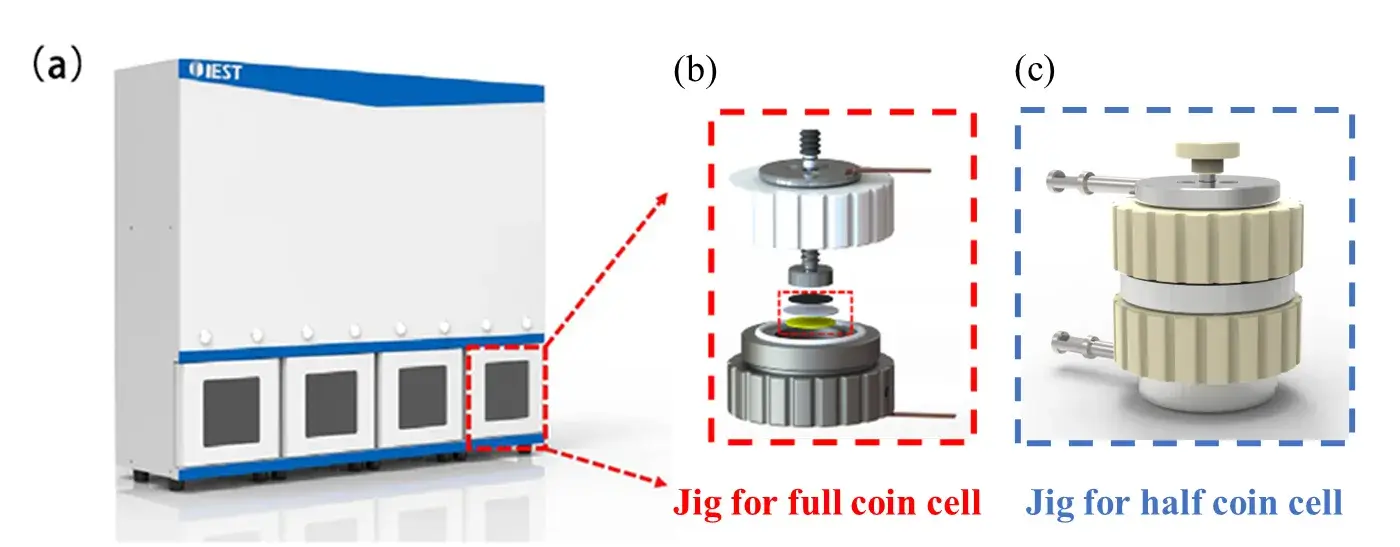
Figure 1. (a) IEST RSS1400 Silicon-Based Anode Expansion In-Situ Rapid Screening System with high-precision displacement sensor; (b) Custom coin-cell mold for full-cell expansion measurement; (c) Monopolar half-cell mold for isolated cathode or anode electrode expansion measurement — structurally isolating lithium counter-electrode dimensional changes.
2.2 In-Situ Testing Protocol
Step 1 — Full coin-cell baseline: NCM523 cathode and SiC (silicon-carbon composite) anode were assembled into a full coin cell using the custom coin-cell mold (Figure 1(b)). Cells were charged and discharged at 0.1C rate under 5 kg preload, with in-situ thickness expansion recorded continuously.
Step 2 — Half-cell decoupling: NCM523 cathode and SiC anode were each assembled separately into the monopolar expansion test mold (Figure 1(c)) against lithium counter electrodes. Each half-cell was cycled at 0.1C under 5 kg preload. Charge/discharge voltage ranges: NCM523 full cell and cathode half-cell: 3.0–4.25 V; SiC anode half-cell: 0.005–2.0 V (vs. Li/Li⁺). Thickness expansion curves for each electrode were recorded in-situ.
3. Results: Quantifying Each Electrode’s Contribution to Total Battery Expansion
Table 2 summarizes the electrochemical performance of half-cells and full cell across two charge/discharge cycles. A key observation: the charge/discharge efficiency of the half-cell configuration using the monopolar expansion mold is slightly lower than that of a standard commercial 2032 coin cell. This is attributable to the specialized ceramic separator and fixture geometry required to isolate the lithium counter electrode expansion from the working electrode signal. Importantly, since thickness expansion is proportional to charge/discharge capacity, and the capacity values differ between half-cells and full cell, all expansion data were normalized to capacity — expressing thickness expansion per unit capacity (μm/mAh) — to enable direct comparison.
| Cycle | NCM523/Li (Half Coin Cell) | SiC/Li (Half Coin Cell) | NCM523/SiC (Full Coin Cell) | ||||||
|---|---|---|---|---|---|---|---|---|---|
| Chg Cap (mAh) | Dchg Cap (mAh) | Eff (%) | Chg Cap (mAh) | Dchg Cap (mAh) | Eff (%) | Chg Cap (mAh) | Dchg Cap (mAh) | Eff (%) | |
| 1 | 4.058 | 2.793 | 58.83% | 5.212 | 7.595 | 80.71% | 4.058 | 2.793 | 58.83% |
| 2 | 2.492 | 2.243 | 90.04% | 5.704 | 5.792 | 83.98% | 2.492 | 2.243 | 90.04% |
3.1 Voltage–Time Profiles: Capacity-Normalized Comparison
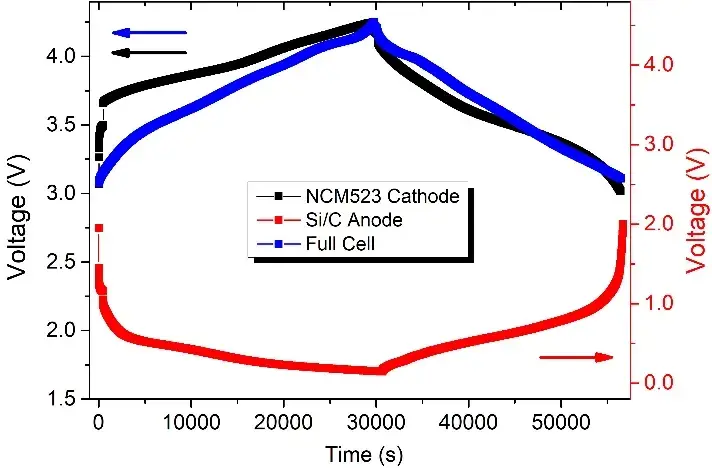
Figure 2. Voltage versus capacity-normalized time for the second charge/discharge cycle: NCM523 cathode half-cell (3.0–4.25 V), SiC anode half-cell (0.005–2.0 V vs. Li/Li⁺), and NCM523/SiC full coin cell (3.0–4.25 V). All curves are normalized to their respective capacity utilization for direct expansion comparison.
3.2 Decoupled Expansion Results: Anode Dominates Full-Cell Expansion

Figure 3. Capacity-normalized thickness expansion (unit capacity expansion, μm/mAh) versus time for the second charge/discharge cycle: SiC anode half-cell, NCM523 cathode half-cell, and NCM523/SiC full coin cell. The SiC anode expansion dominates the full-cell signal, contributing >80% of total battery thickness change; NCM523 cathode expansion contributes <10%.
The decoupled expansion measurements reveal a clear quantitative hierarchy in electrode expansion contributions to full-cell swelling:
| Electrode | Contribution to Full-Cell Expansion | Consistency with Literature |
|---|---|---|
| SiC anode (silicon-carbon composite) | >80% | ✅ Consistent with published literature[4,5] |
| NCM523 cathode | <10% | ✅ Consistent with published literature[4,5] |
| Remaining balance | ~10–20% | Electrolyte, SEI growth, gas evolution, and cell hardware contributions |
The dominance of anode expansion in total cell swelling reflects the fundamental asymmetry between anode and cathode volume change mechanisms. Silicon-carbon (SiC) composite anodes have intrinsic volume expansion up to 300% for pure silicon phases, with the carbon matrix partially buffering this expansion. Graphite anodes expand 10–15% per full lithiation cycle. Both are substantially larger than the cathode expansion (<10% for most commercial cathode materials).
Furthermore, the cathode’s expansion mechanism — interlayer Coulomb repulsion during delithiation — is generally more isotropic and mechanically well-contained within the layered crystal structure, making cathode expansion less damaging to electrode integrity per unit volume change compared to the anisotropic, particle-fracture-prone expansion of silicon-based anodes.
4. Summary
This study uses IEST’s monopolar expansion test molds and the IEST RSS 1400 In-Situ Silicon-Based Anode Swelling Rapid Screening System to decouple and independently quantify the volume expansion contributions of cathode and anode electrodes in a lithium-ion full cell. Despite the charge/discharge efficiency of the monopolar mold being slightly lower than a standard 2032 commercial coin cell — a result of the specialized ceramic separator required to isolate the lithium counter electrode — the expansion decoupling results are clear and consistent with published literature:
- The SiC silicon-carbon anode accounts for more than 80% of the total full-cell thickness expansion.
- The NCM523 cathode contributes less than 10% of full-cell expansion — and this contribution is expansion (not contraction) due to interlayer Coulomb repulsion during delithiation.
- Graphite anodes expand 10–15% during lithiation; silicon-based anodes can reach 300% expansion at full lithiation.
- Reference volume expansions for common cathode materials: LFP ≈ 6.5%, LCO ≈ 1.9%, LMO ≈ 7.3%, NCM ≈ 6.5% (Ni-content dependent), NCA ≈ 6%.[4,5]
These quantitative results provide electrode-material developers with a clear framework: for batteries with silicon-based anodes, reducing anode volume expansion is the primary lever for improving cell swelling performance — because the anode’s contribution exceeds 80% of total expansion. Cathode material changes — while important for energy density and cycle life — have a disproportionately smaller impact on overall cell swelling management. The IEST monopolar expansion mold and RSS1400 system enable this decoupling measurement to be performed routinely, supporting data-driven material selection and targeted optimization of anode formulations for low-expansion battery designs.
5. References
[1] F.B. Spingler, S. Kucher, R. Phillips, E. Moyassari and A. Jossen, Electrochemically Stable In-Situ Dilatometry of NCM, NCA and Graphite Electrodes for Lithium-ion Cells Compared to XRD Measurements. J. Electrochem. Soc. 168 (2021) 040515.
[2] B. Rieger, S. Schlueter, S.V. Erhard and A. Jossen, Strain Propagation in Lithium-ion Batteries from the Crystal Structure to the Electrode Level. J. Electrochem. Soc. 163 (2016) A1595-A1606.
[3] C. Luo, H. Hu, T. Zhang, S.J. Wen, R. Wang, Y.N. An, S.S. Chi, J. Wang, C.Y. Wang, J. Chang, Z.J. Zheng and Y.H. Deng, Roll-to-Roll Fabrication of Zero-Volume-Expansion Lithium-Composite Anodes to Realize High-Energy-Density Flexible and Stable Lithium-Metal Batteries. Adv. Mater. 34 (2022) 2205677.
[4] R. Koerver, W.B. Zhang, L. Biasi, S. Schweidler, A.O. Kondrakov, S. Kolling, T. Brezesinski, P. Hartmann, W.G. Zeier and J. Janek, Chemo-mechanical expansion of lithium electrode materials – on the route to mechanically optimized all-solid-state batteries. Energy Environ. Sci. 11 (2018) 2142-2158.
[5] Y. Koyama, T.E. Chin, U. Rhyner, R.K. Holman, S.R. Hall and Y.M. Chiang, Harnessing the Actuation Potential of Solid-State Intercalation Compounds. Adv. Funct. Mater. 16 (2006) 492-498.
6. FAQs
6.1 How much does a graphite anode expand during lithiation?
Graphite anode volume expansion during lithiation is typically 10–15% by thickness at full lithiation (LiC₆ stage), corresponding to the complete filling of graphene interlayer sites with lithium. This expansion occurs in discrete steps as lithium fills the graphite staging structures (stages 4 → 3 → 2 → 1), with each stage transition producing a distinct expansion increment visible as a voltage plateau in the half-cell charge curve (near 0.09 V and 0.13 V vs. Li/Li⁺ for graphite). The 10–15% thickness expansion is reversible per cycle but mechanical fatigue accumulates over hundreds of cycles as the graphite particles experience repeated strain during lithiation and de-lithiation.
6.2 How much does a silicon anode expand? Why is it 300%?
Silicon anodes can expand up to 300% in volume (approximately 280% in linear dimensions) at full lithiation, when silicon forms the Li₁₅Si₄ alloy phase. This extreme expansion occurs because silicon participates in an alloying reaction rather than intercalation: each silicon atom can host up to 3.75 lithium atoms, requiring a dramatic restructuring of the silicon crystal lattice that produces far greater volumetric change than the simple layer-spacing increase in graphite. Silicon-carbon composite (SiC) anodes typically exhibit reduced effective expansion (below 300%) because the carbon matrix absorbs and buffers some of the silicon expansion — but even buffered SiC anodes expand far more than graphite. This large and partially irreversible expansion is the primary reason silicon anodes cause accelerated capacity fade and cell swelling in full batteries.
6.3 What is the capacity of a graphite anode in mAh/g?
The theoretical specific capacity of graphite is 372 mAh/g, corresponding to the fully lithiated LiC₆ stage where one lithium atom is hosted per six carbon atoms. Commercial graphite anodes in lithium-ion batteries typically deliver 340–360 mAh/g in practical operation, with first-cycle Coulombic efficiency of 90–95% (the remainder is consumed in forming the SEI layer). The capacity utilization is directly related to volume expansion: at the theoretical capacity (372 mAh/g, full LiC₆ lithiation), graphite expansion reaches its maximum 10–15%. The capacity-normalized expansion (μm/mAh) measured in half-cell experiments represents the mechanical cost per unit of energy stored — a key material selection metric for balancing energy density against mechanical stability.
6.4 How does silicon anode volume expansion compare to graphite? Silicon 300% vs graphite 10%?
Silicon anode volume expansion (up to 300%) is approximately 20–30× greater than graphite anode expansion (10–15%). This fundamental difference arises from the reaction mechanism: graphite expands through lithium intercalation between graphene layers (~3.35 Å spacing increases to ~3.7 Å at full lithiation), producing moderate and reversible expansion. Silicon undergoes lithium alloying, where the silicon crystal structure completely transforms to an amorphous Li–Si alloy, requiring a volume increase proportional to the ~3.75 Li atoms hosted per Si atom. In in-situ half-cell decoupling experiments with a silicon-carbon composite (SiC) anode paired against an NCM523 cathode, the anode contributes more than 80% of total full-cell thickness expansion despite the NCM cathode also expanding ~6.5% during delithiation.
6.5 Does the cathode electrode expand or shrink during charging? Why?
Cathode electrodes expand during charging (delithiation), not shrink — counterintuitive because lithium is being removed and the electrode loses mass. The reason is interlayer Coulomb repulsion: in layered cathode structures such as NCM or LCO, lithium ions between transition-metal oxide layers act as electrostatic screeners. When lithium is extracted, the repulsion between negatively charged oxide layers in the c-axis direction increases, forcing the layers apart and expanding the crystal structure macroscopically. Common cathode volume expansions: NCM ≈ 6.5%, LFP ≈ 6.5%, LMO ≈ 7.3%, LCO ≈ 1.9%, NCA ≈ 6%. Despite this expansion, cathode contribution to total full-cell thickness change is less than 10% compared to the anode’s dominant 80%+ contribution, because cathode materials expand less than graphite and far less than silicon-based anodes.
6.6 How can you separately measure cathode and anode volume expansion using half-cells?
Decoupling cathode and anode volume expansion requires three measurements: (1) a full coin-cell swelling measurement for the reference total expansion; (2) a cathode half-cell expansion measurement with the cathode electrode paired against a lithium counter electrode; (3) an anode half-cell expansion measurement with the anode against lithium. The key engineering challenge is that lithium metal counter electrodes themselves undergo large volume changes during cycling, which confounds the electrode expansion signal being measured. IEST‘s monopolar expansion test mold solves this by using a specialized structural design and dedicated ceramic separator that mechanically isolates the lithium counter electrode’s dimensional changes from the working electrode expansion sensor — allowing clean, independent measurement of cathode or anode thickness change during cycling.
6.7 What percentage of full battery thickness expansion comes from the anode vs. cathode?
In-situ half-cell decoupling experiments on an NCM523/SiC (silicon-carbon composite) coin cell show that the anode accounts for more than 80% of total full-cell thickness expansion, while the cathode contributes less than 10%. This result is consistent across multiple published studies using different cathode and anode material systems. The dominant anode contribution reflects the inherently larger volume change of anode materials (graphite: 10–15%; silicon composite: up to 300%) compared to cathode materials (NCM, LFP, NCA: 6–7%; LCO: ~2%). For battery module engineers and materials developers, this means that anode expansion management — through material selection (lower-silicon content SiC composites, optimized graphite), electrode engineering (compaction density, binder formulation), and swelling compensation design — has far greater impact on overall cell and module swelling performance than equivalent cathode optimization.