-
iestinstrument

Abstract
Compaction density—defined as the mass of active material per unit volume of the calendered electrode sheet—is a primary design parameter for cathode electrode sheets in lithium-ion batteries. It quantifies how densely active material particles pack after roll-pressing and directly determines areal capacity, electrode porosity, electrolyte wetting, ion transport resistance, and cycle life. For commercial cathode materials, achievable compaction density follows the hierarchy: LiCoO₂ (LCO, ~3.9–4.1 g/cm³) > NCM ternary (~3.3–3.8 g/cm³) > LiMn₂O₄ (LMO, ~3.0–3.3 g/cm³) > LiFePO₄ (LFP, ~2.2–2.5 g/cm³), primarily reflecting differences in material true density. Within each material class, particle morphology, particle size distribution (PSD), and electrode manufacturing process parameters—binder content, conductive additive loading, coating weight, and calendering conditions—determine how closely the electrode approaches its theoretical maximum. This article analyzes each factor, presents SEM-based evidence, and outlines practical strategies for cathode powder battery testing and process optimization.
1. Why Compaction Density of Cathode Electrode Sheets Matters
During lithium-ion battery manufacturing, electrode density has a direct and measurable impact on cell performance. Within a material’s allowable compaction range, higher electrode density enables greater areal capacity and thus higher cell energy density—making it a key indicator for estimating a material’s practical energy output. However, the relationship is not monotonic: optimizing compaction density requires balancing several competing effects.
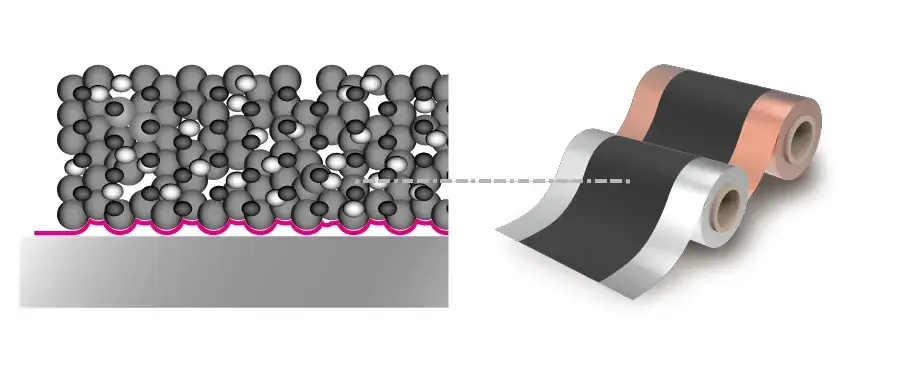
Figure 1. Electrode sheet structure — compaction density controls the pore volume remaining after calendering
As electrode density increases, inter-particle voids decrease. This reduction in porosity directly limits electrolyte absorption and electrolyte wetting of the electrode, reducing accessible surface area for lithium-ion intercalation. The practical consequences of over-compaction include:
- Poor specific capacity utilization due to restricted electrolyte access to inner particle surfaces
- Reduced electrolyte retention, increasing polarization during charge and discharge
- Accelerated capacity fade from mechanical fracture of active material particles under excessive calendering pressure
- Elevated internal resistance from restricted ion transport pathways through the electrode thickness
Conversely, insufficient compaction density leaves excessive porosity, wastes volumetric capacity, and allows poor electrical contact between particles. The optimal electrode density maximizes discharge capacity, minimizes internal resistance and polarization losses, and sustains cycle life—while maintaining sufficient porosity for electrolyte wetting and lithium-ion diffusion.
2. Key Factors Affecting Cathode Electrode Compaction Density
Five primary factors determine the achievable compaction density of cathode electrode sheets:
-
Material True Density
- Particle Morphology and Its Effect on Packing Efficiency
-
Material particle size Distribution and Packing Theory
- Electrode Manufacturing Process Parameters
- Calendering Pressure and Temperature
2.1 Material True Density
True density is the theoretical density of the pure crystalline cathode material, with no intra-particle voids. It imposes the absolute upper bound on achievable compaction density—no real electrode can exceed the true density of its active material. Table 1 shows true density and typical compaction density ranges for common commercial cathode materials (with NCM111 used as the ternary reference).
| Cathode materials | Lithium cobalt oxide | Ternary materials | Lithium iron phosphate | Lithium manganate |
|---|---|---|---|---|
| True Density/(g·cm⁻³) | 5.1 | 4.8 | 3.6 | 4.2 |
| Compaction Density/(g·cm⁻³) | 4.1–4.3 | 3.4–3.7 | 2.2–2.3 | 2.9–3.2 |
The rank order of true density—LCO > NCM > LMO > LFP—directly determines the upper limit for each material’s electrode density. Notably, LFP true density is significantly lower than other cathodes (~3.5 g/cm³), constraining its achievable compaction density to ~2.2–2.5 g/cm³ regardless of morphology or process optimization. For NCM materials, true density varies with nickel-manganese-cobalt ratio: higher nickel content generally increases true density and thus raises the ceiling for electrode compaction.
2.2 Particle Morphology and Its Effect on Packing Efficiency
Material morphology often dominates packing efficiency within a material class. Commercial LiCoO₂ typically presents as large, dense primary (single) crystals, while most NCM powders are secondary agglomerates composed of fine primary nanocrystals held together by surface energy. These structural differences produce dramatically different electrode behaviors:
-
Secondary agglomerate morphology (typical NCM): Secondary particles contain internal voids between constituent nanocrystals. During calendering, inter-spherical voids between secondary particles persist—and the secondary particles themselves may fracture, releasing unbound primary crystals that lack binder contact and contribute to loose material. Both effects lower electrode density and create inconsistent inter-particle electrical contact.
-
Single-crystal or large-primary-crystal morphology (LCO, optimized NCM): Absence of internal agglomerate voids enables denser packing. Larger crystals resist fragmentation during calendering, and with well-dispersed binder, detachment of primary particles is minimized. The result is higher, more reproducible electrode density.
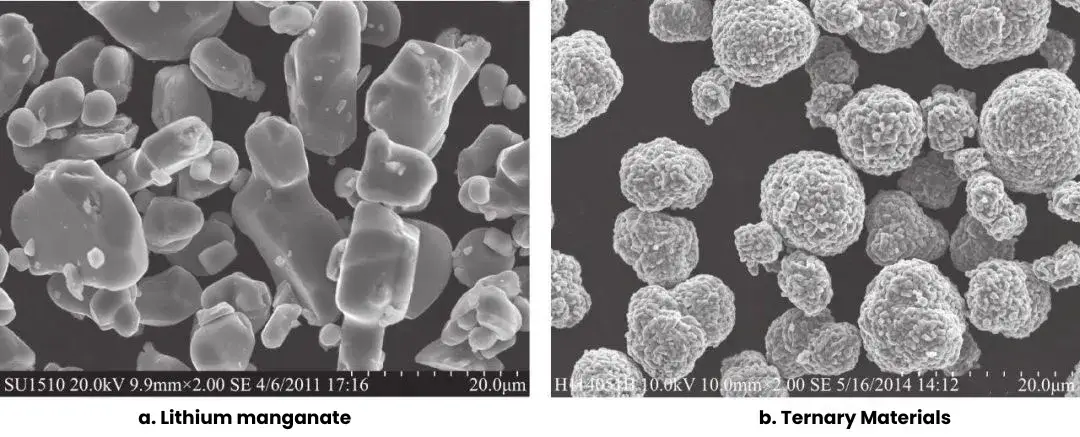
Figure 2. SEM comparison of LiCoO₂ (single crystal, high packing efficiency, higher compaction density) and NCM ternary (secondary agglomerates, lower packing efficiency)
2.3 Particle Size Distribution and Packing Theory
Even for particles of the same morphology, particle size distribution (PSD) profoundly affects packing density. Monosized spheres in random packing leave approximately 36–40% void fraction—independent of sphere diameter. However, when a bimodal or multimodal PSD is used, smaller particles fill the voids between larger ones, increasing overall packing density toward the theoretical limit.
In practice:
-
A narrow, monosized distribution (very similar D₁₀, D₅₀, D₉₀) produces high inter-particle void volume and limits compaction density.
-
An excessively broad distribution with very fine particles creates viscosity problems in slurry processing and can impair coating uniformity.
- A well-controlled bimodal or multimodal distribution—optimized D₁₀/D₅₀/D₉₀ ratios—enables small particles to fill the voids between large particles, maximizing electrode density without sacrificing processability.
Some battery manufacturers specify strict PSD requirements to their active material suppliers; others blend materials with different distributions during mixing to optimize final electrode density. Materials with the same D₅₀ but different D₁₀, D₉₀, or D_max values can produce substantially different compaction densities on otherwise identical electrode lines.
2.4 Electrode Manufacturing Process Parameters
Even with a fixed active material, formulation and process choices significantly influence final electrode density. The main process variables are:
Binder type and content: Common cathode binders such as PVDF have a true density of approximately 1.75–1.80 g/cm³—significantly lower than the active material (~3.5–5.0 g/cm³) and conductive additives (~1.8–2.2 g/cm³). Higher binder loading reduces the effective density of the electrode composite and may also create elastic springback after calendering, limiting achievable compaction. Minimizing binder while maintaining mechanical integrity is therefore a consistent target in cathode electrode formulation.
Conductive additive type and loading: Table 2 lists true densities for common conductive agents. Carbon black grades (Super-P, KS-6) have true densities of approximately 1.8–2.1 g/cm³; carbon nanotubes are similar or slightly higher. Reducing additive percentage—enabled by using highly conductive agents that require lower loading for equivalent conductivity—allows more active material per unit volume, directly increasing compaction density. Carbon nanotubes and graphene-based additives are increasingly used for this reason.
Table 2. True density of common conductive agents and binders — additive selection directly affects electrode compaction density

Coating areal weight (g/cm²): Electrodes with higher coating areal weight—thicker coatings—can achieve higher compaction density at a given calendering pressure because the thicker active layer offers more compressible volume. Very thin coatings may not compact uniformly, producing more variable electrode density.
Mixing and dispersion quality: Insufficient mixing leaves binder and conductive agent unevenly distributed, creating regions of poor inter-particle contact. High-speed mixing with controlled temperature and sequence achieves uniform dispersion, reducing local voids and improving both electrode density and its spatial uniformity across the sheet.
2.5 Calendering Pressure and Temperature
Calendering—passing the coated electrode between precision rolls under controlled pressure—is the final and most direct lever for setting electrode density. Key relationships are:
- Higher calendering pressure increases compaction density, up to the material’s fracture limit. Beyond this threshold, particle cracking increases internal surface area but reduces structural integrity and can sever binder bridges.
- Elevated calendering temperature softens the binder (particularly PVDF), reducing springback and enabling higher final density at equivalent pressure. Temperature must be controlled to avoid binder decomposition.
- Multi-pass calendering at progressively increasing pressure achieves more uniform density through the electrode thickness than a single high-pressure pass, because it allows stress to redistribute between passes.
- Roll speed affects the dwell time under pressure; slower speeds generally produce higher compaction for the same roll gap setting.
3. Practical Strategies to Increase Cathode Electrode Compaction Density
Current optimization approaches focus on three areas: material morphology engineering, PSD control, and process refinement. These are not mutually exclusive—the highest electrode densities are achieved by optimizing all three simultaneously.
3.1 Morphology Optimization
Figure 3 shows SEM images of three NCM variants with different primary crystal morphologies and their corresponding calendered cathode electrode sheets, along with the measured compaction densities at equivalent calendering conditions.
-
Morphology (a): Conventional NCM secondary agglomerates of nano-scale primary crystals. The electrode (b) shows large inter-particle voids and crushed secondary particles with detached primary crystals lacking binder contact—the lowest density of the three.
-
Morphology (c): Single crystals slightly larger than in (a). The electrode (d) shows minimal inter-particle voids; without secondary particle breakdown, detachment is suppressed with proper binder distribution.
- Morphology (e): Agglomerates with much larger primary crystals and looser inter-crystal contacts. The electrode (f) shows significantly reduced voids and achieves a compaction density of 3.9 g/cm³—the highest of the three—with further improvement possible through high-speed mixing optimization.

Figure 3. NCM morphology variants (a, c, e), corresponding calendered electrode SEM images (b, d, f), and compaction density comparison (g) — morphology (e) with large primary crystals achieves 3.9 g/cm³, the highest of the three
3.2 Particle Size Distribution Optimization
Figure 4 illustrates the SEM-visible effect of PSD on cathode electrode sheet microstructure. Materials with controlled bimodal or broad distributions show visibly fewer large voids in the calendered electrode, confirming that smaller particles fill the interstices between large ones.

Figure 4. SEM images of cathode electrode sheets with different particle size distributions — controlled bimodal PSD reduces inter-particle void volume and improves compaction density
Effective PSD optimization strategies include:
-
Specifying D₁₀, D₉₀, and D_span (not just D₅₀) in supplier quality specifications
-
Blending two particle populations with a large/small diameter ratio of ~7:1 to approach theoretical maximum packing
- Controlling milling conditions to avoid creating excessive fines (<1 µm) that increase slurry viscosity and hinder uniform coating
3.3 Process Optimization
With a fixed active material, measurable compaction density improvements are achievable through:
-
Replacing Super-P with lower-loading high-conductivity additives (CNT, graphene hybrid) to reduce total additive volume fraction
-
Reducing PVDF binder to the minimum level consistent with adhesion and flexibility requirements; using water-soluble CMC/SBR systems for graphite anodes where applicable
- Implementing high-speed planetary or dual-asymmetric centrifuge mixing to achieve uniform dispersion and break up soft agglomerates before coating
- Multi-pass calendering with progressively increasing pressure to reduce springback and improve through-thickness density uniformity
- Optimizing calendering temperature to soften binder and reduce elastic recovery after the calender nip
4. How to Measure Compaction Density: Cathode Powder Battery Testing Methods
Accurate compaction density measurement is essential for both material development and production quality control. Several cathode powder battery testing methods are used in practice:
- Tapped density (ASTM B527): a powder measurement made by mechanically tapping a graduated cylinder until volume stabilizes. Tapped density correlates with electrode compaction density but does not replicate the uniaxial stress state of a calender roll. It is useful for rapid screening but should not replace direct electrode testing.
- Calendered electrode density: measured by dividing the coating areal weight by the measured coating thickness (total electrode thickness minus current collector foil thickness) after calendering. This is the direct, most relevant measurement for electrode design.
- Powder compaction density under controlled pressure: performed with a dedicated powder resistivity and compaction density tester such as the IEST PRCD3100, which applies controlled uniaxial pressure (0.15–350 MPa in user-defined increments) to a loose powder sample while recording bulk density, resistivity, and conductivity in real time. This method characterizes the full pressure-density curve, enabling prediction of electrode behavior across different calendering pressures and direct comparison of candidate materials before electrode fabrication.
5. IEST PRCD3100 Powder Resistivity & Compaction Density Measurement System
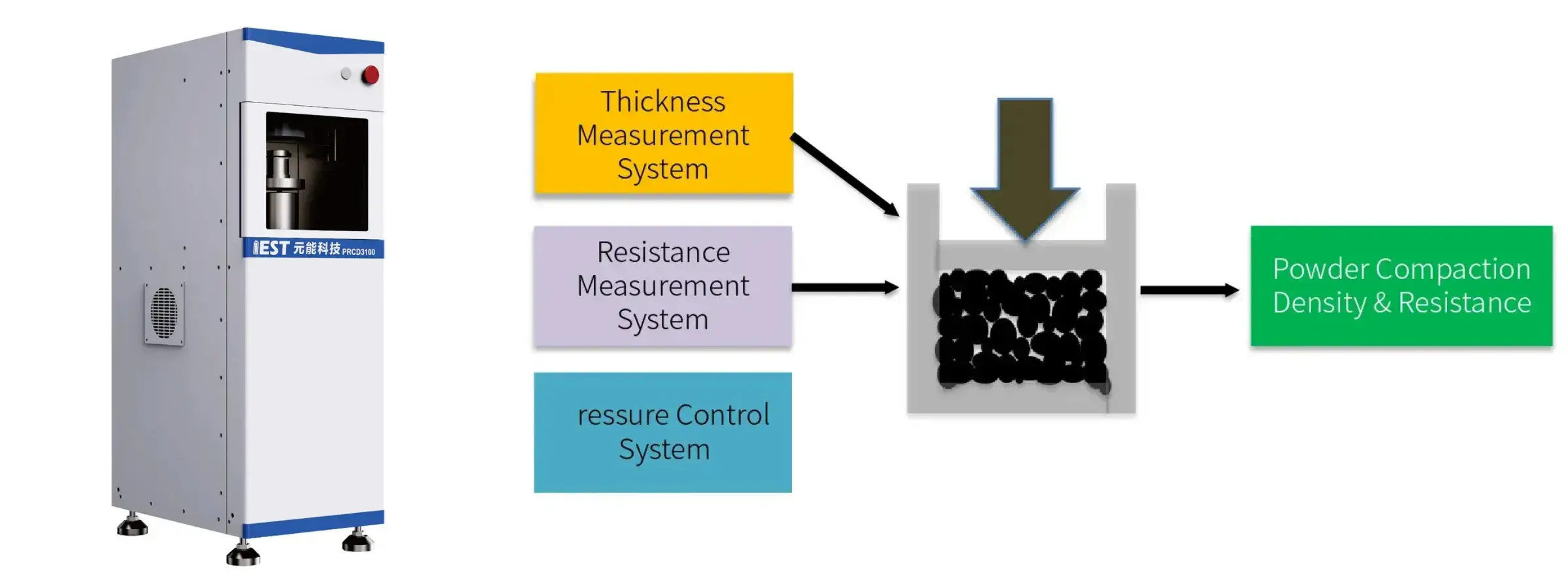
Figure 5. IEST PRCD3100 Powder Resistivity & Compaction Density Measurement System — high-precision pressure control with simultaneous thickness and resistance recording; supports four-probe and two-probe measurement modes
The PRCD3100 integrates high-precision pressure control with simultaneous thickness and resistance measurement, offering free selection between four-probe (eliminating contact resistance for absolute resistivity) and two-probe (through-thickness, mimicking electrode conditions) configurations. It is designed for:
-
Systematic cathode powder battery testing across the full pressure range relevant to electrode calendering (0.15–350 MPa).
-
Direct comparison of candidate cathode materials—LCO, NCM, LFP, and others—under identical conditions, enabling materials R&D teams to screen morphology and PSD variants quantitatively.
-
Batch-to-batch consistency monitoring in production: tracking lot-to-lot variation in powder compaction density and resistivity as a QC gate before electrode manufacturing.
-
Conductive agent and solid electrolyte powder characterization.
By measuring the complete pressure-density curve from 0.15 to 350 MPa rather than a single-point measurement, the PRCD3100 provides process engineers with the calibration data needed to set calendering pressure targets and predict springback behavior for new material formulations.
6. Summary and Design Guidelines
Compaction density of cathode electrode sheets is a multi-factorial outcome, and optimizing it requires a systematic approach across materials selection, formulation, and manufacturing. Key guidelines for electrode designers:
-
True density sets the ceiling. No amount of morphology or process optimization can push electrode density above the active material’s true density. Selecting a high-true-density material (LCO > NCM > LMO > LFP) is the most direct way to raise the compaction target.
-
Morphology determines packing efficiency. For NCM-type cathodes, developing single-crystal or large-primary-crystal morphologies is the highest-leverage improvement—as demonstrated by the 3.9 g/cm³ result for morphology (e) vs the lower densities for conventional nano-agglomerates.
-
PSD engineering multiplies the morphology benefit. A controlled bimodal distribution, with D₅₀ ratio of small-to-large population around 1:7, fills inter-particle voids and raises packing density without changing the base material.
-
Minimize low-density additives. Reducing PVDF binder and conventional carbon black loading—by using high-conductivity CNT additives at lower dose—directly increases the volumetric fraction of active material.
- Integrate cathode powder battery testing into process qualification. Measure tapped density, powder compaction density curve, SEM morphology, and PSD for every material lot before committing to electrode production, to catch batch-to-batch variation before it propagates to cell-level performance.
- Integrate cathode powder battery testing into process qualification. Measure tapped density, powder compaction density curve, SEM morphology, and PSD for every material lot before committing to electrode production, to catch batch-to-batch variation before it propagates to cell-level performance.
7. FAQs
7.1 What is compaction density in battery cathode electrode sheets?
Compaction density is the mass of active material per unit volume of the calendered electrode coating, measured in g/cm³. It quantifies how densely active particles pack after roll-pressing and directly determines the electrode’s areal capacity, porosity, and electrolyte wetting. For commercial cathode materials, typical compaction density targets are: LiCoO₂ (LCO) 3.9–4.1 g/cm³, NCM ternary 3.3–3.8 g/cm³, LiMn₂O₄ (LMO) 3.0–3.3 g/cm³, and LiFePO₄ (LFP) 2.2–2.5 g/cm³. The optimal value for each material balances maximum areal capacity against sufficient porosity for electrolyte infiltration and lithium-ion diffusion. Exceeding the optimal compaction density crushes particles, collapses pore structure, and reduces cycle life; insufficient compaction wastes volumetric capacity.
7.2 What is the typical compaction density and true density of LFP, NCM, and LCO cathode materials?
True density sets the theoretical upper limit for electrode compaction. Typical values are: LCO ~5.0 g/cm³ (achievable compaction: 3.9–4.1 g/cm³), NCM111 ~4.6 g/cm³ (achievable compaction: 3.3–3.8 g/cm³ depending on morphology), LMO ~4.2 g/cm³ (compaction: 3.0–3.3 g/cm³), and LFP ~3.5 g/cm³ (compaction: 2.2–2.5 g/cm³). LFP true density is substantially lower than other cathodes, fundamentally limiting its volumetric energy density. For NCM materials, true density increases with nickel content (NCM811 has higher true density than NCM111), and large-crystal or single-crystal morphology pushes the achievable compaction density toward 3.8–4.0 g/cm³ for high-Ni variants.
7.3 How does particle morphology affect cathode compaction density?
Particle morphology determines packing efficiency—the fraction of the electrode volume occupied by solid material. Conventional NCM secondary agglomerates (nano-scale primary crystals clustered into spherical secondaries) contain internal voids within each secondary particle. During calendering, these internal voids persist and secondary particles may fracture, releasing primary nano-crystals that lack binder contact. Both effects reduce electrode density. Single-crystal or large-primary-crystal NCM avoids these issues: without secondary agglomerate structure, there are no internal voids to preserve, and the larger crystals resist fracture during calendering. SEM comparison in this study demonstrates that morphology (e)—large primary crystals—achieves 3.9 g/cm³, substantially higher than conventional agglomerate morphologies under identical process conditions.
7.4 What is tapped density and how does it relate to cathode electrode compaction density?
Tapped density is a powder-level measurement: the bulk density of a powder sample after mechanical tapping to collapse inter-particle voids, reported in g/cm³ (ASTM B527). It correlates with electrode compaction density because both reflect how efficiently particles pack, but they are not interchangeable: tapped density measures gravity- and vibration-driven rearrangement of powder without binder or conductive additive, while electrode compaction density reflects uniaxial pressure (calendering) applied to a wet-coated electrode with all formulation components present. Tapped density is useful for rapid powder screening and incoming QC, but electrode compaction density must be measured directly on calendered electrode samples or on formulated powder using a controlled-pressure instrument such as the IEST PRCD3100.
7.5 How is cathode powder battery testing performed to measure compaction density across a range of pressures?
Cathode powder battery testing for compaction density uses a powder resistivity and compaction density tester—such as the IEST PRCD3100—that applies controlled uniaxial pressure to a loose powder sample in a defined die while recording bulk density, thickness, resistivity, and conductivity in real time. Testing from 0.15 MPa to 350 MPa in programmable increments generates the full pressure-density curve, enabling engineers to identify the pressure at which density plateaus (indicating material-limited packing) and the onset of particle fracture (indicated by a change in resistivity trend). This data directly informs calendering pressure selection and enables side-by-side comparison of material batches with different morphology or PSD—both critical inputs for electrode manufacturing process development.