
A silicon anode binder with dynamic, reversible cross-links can directly address the structural failure mode that limits silicon anodes: repeated particle fracture from ~300% volume expansion during lithiation. Researchers at Nanjing University of Technology developed TA-c-PAA—a self-healing binder formed by in-situ polymerization of tannic acid (TA) and poly(acrylic acid) (PAA), cross-linked through abundant dynamic hydrogen bonds rather than permanent covalent bonds. This dynamic cross-linking lets the binder network continuously reform broken bonds during cycling, dissipating the mechanical stress that otherwise crushes silicon particles. The resulting Si@TA-c-PAA electrode delivers 3,250 mAh/g reversible specific capacity at 0.05C, 1,599 mAh/g at a 2C rate, and retains 1,742 mAh/g after 450 cycles at 0.25C—substantially outperforming a conventional PAA-only silicon anode binder. In-situ thickness expansion testing confirms the mechanism directly: the TA-c-PAA electrode swells only 82.5% during first-cycle lithiation versus 127.1% for Si@PAA, with irreversible expansion reduced to 15% versus 37.5%.
📄 Source Paper
J.H. Chen, Y.X. Li, X.Y. Wu, H.H. Min, J. Wang, X.M. Liu* and H. Yang*
Dynamic hydrogen bond cross-linking binder with self-healing chemistry enables high-performance silicon anode in lithium-ion batteries. Journal of Colloid and Interface Science 657 (2024) 893–902.
DOI: 10.1016/j.jcis.2023.12.057
✓ IEST In-Situ Silicon-Based Anode Swelling Rapid Screening System(RSS) used in this research
Structural instability and stress-accumulation-induced cycling degradation of silicon (Si) anodes have hindered their practical application in next-generation high-energy-density lithium-ion batteries (LIBs). Researchers Jiahao Chen and Prof. Hui Yang at Nanjing University of Technology (NUIST) developed a cross-linked polymer as a self-healing silicon anode binder by in-situ polymerization of tannic acid (TA) and poly(acrylic acid) (PAA), denoted TA-c-PAA. The branched TA molecule acts as a physical cross-linking agent, binding to the PAA backbone through abundant dynamic hydrogen bonds. This gives the cross-linked TA-c-PAA binder unique self-healing properties and strong adhesion to the silicon anode.
Owing to this mechanical robustness and strong adhesion, the Si@TA-c-PAA electrode achieves a high reversible specific capacity (3,250 mAh/g at a 0.05C rate, where 1C = 4,000 mA/g), excellent rate capability (1,599 mAh/g at 2C), and impressive cycling stability (1,742 mAh/g retained after 450 cycles at 0.25C). Through ex-situ morphological characterization, in-situ swelling analysis, and finite element simulation, the authors confirmed that the TA-c-PAA binder enables the silicon anode to disperse mechanical stress and resist particle pulverization during lithiation and delithiation, and that the hydrogen-bonded interpenetrating network adapts to local stress intensity. This work establishes a practical design route for efficient, low-cost binders for silicon anodes in next-generation lithium-ion batteries.
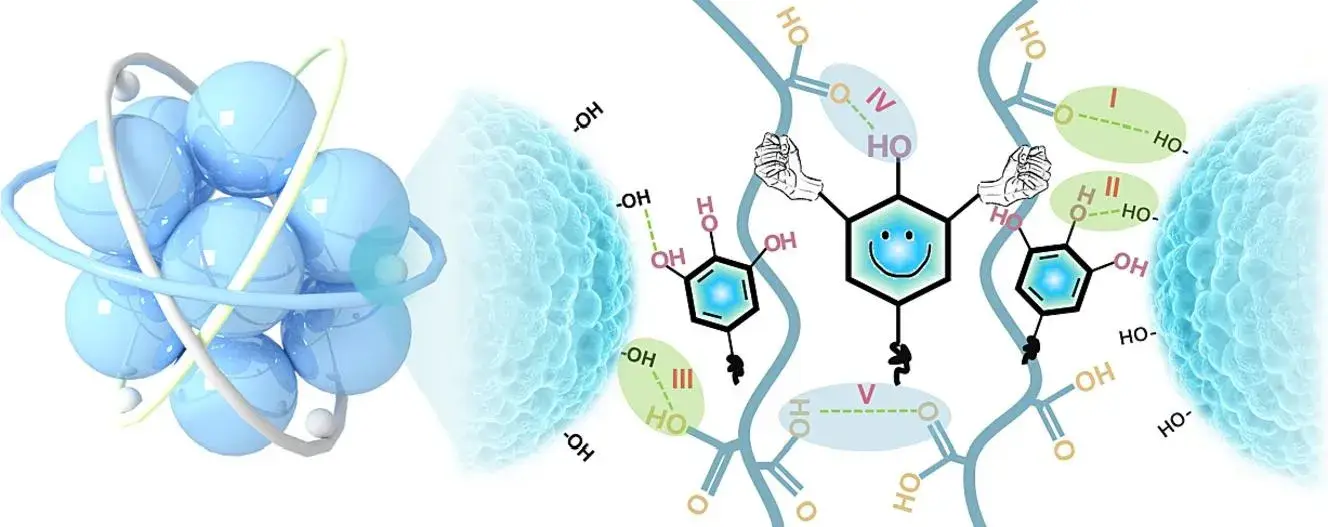
Figure 1. Three-dimensional flexible self-healing adhesive network of poly(acrylic acid) and tannic acid, cross-linked by dynamic intermolecular hydrogen bonding — the structural basis of the TA-c-PAA silicon anode binder
The synthesis route and molecular structure of the TA-c-PAA binder are shown in Figure 2. The three-dimensional cross-linked binder is synthesized by free-radical polymerization using acrylic acid as the monomer and potassium persulfate as the initiator. PAA provides the primary mechanical backbone of the polymer network and has inherently strong adhesion to silicon. The authors introduced tannic acid as a physical cross-linking agent: TA-c-PAA forms an interpenetrating cross-linked network through dynamic hydrogen bonding, giving the binder self-healing capability and excellent mechanical properties. The preparation route is straightforward and readily scalable for production.
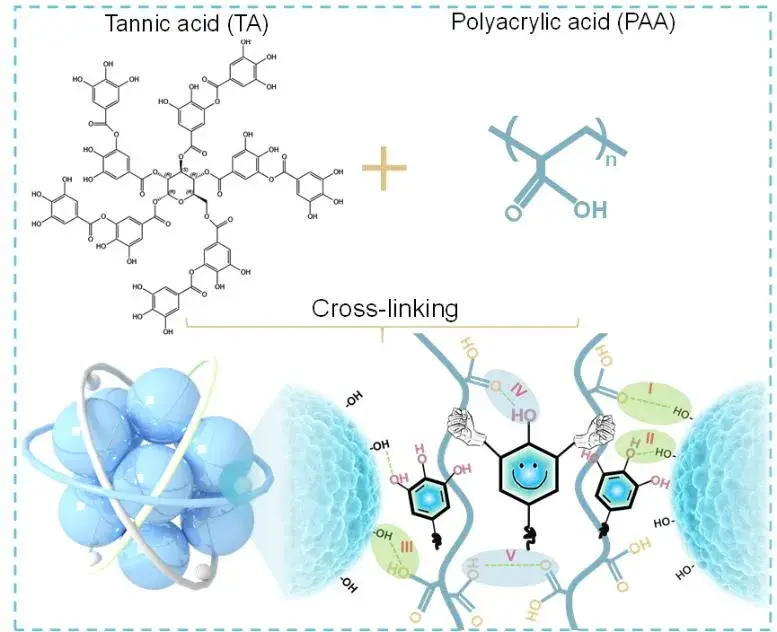
Figure 2. Synthesis process of the cross-linked TA-c-PAA binder and mechanistic study — free-radical polymerization with tannic acid as the dynamic hydrogen-bonding cross-linker
Figure 3(a) presents FTIR spectra of PAA, TA, and TA-c-PAA. The C=O peak shifts from 1720 cm⁻¹ in PAA to 1740 cm⁻¹ in TA-c-PAA, indicating formation of a (P, C=O···H–O–Ph) hydrogen-bonded interaction between TA and PAA. ¹H NMR spectra of TA and TA-c-PAA (Figure 3b) further probe proton distribution within the polymer network: TA-c-PAA shows a larger proton peak shift than either TA or PAA alone, consistent with reduced electron cloud density near the proton from nearby electronegative groups—additional evidence for intermolecular hydrogen-bond formation.
DSC measurements of the glass transition temperature (Tg) for PAA and TA-c-PAA (Figure 3c) show that TA-c-PAA has a substantially lower Tg than PAA, indicating that the hydrogen bonds between PAA and TA weaken intramolecular chain interactions and improve binder toughness. To assess electrochemical stability, the authors performed cyclic voltammetry (CV) over 0.01–1.0 V using coin cells (Figure 3d). Neither PAA nor TA-c-PAA shows a discernible redox peak within this range, confirming both binders are electrochemically inert—a prerequisite for any silicon anode binder, since electrochemical activity in the binder itself would consume capacity and degrade cycling stability.

Figure 3. (a) FTIR spectra of PAA, TA, and TA-c-PAA. (b) ¹H NMR spectra of TA and TA-c-PAA. (c) DSC curves of PAA and TA-c-PAA. (d) CV results for copper foil, Cu@TA-c-PAA, and Cu@PAA confirming electrochemical inertness of the binder
The stress-strain curve in Figure 4(a) shows that the PAA film deforms linearly, with tensile strength of 9.97 MPa and elongation at break of 5.02%. In contrast, the TA-c-PAA film exhibits markedly better ductility: tensile strength of 5.74 MPa and elongation at break of 264.51% (Figure 4d). The introduction of TA therefore allows the binder to disperse stress generated during stretching rather than fracturing brittlely.
To quantify adhesion strength between the silicon electrode and copper current collector, the authors performed 180° peel tests on Si@PAA and Si@TA-c-PAA electrodes (Figure 4b, e). Average peel force values are 2.06 N for TA-c-PAA and 0.51 N for PAA—a roughly four-fold improvement attributable to the abundant hydrogen bonds in the TA-c-PAA molecular network. This confirms that the TA-c-PAA silicon anode binder substantially strengthens the interfacial adhesion between the silicon electrode film and copper foil, directly addressing one of the primary failure modes in silicon anode degradation: loss of electrical contact from delamination.
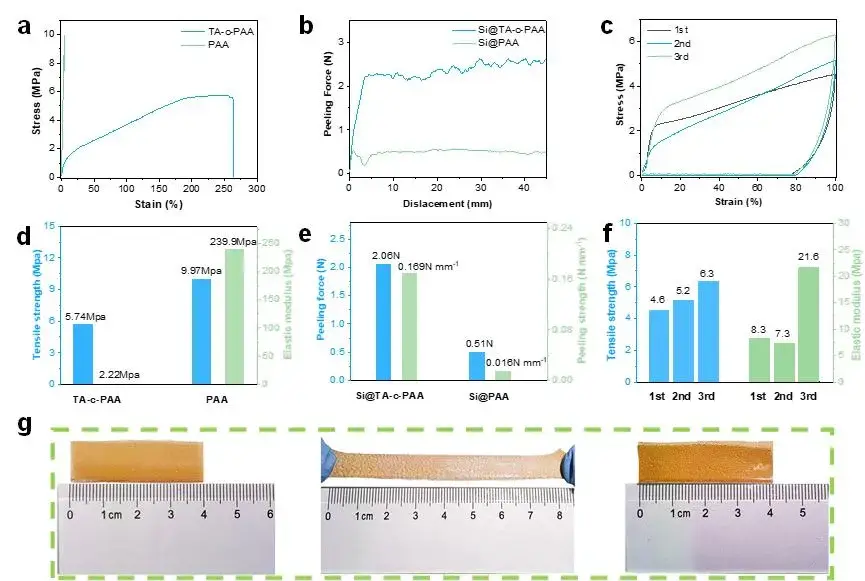
Figure 4. (a) Stress-strain curves of PAA and TA-c-PAA bonded films. (b) 180° peel curves of Si@PAA and Si@TA-c-PAA electrodes. (c) Cyclic stretching curve of the TA-c-PAA binder film. (d) Tensile strength and elastic modulus of PAA and TA-c-PAA films. (e) Peel force and adhesion strength of Si@PAA and Si@TA-c-PAA electrodes. (f) Elastic modulus, tensile strength, and maximum force of TA-c-PAA binder during cyclic stretching. (g) Photographs of the TA-c-PAA film before and after stretching and recovery
In Figure 5, the author used CR2032 type buckle to conduct research on the electrochemical properties of different binders. As can be seen from Figure 5(a), the CV curve of Si@TA-c-PAA gradually increases in intensity as the number of cycles increases, indicating that its electrochemical kinetics has been significantly improved. At the same time, the discharge/charge curves of the Si@TA-c-PAA electrode after 20, 100, 200, 300 and 400 cycles were in good agreement, indicating good reversibility (as shown in Figure 5(b)). In contrast, the reproducibility of the discharge/charge curve of the Si@PAA electrode is poor (as shown in Figure S8). Furthermore, as shown in Figure 5(c) and (d), the Si@TA-c-PAA electrode exhibits stable rate performance under various current densities, for example, the electrode can achieve a high capacity of 1599 mAh/g at a high current density of 2C. In contrast, the Si@PAA electrode only provides a low capacity of 1118 mAh/g at the same current density.
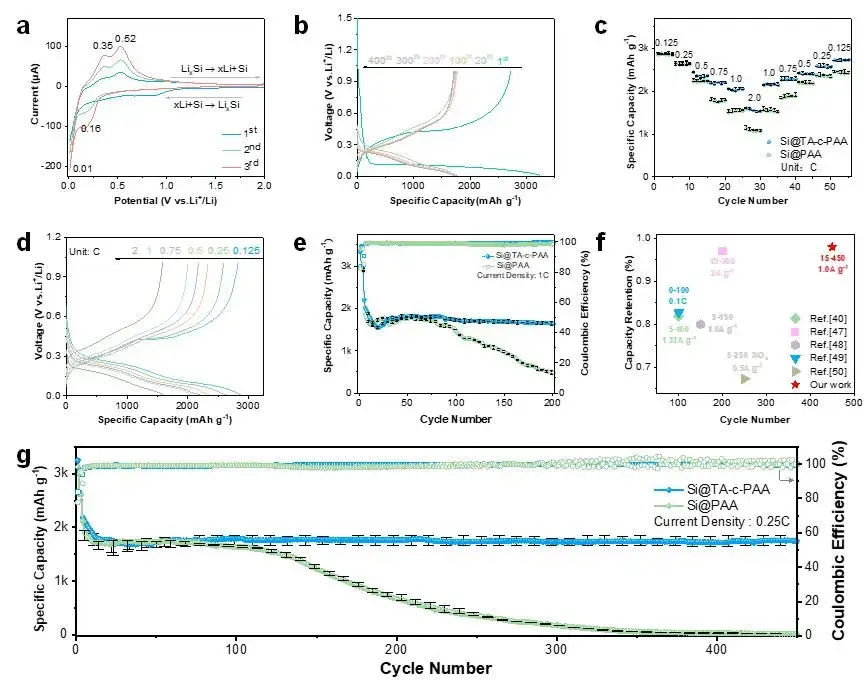
Figure 5. (a) CV curve of Si@TA-c-PAA electrode at a scanning rate of 0.1 mV s-1. (b) Charge-discharge curve of Si@TA-c-PAA electrode at current density of 0.25C. (c) Rate performance test of Si@TA-c-PAA and Si@PAA electrodes (replicated three times for each binder). (d) Charge-discharge curves at different current densities. (e) Cycling performance of Si@PAA and Si@TA-c-PAA electrodes at 1 C rate (three replicates for each binder). (f) Comparison of cycle performance of silicon-based electrodes under different polymer binders reported in other literature [40,47-50]. (g) Long-term cycling performance of Si@PAA and Si@TA-c-PAA electrodes at a rate of 0.25 C (repeated three times for each binder).
At the same time, the authors used electrochemical impedance spectroscopy (EIS) to further study the electrochemical kinetic properties of Si@PAA and Si@TA-c-PAA electrodes, as shown in Figure 6(a). By calculating the Li+ diffusion coefficient, we can see that the Si@TA-c-PAA electrode has a higher Li+ diffusion coefficient than the Si@PAA electrode (as shown in Figure 6(b)). At the same time, using the constant current intermittent titration technology (GITT), it can also be seen that the Si@TA-c-PAA electrode has a high diffusion coefficient during the charge and discharge process, it shows that the TA-c-PAA binder has a good effect in enhancing Li+ diffusion, which is mainly due to the strong self-repairing ability of the binder ensuring the structural stability of the silicon anode.
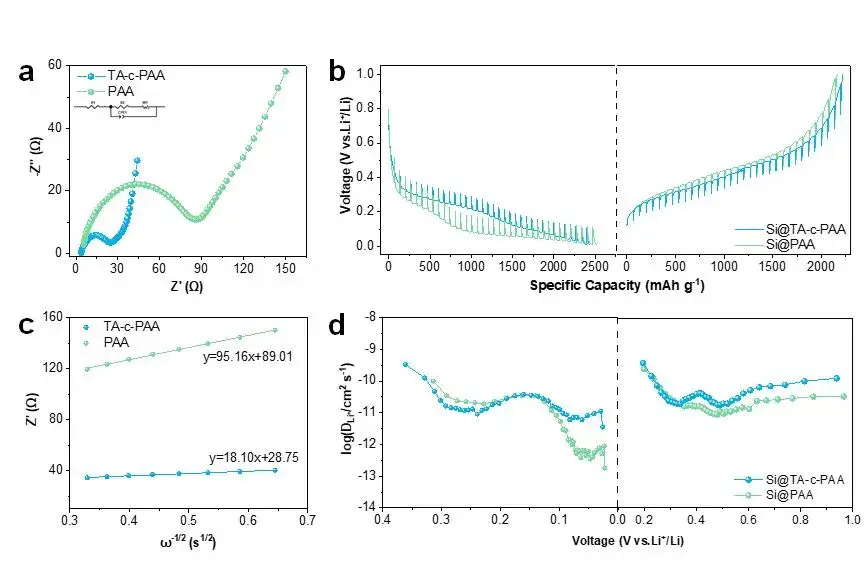
Figure 6. (a) Nyquist plot of EIS pattern. (b) GITT curves of the Si@TA-c-PAA and Si@PAA electrode. (c) The relationship between Z and ω-1/2 for Si@TA-c-PAA and Si@PAA electrodes in the low frequency region. (d) The diffusion coefficient of lithium ions in Si@TA-c-PAA and Si@PAA electrodes.
To investigate the structural origin of the performance improvement, the authors used SEM to examine the Si@TA-c-PAA electrode before cycling and after 100 cycles (Figure 7a–h). Fresh electrodes of both Si@PAA and Si@TA-c-PAA show minor original cracks, likely from high surface tension during rapid drying. After 100 cycles, the Si@PAA electrode develops large cracks 1–2 µm wide, causing loss of conductive pathways and rapid capacity fade. In contrast, the Si@TA-c-PAA electrode remains dense with only a few minor cracks, confirming a mechanically robust structure. This microstructural contrast demonstrates that the abundant hydrogen bonds in the TA-c-PAA silicon anode binder confer self-healing properties and flexibility, rapidly dissipating stress in silicon particles during cycling and preventing particle pulverization.
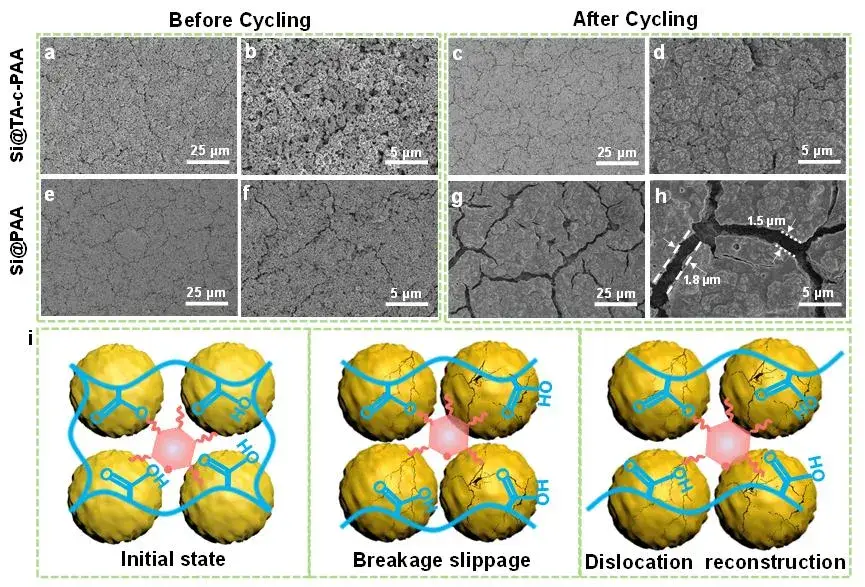
Figure 7. SEM images of (a)-(d) Si@TA-c-PAA electrode and (e)-(h) Si@PAA electrode before and after cycling for 100 times at 0.25C. (i) The self-healing chemical process of cross-linked TA-c-PAA binder with dynamic hydrogen bonding during charge and discharge processes is proposed.
Figure 8 presents in-situ thickness expansion testing used to evaluate how each binder suppresses volumetric expansion of the silicon anode during cycling. The in-situ thickness expansion test setup (Figure 8b) incorporates a force spring and thickness sensor within an in-situ expansion analysis system, with the cathode, separator, and anode positioned between upper and lower pressure heads. An NCM523 cathode was capacity-matched to the Si@PAA and Si@TA-c-PAA anodes and cycled at 0.1C over 3.0–4.25 V, with the thickness sensor recording real-time thickness change during charge and discharge.
The results (Figure 8c) show that the Si@TA-c-PAA electrode exhibits a thickness change of 82.5% during first-cycle lithiation, compared with 127.1% for Si@PAA. During subsequent delithiation, Si@PAA and Si@TA-c-PAA show irreversible thickness expansion of 37.5% and 15%, respectively. Across all cycles, the Si@TA-c-PAA electrode consistently shows smaller thickness change and lower irreversible expansion (Figure 8d–e), providing direct, quantitative confirmation that dynamic hydrogen bonding improves the structural stability of silicon-based electrodes throughout cycling.
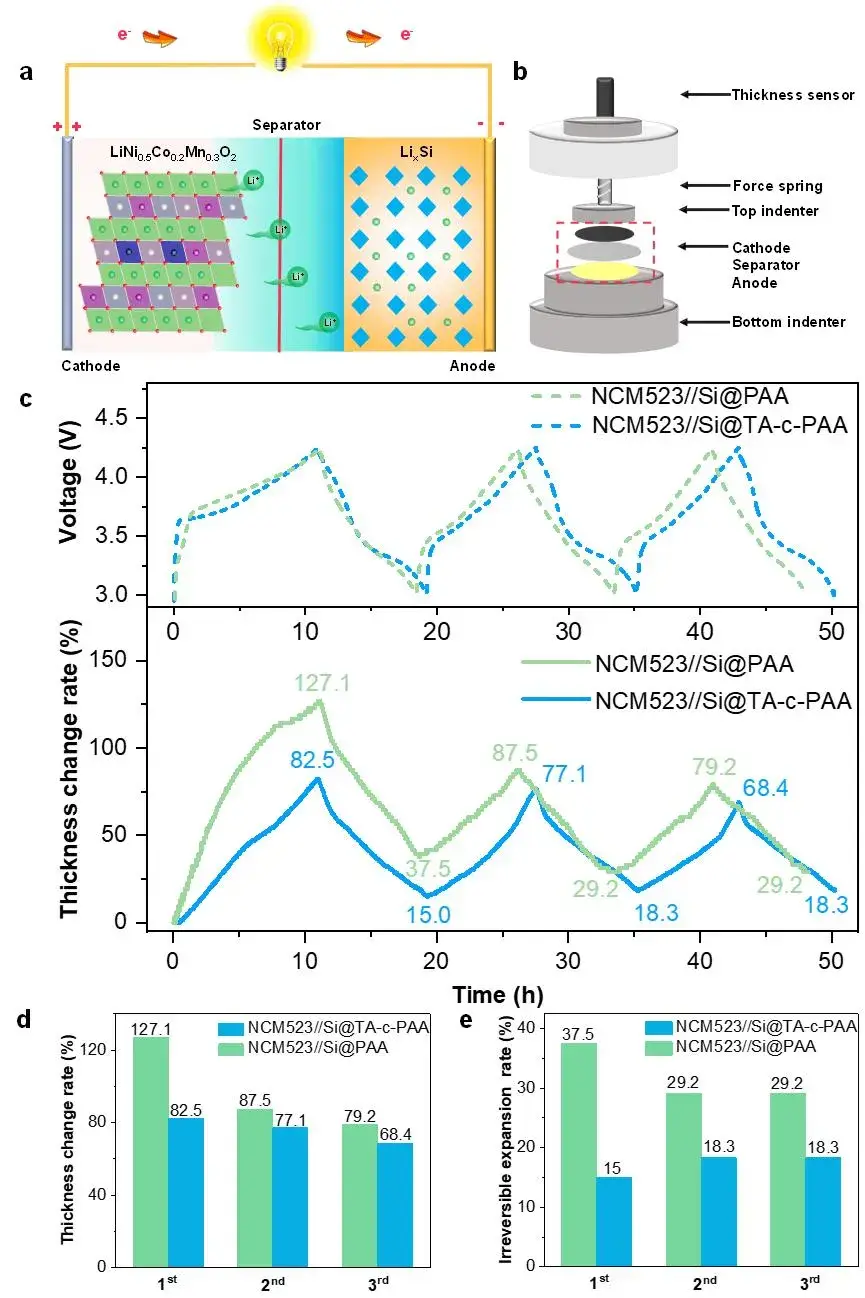
Figure 8. (a) NCM523//Si full-cell configuration. (b) Structural schematic of the in-situ thickness expansion test device. (c) In-situ thickness variation of the NCM523//Si cell with voltage. (d) Electrode thickness change comparison across cycles. (e) Irreversible thickness expansion comparison across cycles — Si@TA-c-PAA shows 82.5% first-cycle lithiation expansion (vs 127.1% for Si@PAA) and 15% irreversible expansion (vs 37.5%)
In Figure 9, the author used the COMSOL software to study the relationship between the binder structure and stress dissipation, and conducted finite element simulations of different lithiation states. In the simulation model, the silicon particles are assumed to be independent regular spheres, and they are uniformly distributed in the polymer binder network. Due to the large volume expansion during the lithium intercalation process, there is severe stress concentration on the Si@PAA electrode surface, which may lead to structural failure of the silicon anode. When the maximum stress reached 950 MPa, the silicon particles were broken and crushed (as shown in Figure 9(a)). In contrast, the stress distribution of the Si@TA-c-PAA electrode is lower and its mechanical properties are better (as shown in Figure 9(b)). Therefore, the finite element simulation results show that the TA-c-PAA binder plays an important role in the stress dissipation during the periodic lithium insertion/delithiation process of the silicon anode.
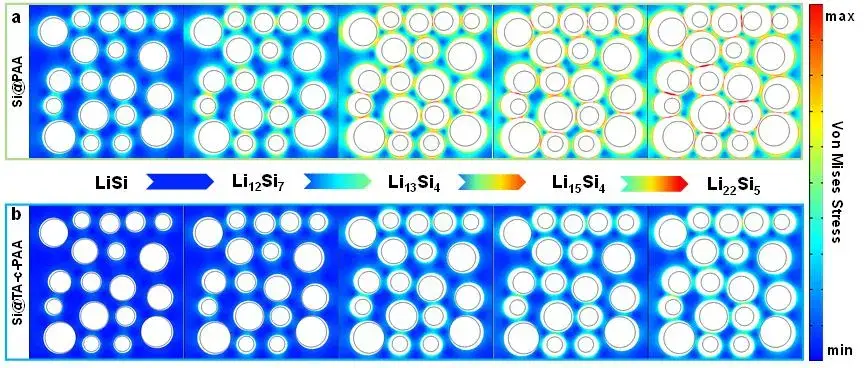
Figure 9. Finite element simulation of stress evolution in (a) Si@PAA and (b) Si@TA-c-PAA electrodes under different lithiation states — Si@PAA reaches 950 MPa maximum stress causing particle fracture, while Si@TA-c-PAA shows lower, more distributed stress
This study reports the first design and preparation of a TA-c-PAA silicon anode binder. Compared with previously reported or commonly used binders such as alginate and conventional poly(acrylic acid), the TA-c-PAA binder exhibits superior mechanical properties that directly translate into superior Si@TA-c-PAA electrode electrochemical performance. The optimized TA-c-PAA composition (TA:PAA ratio of 1:9) is rich in dynamic hydrogen bonds, conferring excellent tensile strength, elongation, and toughness. The resulting Si@TA-c-PAA electrode also shows markedly enhanced interfacial interaction and adhesion between the silicon anode and copper current collector, yielding a high reversible specific capacity (3,250 mAh/g at 0.05C), excellent rate capability (1,599 mAh/g at 2C), and impressive cycling stability (1,742 mAh/g after 450 cycles at 0.25C).
Through ex-situ morphological characterization, in-situ thickness expansion analysis, and finite element simulation, the authors confirmed that the TA-c-PAA binder effectively dissipates stress concentration in the silicon anode during delithiation/lithiation and prevents particle pulverization. The underlying mechanism is linked to the microscale self-healing process of the TA-c-PAA binder network. This study, exploring physical cross-linking with tannic acid as a binder design strategy, offers a generalizable approach to developing efficient, economical silicon anode binders for next-generation lithium-ion batteries.
J.H. Chen, Y.X. Li, X.Y. Wu, H.H. Min, J. Wang, X.M. Liu* and H. Yang*. Dynamic hydrogen bond cross-linking binder with self-healing chemistry enables high-performance silicon anode in lithium-ion batteries. Journal of Colloid And Interface Science 657 (2024) 893-902.
The in-situ thickness expansion test referenced in this study (Figure 8) is the type of measurement enabled by the IEST RSS1400 silicon anode swelling screening system. The RSS series provides real-time, in-situ monitoring of electrode thickness change during charge and discharge cycling under controlled mechanical constraint—directly quantifying both reversible (lithiation/delithiation) and irreversible expansion components for silicon, silicon monoxide (SiO), and silicon-carbon (Si/C) anode materials. This capability allows materials and electrode engineers to rapidly screen candidate binder systems, conductive additive formulations, and electrode designs for their effectiveness in suppressing silicon anode volume expansion—without requiring a full battery cycling study for each formulation variant.
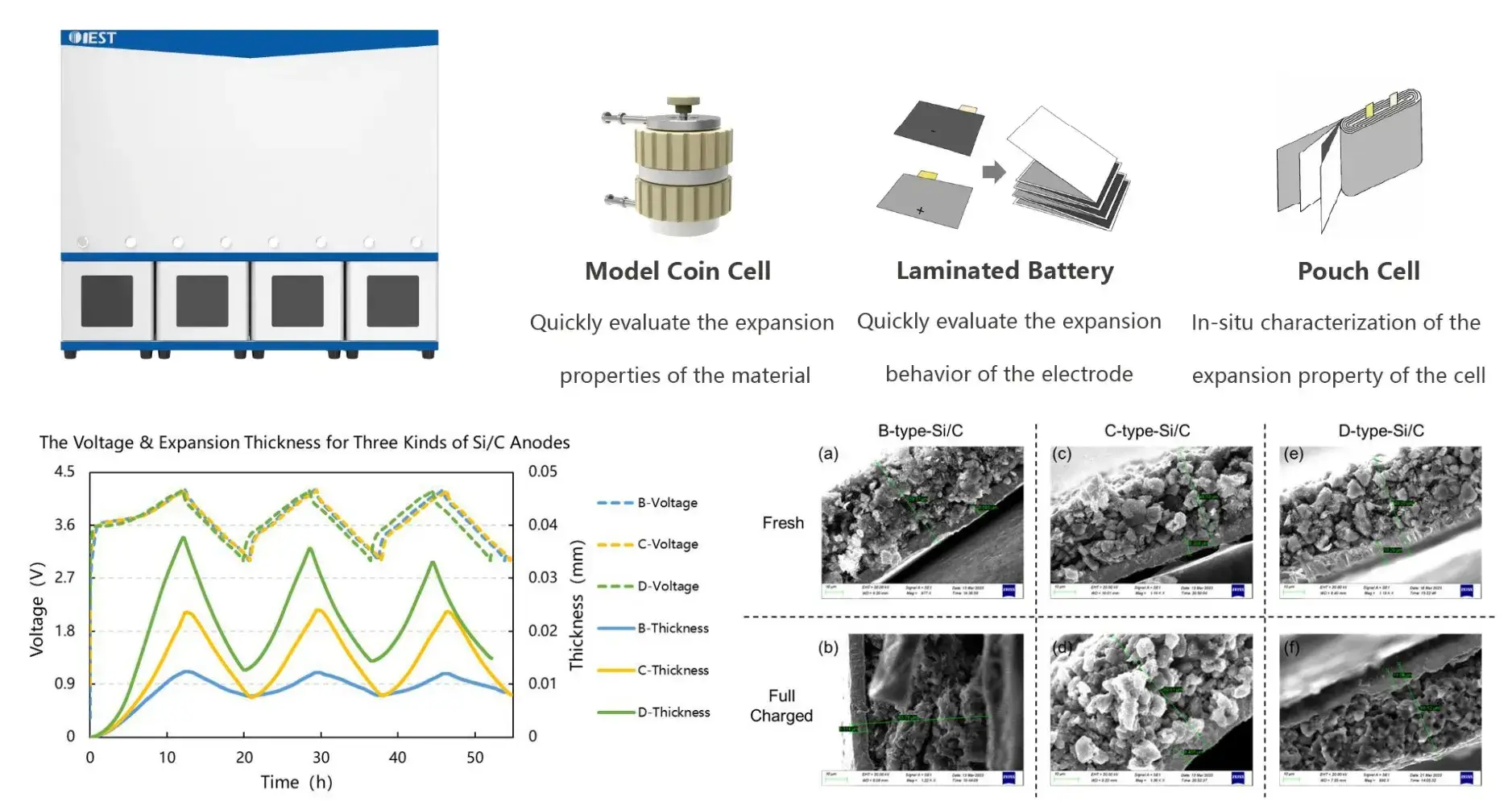
Figure 10. IEST RSS1400 In-Situ Silicon-Based Anode Swelling Rapid Screening System — real-time thickness expansion monitoring for evaluating silicon anode binder performance and electrode formulation design
A silicon anode binder is the polymer component that holds active material particles together and adheres them to the current collector in a battery electrode. Unlike graphite, which expands only ~10% during lithiation, silicon undergoes volume expansion of approximately 300% during full lithiation. A conventional binder—rigid and inelastic—cannot accommodate this magnitude of volume change: it cracks, delaminates from the current collector, and loses electrical contact with active particles, causing rapid capacity fade. Silicon anode binders must therefore provide both strong adhesion (to resist delamination) and high elasticity or self-healing capability (to accommodate repeated large-amplitude volume change without permanent damage). This is the central design challenge that the TA-c-PAA binder addresses through dynamic, reversible hydrogen bonding rather than rigid covalent cross-links.
TA-c-PAA is a cross-linked polymer silicon anode binder formed by combining poly(acrylic acid) (PAA) with tannic acid (TA) through in-situ polymerization. PAA provides the mechanical backbone and inherent adhesion to silicon, while branched TA molecules act as physical cross-linkers, connecting to the PAA backbone through abundant dynamic hydrogen bonds rather than permanent covalent bonds. Because hydrogen bonds are individually weak and can break and reform under stress, the TA-c-PAA network can dissipate local mechanical stress by temporarily breaking bonds at the site of highest strain, then reforming them once the stress relaxes—a self-healing mechanism analogous to a sacrificial bond network. This allows the binder to accommodate the ~300% volume expansion of silicon during cycling without permanent structural failure, unlike binders relying solely on covalent cross-links.
TA-c-PAA substantially outperforms standard PAA across every measured metric in this study. Mechanically, TA-c-PAA achieves 264.51% elongation at break versus 5.02% for PAA, and 2.06 N adhesion (180° peel force) to copper foil versus 0.51 N for PAA—roughly a four-fold improvement in adhesion strength. Electrochemically, the Si@TA-c-PAA electrode delivers 1,599 mAh/g at a 2C rate versus 1,118 mAh/g for Si@PAA, and shows substantially better charge-discharge curve reproducibility across 400 cycles. In-situ thickness measurements confirm the structural origin of this improvement: Si@TA-c-PAA shows only 82.5% thickness expansion during first lithiation (vs 127.1% for Si@PAA) and 15% irreversible expansion (vs 37.5% for Si@PAA), directly demonstrating superior accommodation of silicon’s volume change.
Silicon anodes undergo volume expansion of approximately 300% during full lithiation (forming Li₁₅Si₄), driven by the insertion of lithium into the silicon crystal lattice. This massive expansion generates severe internal mechanical stress—in this study’s finite element simulation, stress in a rigid PAA-bound electrode reached 950 MPa, sufficient to fracture silicon particles. A well-designed silicon anode binder mitigates this stress through one of two mechanisms: high intrinsic elasticity (allowing the binder itself to stretch with the expanding particle) or dynamic, reversible cross-linking (allowing the binder network to locally reconfigure and redistribute stress, as in TA-c-PAA). The TA-c-PAA binder uses the second mechanism: its dynamic hydrogen bonds break and reform under stress, dissipating mechanical energy and preventing the stress concentration that leads to particle pulverization.
Silicon anode volume expansion is measured in-situ using a thickness-sensing device that monitors electrode thickness in real time during charge and discharge, typically within a constrained cell fixture incorporating a force spring and thickness sensor (as used with the IEST RSS series). This in-situ approach is essential for silicon anode binder development because ex-situ (post-mortem) characterization cannot capture the dynamic, reversible component of expansion—only the residual irreversible change after disassembly. In-situ thickness data separates total expansion into a reversible component (recovered each cycle) and an irreversible component (accumulating with cycling), which is exactly the distinction needed to evaluate whether a candidate binder is successfully accommodating silicon’s volume change versus merely surviving it. In this study, this method quantitatively distinguished the TA-c-PAA binder’s superior performance (15% irreversible expansion) from the PAA baseline (37.5% irreversible expansion).