-
iestinstrument

Abstract
1. Key Takeaways: Choosing the Right Measurement Method
-
For Absolute Material Resistivity: Use the four probe method. It eliminates contact resistance, providing the most accurate measurement of a material’s intrinsic conductivity. Ideal for coating slurry research on insulating substrates.
-
For Practical Electrode Evaluation: Use the two probe method (two-point probe configuration). It measures through-thickness resistance—including the coating, interface, and current collector—mirroring real battery conditions. This is the preferred choice for optimizing electrode formulation and manufacturing processes.
-
Pressure Control Is Critical: Uncontrolled contact pressure is a major source of measurement error. Consistent, automated pressure application is essential for reliable and repeatable resistance data across all probe configurations.
| Feature | Two Probe Method | Four Probe Method |
|---|---|---|
| Contact Resistance | Included in results | Eliminated/Excluded |
| Measurement Value | Higher (Total Resistance) | Lower (Absolute Resistivity) |
| Best Application | Battery electrode through-thickness | Thin film material resistivity |
| Current Path | Vertical/Through-thickness | Lateral/Parallel to coating |
2. Introduction: Why Electrode Resistance Measurement Method Matters
The electrode sheet plays a critical role in lithium-ion battery production, directly influencing stability, safety, and performance. Evaluating electrode resistance is essential for understanding material conductivity and optimizing the manufacturing process.
Several probe configurations are used in practice: the single-probe method, the two probe method (2-probe or two-point probe), the four probe method (4-probe or four-terminal measurement), and multi-probe arrays. Among these, the 2 probe method and the 4 probe method are the most widely applied in battery research and industrial quality control.
This article compares the principles, data accuracy, and practical limitations of these techniques, with particular focus on the difference between the two probe and four probe method for measuring electrode resistivity in lithium-ion battery applications.
3. Experimental Equipment and Test Methods
3.1 Experimental Equipment
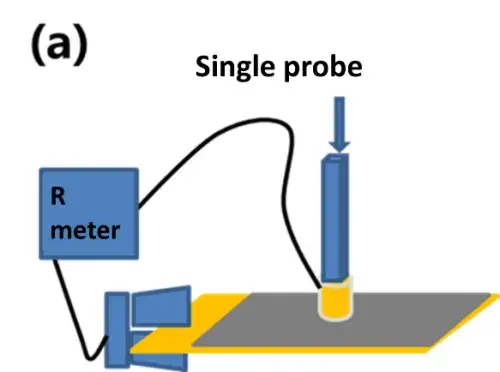
The single-probe device and the two-point probe device used in this study are shown in Figure 1. Contact resistance refers to the impedance that arises at the physical junction between a probe tip and the sample surface; uncontrolled probe pressure causes this value to vary between measurements, directly inflating data variability.
 |
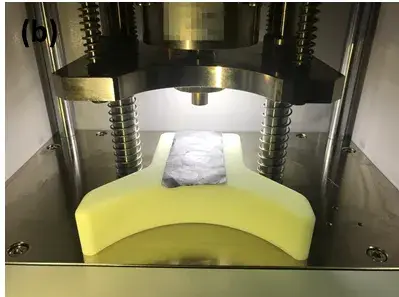 |
Figure 1. (a) Single-probe device; (b) Two-point probe (two probe method) structural diagram
3.2 Test Method
The single-probe method applies one contact terminal to the sample. Variations in applied force produce large measurement fluctuations because contact resistance changes with each test. The two probe method, by contrast, fixes both probes under a controlled pressure system, substantially improving repeatability. Modern software-controlled instruments automatically record electrode thickness, resistance, resistivity, and conductivity for each measurement.
Data such as electrode thickness, resistance, resistivity, and conductivity can be automatically recorded with modern software-controlled test equipment.
4. Results: Single-Probe, Two Probe, and Four Probe Resistivity Data
4.1 Resistance Comparison of Single Probe Pressure Control and Uncontrolled Pressure Test
Ten resistance measurements were taken on aluminum foil, copper foil, anode, and cathode samples using both a pressure-controlled and an uncontrolled single-probe device. The results demonstrate that the uncontrolled configuration produces a Coefficient of Variation (COV) greater than 60% for both foil and electrode samples. This high variability arises because each test establishes a different contact area, leading to inconsistent contact resistance. The pressure-controlled device reduces COV significantly across all sample types.
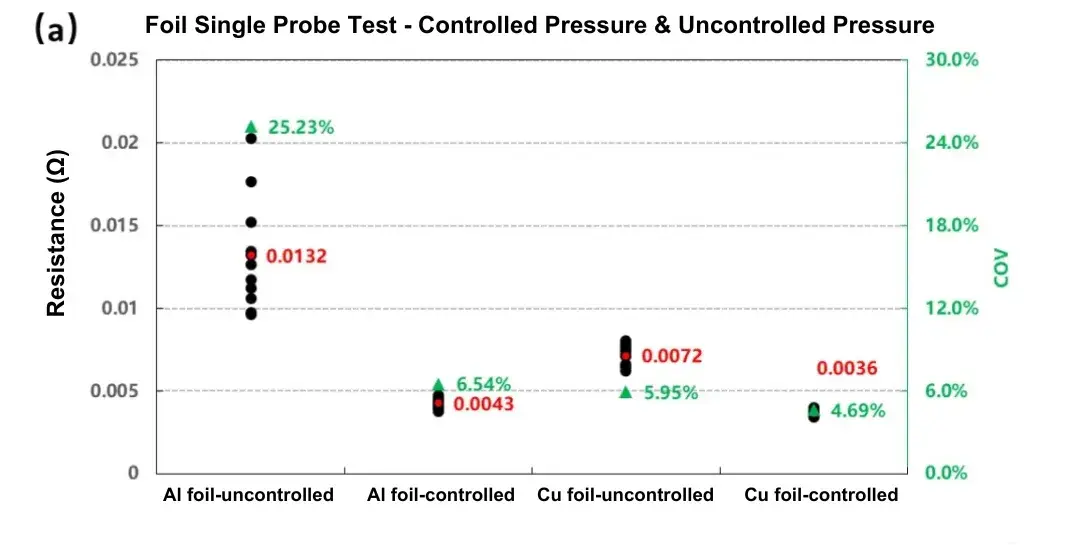
Figure 2(a). Single-probe foil resistance: pressure-controlled vs uncontrolled
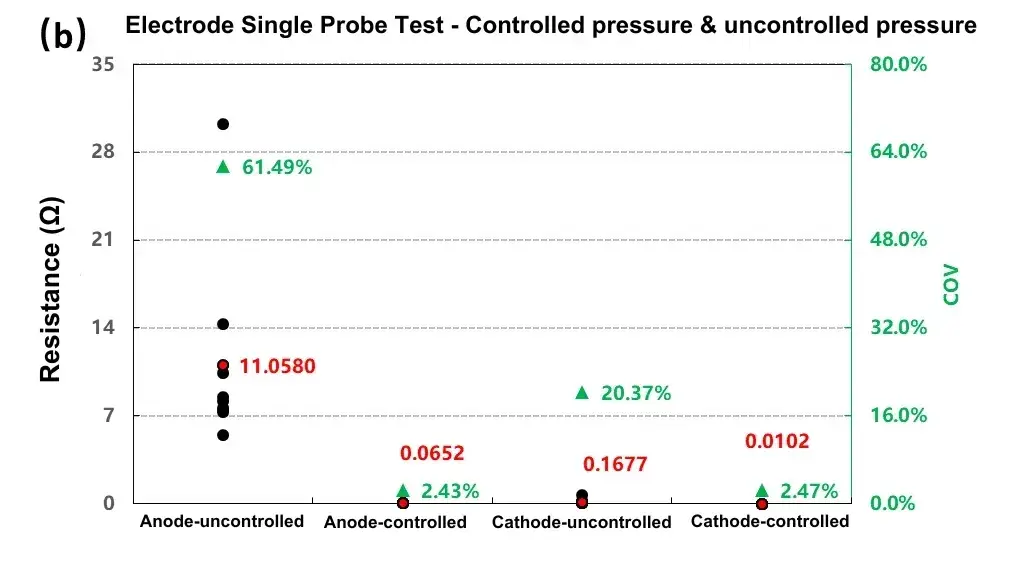
Figure 2(b). Single-probe electrode resistance: pressure-controlled vs uncontrolled
4.2 Resistivity Comparison Across All Three Methods
Using pressure-controlled versions of each configuration, ten measurements were taken per sample type. The resistivity values follow a consistent rank order:
single probe > two probe method > four probe method
This trend holds for both foil and electrode materials.
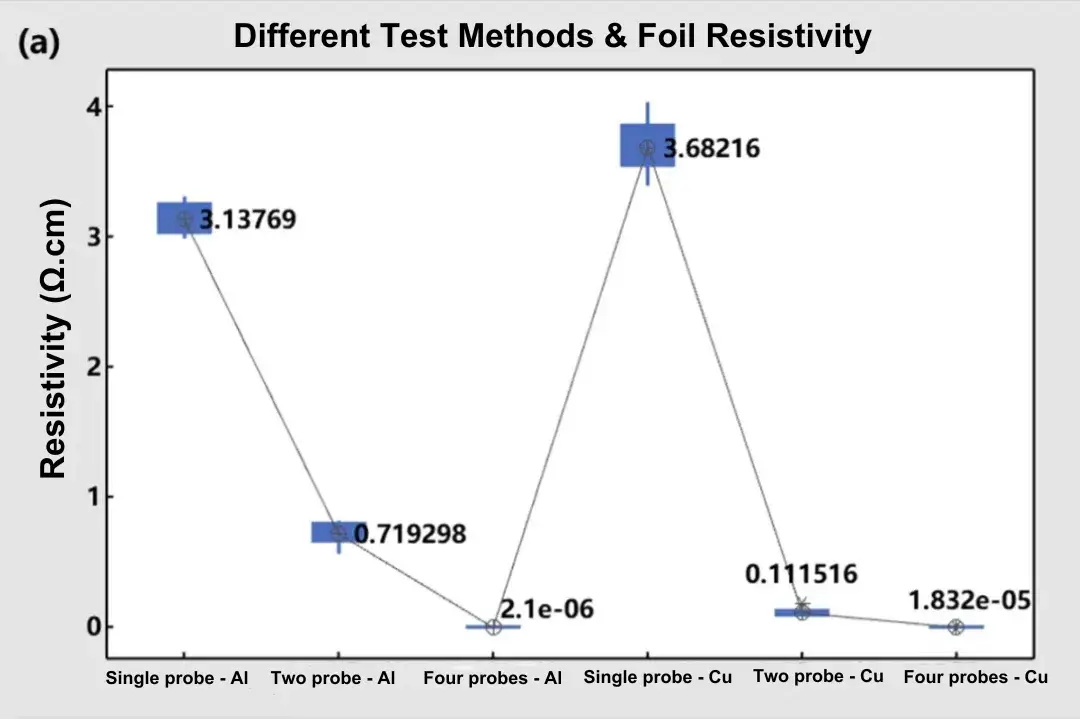
Figure 3(a). Foil resistivity: single-probe vs two probe method vs four probe method
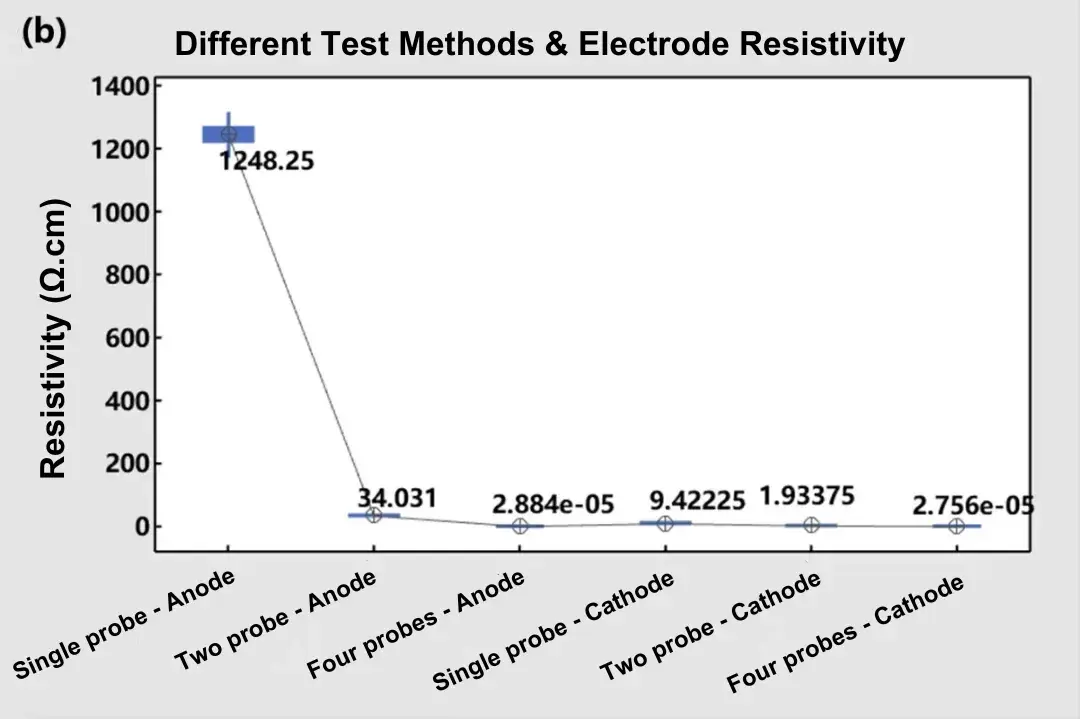
Figure 4(b). Electrode resistivity: single-probe vs two probe vs four probe methods
The discrepancy arises from differences in contact resistance and electron transmission paths across methods. In the single probe method, electrons pass through the coating, the coating–current collector interface, and laterally along the foil. The two probe method includes an additional lateral conduction component. The four probe method uses separate current-injection and voltage-sensing terminals—a configuration also known as Kelvin sensing—which effectively isolates the sample resistance from all contact and lead resistance, producing the lowest absolute resistivity reading.
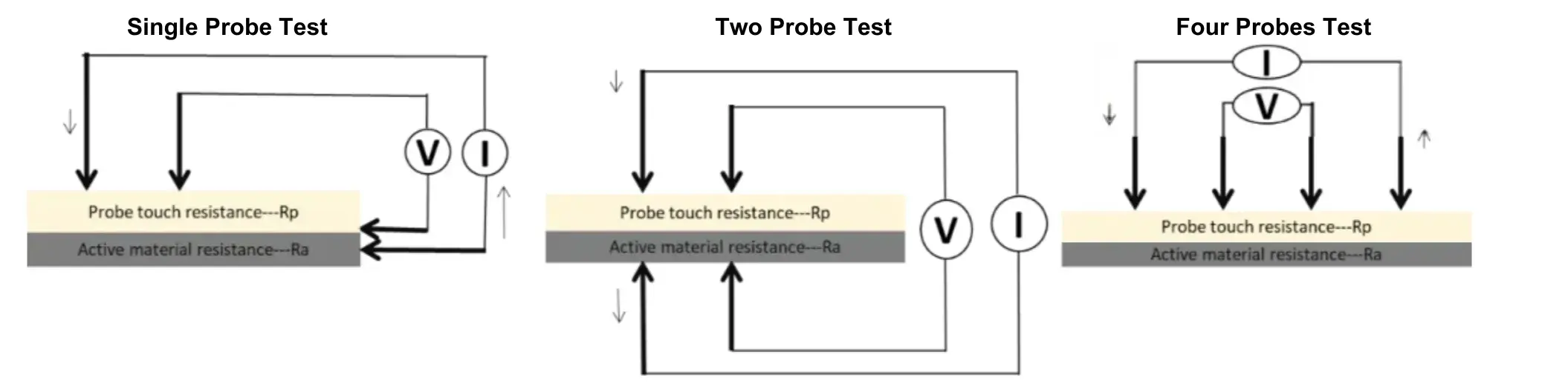
Figure 5. Current path schematic: single-probe, two probe method, and four probe method
5. Why the Four Probe Method Is Preferred for Absolute Resistivity Measurement
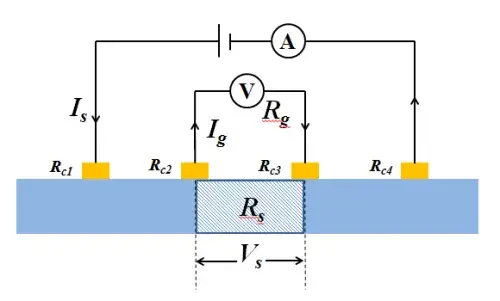
Figure 6. Four probe method diagram — current and voltage terminal arrangement
Figure 5 shows a schematic diagram of the test resistance by the four probe method, assuming that the contact resistance of the four-terminal wiring and the probe are \(R_{c1}\), \(R_{c2}\), \(R_{c3}\), and \(R_{c4}\), respectively; the constant current source applies current \(I_s\) (ammeter reading) to the sample through terminals #1 and #4. If the resistance in the voltmeter is \(R_g\), the voltmeter branch current is \(I_g\), and the voltmeter voltage reading is \(V_g = R_g I_g\); the measured resistance between terminals #2 and #3 is \(R_s\), then the measured resistance branch current is \(I_s – I_g\), and the voltage of the measured resistance is \(V_s\); then:
Calculated by the voltmeter branch, the voltage between terminals 2 # and 3 # is:
\(V_s = I_g (R_{c2} + R_{c3}) + I_g R_g\)
Calculated by the resistance branch to be measured, the voltage between terminals 2 # and 3 # can also be expressed as:
\(V_s = (I_s – I_g) R_s\)
At this point, if \(R_g + R_{c2} + R_{c3} \gg R_s\), then \(I_s \gg I_g\), then \(I_s \approx I_s – I_g\). If \(R_g \gg R_{c2} + R_{c3}\), then \(V_s \approx I_g R_g = V_g\).
Then, the resistance is \(R = V_g / I_s\) or \(V_s / (I_s – I_g) = R_s\) that is calculated from the current and voltmeter readings. Therefore, the resistance calculated according to the current and voltmeter reading is almost equal to the actual measured resistance value, which is equivalent to testing the absolute resistance value of the sample to be tested. The resistivity of the material was then calculated based on the size specification of the probe and the test sample size.
In summary, the separate current and voltage electrodes used in the four probe method eliminate the impedance of the wiring and the probe contact resistance. The key is that the resistance in the voltmeter is large enough, so that the branch current and the pressure drop of the line contact terminal can be ignored. The two probes for the voltage detection must be separated from the current source two probes. For the connection between the two probes for the voltage detection, all the main loop resistance between the two points will be included in the measured resistance. However, if the resistance of the sample to be tested is very large, it may be difficult to ensure that the resistance in the voltmeter is much greater than the sample to be tested, and that is, Rg + Rc2 + Rc3>> Rs may not be true, and the measurement results may have a large error.
The four probe method is therefore the standard for determining the intrinsic electronic conductivity of battery electrode materials. Most implementations coat the electrode slurry onto an insulating substrate rather than a metallic current collector, preventing lateral current bypass through the foil and isolating the coating’s contribution precisely.
However, the approach has practical limitations for production electrodes (coating thickness 60–150 µm): the lateral current path does not replicate the vertical through-thickness conduction that occurs in an actual cell, and interface resistance between coating and current collector is excluded. For these reasons, the four probe method is best suited to fundamental material characterization on controlled test substrates, not to finished electrode evaluation.
The two-point probe configuration, despite including contact resistance in its output, replicates the true vertical electron conduction path of a battery electrode. Its measured value encompasses the current collector, the collector–coating interface, and the coating—all components contributing to cell internal resistance. For studying how formulation or calendering parameters affect electrode conductivity, this makes the 2-probe approach more representative of real operating conditions. The key requirement is consistent, controlled probe pressure to suppress contact resistance variability.
6. Summary
Pressure stability is the most important practical factor in probe-based resistance measurement: uncontrolled contact produces COV values above 60%, making data unreliable regardless of probe configuration. When pressure is controlled, the three methods yield systematically different absolute values—single probe highest, four probe lowest—due to differing contact resistance contributions and current paths.
For fundamental material resistivity research, the four probe method delivers the most accurate absolute value by eliminating all contact and lead resistance. For practical battery electrode evaluation, the two probe method (two-point probe configuration) is recommended: its through-thickness current path mirrors actual battery operation and captures the combined contribution of the current collector, interface, and coating in a single measurement.
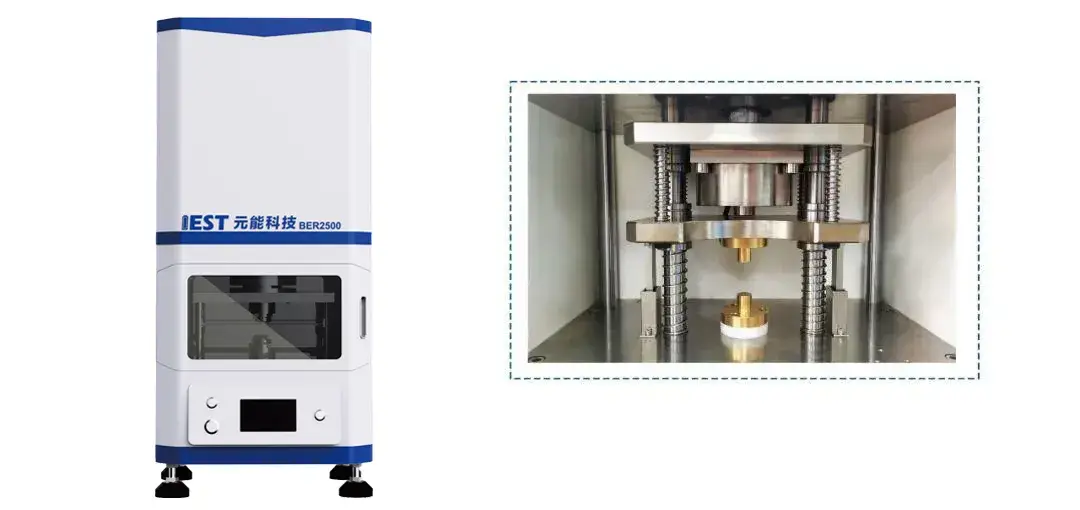
7. IEST Electrode Resistance Tester Recommendation
Solving Core Measurement Challenges with the IEST BER Series Four Probe Resistivity Meter
Traditional electrode resistance testing methods often yield inconsistent data and fail to represent the actual electrochemical environment of a battery. The IEST Battery Electrode Resistance Instrument(BER Series) is engineered to bridge the gap between laboratory research and mass production by solving these critical problems:
-
Eliminating High Data Volatility: Conventional single-probe methods without pressure control can suffer from a Coefficient of Variation (COV) exceeding 60% due to inconsistent contact. The BER series utilizes a high-precision, software-controlled pressure system to ensure stable contact, delivering highly reproducible data essential for quality control.
-
Capturing Real-World Conduction Paths: While the four-probe method is ideal for material resistivity, it often ignores the critical vertical conduction path used in actual batteries. The BER series uses a double-planar disc electrode to measure through-thickness resistance, accurately capturing the contribution of the coating, the current collector, and the vital interface resistance between them.
-
Removing Inductive and Wiring Interference: Inaccurate readings often stem from lead resistance and inductive effects during testing. The BER series implements separate voltage and current sensing (four-terminal wiring principle) to eliminate these factors, ensuring that the measured resistance is the true value of the electrode sheet.
-
Dynamic Process Optimization: Unlike static testers, the BER series provides real-time monitoring of resistance, thickness, and compaction density under varying pressures. This multidimensional data allows engineers to optimize electrode formulations, mixing processes, and calendering parameters with unprecedented precision.
The BER series instrument is ideal for evaluating conductive network performance and electrode microstructure uniformity. It supports optimization of electrode formulation, mixing, coating, and calendering processes.
8. FAQs
8.1 What is the difference between the two probe and four probe method?
The key difference is contact resistance handling. The two probe method (two-point probe) uses one electrode pair for both current injection and voltage sensing, so contact resistance is included in the result and the current travels through-thickness—mirroring a real battery cell. The four probe method uses separate electrode pairs for current and voltage, eliminating contact and lead resistance to yield the material’s absolute resistivity. Neither is universally superior: the right choice depends on whether you need material characterization (four probe) or practical electrode evaluation (two probe).
8.2 Why is the four probe method preferred for resistivity measurement?
The four probe method is preferred for measuring absolute resistivity because it separates current-injection terminals from voltage-sensing terminals. Provided the voltmeter internal resistance is much larger than the sample resistance, virtually no current flows through the voltage branch, making the reading independent of probe contact resistance. This is essential for fundamental material research where intrinsic conductivity must be isolated from measurement artifacts.
8.3 Why is the two probe method recommended for battery electrode testing?
Despite including contact resistance in its output, the two probe (two-point probe) configuration replicates the actual vertical electron conduction path in a battery: current flows through the current collector, across the collector–coating interface, and through the coating thickness. This combined measurement is more representative of real cell conditions than the lateral path used by the four probe method, allowing engineers to study how formulation and processing parameters affect the electrode sheet as a complete functional unit.
8.4 What is contact resistance in the four probe method, and why does it matter?
Contact resistance is the electrical impedance at the physical junction between a probe tip and the sample surface. It arises from surface roughness, oxidation layers, and mechanical contact force. In the four probe method, contact resistance at the voltage-sensing terminals is effectively excluded from the result because negligible current flows through the voltmeter branch. In the two probe method, contact resistance is included—which is why consistent, controlled probe pressure is essential for reproducible results.
8.5 How does pressure control affect electrode resistance measurements?
Pressure control is critical for stable, repeatable data. In uncontrolled single-probe testing, inconsistent contact force changes the contact area with each measurement, causing contact resistance to vary and producing a Coefficient of Variation (COV) above 60%. A software-controlled pressure system—such as that in the IEST BER series—applies a defined, reproducible load, reducing measurement fluctuations to acceptable levels for both research and quality control.