-
iestinstrument

Abstract
Argyrodite-type sulfide solid electrolytes (Li7−xPS6−xClx, LPSCl) deliver room-temperature ionic conductivity exceeding 1 mS/cm—among the highest of any inorganic solid electrolyte—but react rapidly with trace moisture, generating H₂S and forming low-conductivity surface phases. This study by Morino et al. (J. Phys. Chem. C, 2023) uses high-frequency electrochemical impedance spectroscopy (EIS) up to 100 MHz to localize where conductivity losses occur after brief air exposure. After 1 hour at a dew point of −20 °C, ionic conductivity drops from 0.70 to 0.28 mS/cm—a ~60% reduction. Low-temperature EIS (180–250 K) separates bulk and grain-boundary contributions and confirms that this loss originates predominantly at grain boundaries: grain-boundary resistance and its activation energy both increase substantially, while bulk ionic conductivity and its activation energy (Ea1 = 33 kJ/mol) remain essentially unchanged. These findings establish high-frequency EIS as a practical diagnostic tool for quality control of sulfide solid electrolyte handling and all-solid-state battery manufacturing.
1. Introduction: Argyrodite Solid Electrolyte and Moisture Sensitivity
Argyrodite solid electrolyte refers to the family of Li7−xPS6−xClx compounds (LPSCl), which combine room-temperature ionic conductivity of approximately 1–12 mS/cm with mechanical softness favorable for cold-pressing cell assembly. This high ionic conductivity arises from a disordered Li sublattice within the cubic argyrodite crystal structure, enabling rapid Li⁺ migration through interstitial pathways.
Despite these advantages, the sulfide chemistry of LPSCl reacts readily with water vapor. Even at the low humidity of a standard dry room (dew point −20 to −40 °C), brief exposure generates corrosive H₂S gas and deposits low-conductivity surface phases—phosphates (P–O), sulfates (S–O), carbonates (CO₃²⁻), thiol groups (–SH), and hydrated surface layers—on particle surfaces. Understanding whether the resulting conductivity losses originate in the particle bulk or at particle interfaces (grain boundaries) is essential for specifying safe handling conditions and for developing remediation or protective coating strategies.
2. Experimental: Sample Preparation and High-Frequency EIS Setup
Commercially sourced argyrodite Li7−xPS6−xClx (LPSCl, x ≈ 1, D₅₀ ≈ 3.5 µm, Mitsui Mining & Smelting, Japan) was tested in two states:
- Ref.SE: reference sample measured prior to any air exposure
- Exposed SE: sample after 1 h exposure to flowing air (dew point −20 °C, flow 0.8 L·min⁻¹)
Powder samples (50 mg) were pressed in a 7 mm zirconia die at 200 MPa to form pellets (thickness ~0.9 ± 0.01 mm). EIS spectra were collected between 100 MHz and 20 Hz over 180–298 K (4990EDMS120K, Lakeshore 33x, TOYOTech, Japan). Normalized impedance Z (Ω·cm) was computed as Z = (Zm × S) / d, where S is the pellet cross-sectional area and d the thickness. A custom sealed die and the IEST PRCD powder resistivity and compaction density tester supported pellet preparation and in-situ testing under controlled compaction pressures up to 600 MPa.
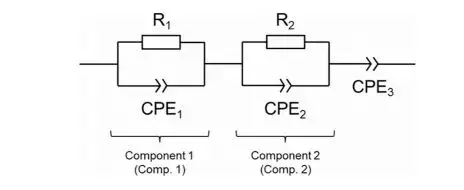
Figure 1. Equivalent circuit for EIS fitting of argyrodite solid electrolyte — series resistance Rs with parallel R1-CPE1 (bulk) and R2-CPE2 (grain boundary) components
3. Results and Discussion
3.1 Room-Temperature Conductivity Degradation After Air Exposure
At 298 K, Nyquist and Bode spectra show that Exposed SE displays a substantially larger impedance semicircle than Ref.SE, indicating higher total ionic resistance after air exposure (Figure 2). Fitting yields room-temperature Li⁺ conductivities of approximately 0.70 mS/cm for Ref.SE and 0.28 mS/cm for Exposed SE — the exposed argyrodite solid electrolyte retains only ~40% of its original ionic conductivity. Because the absolute impedance values remain small even at 100 MHz—owing to the inherently high conductivity of LPSCl—bulk and grain-boundary contributions are not clearly separated at 298 K, preventing a direct assignment of the conductivity drop to a specific microstructural origin at room temperature.
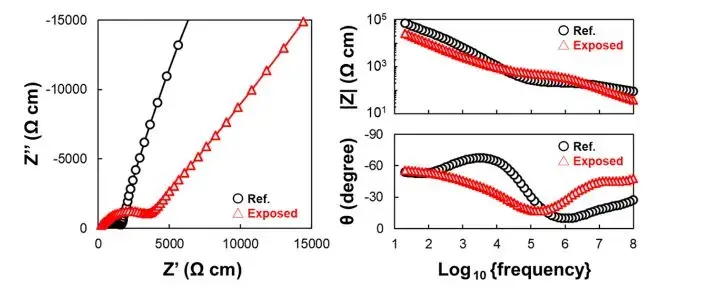
Figure 2. Nyquist and Bode plots of the solid electrolyte before and after exposure to air
3.2 Low-Temperature EIS: Separating Bulk and Grain-Boundary Contributions
Therefore, to more accurately distinguish between the bulk impedance and grain boundary impedance components of the material, the authors conducted EIS measurements at lower temperatures on the sample not exposed to air (Ref.SE) and calculated its ionic conductivity activation energy. The test results are shown in Figure 3. Figures 3a-d depict Nyquist and Bode plots obtained for the samples before and after exposure to air at temperatures ranging from 180 to 250 K. In comparison to the spectra at 298 K (Figure 2), the Nyquist plots clearly show pseudo-capacitive components existing in the form of two semicircles representing different elements. Figure 3e summarizes the capacitance values C1 and C2 calculated from the equivalent circuit fitting at each temperature, revealing consistent values of approximately ~10−12 and ~10−11F for C1 and C2, respectively, which align with results reported in relevant literature. Specifically, the two parallel R-CPE components, R1-CPE1 and R2-CPE2, correspond to bulk impedance and grain boundary impedance of the material.
Figure 3 presents the Arrhenius plot of the ionic conductivity components at different temperatures. The linear fits yielded activation energies Ea1 and Ea2 for the bulk and grain boundary ionic conductivities, respectively, measured at 33 and 36 kJ*mol−1. Notably, the activation energy for ionic conductivity at the grain boundaries of the solid electrolyte interface is slightly higher. This is attributed to the presence of trace substances such as carbonates or adsorbed water on the particle surfaces, which have a certain impact on ion transport even in the absence of exposure to air.
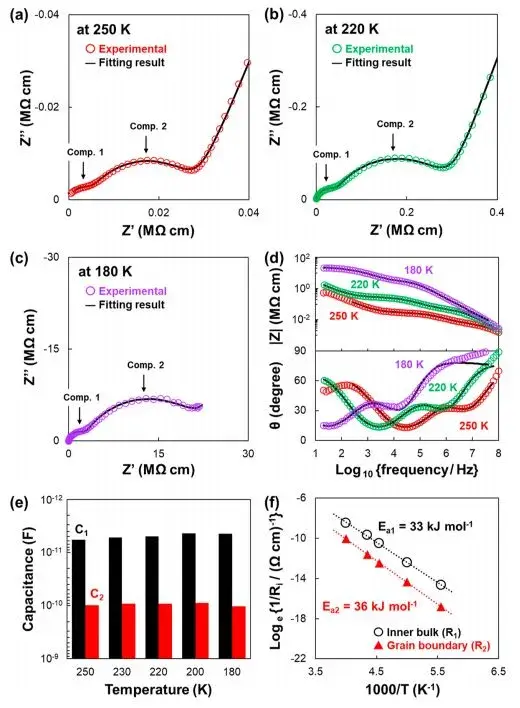
Figure 3. EIS Nyquist plots (a–d) and Arrhenius plots for unexposed argyrodite Ref.SE at 180–250 K — bulk activation energy Ea1 = 33 kJ/mol; grain-boundary activation energy Ea2 = 36 kJ/mol
3.3 Air Exposure Effect: Grain Boundaries Are the Primary Degradation Site
Equivalent low-temperature EIS measurements on Exposed SE reveal a marked increase in the low-frequency R₂ (grain-boundary) semicircle, while the high-frequency R₁ (bulk) semicircle shows little change (Figure 4 and Figure 5). Quantitatively:
- Grain-boundary resistance R₂ increases substantially after air exposure.
- Grain-boundary activation energy Ea2 increases after exposure, confirming that air exposure raises both resistance and the energy barrier for interparticle Li⁺ transport.
- Bulk resistance R₁ and bulk activation energy Ea1 remain essentially unchanged, demonstrating that the particle interior is unaffected by brief exposure at dew point −20 °C.
The 220 K Nyquist overlay (Figure 5) makes this point visually explicit: the high-frequency arc (bulk) is nearly identical between Ref.SE and Exposed SE, while the low-frequency arc (grain boundary) expands substantially after exposure. The study therefore attributes the majority of the room-temperature conductivity loss— from 0.70 to 0.28 mS/cm—to grain-boundary degradation driven by surface hydrolysis rather than bulk crystal decomposition.
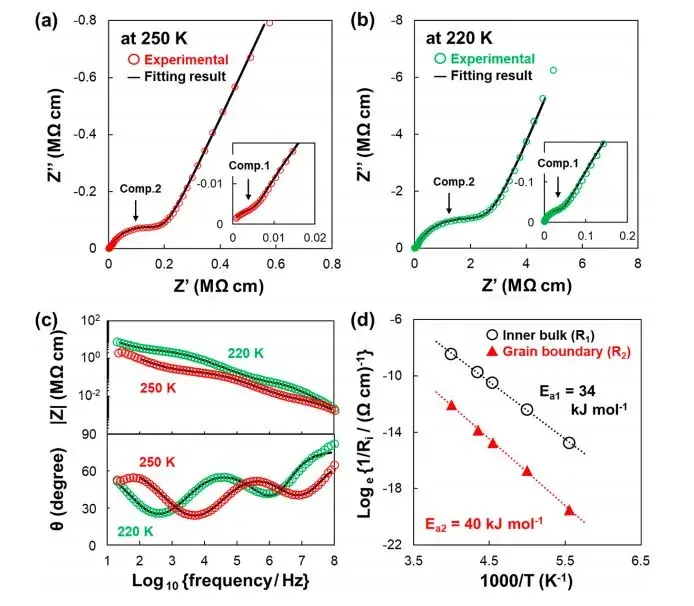
Figure 4. EIS and Arrhenius plots for air-exposed argyrodite (Exposed SE) at low temperatures — grain-boundary R₂ increases substantially; grain-boundary activation energy rises while bulk Ea1 = 33 kJ/mol remains unchanged
3.4 Mechanistic Interpretation: Surface Hydrolysis and Secondary-Phase Formation
Surface analysis by the authors confirms the formation of multiple decomposition products on LPSCl particle surfaces after moisture exposure: phosphate species (P–O), sulfate species (S–O), carbonate (CO₃²⁻), thiol groups (–SH), and hydrated surface layers. Because the ionic conductivity of these decomposition products is orders of magnitude lower than that of argyrodite LPSCl, their presence at particle boundaries effectively blocks Li⁺ pathways and increases grain-boundary impedance.
Initial degradation begins at particle surfaces. Progressive hydrolysis can also lead to nanocrystalline secondary phases and novel interparticle interfaces that generate additional impedance signatures. The authors note that EIS alone cannot unambiguously separate impedance from nanocrystals versus hydrated surface layers—a limitation that multi-technique approaches (XPS, TEM, SIMS) can address in complementary studies.
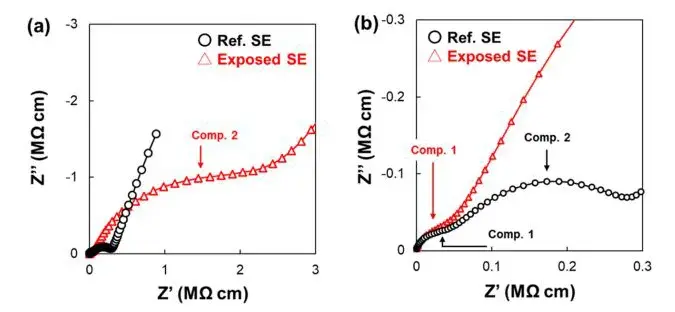
Figure 5. Nyquist plot and high-frequency zoom at 220 K — Ref.SE vs Exposed SE: bulk (high-frequency) semicircle unchanged; grain-boundary (low-frequency) semicircle markedly enlarged after 1-hour air exposure
3.5 High-Frequency EIS as a Process-Control Tool for Solid Electrolyte Manufacturing
Although the precise impedance origin at grain boundaries remains partially ambiguous (nanocrystal vs hydrated layer contributions), high-frequency EIS up to 100 MHz successfully localizes conductivity losses to grain boundaries rather than the bulk—a spatial resolution not achievable with standard EIS equipment limited to lower frequencies. This capability makes high-frequency EIS a powerful diagnostic for:
- Screening the moisture tolerance of different sulfide solid electrolyte formulations under controlled exposure conditions
- Specifying dry-room humidity thresholds (dew point targets) for safe argyrodite solid electrolyte handling
- Evaluating the effectiveness of surface coatings or particle encapsulation strategies designed to block moisture access to grain boundaries
- Monitoring lot-to-lot variation in ionic conductivity and activation energy as a quality-control metric in all-solid-state battery manufacturing
4. Conclusion
This study successfully utilized high-frequency EIS (up to 100 MHz) to analyze an argyrodite solid electrolyte after exposure to a dry air atmosphere. High-frequency EIS successfully deconvolutes the overall impedance of argyrodite Li7−xPS6−xClx solid electrolyte into bulk and grain-boundary components, achieving a spatial resolution of conductivity degradation not accessible by conventional EIS techniques. After 1-hour exposure to air at dew point −20 °C:
- Total ionic conductivity falls from 0.70 to 0.28 mS/cm (~60% reduction)
- Grain-boundary resistance and activation energy increase substantially
- Bulk ionic conductivity and Ea1 (33 kJ/mol) remain essentially unchanged
The degradation is attributed to surface hydrolysis forming low-conductivity phosphate, sulfate, and carbonate phases at grain boundaries, while the argyrodite bulk crystal structure remains intact. This methodology offers a direct, quantitative approach to monitoring sulfide solid electrolyte air stability and optimizing manufacturing conditions for all-solid-state lithium batteries.
5. References
Morino Y, Sano H, Kawaguchi S, et al. High-Frequency Impedance Spectroscopic Analysis of Argyrodite-Type Sulfide-Based Solid Electrolyte upon Air Exposure[J]. The Journal of Physical Chemistry C, 2023, 127(37): 18678-18683.
6. IEST Related Testing Equipment
IEST has developed the SEMS Solid Electrolyte Measurement System—an automated platform integrating pressing, electrochemical testing, and density measurement for in-situ characterization of sulfide, oxide, and polymer solid electrolytes. The all-in-one design includes a pressing module, electrochemical testing module, density measurement module, and ceramic clamping fixture, enabling controlled-atmosphere testing of argyrodite solid electrolytes and other air-sensitive materials without sample transfer.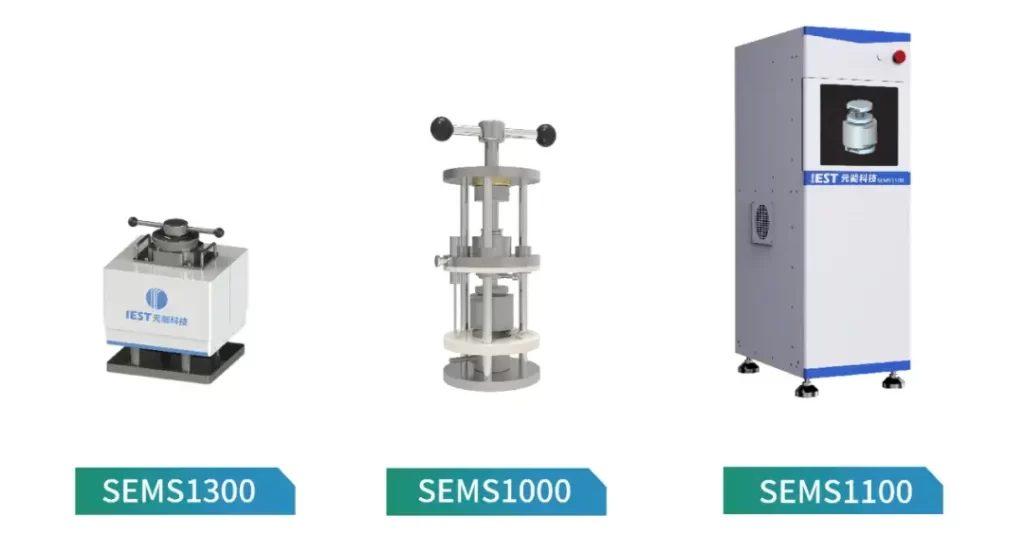
Figure 6. IEST SEMS1100 Solid Electrolyte Measurement System — all-in-one pressing, EIS, and density measurement for in-situ testing of sulfide, oxide, and polymer solid electrolytes under controlled atmosphere
7. FAQs
7.1 What is argyrodite solid electrolyte and why is it moisture-sensitive?
Argyrodite solid electrolyte refers to the Li7−xPS6−xClx (LPSCl) family of sulfide-based solid electrolytes, named after the argyrodite mineral structure (cubic space group F̄43m). These materials offer room-temperature ionic conductivity of 1–12 mS/cm—comparable to liquid electrolytes—making them among the most promising solid electrolytes for all-solid-state lithium batteries. Moisture sensitivity arises from the P–S and Li–S bonds in the sulfide lattice, which hydrolyze rapidly in the presence of even trace water vapor, releasing toxic H₂S gas and depositing low-conductivity phosphate, sulfate, and carbonate phases on particle surfaces. These surface phases block Li⁺ pathways at grain boundaries, reducing ionic conductivity substantially—even in dry-room conditions (dew point −20 to −40 °C).
7.2 What is the ionic conductivity of argyrodite sulfide solid electrolyte at room temperature?
Pristine argyrodite LPSCl (Li6PS5Cl, x ≈ 1) achieves room-temperature ionic conductivity of approximately 1–12 mS/cm depending on synthesis route, particle size, and compaction pressure. In this study, the reference argyrodite solid electrolyte (Ref.SE, D₅₀ ≈ 3.5 µm, pressed at 200 MPa) showed 0.70 mS/cm at 298 K—a representative value for commercially sourced powder. After 1 hour of air exposure at dew point −20 °C, ionic conductivity decreased to 0.28 mS/cm, retaining only ~40% of the original value. Optimized synthesis and surface engineering can push room-temperature ionic conductivity above 10 mS/cm; however, all argyrodite compositions remain sensitive to moisture and require inert-atmosphere handling to preserve this high conductivity.
7.3 How does air exposure affect sulfide solid electrolyte conductivity, and which microstructural region is most affected?
Air exposure reduces the ionic conductivity of argyrodite sulfide solid electrolytes by depositing low-conductivity surface phases—phosphates, sulfates, carbonates, and hydrated layers—on particle surfaces. These phases accumulate preferentially at grain boundaries between particles, where they block Li⁺ transport pathways. High-frequency EIS analysis at low temperatures (180–250 K) confirms that grain-boundary resistance increases substantially after exposure, while the particle bulk remains essentially unaffected: bulk ionic conductivity and its activation energy (Ea1 = 33 kJ/mol) are unchanged, while grain-boundary activation energy Ea2 increases. This spatial selectivity means that protective strategies focused on particle surfaces— coatings, encapsulation, or surface passivation—are the most relevant approach for improving air stability.
7.4 What is activation energy in solid electrolyte EIS, and what do Ea1 and Ea2 represent?
Activation energy (Ea, kJ/mol or eV) in solid electrolyte EIS is the energy barrier that Li⁺ ions must overcome to migrate between adjacent sites in the crystal lattice or across grain boundaries. It is extracted from the slope of an Arrhenius plot of ionic conductivity vs. inverse temperature (ln σ vs 1/T). In this study, Ea1 = 33 kJ/mol represents the bulk activation energy— the migration barrier within the argyrodite crystal interior—while Ea2 = 36 kJ/mol is the grain-boundary activation energy, reflecting the slightly higher energy cost for Li⁺ to cross interparticle interfaces. After air exposure, Ea2 increases (grain boundaries become harder to cross), while Ea1 remains 33 kJ/mol, confirming that degradation is confined to surfaces and interfaces rather than the bulk crystal structure.
7.5 Why is high-frequency EIS needed for sulfide solid electrolyte characterization?
Standard EIS equipment typically measures to 1–10 MHz. For highly conductive sulfide solid electrolytes such as argyrodite LPSCl, the bulk and grain-boundary relaxation frequencies fall in the MHz range even at room temperature. To resolve the two semicircles corresponding to bulk and grain-boundary contributions at 298 K, frequencies up to 100 MHz are required. At lower measurement frequencies, the two arcs overlap and cannot be deconvoluted. High-frequency EIS to 100 MHz therefore enables spatial localization of impedance changes—distinguishing whether conductivity degradation after air exposure originates in the particle bulk or at grain boundaries—which is critical information for developing handling protocols and surface protection strategies for all-solid-state battery manufacturing.