-
iestinstrument

Abstract
1. The Micromechanics of Powder Compaction
The compaction of powder in electrode manufacturing involves multiple simultaneous deformation mechanisms — unlike dense solids, powder systems conserve mass but not volume during compression, making their densification behavior fundamentally more complex. Dense materials deform under force following mass conservation and volume constancy. In contrast, powder deformation obeys only mass conservation, encompassing both particle-level deformation and the alteration of inter-particle pore morphology as particles displace.
During the powder compaction process, four microscopic deformation mechanisms operate in sequence and in combination:
-
Particle Rearrangement: Initially irregularly arranged electrode particles realign under stress, adopting a tighter packing configuration. Contact point number increases, filling original pore space.
-
Particle Repacking: With increasing external stress, dispersed particles form local aggregates that fill local regions, reducing inter-particle gaps and enhancing compactness.
-
Particle Compression Deformation: Under sufficient stress, electrode particles undergo compressive (elastic and plastic) deformation. The contact area between particles increases, reducing pore number and size.
-
Particle Fragmentation: At high local contact stresses, secondary electrode particles crack or fracture. This powder compression fragmentation alters overall powder morphology and conductivity-relevant surface area.
The balance between elastic (recoverable) and plastic (irreversible) behaviour during the powder compaction process determines the final compact’s density and its spring-back after the calender nip — a key variable for targeting electrode thickness.
2. Experimental Process
2.1 Materials & Equipment
Four LCO powder samples with different average particle sizes were analyzed (designated LCO-1 through LCO-4, with LCO-4 being the finest and particle size ordering: LCO-4 < LCO-2 < LCO-3 < LCO-1). The test instrument — the battery powder compaction tooling and measurement platform — was the IEST PRCD3100 Powder Resistivity & Compaction Density System, which applies precise uniaxial pressure while measuring powder compact thickness in real time. The PRCD3100 serves as both the powder compaction tooling and data acquisition platform for this study.
| Name | LCO-1 | LCO-2 | LCO-3 | LCO-4 |
|---|---|---|---|---|
| Average Particle Size (µm) | 22.08 | 12.78 | 18.06 | 6.27 |

Figure 1. Schematic diagram of experimental materials and instruments: (a) Four LCO powders (2 g each); (b) Internal structure of powder compaction detector; (c) External diagram of the PRCD3100; (d) Powder compaction experiment procedure.
2.2 Test Protocol
A stepwise pressure profile from 10 MPa to 350 MPa (in 20 MPa increments) was applied, with a 10-second hold at each step to ensure stress equilibration and accurate thickness measurement before moving to the next pressure level.
3. Mechanical Analysis Tool: The Heckel Equation
The Heckel equation is the standard semi-empirical model for quantifying the powder compaction process — it describes how relative density evolves with applied pressure and separates the contributions of particle rearrangement, elastic deformation, and plastic deformation. The Heckel equation expresses the porosity-pressure relationship as:
\[\ln\left(\frac{1}{1-D}\right) = kp + A\]
where:
-
\(p\) — applied pressure
-
\(D\) — relative density of the powder column at pressure \(p\)
-
\(k\) — Heckel slope (plasticity parameter): the larger the \(k\) value, the greater the density change per unit pressure increment, indicating higher plasticity. When \(k\) is constant, \(\ln[1/(1-D)]\) vs \(p\) is linear — indicating purely plastic densification. If \(k\) varies, the relationship is curvilinear, indicating rearrangement, fragmentation, or other mechanisms.
-
\(A\) — Heckel intercept: physically interpreted as \(A = \ln[1/(1-D_0)]\), where \(D_0\) is the relative density after initial rearrangement at low pressure before plastic deformation begins. This value is related to true density, morphology, and particle size distribution of the electrode powder.
A Heckel plot — the graphical representation of \(\ln[1/(1-D)]\) versus applied pressure \(p\) — allows direct extraction of \(k\) and \(A\) from the linear region. The Heckel plot slope \(k\) ranks powders by their expected plasticity in the industrial powder compaction process and provides the quantitative basis for setting calendaring pressure windows.
| Parameter | Symbol | Physical meaning | Practical implication |
|---|---|---|---|
| Heckel slope | k | Plasticity index — density change per MPa in the linear region | Higher k = more plastic densification; set calendaring pressure to avoid fragmentation |
| Heckel intercept | A | Packing density after rearrangement, before plastic deformation | Related to particle size distribution and morphology |
| Linear region | Slope = k (constant) | Plastic deformation dominant | Densification is irreversible; spring-back is low |
| Curvilinear region | k varies | Rearrangement or fragmentation dominant | Monitor PSD for evidence of particle breakage |
4. Results: Linking Particle Size to Deformation Mechanics
4.1 Heckel Analysis Reveals Compressibility Trends
Heckel equation analysis of the four LCO powders reveals a clear, particle-size-dependent ranking of powder compaction plasticity — with coarser powders showing higher k values and finer powders exhibiting more elastic behavior. The stress-compaction density relationship curves and Heckel plot fitted straight lines for the four LCO powders are shown in Figure 2.
-
LCO-1 and LCO-3 (coarser): Higher Heckel k values — at these particle size distributions, rearrangement and pore-filling by particle displacement are less efficient under equivalent pressure, so particles undergo more pronounced elasto-plastic deformation to achieve densification.
-
LCO-4 (finest): Smallest Heckel k value — fine particles achieve efficient packing and rearrangement early in the powder compaction process, creating more inter-particle contact points with less additional plastic densification at higher pressures. This results in smaller density change per unit pressure increment and a greater relative contribution from elastic interactions during compaction of this powder.
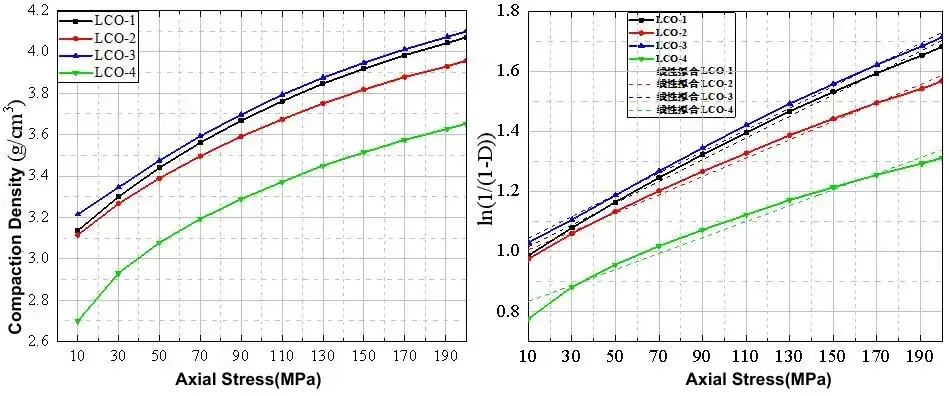
Figure 2. Stress-compaction density curves and Heckel plots for the four LCO powder samples (LCO-1 to LCO-4).
4.2 Energy Decomposition: Quantifying Elastic vs Plastic Work
Integration of pressure-displacement traces from the powder compression test decomposes total mechanical input work into irreversible (plastic) and recoverable (elastic) components — providing quantitative spring-back predictions for calendaring process design.
-
Total input work = area under the loading curve to peak displacement
-
Plastic work = irreversible area (does not recover during unloading)
-
Elastic work = recoverable area observed as rebound on unloading
Across the four LCO powders, plastic deformation accounted for approximately 90% of total mechanical work, confirming that the powder compaction process is predominantly irreversible under these conditions. Finer LCO powder (LCO-4) consistently showed a higher elastic fraction and more pronounced spring-back, while coarser powders consumed a greater share of energy as plastic work — consistent with their higher Heckel k values.
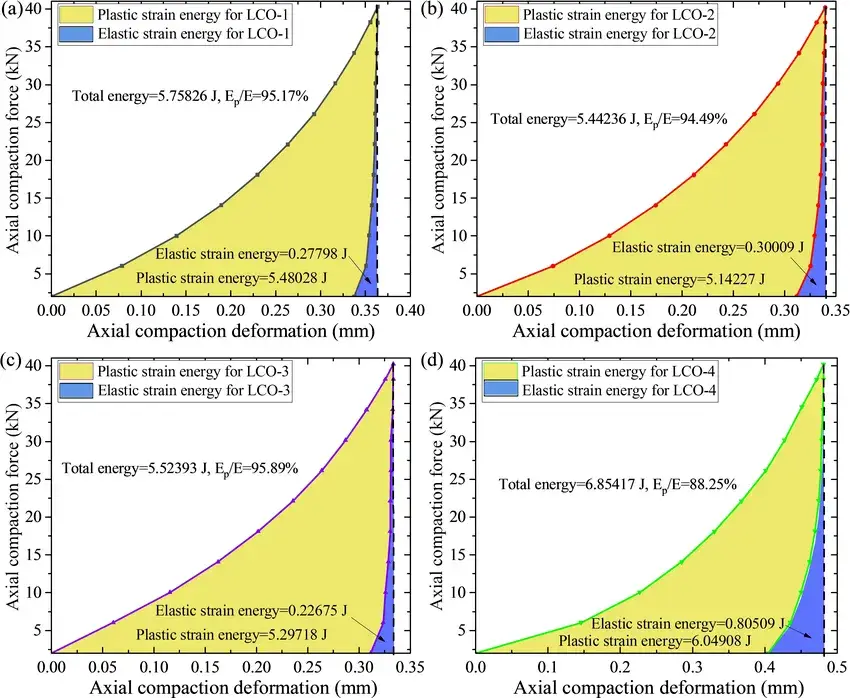
Figure 3. (Top) Deformation curves under different pressures. (Bottom) Energy distribution between elastic and plastic deformation for each LCO powder.
| Name | LCO-1 | LCO-2 | LCO-3 | LCO-4 |
|---|---|---|---|---|
| Energy consumed by elastic deformation (J) | 0.27 | 0.3 | 0.22 | 0.85 |
| Energy consumed by plastic deformation (J) | 5.48 | 5.14 | 5.29 | 6.04 |
| Plastic energy ratio | 95.17% | 94.49% | 95.89% | 88.25% |
| Sample | Relative particle size | Heckel k value | Dominant deformation | Elastic fraction | Spring-back |
|---|---|---|---|---|---|
| LCO-1 | Coarsest | Highest | Plastic (large) | Lowest (~10%) | Minimal |
| LCO-3 | Second coarsest | High | Plastic (moderate-high) | Low | Low |
| LCO-2 | Second finest | Moderate | Mixed | Moderate | Moderate |
| LCO-4 | Finest | Lowest | Rearrangement + elastic | Highest | Most pronounced |
5. Energy partitioning: How Much Work is Plastic vs. Elastic?
Integrating pressure-displacement traces provides a direct mechanical energy budget for the powder compaction process — a more informative metric than density alone for predicting post-calender spring-back and particle fracture risk. Across the tested LCO powders, plastic deformation accounted for roughly ~90% of the mechanical work, indicating predominantly irreversible compaction. Finer powders (LCO-4) showed higher elastic fractions and smaller plastic-work shares, consistent with their lower Heckel k values. These energy metrics help predict the degree of particle fracture and surface-area increase introduced by calendaring.
6. Micro-Mechanisms Explaining the Macroscopic Response
Three interacting microscale processes produce the particle-size-dependent compaction of powder observed in this study:
-
Particle rearrangement — dominates at low pressures; particles reposition to fill voids with minor permanent strain. Finer particles achieve efficient rearrangement early, reducing the need for subsequent plastic work.
-
Elastic powder compression — particles elastically deform under moderate stress and partly rebound on unloading; this mode is more prominent in finer powders, explaining their higher spring-back and elevated elastic fraction in the energy budget.
-
Plastic deformation and fragmentation — at higher local contact stresses, particles plastically flow or fracture, creating permanent densification and new surface-active fines. Coarser powders in this dataset showed more fragmentation at equivalent nominal pressures, because their larger contact areas generate higher local stress concentrations.
7. Practical Implications for Electrode Manufacturing and Calendaring
Heckel equation parameters from powder compaction process testing provide direct, quantitative guidance for calendaring pressure selection and powder qualification in electrode manufacturing:
-
Powder selection trade-offs: Finer LCO powder can reach target packing density with less fragmentation and lower introduction of new surface area, preserving electrochemical stability. However, excessive fines elevate slurry viscosity and may impair battery electrode coating performance.
-
Calendaring pressure windows: Derive pressure setpoints from Heckel-based ranking (k and A). Avoid pressures where coarser powders enter aggressive fragmentation regimes — verify by post-calender particle-size distribution (PSD) checks.
-
Energy budgeting: Because ~90% of mechanical work is plastic under these test conditions, densification will be largely irreversible; do not rely on elastic rebound to recover porosity after the calender nip.
-
Quality control: Monitor incoming particle-size distributions and set acceptance bands. Small PSD shifts can accumulate and cause stack-level non-uniformities in multilayer assemblies.
8. Summary
-
Particle size dictates spring-back: Finer LCO powder consistently demonstrates greater elastic recovery post-compaction — a critical factor for predicting final electrode thickness after calendering.
-
Heckel k as a predictive parameter: The Heckel constant k serves as a quantitative indicator of a powder’s compaction mechanism in the powder compaction process, with lower k values corresponding to finer particle sizes and a higher proportion of elastic behavior.
-
~90% plastic work: Across all four LCO powders, approximately 90% of total mechanical input is consumed as irreversible plastic deformation — confirming that electrode densification under these conditions is essentially permanent.
- Process design insight: Heckel plot analysis moves electrode process design from trial-and-error toward a predictive, mechanistic approach — enabling evidence-based calendaring window selection by particle size.
🔬 IEST PRCD3100 Powder Resistivity & Compaction Density System
The PRCD3100 is the battery powder compaction tooling and measurement platform used in this study. It applies precise uniaxial pressure while simultaneously measuring powder compact thickness and resistivity in real time, supporting Heckel equation analysis, stepped-pressure protocols, and powder compression energy decomposition for cathode and anode electrode powder qualification.
- Pressure range: Stepwise from 10 MPa to 350 MPa (configurable increments)
- Hold time per step: Configurable (10 s in this study) for stress equilibration
- Simultaneous output: Compact thickness + electrical resistivity at each pressure step
- Analysis: Direct Heckel plot generation, elastic/plastic work decomposition, k and A extraction
- Applications: LCO, NCM, NCA, LFP cathode powders; graphite and silicon-graphite anode powders
9. References
[1] YANG Shaobin,LIANG Zheng. Principles and applications of lithium-ion battery manufacturing process[J]. [2023-07-08].
[2] Kai W, Jw A, Yx A, et al. Recent advances and historical developments of high voltage lithium cobalt oxide materials for rechargeable Li-ion batteries [J]. Journal of Power Sources, 460.
[3] Park M, Zhang X, Chung M, et al. A review of conduction phenomena in Li-ion batteries[J]. Journal of Power Sources, 2010, 195(24):7904-7929.
10. FAQs
10.1 What is the powder compaction process in lithium-ion battery electrode manufacturing?
The powder compaction process in electrode manufacturing refers to the densification of cathode or anode active material powder under uniaxial compression — mimicking the calendaring step that follows electrode coating. During this process, electrode particles undergo sequential rearrangement, elastic deformation, plastic deformation, and fragmentation as applied pressure increases from initial packing to the target compact density. The balance between elastic (spring-back) and plastic (permanent) deformation determines final electrode thickness, porosity, and calendaring pressure window. Across the four LCO powders tested in this study, approximately 90% of total mechanical work was consumed as irreversible plastic deformation.
10.2 What is the Heckel equation and how is it used in powder compaction analysis?
The Heckel equation — ln[1/(1−D)] = kp + A — is a semi-empirical model that quantifies the relationship between applied pressure (p) and relative compact density (D) during the compaction of powder. The slope k is the plasticity parameter: higher k indicates greater density change per unit pressure, signifying a more plastic powder. The intercept A reflects the packing density achieved after initial particle rearrangement, before plastic deformation begins. A Heckel plot (ln[1/(1−D)] vs p) extracts k and A graphically: the linear region confirms plastic-dominated densification (constant k), while curvature indicates rearrangement or fragmentation. For LCO electrode powders, Heckel k values rank powders by their calendaring behavior — enabling evidence-based pressure window selection.
10.3 How does LCO particle size affect the powder compaction process and spring-back?
LCO particle size directly governs which deformation mechanism dominates during powder compression. Coarser LCO particles (LCO-1 and LCO-3 in this study) exhibit higher Heckel k values — meaning they undergo more pronounced plastic deformation per unit pressure and show less spring-back after load removal. Finer LCO particles (LCO-4, the finest sample) achieve efficient packing and rearrangement early in the compaction process, with more inter-particle contact points established before significant pressure is applied. As a result, finer powders show lower Heckel k values, consume a higher fraction of energy as elastic work, and exhibit more pronounced spring-back — a critical factor for predicting final electrode thickness after the industrial calendaring step.
10.4 What is the difference between elastic and plastic work in the powder compaction process?
In the powder compaction process, total mechanical input work (area under the loading pressure-displacement curve) divides into plastic work (irreversible: the compact retains its compressed shape after unloading) and elastic work (recoverable: the compact springs back toward its original thickness on unloading). Across the four LCO powders in this study, ~90% of total mechanical work was plastic, confirming that electrode densification under these conditions is predominantly permanent. Finer powders consumed a larger elastic fraction (and showed more spring-back), while coarser powders consumed more energy as plastic work (and fragmented more at equivalent pressures). These metrics directly inform whether a process engineer can rely on spring-back to achieve target post-calender porosity.
10.5 What equipment is used to measure powder compaction behavior and generate Heckel plots for battery electrode powders?
Characterizing the powder compaction process for battery electrode powders requires an instrument that applies controlled uniaxial pressure while measuring compact thickness continuously — serving as both the powder compaction tooling and the data acquisition platform. The IEST PRCD3100 Powder Resistivity & Compaction Density System performs stepped-pressure protocols (10-3500 MPa with configurable hold times) and simultaneously measures compact thickness and electrical resistivity at each pressure step. This data enables direct Heckel plot generation, extraction of k and A parameters, and elastic/plastic energy decomposition — all in a single test sequence for LCO, NCM, NCA, LFP, graphite, and silicon-graphite electrode powders.