
LiFePO4 cells are often used as power trams or energy storage devices with high power or high security requirements because of their high security and stability. As the capacity of a single cell rises, its expansion during charging and discharging increases. Usually, to analyze the expansion behavior of a cell, the cell expansion thickness or expansion force parameter is used, but the test modes of these two are different, and we have previously analyzed the differences between these two aspects of lithium cobalt oxide system cells1. For more information, please refer to the article, “In-situ Expansion Analysis of Pouch Cell: constant Pressure Vs Constant Gap”.
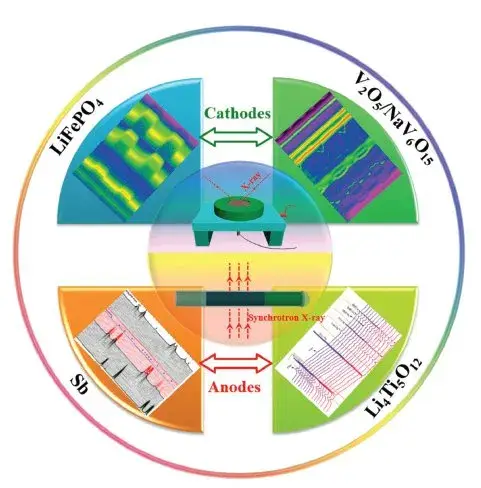
Figure 1. In-situ XRD characterization of lattice changes in different materials 1
The In-situ Swelling Analyzer, model SWE2110 (IEST), was used for this investigation. The equipment is shown in Figure 2. The system supports two measurement modes:
| Mode | What Is Held Constant | What Is Measured |
|---|---|---|
| Constant-Pressure Mode | A set compressive load | Thickness changes of the cell — this is swelling thickness |
| Constant-Gap Mode | A fixed displacement (gap) | The force the cell exerts as it swells — this is swelling force |
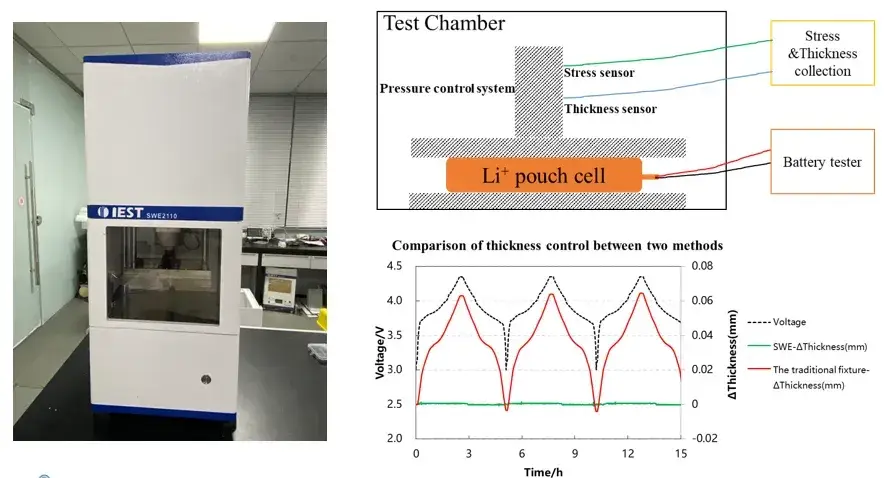
Figure 2. Appearance of SWE2110 Equipment
Cell Information: The test cell specifications are summarized in Table 1.
Charge-Discharge Protocol: The test was conducted at 25°C using the following sequence: Rest 5 min; 1C constant current (CC) charge to 3.65 V, followed by constant voltage (CV) charge until the current dropped to 0.025C; Rest 5 min; 1C constant current (DC) discharge to 2.5 V.
Swelling Measurement: The cell was placed in the corresponding channel of the SWE2110. The MISS software was used to set the cell ID and sampling frequency, automatically recording data for cell thickness, thickness variation, temperature, current, voltage, and capacity.
| Item | Parameter |
|---|---|
| Norminal capacity (Ah) | 54.0 |
| Cathode material | LiFePO4 |
| Anode Material | Graphite |
| Cut-off Voltage range (V) | 2.5–3.65 |
Two different test modes of the In-Situ Swelling Analyzer (SWE2110) were used to test the variation of expansion thickness under constant-pressure conditions and the variation of expansion force under constant-gap conditions. Control stability verification is shown in Figure 3:
| Test Mode | Set Point | Measured Stability |
|---|---|---|
| Constant-pressure | 35 kg and 400 kg (tested separately) | Pressure fluctuation of ±1 kg throughout testing |
| Constant-gap | Fixed gap value | Gap variation within ±1 μm throughout testing |
This ±1 kg / ±1 μm control precision is what makes the subtler swelling curve features discussed below — including the slight thickness decrease during charging and the 25%–70% SOC phase-change behavior in Section 4.3 — reliably distinguishable from equipment noise, rather than obscured by measurement uncertainty.
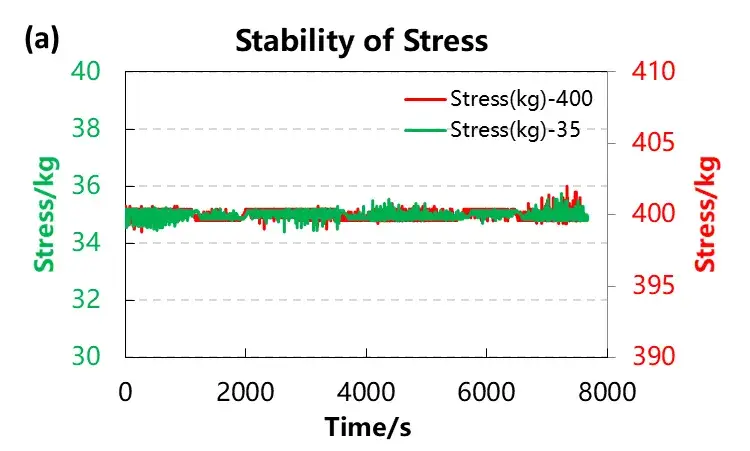
Figure 3. (a) Control stability curves for constant force and constant gap modes
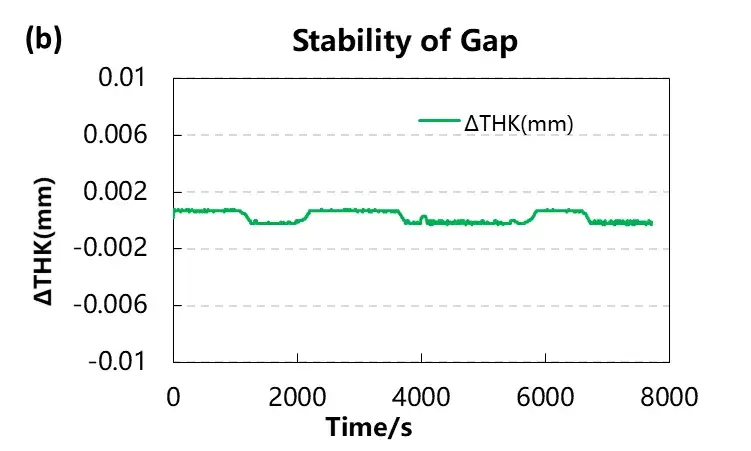
Figure 3. (b) Stability curve of gap under constant pressure and constant gap
Figure 4 shows the cell’s charge-discharge curves, differential capacity (dQ/dV) curve, and thickness expansion curve. A notable observation for this LFP/graphite system is a slight decrease in thickness during the charging process. This thickness decrease coincides with the second lithium intercalation stage of graphite. A plausible explanation is that lithium extraction from the olivine-structured LiFePO₄ cathode causes contraction on the cathode side, which partially offsets the expansion from lithium intercalation into the graphite anode — resulting in a net decrease in overall cell thickness. This phenomenon could be further investigated using techniques like in-situ XRD.
Furthermore, the maximum swelling thickness observed during the cycle increased when a higher constant pressure was applied to the cell — this low-swelling-thickness-under-lower-pressure behavior is an important consideration when interpreting thickness data across different mechanical boundary conditions.
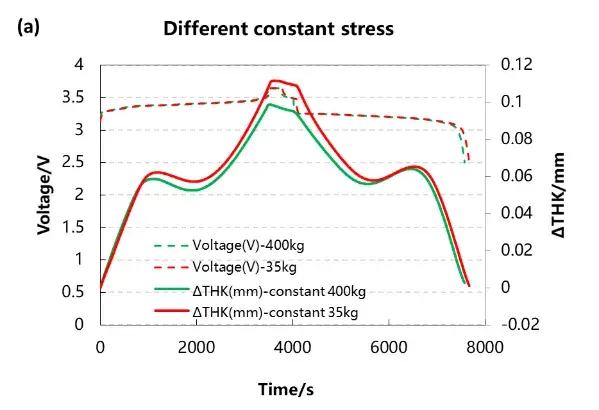
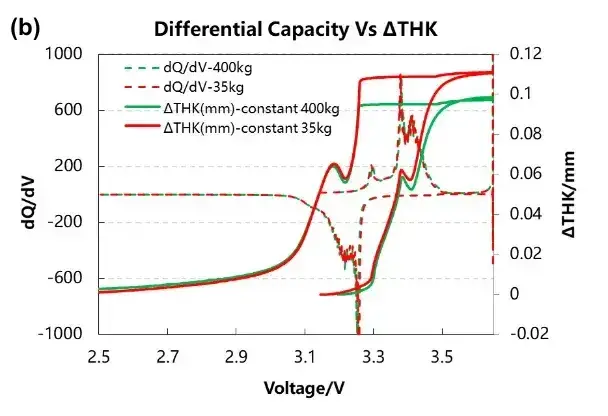
Figure 4. Charge-discharge curves, differential capacity curve, and thickness swelling curves
Figure 5 presents a direct comparison of the swelling force and swelling thickness curves obtained from the two different testing modes:
| Aspect | Observation |
|---|---|
| Overall trend | Swelling force and swelling thickness follow consistent general trends throughout the charge-discharge cycle |
| 25%–70% SOC window | A key phase-transition region for lithium (de)intercalation and an interval of relatively low cell impedance; thickness decreases during charging and increases during discharging within this range |
| Underlying mechanism | Complex, involving opposing expansion and contraction contributions from the anode and cathode; not fully deconvoluted by swelling data alone |
This complex behavior — involving opposing expansion and contraction mechanisms from the anode and cathode — necessitates further investigation using complementary characterization techniques to fully deconvolute the individual electrode contributions.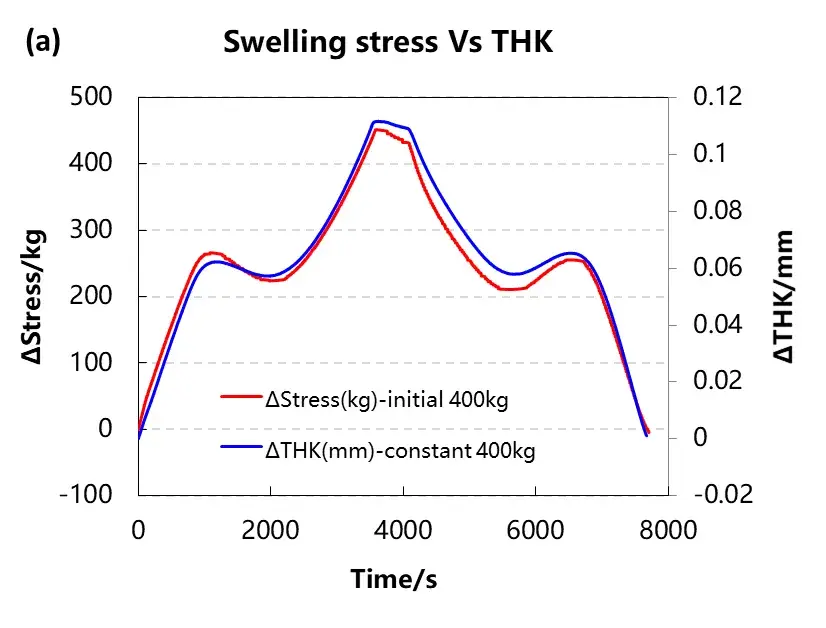
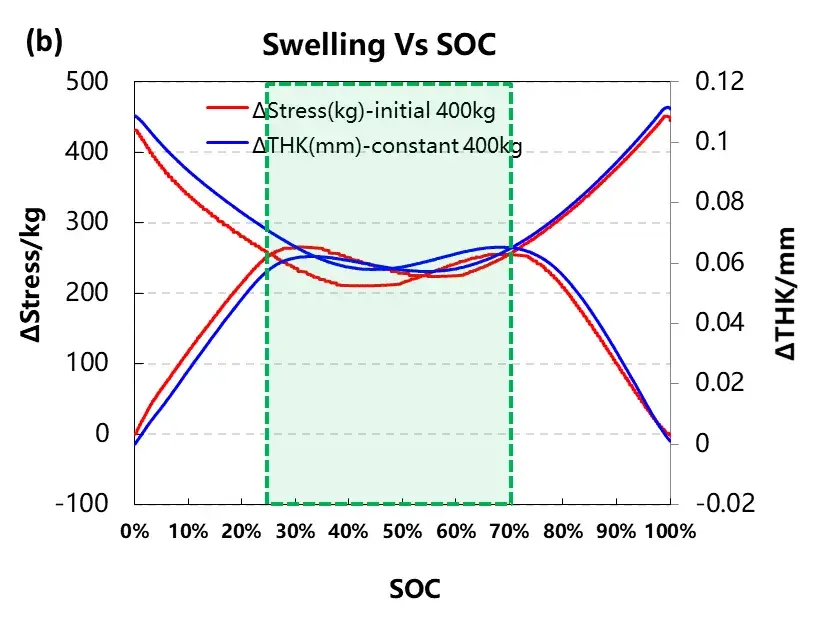
Figure 5. Comparison of swelling force and swelling thickness curves under two different test modes
The IEST SWE2110 In-Situ Cell Swelling Testing System measures both constant-pressure thickness swelling and constant-gap swelling force, with ±1 kg / ±1 μm control precision — the data foundation for mechanical boundary condition and swelling compensation design decisions.
In this paper, an in-situ battery swelling analyzer (SWE2110) is used to perform a comparative analysis of swelling thickness and swelling force on a high-capacity LiFePO4 pouch cell. The results demonstrate that the general swelling trends for force and thickness are consistent during cycling. A distinct thickness decrease during charging and increase during discharging was observed within the 25%–70% SOC range. Further analysis, combining this method with other characterization techniques, is required to fully elucidate the intricate expansion/contraction mechanisms of the positive and negative electrodes in this system.
[1] Xiujuan Wei, Xuanpeng Wang, Qinyou An, Chunhua Han, and Liqiang Mai. Operando X-ray Diffraction Characterization for Understanding the Intrinsic Electrochemical Mechanism in Rechargeable Battery Materials Small Methods 2017, 1700083.
Swelling thickness is measured under a set (constant) applied pressure and records how much the cell’s dimension changes. Swelling force is measured under a fixed (constant) gap and records how much force the cell generates as it tries to expand against that fixed boundary. The two modes generally follow consistent overall trends but can reveal different behavior in specific SOC ranges, such as the 25%–70% window discussed in this study.
In LFP/graphite pouch cells, a slight thickness decrease during charging coincides with the second lithium intercalation stage of graphite. Lithium extraction from the olivine-structured LiFePO4 cathode causes contraction on the cathode side, which can partially offset the expansion from lithium intercalation into the graphite anode, producing a net decrease in overall cell thickness during that phase.
Applying higher constant external pressure to a LiFePO4 cell increases the measured maximum swelling thickness observed during cycling. This means swelling thickness data is not an intrinsic cell property alone — it depends on the mechanical boundary condition under which it is measured, which is why constant-pressure and constant-gap test modes can yield different-looking results for the same cell.
This study specifically tested large-format LiFePO4 pouch cells, not cylindrical cells. Cylindrical LFP cells are constrained by a rigid metal can, which changes the mechanical boundary conditions and swelling behavior compared to a pouch format. The measurement principles (constant-pressure vs. constant-gap testing) apply broadly, but the specific thickness and force curves reported here are representative of pouch cell construction and should not be assumed to transfer directly to cylindrical cell designs.
Swelling force and thickness data — particularly how maximum thickness changes under different applied pressures, as shown in this study — inform the mechanical boundary conditions that pack and module designers use when sizing compensation gaps, buffer pads, or fixture preload in a battery pack. This article provides the underlying cell-level swelling measurement data; specific compensation structure design is a separate downstream engineering step not covered here.
The SWE2110 supports constant-pressure mode, which holds a set compressive load and records cell thickness changes, and constant-gap mode, which holds a fixed displacement and records the swelling force the cell generates. In this study, the SWE2110 maintained ±1 kg pressure control and ±1 μm gap control accuracy throughout testing.