-
iestinstrument

Abstract
Hard carbon electrical conductivity measurement is performed using the four-probe method in a controlled powder resistivity tester to eliminate contact resistance artifacts — critical because hard carbon’s lower resistance makes the two-probe method unreliable. In this study, the IEST PRCD3100 applied 10–200 MPa in 20 MPa steps (10 s hold per step) to four hard carbon and four Prussian blue powder samples. Results:
- Hard carbon conductivity rank: HC-1 > HC-4 > HC-2 > HC-3
- Hard carbon compaction density rank: HC-4 > HC-1 > HC-2 > HC-3
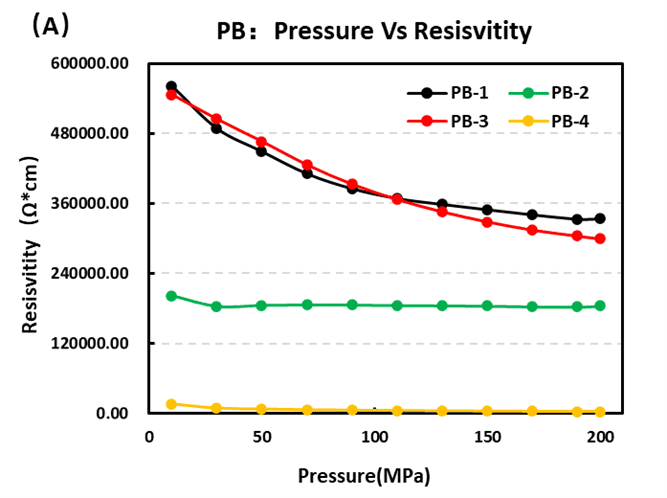
- Prussian blue conductivity: Modified PB-2 and PB-4 show substantially better conductivity than unmodified PB-1 and PB-3
- Prussian blue compaction density rank: PB-1 > PB-3 > PB-4 > PB-2 — higher conductivity modification does not necessarily increase packing density
1. Background: Sodium-Ion Battery Materials
Sodium shares similar chemical properties with lithium due to their common group placement in the periodic table, while offering significant advantages in natural abundance and cost. Sodium-ion batteries (SIBs) have attracted considerable research attention as promising alternatives to lithium-ion batteries, owing to their rapid charging capability, superior low-temperature performance, enhanced safety, and compatibility with existing lithium battery manufacturing processes. These attributes position SIBs as strong candidates for next-generation commercial energy storage.
Advances in SIB research have led to notable progress in both cathode and anode materials. Cathode materials primarily include layered oxides, polyanionic compounds, Prussian blue analogues (PBAs), and organic compounds. Anode materials are largely categorized into carbon-based materials, titanium-based compounds, organic electrodes, and alloy-based systems.
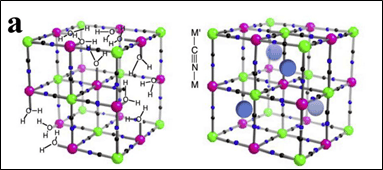
Among cathode options, Prussian blue (PB) and its analogues— representative metal-organic framework (MOF) materials—have attracted interest due to their low cost, facile synthesis, and open three-dimensional framework structure. PB-derived nanomaterials retain high surface area, interconnected pores, and tunable pore size distributions, facilitating efficient charge transfer in energy storage systems. By optimizing synthesis conditions such as temperature and atmosphere, PBAs with desirable structural and electrochemical properties can be achieved.[1] Figure 1 illustrates the Prussian blue crystal structure and its analogues.
 |
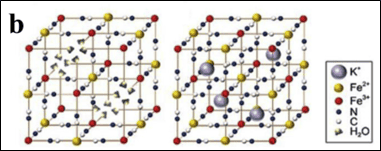 |
Figure 1. Crystal structure of Prussian blue (left) and its analogues (right) — 3D open framework with metal-CN-metal linkages enables Na⁺ intercalation
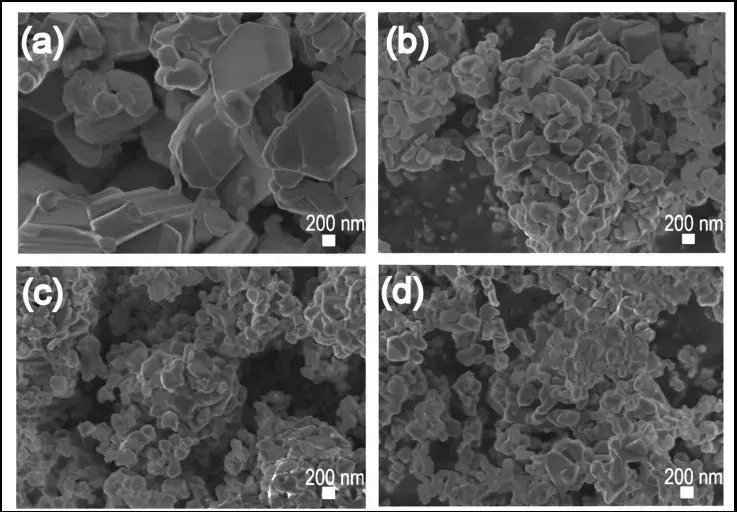
Figure 2. SEM images of layered oxide cathode materials Na0.67Ni0.33Mn1−xSnxO2 with increasing Sn substitution[2]: (a) x=0; (b) x=0.01; (c) x=0.03; (d) x=0.05[2]
On the anode side, carbon-based materials—particularly hard carbon— are considered the most practical choice due to their low sodium-insertion potential, high capacity, excellent cycling stability, resource availability, and relatively simple preparation. Hard carbon stands out for its large interlayer spacing (larger than graphite, enabling Na⁺ storage between disordered graphene layers), low cost, tunable synthesis, and the possibility of derivation from renewable precursors. Figure 3 illustrates a typical hard carbon synthesis process and its microstructural characteristics.
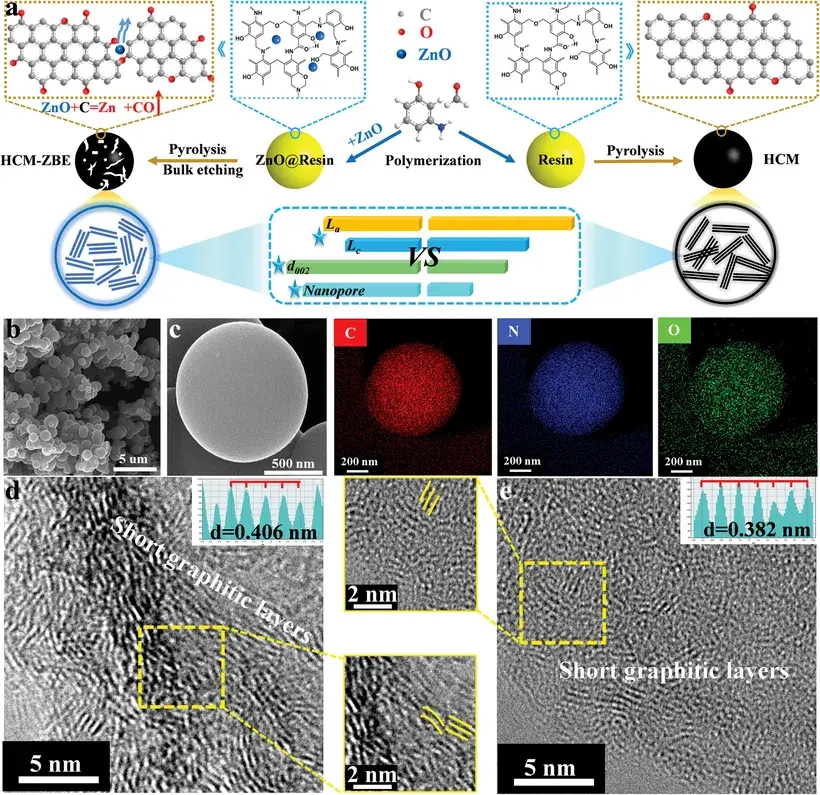
Figure 3. Hard carbon synthesis schematic and microstructure characterization — disordered turbostratic carbon structure with large d-spacing enables Na⁺ storage
Evaluating Prussian blue structure, electronic conductivity, and Prussian blue density together with hard carbon density and conductivity at the powder stage is critical for rapid material screening and downstream electrode design. This study evaluates four Prussian blue materials (PB-1 to PB-4) and four hard carbon materials (HC-1 to HC-4) using the PRCD3100 system to measure their electrical conductivity and compaction density across a controlled pressure range.
2. Test Method: PRCD3100 Hard Carbon Conductivity Measurement
The PRCD3100 (IEST) was used to characterize the conductivity and Prussian blue density and hard carbon density properties. The Prussian blue samples(PB-1/PB-2/PB-3/PB-4) were tested in a two-probe mode, while the hard carbon samples(HC-1/HC-2/HC-3/ HC-4) were measured using a four-probe method to improve accuracy. The testing equipment is shown in Figure 4.
Test parameters included an applied pressure range of 10–200 MPa, incremented at 20 MPa intervals, with a 10-second hold at each pressure step.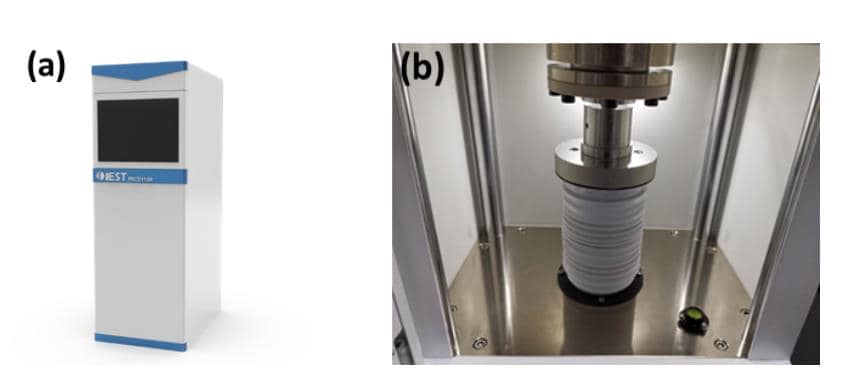
Figure 4. (a) PRCD3100 appearance; (b) PRCD3100 structural diagram — two-probe for Prussian blue, four-probe for hard carbon; 10–200 MPa, 20 MPa steps, 10 s hold
3. Test Results and Analysis
3.1 Prussian Blue: Conductivity, Density, and Modification Effects
Prussian blue and its analogues feature a three-dimensional open framework that enables efficient sodium-ion intercalation and deintercalation, making them attractive cathode materials for sodium-ion batteries. Although PBAs offer a theoretical specific capacity of approximately 170 mAh/g and good cycling stability, practical application has been limited by structural vacancies, coordinated water molecules, and poor rate capability — all of which reduce specific capacity, impede ionic conductivity, and risk structural collapse during cycling.
Modification strategies have been developed to enhance the physical and electrochemical properties of PBAs. Figure 5 presents resistivity and conductivity results for PB-1 through PB-4. PB-2 and PB-4 are modified versions of PB-1 and PB-3 respectively, and clearly show superior electronic conductivity, confirming that material modification effectively improves electron transport in Prussian blue.
 |
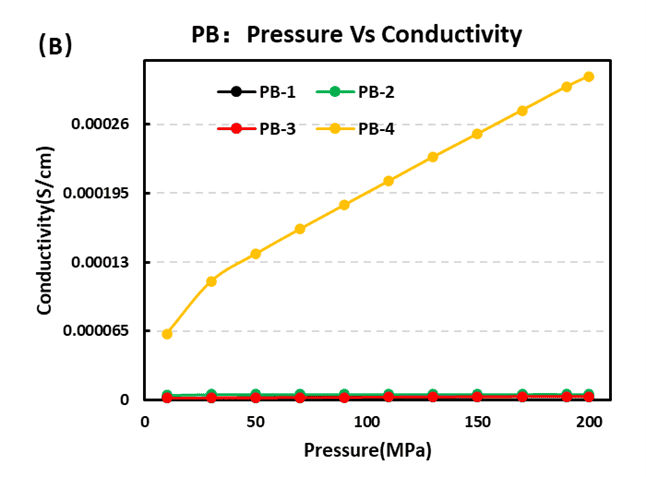 |
Figure 5. (A) Resistivity and (B) conductivity of four Prussian blue materials (PB-1 to PB-4, two-probe method, 10–200 MPa) — modified PB-2 and PB-4 show substantially improved conductivity over unmodified variants
Compaction testing revealed variability in Prussian blue density across samples. Measured compaction densities followed PB-1 > PB-3 > PB-4 > PB-2 under the test conditions. This is an important observation: higher conductivity from modification does not automatically produce higher packing density — Prussian blue structure and surface chemistry must be considered alongside density when screening cathode powders. Key takeaways for PB cathode material selection:
-
Modified PBAs can deliver better electronic conductivity but may alter particle packing behavior and reduce compaction density.
-
Powder-level conductivity testing identifies promising PB derivatives before electrode fabrication, saving cell-level screening cost and time.
-
Optimal PBA performance requires balancing crystal vacancies, coordinated water content, and conductive additive loading alongside compaction density.
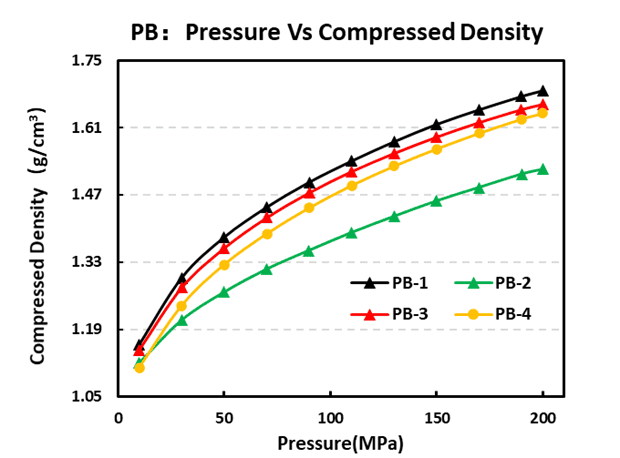
Figure 6. Prussian blue compaction density vs pressure (PB-1 to PB-4) — density rank: PB-1 > PB-3 > PB-4 > PB-2; conductivity improvement via modification does not increase packing density
3.2 Hard Carbon: Conductivity and Density for Sodium-Ion Battery Anodes
Hard carbon is the leading anode choice for sodium-ion batteries. Its disordered, turbostratic carbon microstructure — with interlayer spacings larger than graphite — provides the interstitial sites and nanopore volume needed for Na⁺ storage. Measuring hard carbon electrical conductivity at the powder level is directly relevant to electrode design: lower powder resistivity means fewer conductive additives are needed in the electrode formulation, increasing the volumetric active-material fraction and energy density.
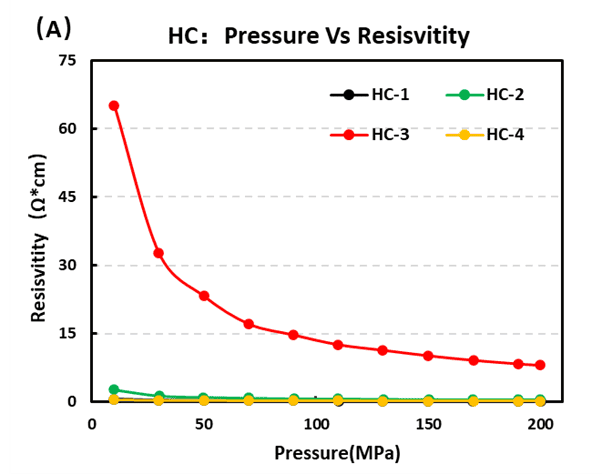
Four-probe resistivity testing (Figure 7) returned a hard carbon conductivity rank of HC-1 > HC-4 > HC-2 > HC-3, with HC-1 showing the best electronic transport. Compaction testing returned hard carbon density rank HC-4 > HC-1 > HC-2 > HC-3, indicating that HC-4 packs most densely under identical pressing conditions — despite ranking second in conductivity. This conductivity-density relationship between HC-1 and HC-4 illustrates a common trade-off in hard carbon material selection: the material with the highest conductivity may not simultaneously deliver the highest compaction density, requiring a balanced assessment of both metrics for electrode applications.
 |
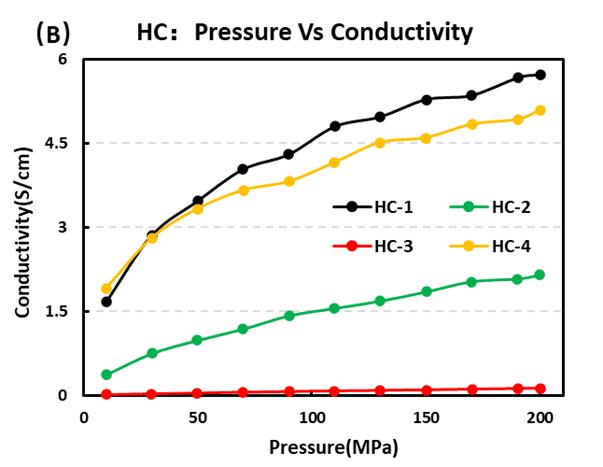 |
Figure 7. (A) Resistivity and (B) conductivity of four hard carbon materials (four-probe method, 10–200 MPa) — HC-1 shows best conductivity; HC-3 shows lowest
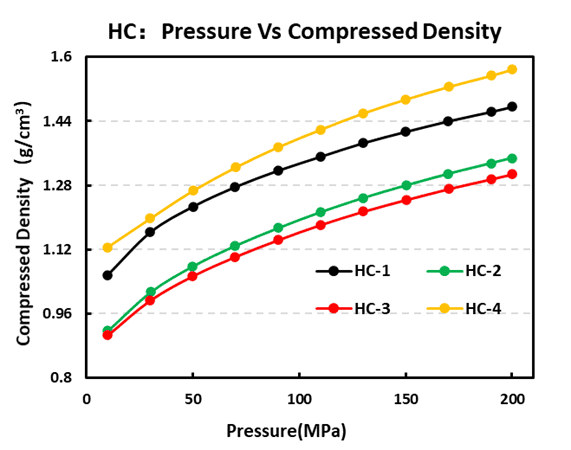
Figure 8. Hard carbon compaction density vs pressure (four-probe, PRCD3100) — density rank: HC-4 > HC-1 > HC-2 > HC-3; HC-4 packs most densely but ranks second in conductivity
4. Discussion: Linking Powder Metrics to Electrode Design
Powder resistivity and compaction density are rapid, low-cost diagnostics that predict key electrode attributes before full electrode fabrication:
-
Electronic percolation: Low powder resistivity suggests fewer conductive additives are needed to reach target electrode conductivity, increasing the volumetric active-material loading.
-
Volumetric energy density: Higher compaction density under equivalent calendering pressure typically translates to higher volumetric capacity at the electrode level.
-
Processing window: Compression and rebound behavior at different pressures informs calendering pressure limits to avoid particle damage while maximizing density.
For Prussian blue cathodes, modifying the structure to reduce coordinated water and stabilize crystal vacancies can improve electronic conductivity but may reduce Prussian blue density if the particle morphology changes. For hard carbon anodes, tuning microstructure and the degree of graphitic ordering optimizes both hard carbon compaction density and sodium storage kinetics. Neither metric alone is sufficient for material selection: HC-1 and HC-4 both present as promising hard carbon candidates—HC-1 for its superior conductivity and HC-4 for its superior compaction density—and the optimal choice depends on the target electrode formulation and rate-capability requirements.
5. Summary
This study used the IEST PRCD3100 powder resistivity and compaction density system to evaluate the conductivity and density properties of four Prussian blue cathode and four hard carbon anode materials for sodium-ion batteries. The two-probe/four-probe dual method configuration — applied according to each material’s resistance range — provides reliable hard carbon conductivity and Prussian blue conductivity data that clearly differentiates sample performance. The results confirm that this powder-level measurement approach is an effective, rapid tool for sodium-ion battery material screening, guiding further optimization toward higher performance and commercial viability.
6. References
[1] Chen J, Wei L, Mahmood A, et al. Prussian blue, its analogues and their derived materials for electrochemical energy storage and conversion – ScienceDirect[J]. Energy Storage Materials, 2020, 25:585-612.
[2] Li J, Risthaus T, Wang J, et al. The effect of Sn substitution on the structure and oxygen activity of Na0.67Ni0.33Mn0.67O2 cathode materials for sodium ion batteries[J]. Journal of Power Sources, 2019, 449:227554.
[3] Yin X, Lu Z, Wang J, et al. Enabling Fast Na+ Transfer Kinetics in the Whole-Voltage-Region of Hard-Carbon Anodes for Ultrahigh-Rate Sodium Storage[J]. Advanced Materials, 2022.
[4] Wu Junda, Zhao Yabin, Zhang Fuming. Research progress on hard carbon materials as anode materials for room temperature sodium-ion batteries [J]. Shandong Chemical Industry, 2019, 488.
7. FAQs
7.1 How is hard carbon electrical conductivity measured — what method, conditions, and equipment are used?
Hard carbon electrical conductivity is measured using the DC four-probe method in a controlled powder resistivity tester such as the IEST PRCD3100. The four-probe configuration is essential for hard carbon because its relatively low resistance means contact resistance between the probe electrodes and the powder surface would be a significant fraction of the total measured resistance in a two-probe setup, introducing systematic error. In the four-probe method, separate electrode pairs supply current and measure voltage, eliminating contact resistance entirely. Test conditions in this study: applied pressure 10–200 MPa in 20 MPa steps, 10-second hold at each step. The system simultaneously records resistance, resistivity, conductivity, and compaction density at each pressure point, generating the full pressure-property curve needed to compare hard carbon candidates for sodium-ion battery anode formulation.
7.2 What is the density of Prussian blue cathode material for sodium-ion batteries?
Prussian blue density at the powder level depends on the specific PBA composition, synthesis route, and degree of modification. In this study’s compaction density testing (PRCD3100, 10–200 MPa), the four Prussian blue samples ranked as PB-1 > PB-3 > PB-4 > PB-2 under test conditions. Importantly, the modified variants (PB-2 and PB-4) that showed the best electronic conductivity did not necessarily show the highest Prussian blue density—demonstrating that conductivity-improving modifications can alter particle morphology and packing behavior in ways that reduce compaction density. The true density of Prussian blue frameworks is generally in the range of 1.8–2.0 g/cm³ depending on composition and water content; higher coordinated water content in the framework reduces effective density. Reducing crystal vacancies and coordinated water through controlled synthesis is a key strategy to improve both the density and electrochemical performance of PBA cathodes.
7.3 Why use the four-probe method for hard carbon and two-probe for Prussian blue?
The choice of probe method in powder resistivity testing depends on the resistance range of the material. The two-probe method is suitable when the sample’s intrinsic resistance is high enough that probe contact resistance is a negligible fraction of the total—typically for materials with resistivity above roughly 1 Ω·cm, such as Prussian blue cathode materials and other oxide/polyanionic compounds. The four-probe method is required when sample resistance is low—below approximately 1 Ω·cm—because contact resistance between the electrode surfaces and the powder compaction becomes comparable to or larger than the sample resistance itself. Hard carbon has good intrinsic electronic conductivity (reflecting its partially graphitic microstructure) and falls in this low-resistance regime, so four-probe measurement is necessary to avoid overestimating resistivity due to contact resistance artifacts.
7.4 What is hard carbon and why is it the preferred anode for sodium-ion batteries?
Hard carbon is a disordered carbon material — distinct from graphite’s well-ordered layered structure — characterized by turbostratic stacking of distorted graphene layers and nanopore volume between them. It is called “hard” because it cannot be graphitized even at temperatures above 2,500 °C. This disordered structure gives hard carbon a larger interlayer d-spacing (~0.38–0.42 nm) than graphite (~0.335 nm), which is crucial for sodium-ion batteries: Na⁺ ions (ionic radius 1.02 Å) are too large to intercalate efficiently into graphite’s tightly spaced layers, but readily insert into hard carbon’s wider interstices. Hard carbon also has available nanopore volume for additional sodium storage via pore-filling. These properties give hard carbon high reversible sodium storage capacity (typically 200–400 mAh/g), low sodium-insertion potential, good cycling stability, and the ability to be synthesized from renewable biomass precursors, making it the leading practical anode material for sodium-ion batteries.
7.5 How does Prussian blue modification improve conductivity for sodium-ion battery cathode applications?
Prussian blue and its analogues (PBAs) have inherently limited electronic conductivity due to their metal-organic framework structure, which constrains electron transport through the Fe–CN–M–CN–Fe linkage network. Modification strategies to improve conductivity include: reducing coordinated water molecules and crystal vacancies (which interrupt the conduction pathway and trap sodium in inactive sites); tuning the transition metal composition (e.g., substituting Co, Mn, or Ni for Fe/Cu to alter the electronic structure); carbon coating the PBA particle surface; and nano-structuring to shorten electron and ion transport distances. In this study, comparing unmodified PB-1 and PB-3 with their modified counterparts PB-2 and PB-4, the modified variants show clearly lower resistivity and higher conductivity across the full 10–200 MPa pressure range. Prussian blue test data at the powder level can reveal these conductivity differences before any electrode or cell is fabricated, making PRCD3100 powder testing a cost-effective screening step in PBA material development.