-
iestinstrument

Abstract
Under coupled high-temperature and over-discharge (HO) conditions, commercial LiFePO4 Graphite Pouch Cells undergo severe nonlinear degradation with an acceleration factor of 2.5×, requiring only 40% of the equivalent full cycles (EFC) of normal conditions to reach 80% capacity retention. High temperature accelerates early electrolyte decomposition, Fe dissolution, and SEI rupture, while over-discharge triggers copper current collector dissolution, graphite lattice disordering, and edge-localized lithium plating. Operando mechanical characterization using the IEST SWE2100 In-Situ Cell Swelling Testing System confirmed that coupled HO stress drastically accelerates cell thickness expansion and internal gas evolution, establishing a direct link between spatial electrochemical heterogeneity and mechanical swelling failure.
📄 Source Paper
Rui Tang, Lai Chen, Xuebing Han, Yuefeng Su* , et.al
DOI: doi.org/10.1016/j.etran.2025.100523
| Journal: eTransportation
| Institutions: Beijing Institute of Technology, Beijing Institute of Technology Chongqing Innovation Center, Tsinghua University
✓ IEST In-situ Battery Swelling Tester(SWE2100) used in this research
1. The Challenge of Battery Aging Under Coupled Real-World Operating Stresses
Lithium iron phosphate/graphite (LiFePO4/Gr) batteries represent the cornerstone of modern commercial electric vehicles (EVs) and grid-scale energy storage systems (BESS) owing to their exceptional thermal stability, cost efficiency, and long lifespan. However, in practical deployment, batteries are rarely subjected to isolated single-stress factors. Instead, they endure complex combinations of thermal extremes (ambient heat or localized thermal runaway precursors) and electrical mismanagement, such as prolonged deep discharge or extreme over-discharge during vehicle idling, cell imbalance, or battery management system (BMS) failure.
Conventional accelerated aging protocols predominantly evaluate single parameters (e.g., calendar aging at elevated temperature or high C-rate cycling at room temperature), overlooking non-linear coupling effects. Elevated temperature accelerates electrolyte decomposition, transition metal dissolution from cathodes, and SEI degradation. Concurrently, over-discharge lowers anode potentials below the thermodynamic stability window, driving copper current collector oxidation (Cu → Cu2+ + 2e–) and severe graphite lattice exfoliation. Uncovering whether their simultaneous coupling generates linear superposition or dramatic synergistic degradation is vital for developing physics-based state-of-health (SOH) algorithms and robust battery pack safety enclosures.
2. Decoding Synergistic Degradation Pathways: Research Overview
To address this critical challenge, a collaborative research team led by Researcher Lai Chen, Professor Yuefeng Su (Beijing Institute of Technology), and Associate Professor Xuebing Han (Tsinghua University) published a landmark study in eTransportation. The authors developed a multi-scale diagnostic matrix integrating operando swelling mechanics, spatial non-destructive imaging, and atomic-level surface spectroscopy to systematically decode how coupled high-temperature and over-discharge (HO) conditions drive nonlinear aging trajectories and cross-electrode degradation in commercial LiFePO4 Graphite pouch cells.
Crucially, the study demonstrated that high temperature dominates early-stage interfacial deterioration and iron dissolution from LiFePO4, while subsequent over-discharge exacerbates copper current collector corrosion, graphite structural breakdown, and edge-localized lithium plating. The research proves that coupled stress accelerates aging nonlinearly through cross-talk between the cathode and anode, providing vital theoretical and experimental references for next-generation battery health management.
3. Electrochemical Kinetics and In-Situ Swelling Dynamics via IEST SWE2100
Quantitative electrochemical evaluation revealed dramatic discrepancies between standard baseline conditions (NN: Normal temperature 25°C, Normal cut-off 2.5 V) and coupled stress conditions (HO: High temperature 55°C, Over-discharge to 0 V):
- Nonlinear Acceleration Factor of 2.5×: While NN cells exhibited standard linear capacity degradation, HO-aged cells suffered severe nonlinear capacity drop. The equivalent full cycle (EFC) number required to reach 80% capacity retention under HO was only 40% of the baseline NN group, confirming a 2.5× acceleration factor.
- Loss of Active Lithium (LLI) Dominance: Incremental Capacity (IC) and Differential Voltage (DV) peak deconvolution demonstrated that LLI and loss of active negative material (LAMNE) increased exponentially in HO cells, accompanied by sharp voltage plateau shifts.
- Operando Swelling and Gassing Behavior Captured by IEST SWE2100: Dynamic cell thickness expansion was continuously tracked throughout cycling using the IEST In-Situ Cell Swelling Testing System (SWE2100). HO cells exhibited a dramatically larger swelling amplitude at the end of charge. This mechanical dilation correlated directly with severe electrolyte oxidation, organic gas generation, and irreversible structural dilation of disordered graphite layers.
- Dynamic SEI Instability: Distribution of Relaxation Times (DRT) analysis indicated that the SEI-associated impedance peak (PSEI) in HO cells rose rapidly in early cycles and decayed abruptly later, demonstrating an inherently unstable passivation film undergoing continuous mechanical fracturing, dissolution, and imperfect reconstruction.
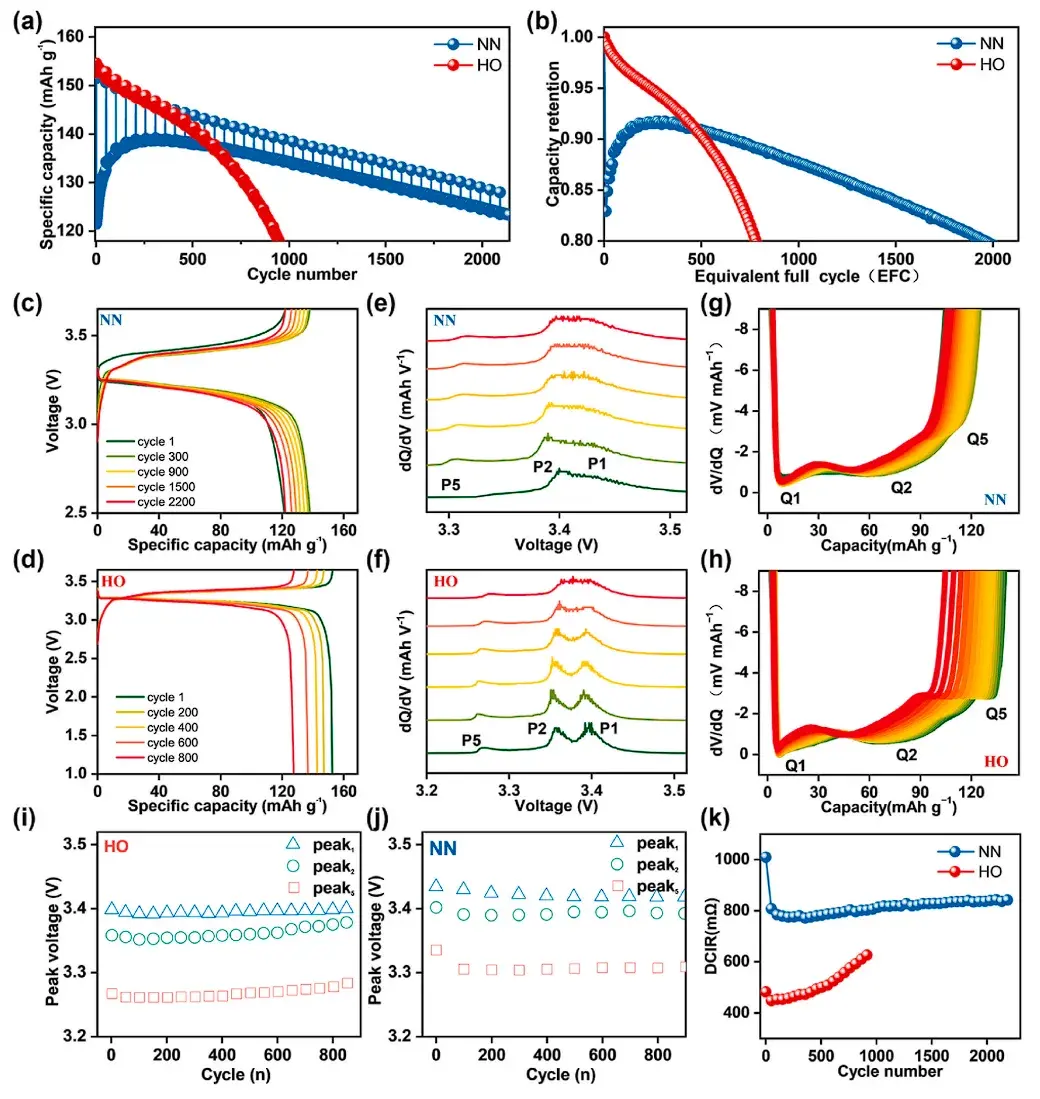
Figure 1. (a) Capacity retention curves, (b) comparison of equivalent full cycle numbers, (c, d) charge/discharge curves under NN and HO conditions, (e-h) DV and IC differential curves, (i, j) IC peak voltage shifts, and (k) DC internal resistance (DCIR) changes across cycling.
4. Revealing Spatial Heterogeneity Through Multi-Modal Non-Destructive Diagnostics
A central scientific breakthrough of this research is the direct visual confirmation of pronounced spatial heterogeneity across the electrode surface under coupled HO stress:
- Operando Ultrasonic Transmission Scanning: Ultrasonic imaging revealed localized acoustic attenuation zones inside HO cells. Regions with depleted acoustic transmission directly matched areas of severe electrolyte dry-out and localized gas pocket accumulation.
- Infrared (IR) Thermography: High-resolution thermal mapping during natural cooling captured sharp local surface temperature anomalies on HO-aged LiFePO4 cathodes, reflecting degraded and non-uniform thermal conductivity caused by uneven interfacial decomposition.
- Edge-Localized Plating via Fluorescence & μXRF: Fluorescence imaging coupled with synchrotron-grade micro X-ray fluorescence (μXRF) confirmed that metallic lithium plating and dissolved iron (Fe) deposition signals were overwhelmingly concentrated along the perimeter edges of HO graphite anodes, exhibiting a distinct “edge-aggregation effect” far exceeding the uniform profiles observed in NN cells.
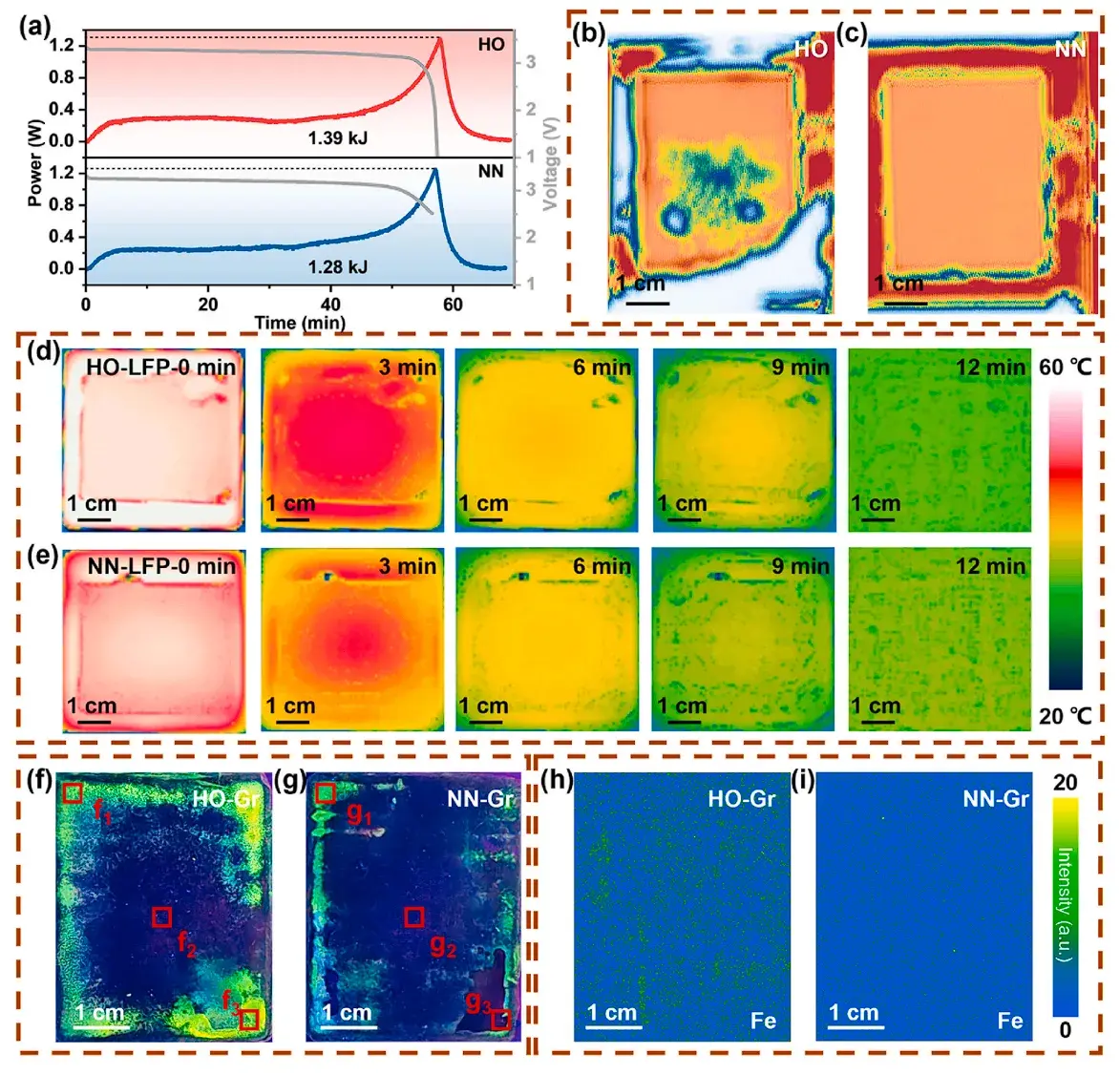
Figure 2. Multi-modal spatial diagnostic mapping: (a) heat generation rate during adiabatic discharge, (b, c) operando ultrasonic scanning images after discharge for HO and NN cells, (d, e) IR thermography of HO- and NN-aged LFP cathodes, (f, g) fluorescence images of graphite anodes, and (h, i) micro-XRF mapping of Fe element distribution on graphite anodes.
5. Multi-Scale Cathode Degradation: Surface Reconstruction and Cross-Deposition
Advanced interfacial nanomechanical and spectroscopic characterization demonstrated that coupled HO conditions trigger deep chemical and crystallographic degradation on the LiFePO4 cathode:
- Surface Roughness and Modulus Non-Uniformity: Atomic Force Microscopy (AFM) revealed heavy surface precipitation, elevated topographical roughness, and an inhomogeneous distribution of Young’s modulus on HO-aged LFP particles, indicating mechanically compromised interfacial boundaries.
- ToF-SIMS 3D Chemical Profiling: Time-of-Flight Secondary Ion Mass Spectrometry (ToF-SIMS) identified an intense, non-uniformly distributed F– signal and steep gradients of FeO2– fragments, confirming localized, uneven decomposition of fluorinated electrolyte salts.
- HRTEM Lattice Phase Transitions & Anode Cross-Talk: High-Resolution Transmission Electron Microscopy (HRTEM) and elemental mapping revealed a thick amorphous surface reconstruction layer on HO-LFP particles, accompanied by a phase transition from crystalline olivine LiFePO4 to disordered FePO4 structures. Crucially, significant copper (Cu) signals were detected on the LFP cathode surface—originating from over-discharge-induced dissolution of the anode copper foil, migrating across the separator, and electrochemically plating on the cathode.
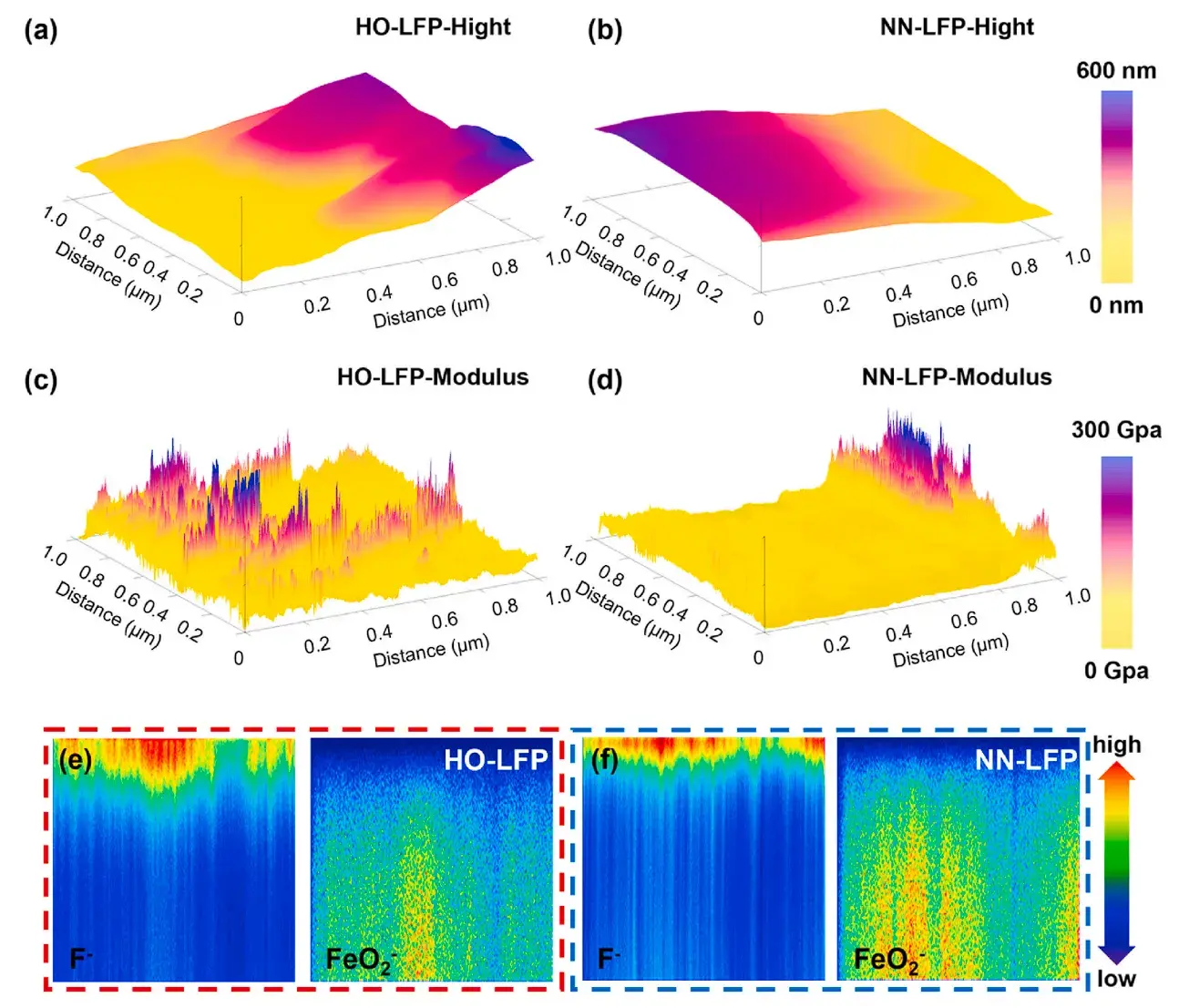
Figure 3. Interfacial degradation and chemical restructuring of LFP cathodes: (a, b) AFM surface topography, (c, d) corresponding nanomechanical Young’s modulus mapping, and (e, f) ToF-SIMS depth profiling and chemical reconstruction for HO- and NN-aged LFP electrodes.
6. Multi-Scale Anode Degradation: SEI Breakdown, Graphitic Disorder, and Lithium Plating
The graphite anode underwent severe physical and structural degradation under coupled HO conditions:
- Trench-Peak Morphology and Thickened SEI: Scanning electron microscopy (SEM) and AFM revealed moss-like aggregates with pronounced alternating “trench-peak” features. ToF-SIMS 3D depth profiling confirmed substantial thickening of the SEI layer, showing massive increases in both organic fragments (CH2–, CH3O–) and inorganic compounds (F–).
- Lattice Exfoliation and Disorder: HRTEM and Geometric Phase Analysis (GPA) showed severe lattice distortion, expanded interlayer spacing, and complete loss of graphitic crystallographic order near particle surfaces. Raman spectroscopy confirmed a sharp increase in the defect density ratio (ID/IG).
- XPS Chemical State Tracking: High-resolution X-ray Photoelectron Spectroscopy (XPS) depth profiling detected continuous, high concentrations of LiF throughout all etching depths of the HO-aged SEI, confirming severe parasitic electrolyte breakdown catalyzed by deposited iron and copper metal species.
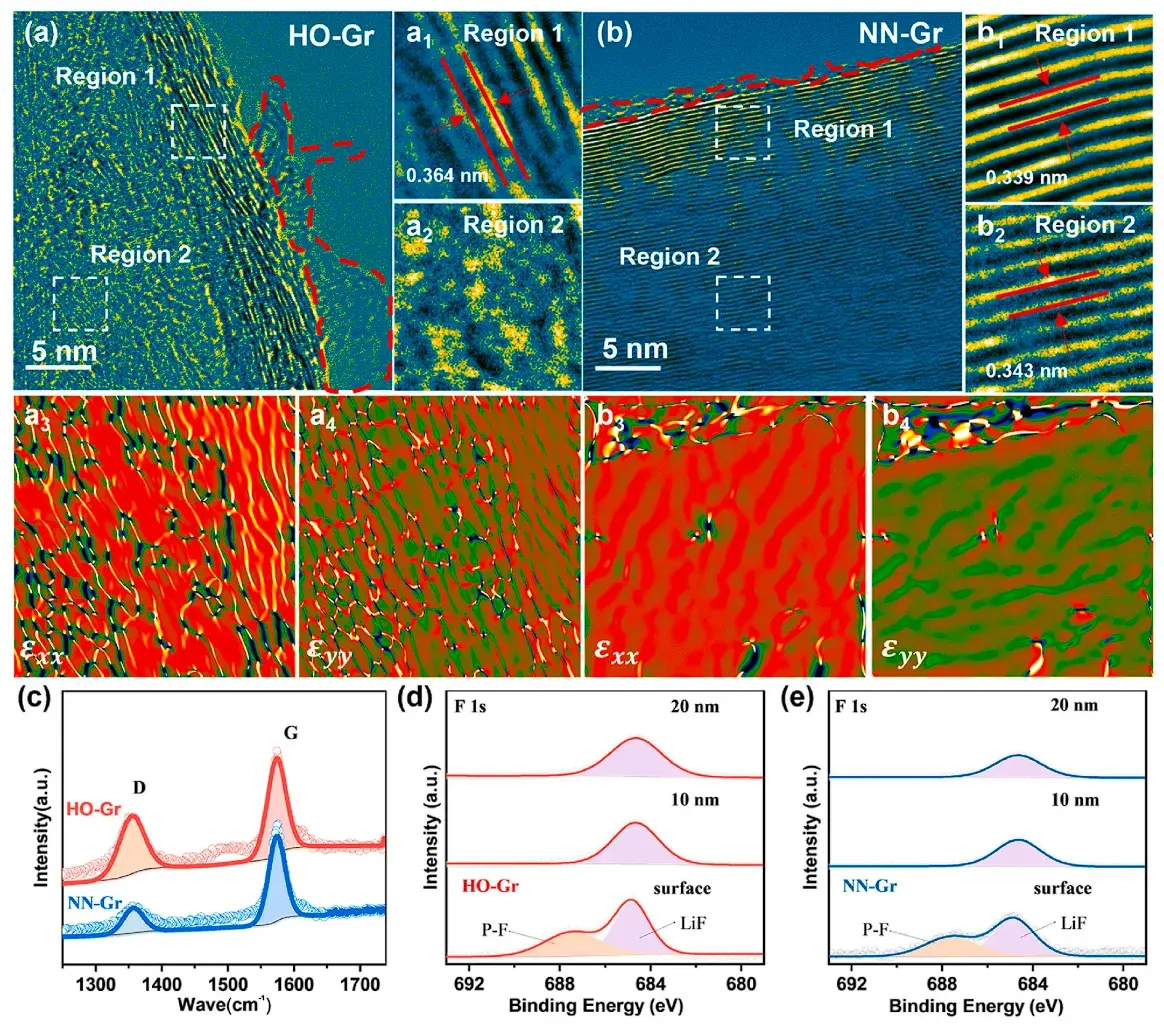
Figure 4. Microstructural collapse and SEI layer chemical evolution on graphite anodes: (a, b) HRTEM lattice fringes and strain GPA mapping, (c) Raman ID/IG defect ratios, and (d, e) high-resolution XPS F 1s depth profiles across the thickened interphase.
7. Scientific Conclusions and Engineering Implications
This study establishes an authoritative multi-scale diagnostic framework that systematically reveals the non-uniform degradation mechanisms in LiFePO4 Graphite pouch cells under coupled thermal and over-discharge conditions. Key conclusions include:
- Synergistic Nonlinear Degradation Loop: High temperature drives early-stage interface decomposition and iron dissolution on the cathode, while over-discharge subsequently triggers copper foil dissolution, graphite structural collapse, and localized lithium plating. The cross-migration of transition metals (Fe and Cu) creates a catastrophic positive feedback loop.
- Pronounced Spatial Edge-Localization: Degradation reactions are not uniformly distributed; current crowding and localized overpotentials strongly drive lithium plating and severe SEI accumulation along the perimeter edges of pouch cell electrodes.
- Validation of Operando Swelling Characterization: In-situ mechanical expansion measurements via high-precision systems like the IEST SWE2100 provide a crucial non-destructive window into internal gas evolution, irreversible structural dilation, and interface mechanical failure.
8. IEST SWE Series In-Situ Battery Swelling Testing Platform: Engineering Solutions
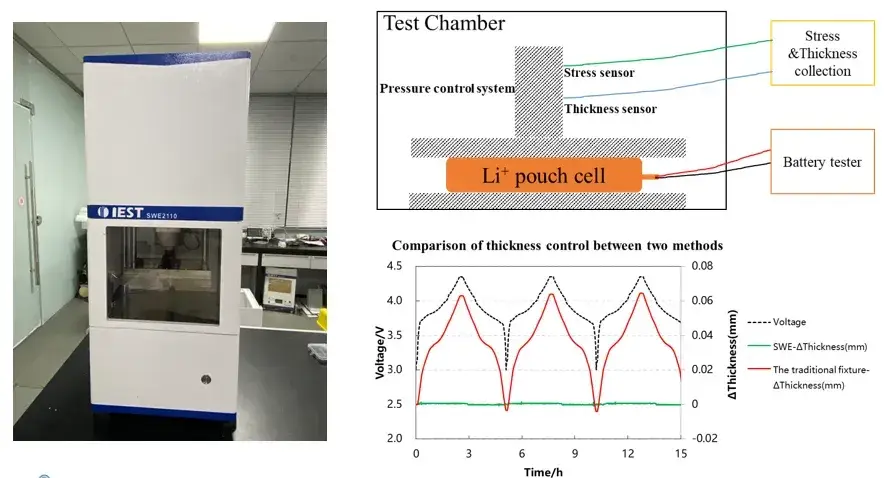
The experimental findings in eTransportation highlight that dynamic mechanical swelling behavior directly reflects internal electrochemical side reactions, structural phase transitions, and gas evolution. To enable battery researchers and industrial manufacturers to accurately characterize these coupled phenomena, IEST Instrument developed the SWE Series In-Situ Cell Swelling Testing System (SWE2100).
Equipped with an ultra-stable automated testing platform and sub-micron displacement sensors, the IEST SWE Series enables continuous operando monitoring of battery thickness changes, swelling forces, and compression moduli throughout extended cycling across controlled environmental conditions:
- Constant Pressure Swelling Thickness Mode: Measures real-time cell thickness evolution and volumetric dilation rates under programmable mechanical preloads (0.1–10 kN or custom ranges).
- Constant Gap Swelling Force Mode: Tracks internal mechanical stress build-up and peak expansion forces under fixed boundary gap constraints, accurately simulating rigid EV pack module conditions.
- Mechanical Compression Modulus & Stress-Strain Profiling: Automatically evaluates the cell’s mechanical compliance, compression modulus, and plastic deformation behavior across different states of charge (SOC) and states of health (SOH).
- Stepwise Force-Displacement Testing: Quantifies internal gas accumulation vs. solid-state structural swelling via multi-stage relaxation protocols.
- Integrated Wide-Temperature Environmental Chamber: Supports operando thermal-mechanical-electrochemical coupled testing across a wide temperature range of −20°C to +80°C.
🔬 Accelerate Your Battery Degradation & Swelling Research
Are you researching multi-stress battery aging, mechanical-electrochemical coupling, or module-level structural constraint design? IEST Instrument provides industry-leading in-situ swelling analyzers, gas volume monitors, and powder/electrode resistance characterization systems trusted by top universities and Tier-1 battery manufacturers globally.
9. FAQs
What causes spatial heterogeneity in LiFePO4 Graphite pouch cells?
Spatial heterogeneity in LiFePO4 Graphite pouch cells is driven by non-uniform planar pressure distributions, localized temperature gradients, and edge electric field fringing. Under coupled high-temperature and over-discharge conditions, these gradients concentrate iron/copper cross-deposition and metallic lithium plating along electrode perimeter edges.
Why does coupled thermal and over-discharge stress cause nonlinear aging?
Coupled high-temperature and over-discharge stress triggers an accelerated positive feedback loop. High temperature (55°C) accelerates electrolyte breakdown and cathode iron dissolution, while deep over-discharge (0 V) dissolves anode copper foil and destroys graphite crystalline order. The dissolved Cu and Fe cross-migrate and catalyze severe SEI rupture and rapid lithium loss.
How does operando in-situ swelling testing identify battery gassing vs structural expansion?
Operando in-situ swelling testing with systems like the IEST SWE2100 measures dynamic thickness and force curves under constant pressure or constant gap. Reversible lattice expansion correlates directly with lithium intercalation state of charge, whereas abrupt, non-recovering swelling inflection points reveal irreversible electrolyte gassing and SEI accumulation.
What is the difference between constant pressure and constant gap swelling tests?
Constant pressure testing applies a steady mechanical preload (e.g., 0.1–1.0 MPa) to measure absolute thickness dilation (μm) during cycling. In contrast, constant gap testing maintains a rigid fixed displacement boundary to measure internal expansion force (N or MPa), simulating the mechanical stress environment inside constrained automotive EV modules.
How do I select the right in-situ swelling analyzer for pouch and prismatic cells?
Selecting an in-situ swelling analyzer depends on cell form factor, maximum force requirements, and thermal range. IEST Instrument‘s SWE Series provides customizable fixtures for pouch, prismatic, and cylindrical cells, featuring sub-micron displacement accuracy (±0.1 μm), automated load control up to 20 kN, and wide-temperature operando chambers (−20°C to 80°C).