-
iestinstrument

Abstract
📄 Source Paper
Wenhao Qiu , Mingjie Dong, Ziyi Zhan, Wenhai Ji, Ping Miao, Wujun Peng, Wei Xu, Xinxin Teng, Kejun Zhang, Ziwei Chen*, Qinghua Zhang*
DOI: doi.org/10.1016/j.cej.2026.175314
| Journal: Chemical Engineering Journal
| Institutions: Zhejiang University
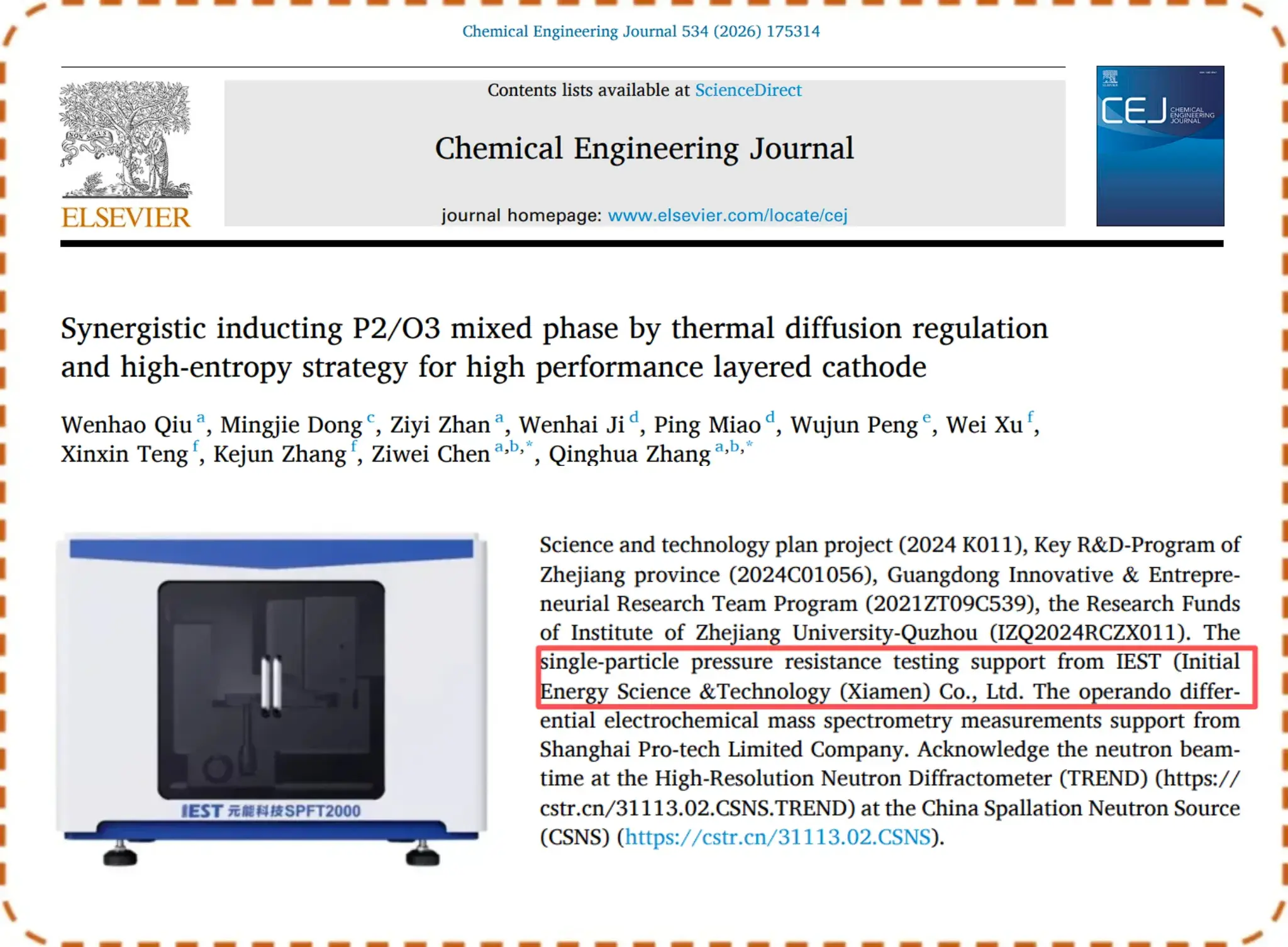
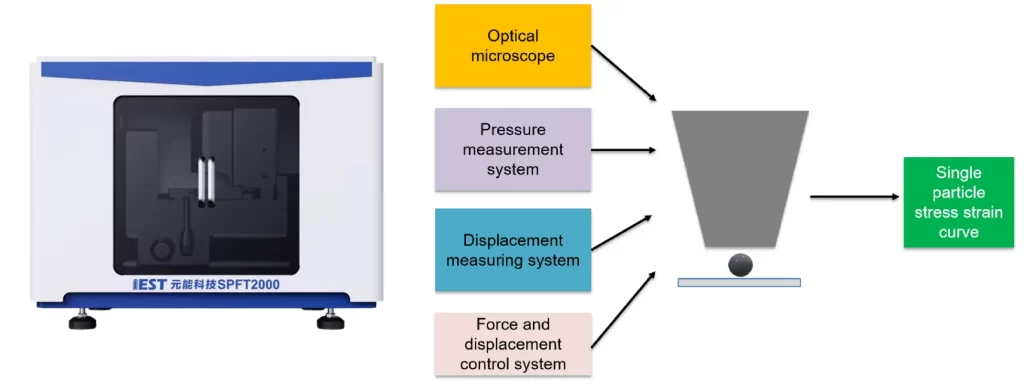
✓ IEST SPFT2000 Single Particle Mechanical Properties Test System used in this research
1. Research Background
Sodium-ion batteries are promising energy storage systems because they operate through mechanisms similar to those of lithium-ion batteries while relying on lower-cost and more abundant sodium resources. The typical P2-type $Na_{0.67}Ni_{0.33}Mn_{0.67}O_2$ cathode material is easy to synthesize and can deliver relatively high specific capacity under high-voltage conditions. However, above 4.0 V, this material undergoes an irreversible P2-OP4/O2 phase transition, resulting in significant volume changes and structural degradation. In addition, the generation of non-bonding oxygen species at high voltage promotes cation migration and lattice distortion. In contrast, O3-type materials are generally more stable at high voltage, but their higher sodium content and narrower diffusion channels limit their rate capability and air stability. Therefore, how to balance the high-voltage stability, capacity, and rate performance of these layered oxides remains a critical challenge in the design of layered oxide cathodes.
2. Study Overview
Researchers at Zhejiang University combined thermal diffusion regulation with a high-entropy strategy to control the spatial distributions of Cu and Na. The resulting heterogeneous distributions produced a P2/O3 mixed-phase material with the composition $Na_{0.67}Ni_{0.3}Fe_{0.1}Mn_{0.3}Cu_{0.1}Ti_{0.2}O_2$ (NFMCT).
The interlocking effect of the biphasic structure, together with the high-entropy effect, effectively suppressed irreversible phase transitions and undesirable anion redox at high voltage, improving structural stability. This work provides a new design paradigm for layered oxide cathodes that balance capacity, rate capability, and cycling stability.
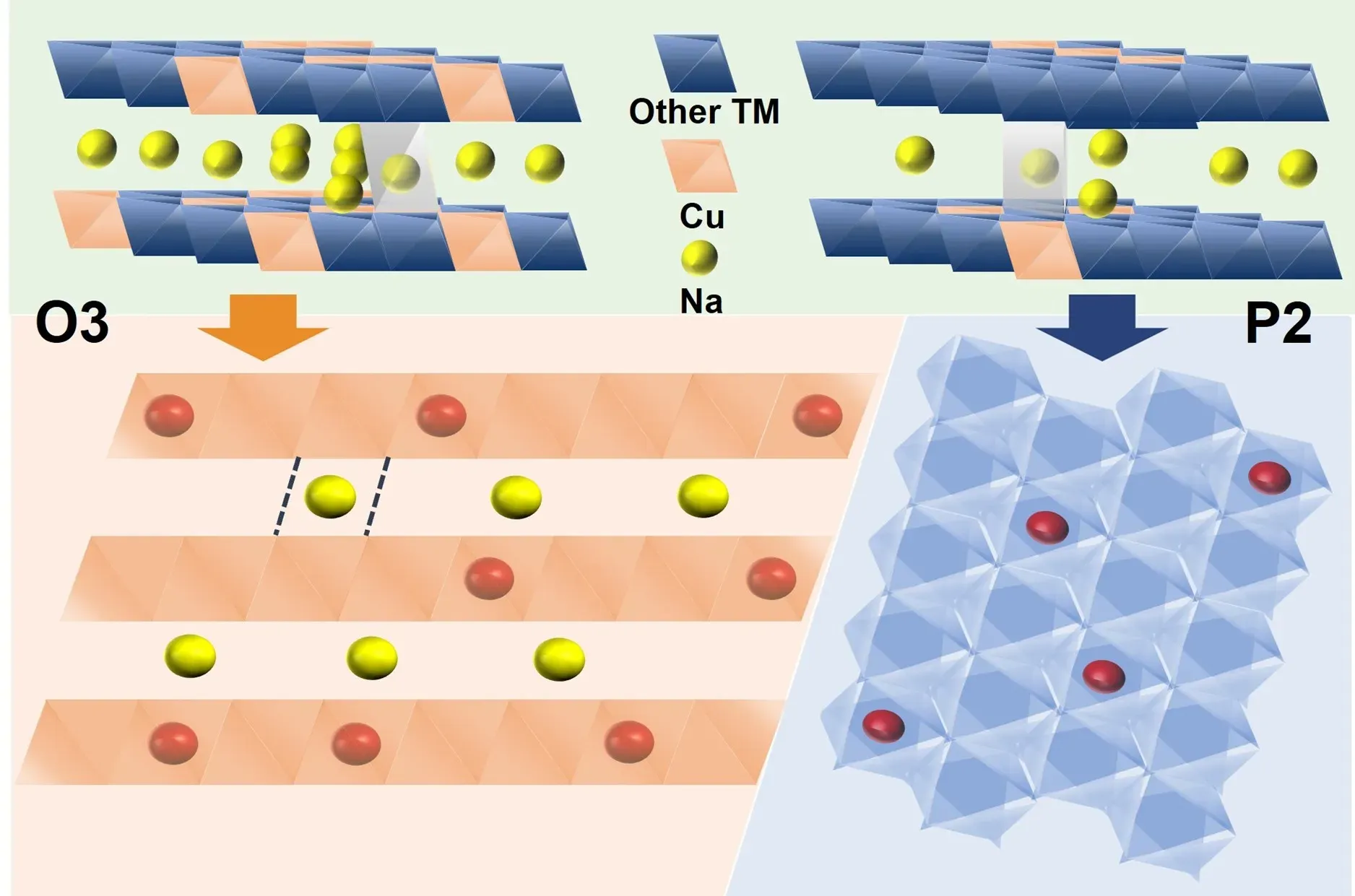
Figure 1. Schematic of how calcination time controlled non-uniform distribution of high-entropy elements and induced P2/O3 mixed-phase formation.
3. Key Findings
3.1 Mechanism of P2/O3 Mixed-Phase Induction via Thermal Regulation
At a calcination temperature of 900°C in a multi-element system, Cu, which has the largest atomic radius, diffuses more slowly and segregates locally. To maintain charge balance, additional $\text{Na}^+$ ions accumulate preferentially in the Cu-rich regions, forming local Na-rich O3 domains.
Changing the calcination holding time controlled the extent of elemental diffusion and the resulting phase ratio. A holding time of 15 hours produced an O3:P2 ratio of approximately 80:20. The results showed that thermal diffusion regulation, combined with the high-entropy effect, can produce a Na-lean mixed-phase material.
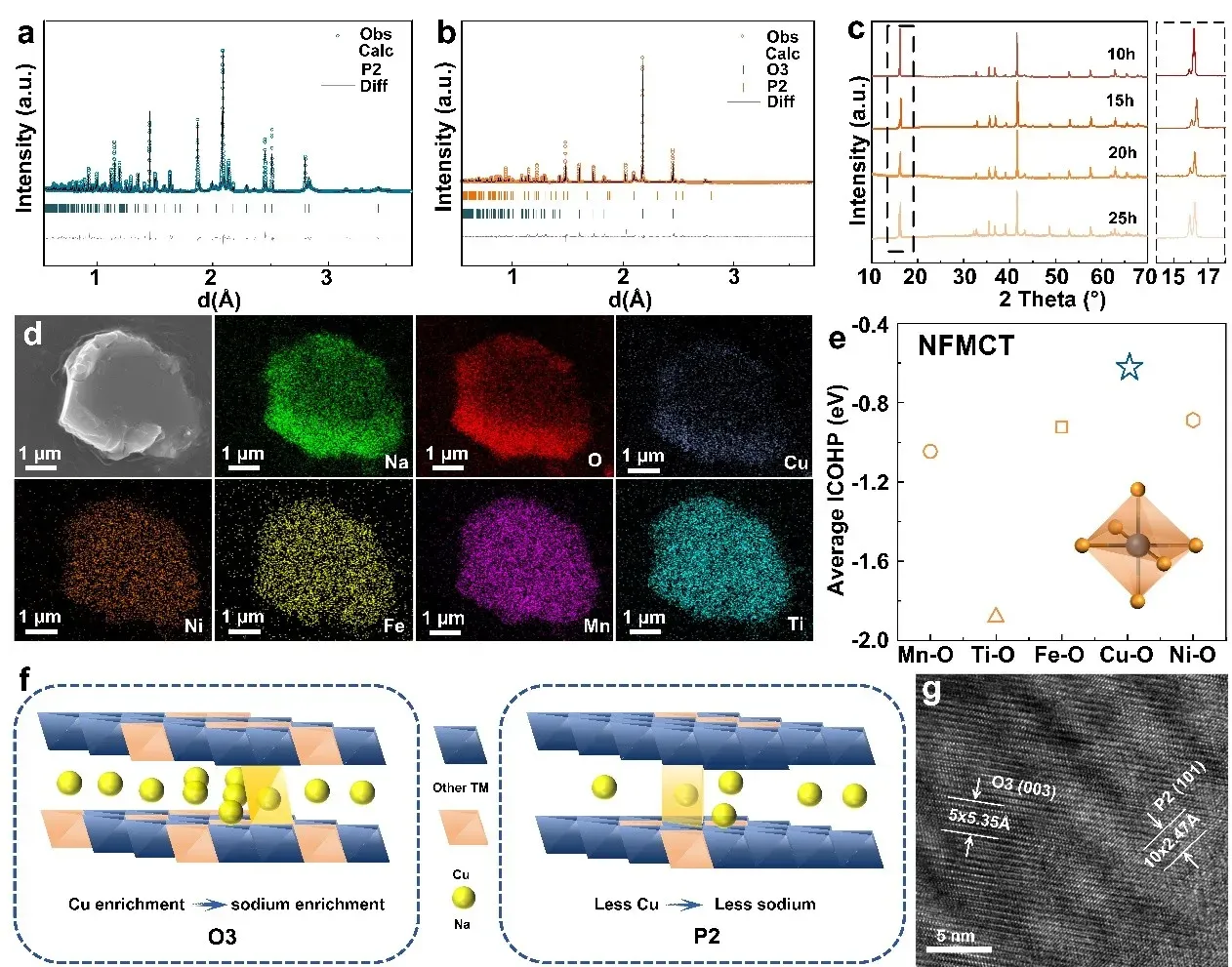
Figure 2. Effects of calcination time and high-entropy element distribution on P2/O3 mixed-phase formation.
3.2 Structural Stabilization and Phase‑Transition Suppression
Operando X-ray diffraction (XRD) revealed that the interlocking effect of the mixed phase suppressed the pronounced P2-to-O2 transformation at high voltage. During cycling, the NFMCT cathode followed a highly reversible $\text{P2/O3} \rightarrow \text{P2/P3} \rightarrow \text{OP4/OP2}$ transition sequence, which limited irreversible lattice damage.
Both Density Functional Theory (DFT) calculations of the electronic density of states and operando mass spectrometry/Raman spectroscopy showed that the introduction of Ti and Cu strengthened Ni-O bonding. The high-entropy configuration enhances the anchoring of oxygen atoms, effectively inhibiting oxygen loss and unwanted anionic redox activity at high voltage.
3.3 Excellent Electrochemical Capacity and Rate Capability
The high-entropy composition promoted the exposure of favorable crystal facets, while the strip-like supporting morphology increased the accessible area of Na-ion diffusion channels.
-
Specific Capacity: From 2.0 to 4.3 V, NFMCT delivered a high specific capacity of $152.3\text{ mAh g}^{-1}$ at 0.2C.
-
Cycling Stability: At 5C, NFMCT retained 89.1% of its initial capacity after 200 cycles.
-
Ultra-High Rate Performance: From 2.0 to 4.0 V at 10C, NFMCT retains 82.0% of its initial capacity after 1,000 cycles.
These results showed that NFMCT mitigated the rate and cycling limitations commonly associated with O3-type cathodes.
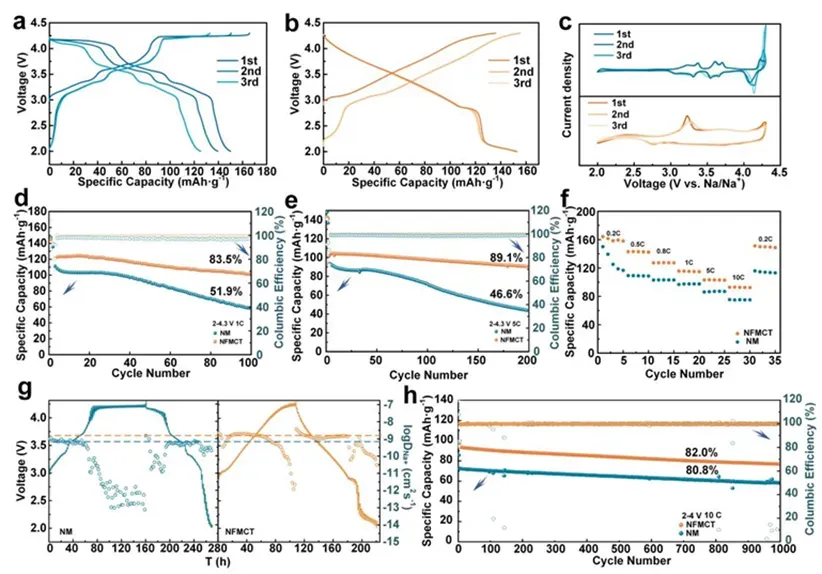
Figure 3. Electrochemical performance of the P2/O3 biphasic cathode.
3.4 Full-Cell Performance, Air Stability, and Mechanical Properties
Full cells pairing the P2/O3 biphasic cathode with hard carbon anodes exhibited 93.1% capacity retention after 50 cycles at 5C, indicating strong high-rate cycling performance. The material also exhibited excellent air stability: after 15 days of exposure at 50% relative humidity, the P2/O3 structure remained intact with minimal electrochemical degradation. The air stability is attributed to the material’s lower sodium content, which limits $\text{Na}_2\text{CO}_3$ formation.
To evaluate microstructural robustness, single-particle compression tests were conducted with the IEST SPFT2000 Single-Particle Force Properties Test System. The force-displacement curves revealed a multi-stage fracture response associated with the interlocking biphasic structure. This response suggests greater resistance to abrupt particle pulverization and intergranular cracking under localized mechanical loading.

Figure 4. Comprehensive performance evaluation of the high-entropy P2/O3 mixed phase cathode.
4. Conclusion
This study used differences in Cu diffusion kinetics within a multi-element high-entropy system to redistribute Na and form a robust P2/O3 mixed-phase cathode. This material architecture limited irreversible phase transitions, stabilized the oxygen lattice, and enhanced particle-level mechanical robustness at high voltage. These findings provide materials-design guidance for layered sodium-ion cathodes that combine high capacity, high-rate performance, and long cycle life.
5. Acknowledgements
This research was supported by the Zhejiang Provincial Natural Science Foundation (Grant No. LQN25B060007), the National Natural Science Foundation of China (12505345), the Quzhou Science and Technology Plan Project (2024K011), the Zhejiang Provincial Key R&D Project (2024C01056), the Guangdong Innovative and Entrepreneurial Team Project (2021ZT09C539), and the Institute of Zhejiang University-Quzhou Research Fund (IZQ2024RCZX011).
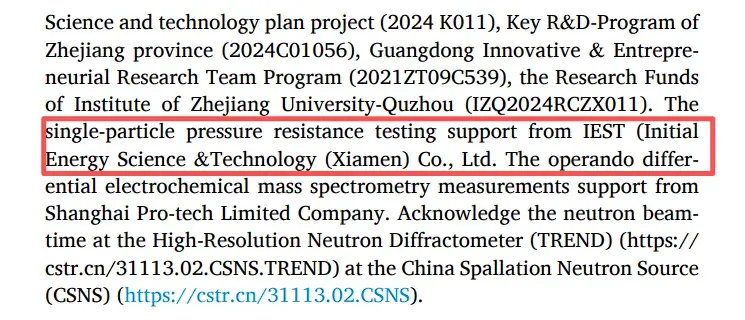
The authors also thank IEST Instrument for support with single-particle compression testing using the IEST SPFT2000, and the China Spallation Neutron Source (CSNS) for neutron beam time at the high-resolution neutron diffractometer (TREND).
🔬 Quantify Single-Particle Mechanical Stability with IEST SPFT2000
Precisely measures the mechanical properties of individual cathode and anode active particles—including crushing strength, elastic modulus, and fracture behavior. It is the ideal metrology solution for evaluating particle robustness in high-entropy layered oxides, single-crystal cathodes, and advanced battery materials subjected to extreme volume changes.
6. FAQs
What is a P2/O3 mixed phase in sodium-ion battery cathodes?
A P2/O3 mixed phase is an engineered biphasic crystal structure combining P2 and O3 packing sequences. This interlocking configuration harnesses the fast ionic transport of P2 domains alongside the high capacity of O3 domains, minimizing structural stress during high-voltage cycling.
How does a high-entropy strategy improve layered oxide cathodes?
A high-entropy strategy incorporates multiple transition metal elements into a single crystallographic site. The resulting high configurational entropy enhances transition metal-oxygen bonding energy, suppresses adverse phase transitions, and prevents oxygen loss at cutoff voltages above 4.0 V.
What is the primary difference between P2-type and O3-type layered cathodes?
P2-type cathodes provide superior rate capability and structural stability but suffer from lower initial sodium content. In contrast, O3-type cathodes offer higher specific capacity but suffer from sluggish diffusion kinetics and poor air stability. A biphasic P2/O3 architecture balances these trade-offs.
How do I select the right equipment to evaluate cathode particle mechanical strength?
Evaluating cathode particle mechanical properties requires high force resolution and precision displacement control at the micron scale. IEST SPFT2000 meets these requirements by measuring individual particle crushing strength, yield modulus, and deformation curves under controlled load.
How does thermal diffusion regulation affect the synthesis of high-entropy layered oxides?
Thermal diffusion regulation controls calcination holding time (e.g., 15 hours at 900°C) to exploit differences in elemental diffusion kinetics. Slower-diffusing elements like Cu segregate locally, directing sodium ions to form stable, interlocking P2/O3 mixed phase domains.