-
iestinstrument

1. Introduction
Silicon stands out as a highly promising anode material for lithium‑ion batteries due to its theoretical specific capacity of 4200 mAh g⁻¹ and environmental friendliness. However, its practical application faces severe obstacles: high volume expansion (>300%), low electronic conductivity, and electrode pulverization. Chemical vapor deposition (CVD) silicon‑carbon has emerged as a next‑generation silicon‑based anode technology. By depositing silane in situ onto a porous carbon matrix, CVD silicon‑carbon composites combine the excellent conductivity and mechanical support of porous carbon with the high capacity of silicon. The resulting material achieves high initial Coulombic efficiency, superior cycling stability, and a specific capacity up to 2148 mAh g⁻¹ – and has already entered commercial production. In fact, China officially released two group standards for silicon‑based anode materials and porous carbon for silicon‑carbon anodes in 2024.

Figure 1. Group standards for silicon-based anodes and porous carbon materials.
Good mechanical properties are a critical requirement for both the porous carbon substrate and the final CVD silicon‑carbon composite. In the past, mechanical performance was often inferred indirectly from electrode structural integrity after cycling. As the industry has matured, multi‑level mechanical evaluation – spanning single particles, powder, electrode, and cell – has become an accepted practice.
This study focuses on two representative materials: a porous carbon (Sample A) and a CVD silicon‑carbon (Sample B). We compare their mechanical behavior using three complementary methods: single‑particle crush strength testing, powder rebound after decompression, and powder stress‑strain analysis.
2. Experimental Section
2.1 Materials and Samples
Two samples with similar D50 particle sizes were selected:
-
Sample A: Porous carbon
-
Sample B: CVD silicon‑carbon
Each sample was subjected to single‑particle crush strength measurement, powder decompression rebound test, and powder stress‑strain (loading/unloading) test.
2.2 Instrumentation
-
Single particle crushing strength test: IEST SPFT series single‑particle mechanical testing system (Figure 2a).
-
Powder rebound and stress‑strain test: IEST PRCD series powder resistivity & compaction density tester (Figure 2b).
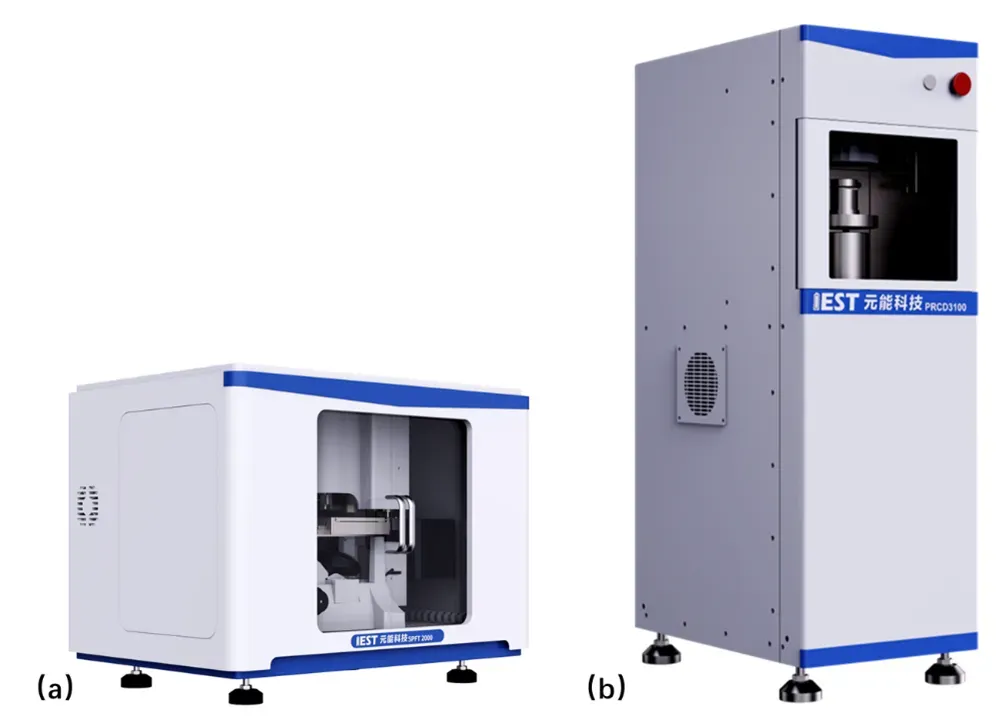
Figure 2. (a) IEST Single‑particle mechanical tester (SPFT2000); (b) IEST Powder resistivity & compaction density tester (PRCD3100).
3. Results and Discussion
3.1 Porous carbon and CVD silicon‑carbon Single‑Particle Crush Strength
Using the SPFT system, we measured the crush strength of individual particles at the D50 size for both materials. Figure 3 shows the force‑displacement curves and the crush load points.
Porous carbon fractured at 10.71 mN, whereas CVD silicon‑carbon fractured at 28.74 mN. Clearly, the CVD silicon‑carbon exhibits substantially higher mechanical strength. Moreover, before fracture, a particle typically undergoes elastic deformation, plastic deformation, and finally collapse. At the same applied force, porous carbon shows larger deformation, indicating lower stiffness.
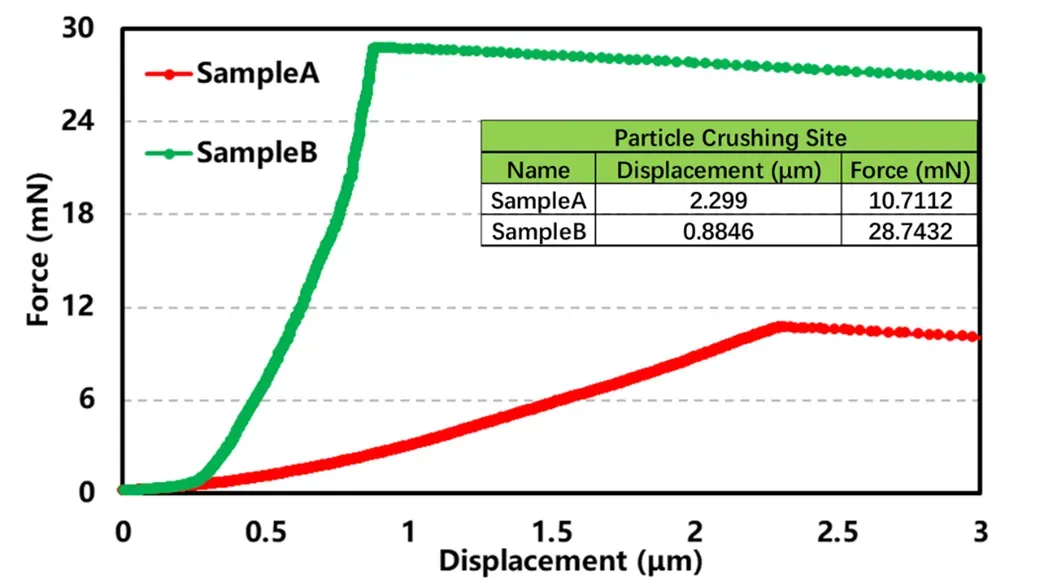
Figure 3. Single particle crushing strength curves and fracture force data.
3.2 Powder Rebound after Decompression
Powder compaction and rebound measurements are essential for evaluating lithium‑ion battery materials. During compaction, particles rearrange, interparticle voids are eliminated, and elastic‑plastic deformation occurs – all reducing the powder bed thickness. When the pressure is released, the powder thickness partially recovers due to interparticle repulsive stress and the inherent spring‑back effect. We define thickness rebound as the difference between the thickness after pressure release and the thickness under pressure.
Figure 3(a) illustrates the pressure‑application profile for the rebound mode. Figure 3(b) shows the thickness rebound curves for the two materials. Porous carbon exhibits a larger rebound deformation than CVD silicon‑carbon – consistent with the single‑particle crush results and further confirming the mechanical differences.

Figure 4. (a) Pressure profile for powder rebound test; (b) Thickness rebound curves.
3.3 Powder Stress‑Strain Behavior
A stress‑strain curve describes the relationship between internal stress and resulting strain under an external force. It is a fundamental tool in materials mechanics, revealing the full mechanical history from elastic deformation through plastic deformation to final failure. It also provides key parameters such as strength, stiffness, ductility, and toughness.
We performed stress‑strain tests on both powders over a pressure range of 5–369 MPa. Figure 4(a) shows the loading/unloading profile; Figure 4(b) presents the resulting stress‑strain curves and the percentage deformation.
Porous carbon (Sample A) shows greater maximum compression strain, reversible strain, and irreversible strain than CVD silicon‑carbon (Sample B). This trend agrees perfectly with both the single‑particle test data and the powder rebound results, reinforcing the conclusion that the two materials differ markedly in their mechanical properties.
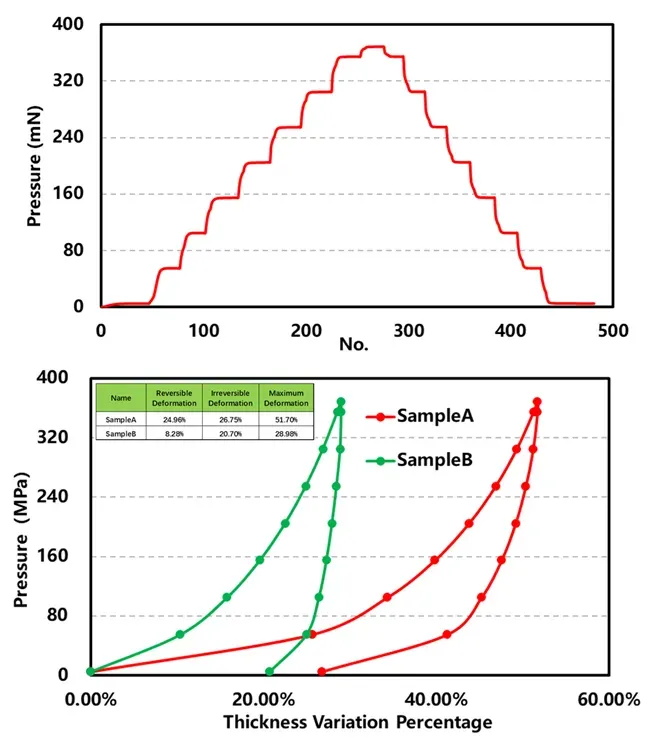
Figure 5. (a) Pressure application profile for stress-strain testing; (b) Stress-strain curves and deformation data for the two powder materials.
4. Summary
By combining the IEST SPFT single‑particle mechanical testing system and the IEST PRCD powder resistivity & compaction density tester, we have systematically evaluated the mechanical properties of porous carbon and CVD silicon‑carbon at multiple levels and from multiple perspectives. The three methods – single‑particle crush, powder rebound, and powder stress‑strain – gave consistent results, demonstrating that CVD silicon‑carbon possesses superior mechanical robustness.
This multi‑level mechanical assessment protocol offers an effective screening tool for lithium‑ion battery anode materials, helping to prevent low‑quality materials from entering downstream production and thereby saving both time and cost.
5. References
[1] Wu Mingbo, Zheng Jingtang, Qiu Jieshan. Physicochemical structure and characterization of porous carbon [J]. Chemical Bulletin, 2011.
[2] Materials Science and Engineering. Study on the Preparation of Silicon-Carbon Anode Materials by Chemical Vapor Deposition and Their Lithium Storage Performance [D].
[3] Mu X , Xu X , Xu H ,et al.Optimizing the pore structure in silicon–carbon anodes: the impact of micropore and mesopore ratios on electrochemical performance[J]. Journal of Materials Chemistry,A:Materials for Energy and Sustainability, 2025.