
CVD silicon-carbon anode (chemical vapor deposition Si-C anode, also called gas-phase or vapor-deposition silicon-carbon) deposits nano-silicon into a porous carbon scaffold via silane decomposition at elevated temperature — the most commercially promising approach to high-capacity silicon-based anodes because it achieves nanoscale silicon distribution without wet milling. Scaling CVD silicon-carbon anode production reliably requires fast, non-destructive screening at the powder level before electrode and cell fabrication. This application note describes a three-stage anode powder testing workflow: (1) powder resistivity and compaction density measured by the IEST PRCD3100 (10–350 MPa sweep), (2) electrode sheet resistance measured by the IEST BER2500 (5 MPa, six locations per electrode), and (3) coin-cell electrochemical performance — tested across eight batches from two CVD process routes (Process A: GA-1 to GA-4; Process B: GB-1 to GB-4). Key result: anomalous powder batches (GA-4 with high resistivity; GB-2 with unusually low resistivity) mapped directly to anomalous coin-cell performance, validating powder-level anode testing as a fast QC gate.
CVD silicon-carbon anode (chemical vapor deposition Si-C anode, also called gas-phase or vapor-deposition silicon-carbon) deposits nano-silicon into a porous carbon scaffold via silane decomposition at elevated temperature — the most commercially promising approach to high-capacity silicon-based anodes because it achieves nanoscale silicon distribution without wet milling. Scaling CVD silicon-carbon anode production reliably requires fast, non-destructive screening at the powder level before electrode and cell fabrication.
Silicon-based anodes offer theoretical capacity (~4,200 mAh/g) nearly ten times that of graphite (372 mAh/g), but massive volume expansion during lithiation (~300%) leads to particle pulverization, structural degradation, and continuous SEI reformation — causing rapid capacity fade and low initial coulombic efficiency.[1] Research has pursued nano-structuring, compositing, carbon coating, silicon oxidation, alloying, pre-lithiation, and pre-magnesiation to address these challenges.[2]
Two silicon-carbon material categories have reached commercial scale:
CVD silicon-carbon (vapor deposition Si-C) has emerged as the next-generation route: silane is thermally decomposed inside a porous carbon scaffold in a rotary kiln or fluidized bed reactor, depositing nano-scale silicon directly into the scaffold’s pores. This avoids the agglomeration problems of milled nano-Si and achieves uniform silicon distribution at the nanometer scale. Three industrialization challenges remain for CVD silicon-carbon anodes:
These industrialization challenges mean that anode powder testing — specifically, measuring batch-to-batch variation in powder resistivity and compaction density before electrode fabrication — is essential for CVD silicon-carbon anode process control. This study demonstrates a validated powder-to-cell screening workflow for exactly this purpose.
Two key instruments from IEST Instrument were utilized:
PRCD3100 Powder Resistivity & Compaction Density Meter: Applies pressure up to 5 tonnes while simultaneously measuring powder resistivity, conductivity, and compaction density. Generates the full pressure-property curve needed to compare CVD silicon-carbon anode powder batches across the full compression range (Figure 1).
BER2500 Electrode Resistance Tester: 14 mm diameter probe, pressure range 5–60 MPa. Measures resistance, resistivity, conductivity, and compaction density of calendered electrode sheets in a single-point or multi-point test (Figure 2).

Figure 1. IEST PRCD3100 Powder Resistivity & Compaction Density Meter — schematic and two testing principles (two-probe and four-probe) for anode powder testing
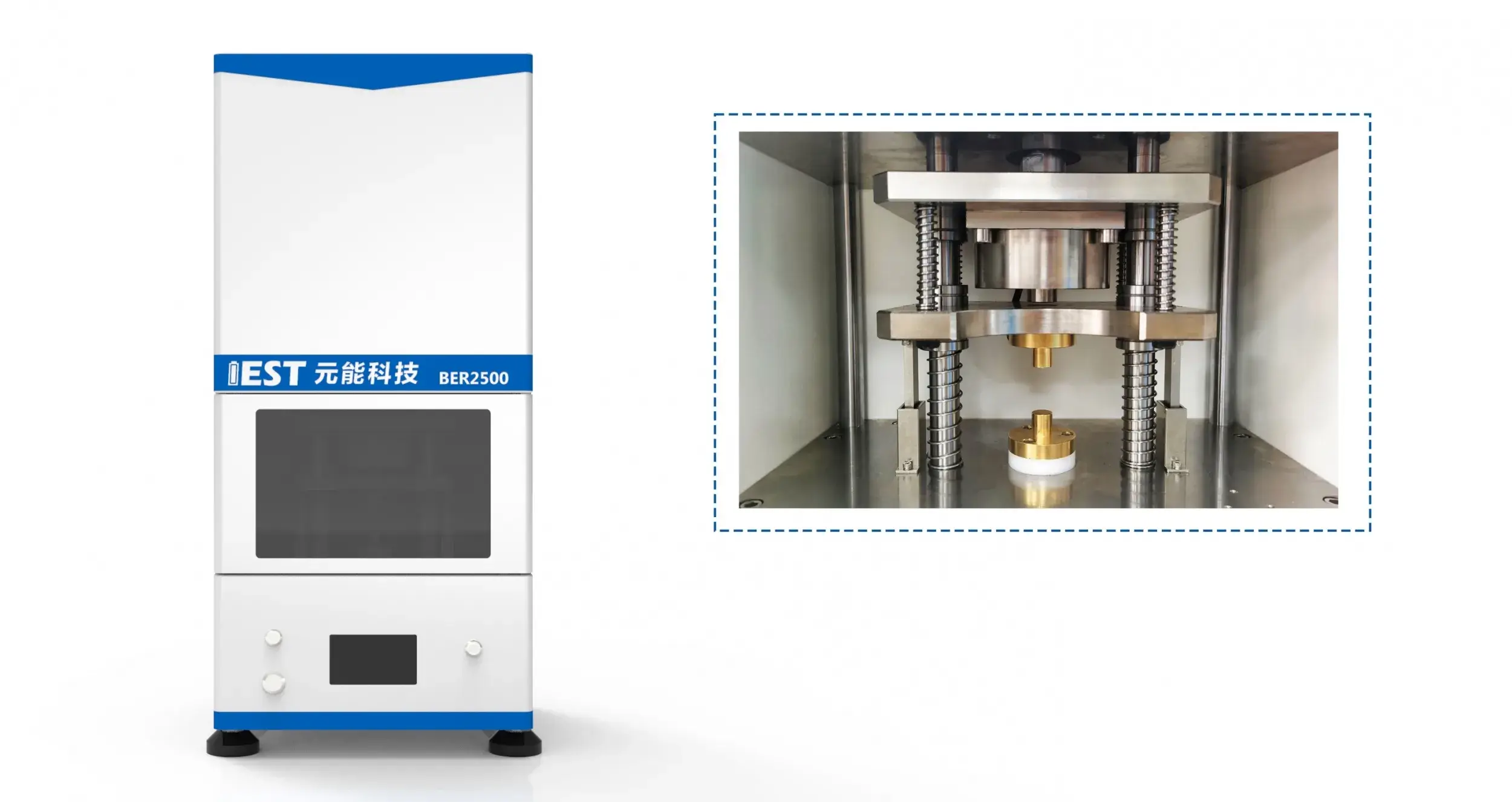
Figure 2. IEST BER2500 Electrode Resistance Tester — (a) appearance; (b) structural diagram; 14 mm probe, 5–60 MPa, measures silicon-carbon anode electrode resistance and resistivity
| Materials | Silicon Carbide Gas Phase | SP | CNT | LA133 |
|---|---|---|---|---|
| JA Group | 94% | 1% | 1% | 4% |
| JB Group | 94% | 1% | 1% | 4% |
Figures 3 and 4 show the resistivity and compaction density trends for all eight CVD silicon-carbon anode powder batches under increasing pressure.
Key Observations:
Resistivity decreased with applied pressure for all samples, reflecting reduced inter-particle contact resistance as particles are forced into closer contact.
Process B powders (GB series) consistently showed lower resistivity than Process A (GA series), indicating superior intrinsic electronic conductivity — attributable to more uniform silicon deposition and better carbon coverage in the CVD process.
Batch consistency was pressure-dependent. Below 100 MPa, both process routes showed significant batch-to-batch variation, driven by differences in particle contact geometry and morphology. Above 100 MPa, GB batches converged closely while GA batches still showed discernible differences — indicating that Process B achieves more uniform silicon deposition within and between batches.
Compaction density trends were similar for both process routes, though Process A powders were slightly less dense. This suggests a more porous particle structure from Process A — which can accommodate more silicon but also contributes to higher resistivity, since silicon’s intrinsic conductivity is low.

Figure 3. Powder resistivity vs pressure for GA-1 to GA-4 (Process A) and GB-1 to GB-4 (Process B) — Process B shows lower, more consistent resistivity; GA-4 exhibits anomalously high resistivity

Figure 4. Powder compaction density vs pressure (PRCD3100, 0–200 MPa) — Process A powders are slightly less dense; GA-4 shows anomalously low compaction density consistent with an out-of-specification deposition batch
Figure 5 shows electrode resistance and resistivity for JA and JB electrode series. The electrode-level measurements directly preserve the powder-level trend: JA electrodes (from GA powders, Process A) show consistently higher resistance and resistivity than JB electrodes (from GB powders, Process B), even though both series used an identical slurry formulation with the same conductive agent loading. This demonstrates that the active material’s own conductivity and morphology independently influence electrode conductivity, beyond the contribution of added conductive agents.
More significantly, the COV of JA electrode resistance is larger than that of JB — mirroring the larger batch-to-batch resistivity variation seen in GA powder (Figure 3). This amplification effect occurs because non-uniform powder particles are more difficult to disperse evenly during slurry preparation, and uneven dispersion produces spatially variable electrode sheet resistance after coating and drying. The BER2500‘s six-location sampling protocol per electrode makes this spatial COV directly visible as a production-quality signal.

Figure 5. Electrode resistance and resistivity results (BER2500, 5 MPa, 15 s hold, six locations per sample) — JA electrodes show higher resistance and larger COV than JB; the powder-level trend is preserved and amplified at the electrode level
| Batch Number | JA-1 | JA-2 | JA-3 | JA-4 | JB-1 | JB-2 | JB-3 | JB-4 |
|---|---|---|---|---|---|---|---|---|
| Charge Capacity mAh/g |
1958.83 | 1989.82 | 1950.70 | 1710.96 | 1925.04 | 1798.10 | 1896.48 | 1870.01 |
| Discharge Capacity mAh/g |
2096.65 | 21334.10 | 2094.98 | 1924.95 | 2061.89 | 1952.51 | 2040.86 | 2003.80 |
| Initial Effect | 93.41% | 93.24% | 93.11% | 88.88% | 93.36% | 92.09% | 92.92% | 93.29% |
The above-mentioned electrodes were prepared into buckles and electrical performance tests were conducted. As can be seen from Table 2, provided the final performance link. The JA cells generally delivered higher charge capacity than JB cells, possibly due to a higher silicon content in Process A material.
Crucially, outliers in cell performance could be traced back to powder properties:
JA-4 showed anomalous coin-cell performance. Its source powder GA-4 exhibited abnormally high resistivity (Figure 3) and low compaction density (Figure 4) — both out-of-specification signals relative to GA-1, GA-2, and GA-3. These powder-level flags were detectable before electrode fabrication, meaning the batch anomaly could theoretically have been identified and quarantined at the anode powder testing stage.
JB-2 showed lower capacity than the other JB cells. Its source powder GB-2 exhibited notably lower resistivity — potentially indicating lower silicon content than specification, reducing stored capacity.
It can be seen from the above analysis that the resistivity and compaction density of silicon carbon powders of different processes and batches have a relatively good correlation with the final battery performance. This correlation makes the detection of parameters such as resistivity and compaction density of active particle powder an effective means of predicting final battery performance. By accumulating a certain amount of powder characterization test data during production, we can establish this correlation, allowing us to quickly identify batch anomalies and predict final cell performance. Therefore, the detection of parameters such as resistivity and compacted density of active granular powder is of great significance for improving production efficiency and product quality.
This case study demonstrates an effective multi-scale workflow for monitoring CVD silicon-carbon anode production batch stability. Using the PRCD3100 and BER2500 instruments, we rapidly characterized the electrical and physical properties of powders and electrodes from two CVD process routes across eight production batches.
Process B produced silicon-carbon anode material with better conductivity, higher compaction density, and superior batch-to-batch consistency compared to Process A. These powder-level advantages translated directly to more consistent electrode resistance and predictable cell performance. Anomalies in final cell data were traceable to anomalies in initial powder characterization data. Anode powder testing using powder resistivity, compaction density, and electrode resistance monitoring provides a powerful, rapid screening method for CVD silicon-carbon anode quality control—invaluable for both R&D process optimization and production-line batch release decisions.
[1] Q. Liu, Y. Hu, X. Yu, et al. The Pursuit of Commercial Silicon-Based Microparticle Anodes for Advanced Lithium-Ion Batteries: A Review. Nano Research Energy. 2022, 1: e9120037.
[2] Hu B, Jiang S, Shkrob I A, Zhang J, Trask S E, Polzin B J, et al. Understanding of prelithiation of poly(acrylic acid) binder: Striking the balances between the cyclingperformance and slurry stability for silicon-graphite composite electrodes in Li-ion batteries[J].Journal of Power Sources.2019,416(1):125-131.
[3] WANG W,KUMTA P N. Nanostructured hybrid silicon/carbon nanotube heterostructures: reversible high-capacity lithium-ion anodes[J].ACS Nano,2010,4(4):2233-2241.
[4] Shi H,Zhang H,Li X,et al. In-situ fabrication of dual coating structured SiO composite as high-performance lithium ion battery anode by fluidized bed chemical vapor deposition[J]. Carbon,2020,168:113-124
[5] CABELLO M,GUCCIARDI E,HERRÁN A,et al. Towards a high-power Si@graphite anode for lithium ion batteries through a wet ball milling process[J].Molecules,2020,25(11):2494.
A CVD silicon-carbon anode (chemical vapor deposition Si-C anode) uses silane gas thermal decomposition inside a porous carbon scaffold to deposit nano-scale silicon directly within the carbon’s pore network. This is fundamentally different from the two other major silicon-carbon anode types: the grinding nano-Si route (where silicon is mechanically milled to ~100 nm then composited with carbon, suffering from agglomeration and limited cycle life), and the SiOx (silicon oxide-carbon) route (where SiO reacts during first lithiation to form inert buffer phases, reducing expansion to ~118% but causing ~30% first-cycle capacity loss). CVD silicon-carbon avoids wet milling and achieves more uniform nano-silicon distribution within the carbon scaffold, producing better rate performance and cycle stability — but requires specialized deposition equipment (rotary kiln or fluidized bed) and tight process control to maintain batch-to-batch consistency in silicon loading and distribution.
The recommended anode powder testing workflow for CVD silicon-carbon material combines two instruments. First, a powder resistivity and compaction density tester (such as the IEST PRCD3100) applies a controlled pressure sweep (e.g., 10–350 MPa in steps) to the powder, recording resistivity/conductivity and compaction density at each pressure point. This generates a pressure-property profile that reliably distinguishes process routes and flags batch anomalies (abnormally high resistivity, abnormally low or high compaction density) before any electrode coating begins. Second, after electrode preparation, an electrode resistance tester (such as the IEST BER2500) measures sheet resistance at multiple locations per electrode, quantifying spatial uniformity via coefficient of variation (COV). In this study, both instruments together provided a fast, non-destructive screening gate that correlated directly with coin-cell performance outcomes.
In this study, powder resistivity measured at the PRCD3100 level correlated directly with electrode resistance at the BER2500 level, and both correlated with final coin-cell performance. Process B (GB series) powders consistently showed lower resistivity, which translated to lower electrode resistance in the JB electrode series and more consistent cell performance across batches. Outlier batches (GA-4 with anomalously high powder resistivity; GB-2 with unusually low resistivity) both produced anomalous cell-level results. This powder-to-cell correlation enables early detection of batch anomalies: by setting powder resistivity and compaction density specification limits based on accumulated historical data, production teams can flag and quarantine out-of-specification batches before the more expensive electrode and cell assembly steps.
Three categories of challenge dominate CVD silicon-carbon anode scale-up. First, porous carbon scaffold selection: the scaffold determines both silicon loading capacity and the graphite blend ratio needed for target battery performance; different porous carbon morphologies require different process parameters. Second, deposition equipment: rotary kilns tend to produce non-uniform silicon deposition and have lower silane gas utilization efficiency; fluidized beds achieve more uniform deposition at higher silane utilization but require high-airtightness, high-pressure reactors, creating a scale-up engineering challenge. Third, process consistency at scale: mass production requires tight control of feedstock mass (hundreds of kilograms per batch), furnace temperature uniformity across multiple zones, cavity partial pressures, and deposition residence time — all of which are more difficult to control at scale than in lab-scale trials. These challenges make batch-to-batch resistivity and compaction density monitoring via anode powder testing an essential process quality-control tool.
Measuring electrode resistance at multiple locations per sheet (six points per sample in this study, using the BER2500 at 5 MPa with a 15 s hold) provides two distinct pieces of information. The average resistance characterizes the overall conductivity level of the electrode. The coefficient of variation (COV) — standard deviation divided by mean, expressed as a percentage — quantifies spatial uniformity within the sheet. A high COV indicates that the active material is unevenly distributed across the electrode, which typically leads to non-uniform current distribution during battery cycling, creating localized over-lithiation or under-lithiation zones that accelerate degradation. In this study, JA electrodes (from Process A powders with larger batch-to-batch variability) showed consistently higher COV than JB electrodes — because non-uniform powder particles are harder to disperse uniformly during slurry mixing, and this non-uniformity is amplified in the coated electrode.