-
iestinstrument

Abstract
📄 Source Paper
Zhang, Z., Zhang, X., Liu, Y. et al.
Silicon-based all-solid-state batteries operating free from external pressure
DOI: 10.1038/s41467-025-56366-z
| Journal: Nat Commun 16, 1013 (2025).
| Institutions: Xiamen University (Chen Songyan & Wang Mingsheng group)
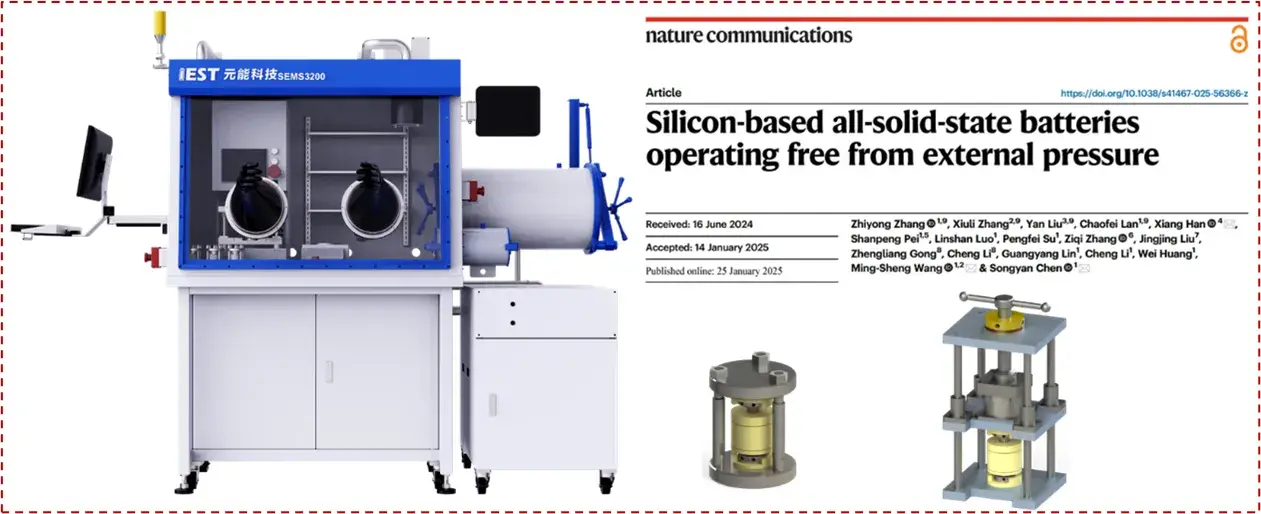
✓ IEST Instrument acknowledged — IEST SEMS series Multi-dimensional solid electrolyte characterization instrument used in material characterization
1. Research Summary
A research team led by Chen Songyan and Wang Mingsheng from Xiamen University has published a significant advance in silicon-based anode materials for all-solid-state batteries in Nature Communications, titled “Silicon-based all-solid-state batteries operating free from external pressure” (Nat Commun 16, 1013, 2025). First author Dr. Zhang Zhiyong designed and constructed a Li₂₁Si₅/Si–Li₂₁Si₅ bilayer composite anode that enables stable ASSB operation without external pressure — overcoming a fundamental barrier in solid-state battery engineering.
The battery achieved 1,000 cycles at 2.5 mA cm⁻² with a capacity retention rate of 54.9% and a volume expansion of only 14.5%, establishing a new performance record for pressure-free silicon-based ASSBs. To characterize the bilayer anode’s microstructure, interfacial chemistry, surface potential, and lithium-ion states, the research team employed SEM, XRD, XPS, AFM, and SSNMR, supported by COMSOL Multiphysics simulations. Material characterization was performed using IEST SEMS series solid electrolyte characterization instruments — acknowledged by the authors in the published paper.

Figure 1. Structural characterization and surface potential of the Li21Si5/Si-Li21Si5 anode.
2. Key Performance Data: Pressure-Free Silicon-Based All-Solid-State Batteries
The Li₂₁Si₅/Si–Li₂₁Si₅ bilayer anode enables the following verified electrochemical performance in all-solid-state batteries without external mechanical pressure:
3. The Challenge: The “Pressure Dilemma” in All-Solid-State Batteries
The fundamental problem: silicon undergoes dramatic volume expansion (up to ~300%) during lithium intercalation, which disrupts the critical solid-solid contact at the electrode–electrolyte interface in all-solid-state batteries. Conventional approaches require applying substantial external pressure — typically 10–250 MPa for oxide electrolyte systems, 1–10 MPa for sulfide electrolytes — to maintain this contact throughout cycling. For silicon anodes specifically, the large volumetric change makes pressure management particularly complex: the optimal pressure at the start of cycling diverges significantly from the pressure state after hundreds of cycles.
This “pressure dilemma” — the requirement for high, carefully controlled external mechanical load — is one of the primary barriers to practical ASSB integration into electric vehicles and portable electronics, where applying and maintaining hundreds of MPa across a battery pack is mechanically impractical and adds significant system complexity and weight.
4. The Solution: Li₂₁Si₅/Si–Li₂₁Si₅ Bilayer Composite Anode
To overcome this barrier, the Xiamen University team designed a novel Li₂₁Si₅/Si–Li₂₁Si₅ bilayer composite anode fabricated via an integrated cold-pressing and sintering process. The two-layer architecture addresses the pressure requirement through material design rather than external constraint:
- Top Li₂₁Si₅ layer (mixed ionic-electronic conductor, MIEC): homogenizes the interfacial electric field and guides uniform lithium-ion flux across the anode–electrolyte interface, preventing the localized current concentration that drives dendrite formation and interface failure.
- Bottom Si–Li₂₁Si₅ layer (3D conductive network): facilitates ionic and electronic transport throughout the anode volume while effectively dissipating the mechanical stress generated by silicon’s volume expansion — converting what would be destructive localized stress into distributed, manageable deformation.
A key intrinsic feature of this design is a spontaneous self-pre-lithiation effect: lithium migrates from the Li₂₁Si₅ phase to surrounding Si particles during assembly, enhancing initial ionic conductivity and structural integrity before the first charge cycle.
5. Electrochemical Performance Without External Pressure
The bilayer silicon-based anode enables all-solid-state batteries to operate without applied stack pressure while delivering practically relevant performance across all key metrics (see Table 1 above for complete data summary). The combination of 97 ± 0.7% initial Coulombic efficiency, 10 mA cm⁻² critical current density, and 1,000-cycle stability at 2.5 mA cm⁻² in the absence of external pressure represents a significant advance over prior silicon ASSB designs, which typically required pressure to maintain interface integrity and showed substantially faster capacity fade under pressure-free conditions.
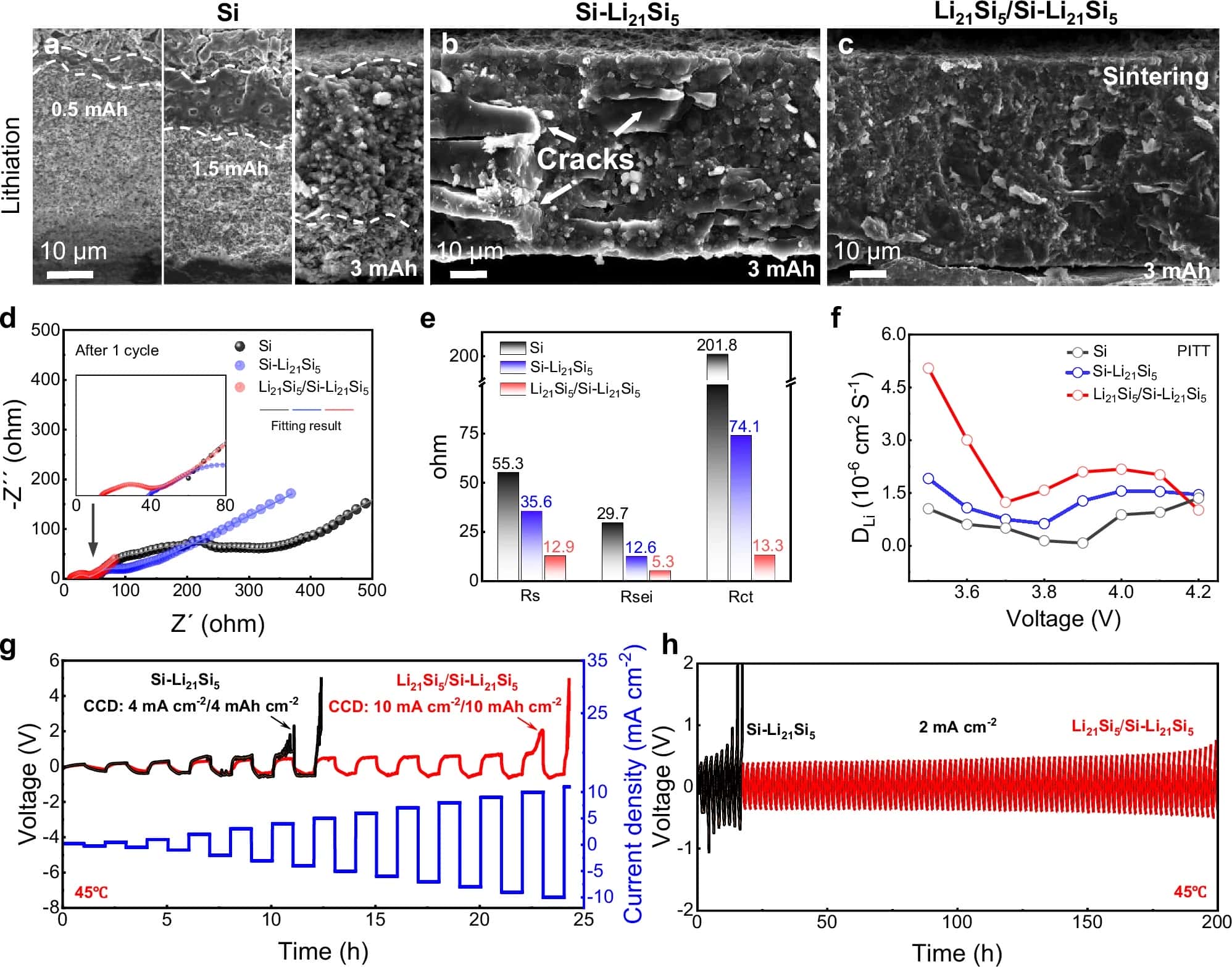
Figure 2. Ionic/electronic transport characterization of the Li21Si5/Si–Li21Si5 anode for ASSBs.
6. Characterization Methods: Multi-Modal Analysis of the Pressure-Free Interface
Establishing the mechanistic basis for the bilayer anode’s pressure-free stability required a multi-scale, multi-modal characterization approach:
- Microstructure and phase composition: SEM, XRD — established morphological integrity and phase distribution before and after cycling.
- Interfacial chemistry: XPS — quantified surface chemical states and interfacial reaction products at the anode–electrolyte boundary.
- Surface potential mapping: AFM (Kelvin probe force microscopy) — visualized the electric field homogenization effect of the Li₂₁Si₅ top layer.
- Lithium-ion local environment: solid-state NMR (SSNMR) — probed the chemical state of lithium in the Li₂₁Si₅ and Si–Li₂₁Si₅ phases, providing atomic-level insight into ion transport pathways.
- Real-time structural evolution: in-situ TEM — visualized silicon particle lithiation and volume change behavior under realistic cycling conditions without applied pressure.
- Multiphysics simulation: COMSOL model parameterized by the above data validated that the bilayer design homogenizes current density and redistributes mechanical stress throughout the anode volume, preventing localized failure.
🔬 IEST Instrument Contribution to This Research
The Xiamen University research team utilized IEST SEMS series solid electrolyte characterization instruments in the material testing workflow for this study. The IEST SEMS system provides multi-dimensional solid electrolyte characterization — integrating controlled pressure application, electrochemical impedance spectroscopy (EIS), and real-time mechanical response measurement in a single platform — directly relevant to studying the interfacial contact behavior that is central to this paper’s findings.
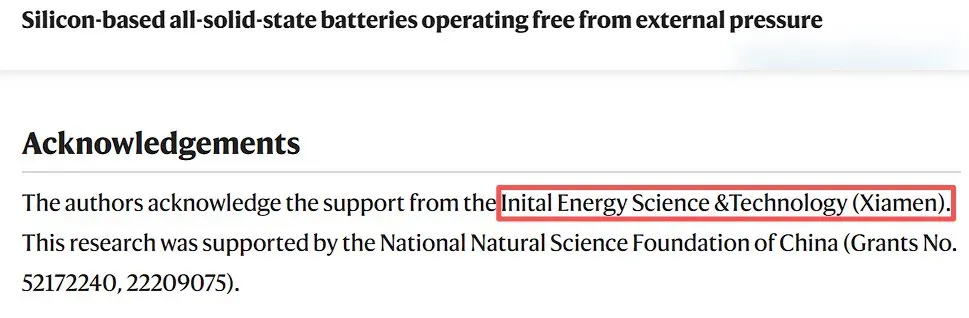
Acknowledgement: “The authors acknowledge the support from Inital Energy Science & Technology (Xiamen).”
— Zhang et al., Nature Communications 16, 1013 (2025)
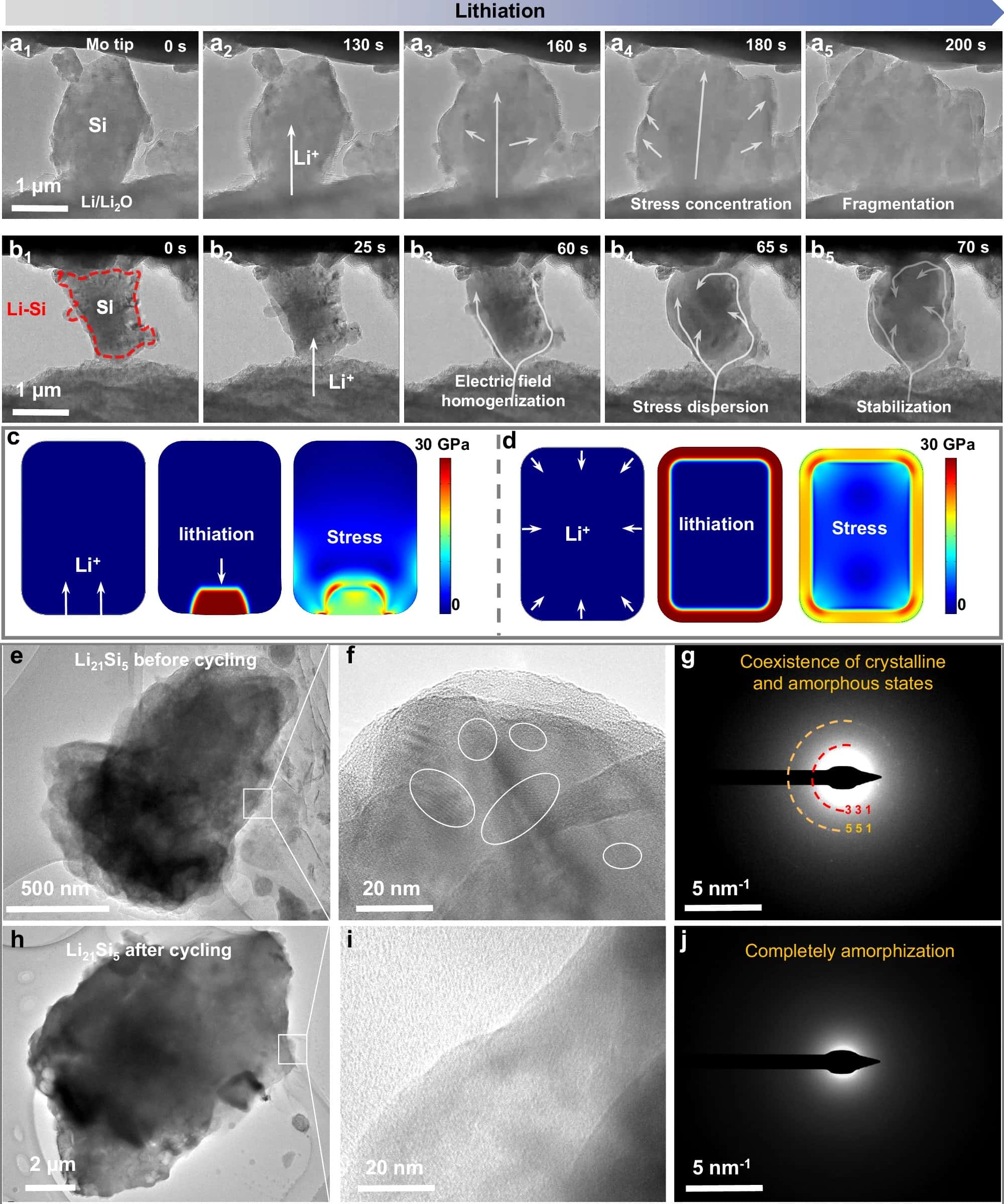
Figure 3. Structure evolution of the Li21Si5/Si–Li21Si5 anode during cycling — demonstrating structural stability without external pressure.
7. Engineering Implications for Pressure-Free All-Solid-State Batteries
This work establishes a pathway toward ASSBs that do not depend on impractically high external mechanical pressure. Key engineering implications for ASSB development and manufacturing:
- Cell and pack simplification: removing the external pressure requirement eliminates the need for spring-loaded compression frames, engineered swelling pads, and pressure management systems — reducing module complexity and enabling thinner, lighter pack designs.
- Scalability indicators: cold-press sintering and composite layering are compatible with existing electrode manufacturing flows. Reproducibility of the pre-lithiation extent, microstructure uniformity, and controlled porosity will be the critical scale-up challenges.
- Rate capability and safety balance: achieving 10 mA cm⁻² critical current density with only 14.5% volume expansion demonstrates that the bilayer design balances fast-charging kinetics with mechanical stability — a combination required for high-energy, fast-chargeable EVs.
- Application scope: pressure-free operation opens ASSB applications in flexible electronics, wearables, and curved-surface devices where stack pressure is structurally incompatible with the device form factor.
Key data from this work: a Li₂₁Si₅/Si–Li₂₁Si₅ bilayer silicon anode in an all-solid-state battery achieved 1,000 cycles at 2.5 mA cm⁻², 54.9% capacity retention, 97 ± 0.7% initial Coulombic efficiency, and only 14.5% volume expansion — without any external applied pressure (versus the 10–250 MPa typically required). The bilayer architecture works by homogenizing electric field distribution (via the MIEC Li₂₁Si₅ top layer) and distributing mechanical stress through a 3D Si–Li₂₁Si₅ network, eliminating the localized failure modes that make conventional silicon ASSBs pressure-dependent.
8. Original Paper
Zhang, Z., Zhang, X., Liu, Y. et al. Silicon-based all-solid-state batteries operating free from external pressure. Nat Commun 16, 1013 (2025).
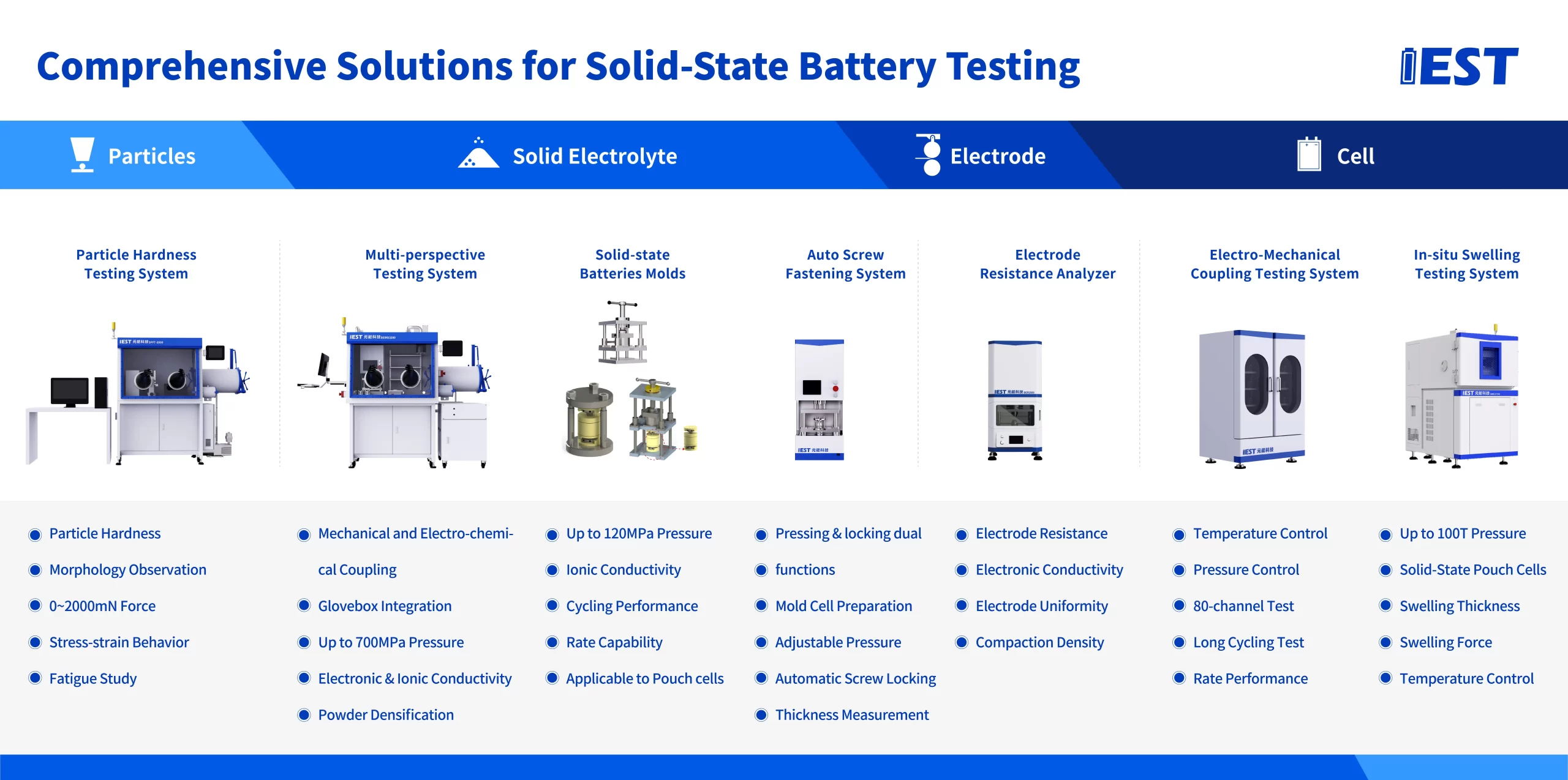
9. IEST Comprehensive Solid-State Battery Testing Solutions
IEST Instrument provides a comprehensive suite of testing systems for solid-state battery research and development — spanning material-level characterization through full-cell performance evaluation. The product portfolio directly supports the multi-scale characterization workflows used in solid-state battery research, accelerating the development and commercialization of next-generation batteries:
- SEMS series — Multi-dimensional solid electrolyte characterization: integrates controlled pressure (up to 350 MPa), electrochemical impedance spectroscopy (EIS, 0.1 Hz–100 kHz), and real-time mechanical response measurement. Directly applicable to studying pressure-contact relationships in solid electrolytes and composite anodes — the core characterization need in pressure-free ASSB research.
- SWE in-situ swelling analyzers: real-time thickness and force monitoring during cycling, capturing volume expansion dynamics across full charge-discharge cycles — critical for quantifying the 14.5% expansion performance that defines pressure-free silicon anode behavior.
- BPD pressure/temperature distribution mapping: spatial pressure uniformity verification across the electrode area — essential for validating that mechanical load is applied or absent uniformly in ASSB test assemblies.
10. FAQ: Silicon-Based Anodes and Pressure-Free All-Solid-State Batteries
10.1 Why do silicon anodes cause problems in all-solid-state batteries?
Silicon anodes undergo up to ~300% volume expansion during lithium intercalation — far greater than graphite (~10%) or LFP (~0%). In all-solid-state batteries, this expansion repeatedly disrupts the solid-solid contact at the silicon anode–solid electrolyte interface, creating gaps that increase ionic resistance and eventually causing interface delamination and capacity fade. Conventional approaches address this by applying 10–250 MPa external pressure to force contact maintenance, but this pressure requirement complicates pack design and limits practical applicability. The Li₂₁Si₅/Si–Li₂₁Si₅ bilayer design in the Xiamen University Nature Communications (2025) study reduces effective volume expansion to 14.5% while maintaining interface stability without pressure, through electric field homogenization and 3D stress distribution within the anode structure.
10.2 What is the Li₂₁Si₅/Si–Li₂₁Si₅ bilayer anode and how does it work?
The Li₂₁Si₅/Si–Li₂₁Si₅ bilayer anode is a composite silicon-based anode architecture designed for pressure-free all-solid-state battery operation. It consists of two functional layers: a top Li₂₁Si₅ layer that acts as a mixed ionic-electronic conductor (MIEC), homogenizing the electric field at the anode–electrolyte interface to ensure uniform lithium-ion flux; and a bottom Si–Li₂₁Si₅ layer that forms a continuous 3D conductive network, distributing mechanical stress from silicon expansion throughout the structure rather than concentrating it at the interface. An additional intrinsic feature — spontaneous self-pre-lithiation, where lithium migrates from Li₂₁Si₅ to surrounding Si particles before cycling — enhances initial conductivity and structural integrity. Together these mechanisms eliminate the localized interface failure that makes conventional silicon anodes pressure-dependent.
10.3 What performance did the pressure-free silicon-based ASSB achieve?
Published in Nature Communications (2025), the pressure-free Li₂₁Si₅/Si–Li₂₁Si₅ bilayer silicon-based ASSB achieved: 1,000 stable cycles at 2.5 mA cm⁻² (a new record for pressure-free silicon ASSBs); 54.9% capacity retention after 1,000 cycles; initial Coulombic efficiency of 97 ± 0.7%; critical current density of 10 mA cm⁻² at 10 mAh cm⁻²; areal capacity of 2.8 mAh cm⁻²; and volume expansion of only 14.5% — compared to the ~300% expansion of unmodified silicon. All results were obtained without any external applied pressure.
10.4 Why is eliminating external pressure important for solid-state battery commercialization?
External pressure requirements (10–250 MPa for oxide electrolyte ASSBs) are one of the primary barriers to practical ASSB commercialization. Applying and maintaining high stack pressure requires engineered compression frames, calibrated spring systems, or active pressure management — adding mass, volume, cost, and mechanical complexity to the battery pack. For electric vehicles, this complicates module design and conflicts with the lightweight, compact packaging goals. For flexible electronics and wearables, maintaining high stack pressure is structurally impossible. Pressure-free ASSB designs simplify pack engineering, enable new form factors, and remove a key cost barrier — making them a significant step toward commercial viability.
10.5 What characterization techniques are used to study pressure-free ASSB anodes?
The Xiamen University study employed six complementary characterization techniques to establish the mechanistic basis for pressure-free stability: SEM and XRD for morphological and phase analysis; XPS for interfacial chemical state characterization; AFM (Kelvin probe force microscopy) for surface potential mapping; solid-state NMR (SSNMR) for lithium-ion local environment analysis; in-situ TEM for real-time structural evolution observation during cycling; and COMSOL Multiphysics simulation parameterized by the experimental data to validate current density homogenization and stress redistribution in the bilayer structure. IEST SEMS series instruments contributed to the solid electrolyte characterization component of this workflow, as acknowledged by the authors in the published paper.