-
iestinstrument

1. Introduction
As lithium-ion batteries become ubiquitous in electric vehicles, energy density, cycle life, safety, and cost remain the primary concerns. During cycling, cathode active materials — particularly Ni-rich NCM — undergo repeated lithium intercalation and deintercalation, accompanied by anisotropic volume changes, microcrack propagation, and phase transitions. Single particle mechanical failure is now recognized as a key driver of accelerated capacity fade. For instance, Moon et al. demonstrated that Mg doping increases the single particle hardness of NCM622 and improves its cycling performance. Thus, particle hardness directly influences the long-term cycle stability of NCM cathodes. Similarly, the mechanical strength (crush resistance) of both cathode and anode materials affects their electrochemical performance — a correlation that opens new avenues for material research.
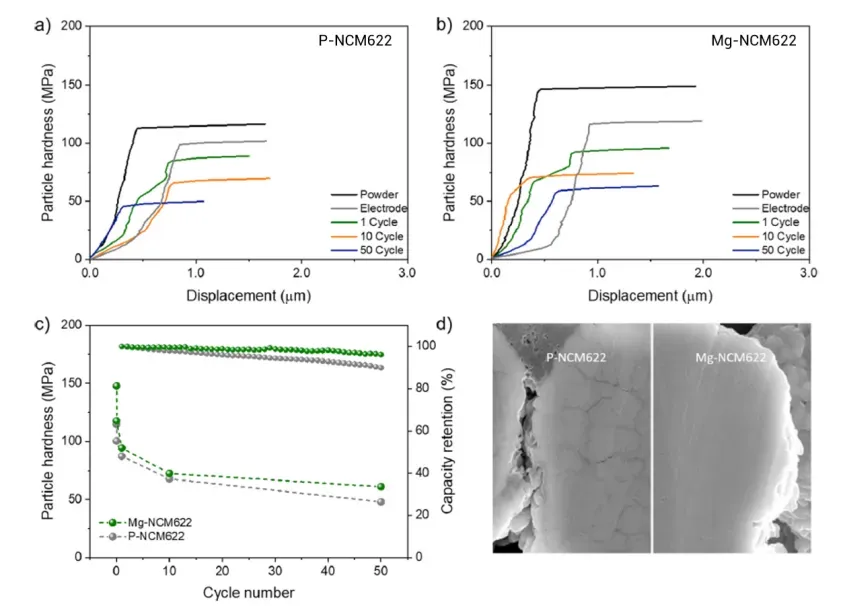
Figure 1. Mg doping increases single particle hardness and improves cycle performance 1
2. Experimental Equipment and Methods
2.1 Equipment
We used a Single particle mechanical testing system(SPFT2000) (IEST Instrument), shown in Figure 2(a).
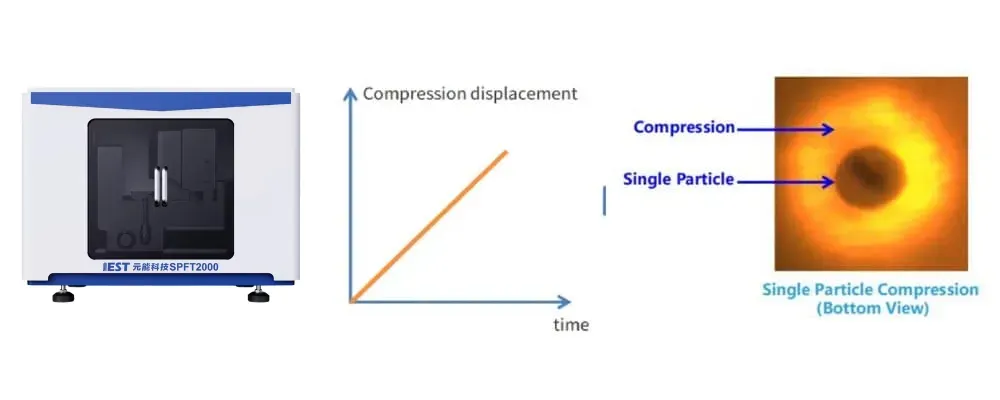
Figure 2. (a) IEST SPFT2000 appearance; (b) testing mode; (c) bottom view of the optical system.
2.2 Test Methods
-
From the same batch of cathode material, we scraped powder from fresh electrodes (0 cycle), after 100 cycles, after 200 cycles, and from a cell that experienced cycle diving (capacity jump) at 400 cycles. These samples are denoted as 0 cycle (fresh particles), 100 cycles, 200 cycles, and 400 cycles(failure) (failed cell particles).
-
For the anode, we collected fresh particles (A-0 cycle) and particles from the failed cell after 400 cycles (A-400 cycles(failure)).
-
Each of the six powder samples was dispersed in solution, dropped onto glass slides, and placed under a microscope. Using a displacement-controlled compression mode (constant indenter displacement rate), we measured the stress evolution during particle compression to determine the crushing force. The powder crushing strength was then calculated using the formula shown in follow (based on Chinese national standard GB/T 43091-2023).
The powder crushing strength is calculated using formula:
\[
p_{\text{co}} = \alpha \times 1000 \times \frac{F_{\text{yk}}}{\pi \cdot d^2}
\]
Where:
– \( p_{\text{co}} \) — crushing strength, in MPa;
– \( \alpha \) — calculation coefficient, taken as 2.48;
– \( F_{\text{yk}} \) — crushing force, in mN;
– \( d \) — particle size (diameter), in μm.
3. Results and Discussion
3.1 Cathode Active Material
Figures 4 and 5 summarize the results for the Ni-rich NCM cathode. The crushing strength of particles after 100 cycles and 200 cycles is lower than that of fresh particles (0 cycle). More dramatically, particles from the failed cell (400 cycles) show a crushing strength more than 90% lower than fresh particles.
Previous studies have shown that capacity fade in materials with nickel content above 80% originates mainly from the H2→H3 phase transition during charge/discharge, which induces anisotropic contraction/expansion. The resulting internal stresses generate microcracks and trigger interfacial side reactions [3]. As microcracks propagate, more particle surfaces become exposed to the electrolyte, accelerating structural degradation and ultimately causing a sudden capacity drop (cycle diving).
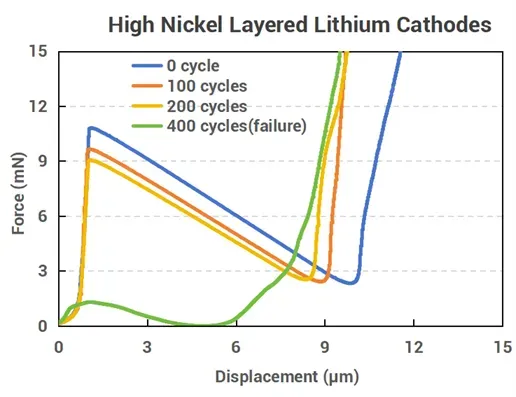
Figure 3. Single particle compression curves of a Ni-rich NCM material.
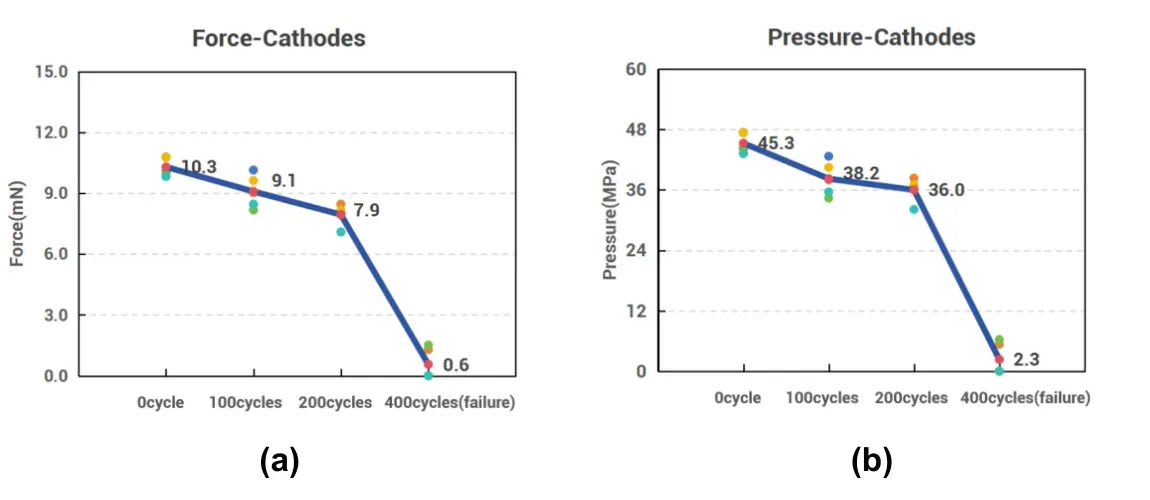
Figure 4. (a) Single particle crushing force of a Ni-rich NCM material; (b) Single particle crushing strength of a Ni-rich NCM material.
3.2 Anode Active Material (Graphite)
Figure 6 presents the anode results. Particles from the failed cell (A-400 cycles(failure)) exhibit a crushing strength more than 80% lower than fresh particles (A-0 cycle). This drastic reduction is attributed to the repeated volume changes of graphite during lithiation/delithiation. Mechanical stresses cause microcrack initiation, propagation, and coalescence, increasing internal defects and disrupting the ordered layered structure [4]. Consequently, the single particle crushing strength declines. Moreover, cracks force the SEI to repeatedly break and reform, consuming Li⁺, raising internal resistance, and leading to a cliff-like capacity fade.
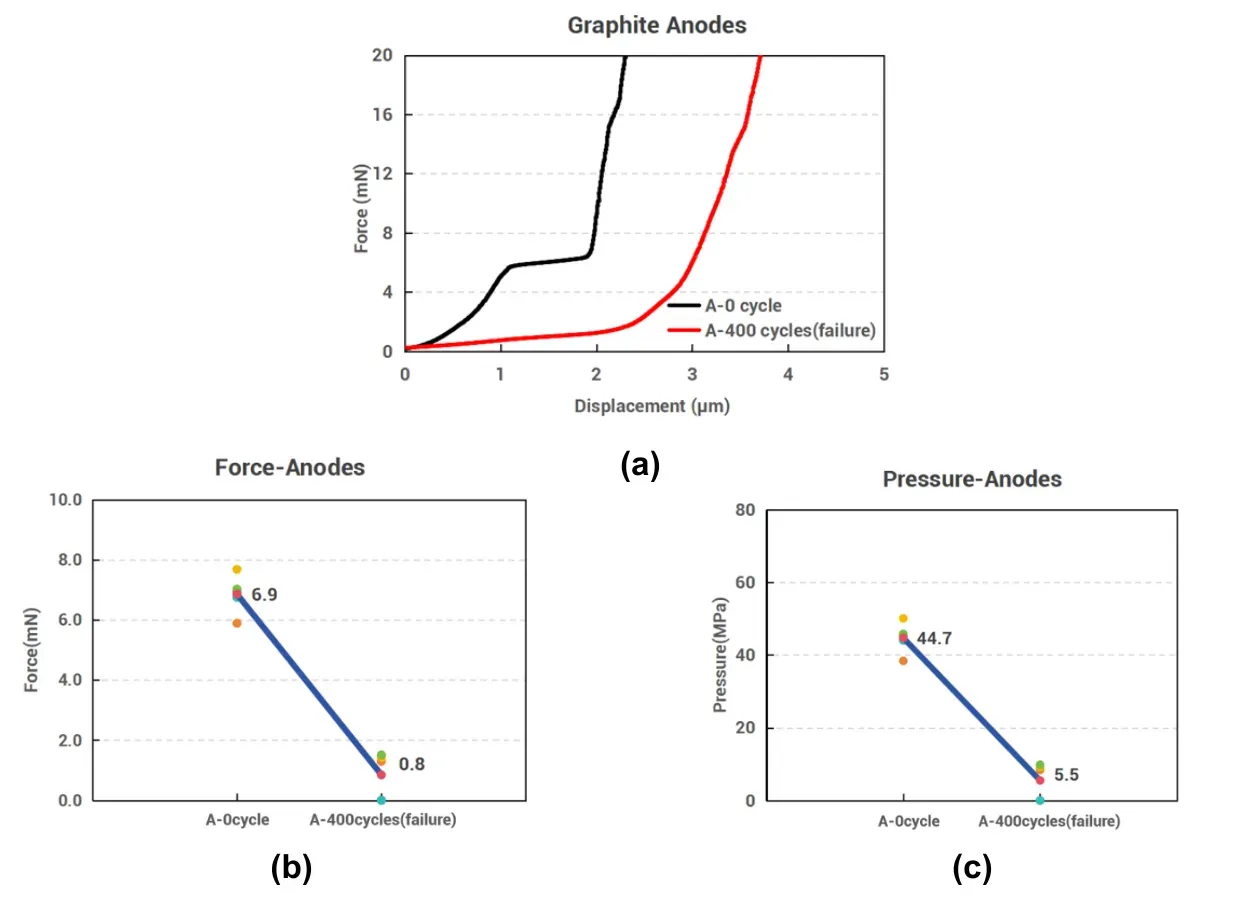
Figure 5. (a) Single particle compression curves of graphite anode material; (b) Anode single particle crushing force; (c) Anode single particle crushing strength.
4. Summary
Using the SPFT2000 single particle mechanical testing system (IEST Instrument), this study systematically demonstrates the intrinsic link between single particle mechanical failure of both cathode and anode materials and cycle diving in lithium-ion cells. These findings provide a solid experimental and theoretical foundation for failure mechanism analysis, fault diagnosis, and performance optimization. As the demand for longer life and higher safety in Li-ion batteries grows, single particle mechanical testing will become an indispensable tool for material development, electrode process optimization, and battery failure analysis.
5. References
[1] Janghyuk Moon, Jae Yup Jung, Trung Dinh Hoang, et al. The correlation between particle hardness and cycle performance of layered cathode materials for lithium-ion batteries. Journal of Power Sources, 486 (2021) 229359.
[2] GB/T 43091-2023, Powder crushing strength test method (Chinese national standard).
[3] Yingshuang Sun, Congcong Li, Jun Chen, et al. In-situ crystal structure growth and control for enhancing comprehensive performance in ultra-high nickel layered lithium cathodes. Angew. Chem. Int. Ed., 2025, e13466.
[4] Liu, Y., Li, D., et al. Understanding the crack formation of graphite particles in cycled commercial lithium-ion batteries by focused ion beam – scanning electron microscopy. Journal of Power Sources, 2017, 360: 321-329.