
In lithium-ion battery manufacturing, double-layer coating technology — also referred to as dual-layer coating, tandem coating, or a multi-layer/multi-gradient anode coating system — has emerged as a practical route to balance the perennial trade-off between energy density and power density. A typical double-layer anode design employs a top layer (near the separator) of small-particle, rate-capable graphite to facilitate rapid lithium-ion intercalation, while the bottom layer (adjacent to the copper current collector) uses large-particle, high-compaction graphite to deliver stable specific capacity.
Although the industry often adopts a wet, single-pass co-extrusion process for simultaneous double-layer coating using slurries formulated with organic compound binders and conductive additives, a critical question remains unanswered: does the intended bilayer structure survive after drying, calendering, and downstream processing? Currently, no universally accepted layer-resolved characterization method exists to verify the preserved gradient distribution or to detect interlayer intermixing.
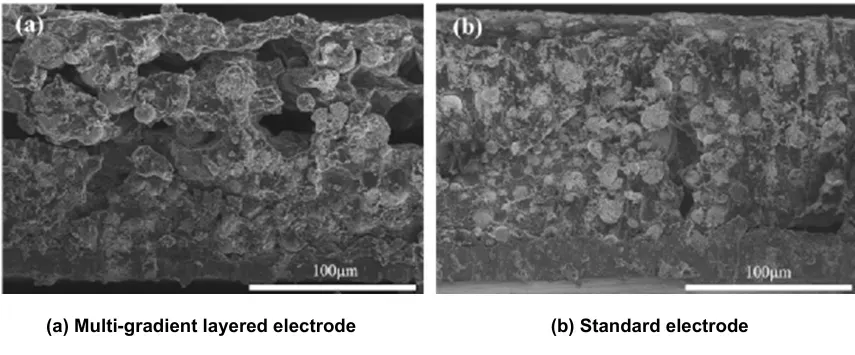
Figure 1. Multi‑gradient layered electrode design: High porosity in the top layer, high compaction in the bottom layer
In this study, we mechanically peeled a finished, calendered double-layer coated graphite anode and collected powder samples from the top, middle, and bottom regions for multi-dimensional physical characterization. Our objective was to determine whether the original property differences between the top and bottom layers are retained after industrial coating, drying, and calendering.
We analyzed a commercial double-layer coated graphite anode roll supplied by a manufacturer. The actual sample was a double-side coated graphite electrode with a total thickness of approximately 208 μm and a current collector thickness of ~3 μm, giving a single-side coating thickness of about 100 μm. According to the design specifications, the top layer (surface side) used a rate-type graphite, the bottom layer (foil side) a capacity-type graphite, with a designed thickness ratio of 1:1 (approximately 50 μm each). The type and content of conductive additives and binder — the organic compound components of the slurry — were identical for both layers.
Conventional, whole-electrode powder characterization mixes material from both layers together during sampling, making it impossible to verify whether the designed top/bottom gradient actually survives coating, drying, and calendering — this is precisely the gap that layer-resolved sampling addresses. Using an IEST Automated Electrode Powder Sampling System(LEPS Series) , we sequentially scraped powder samples from three depth intervals on the single-side coating: 0–30 μm, 30–60 μm, and 60–90 μm, as illustrated in Figure 2.
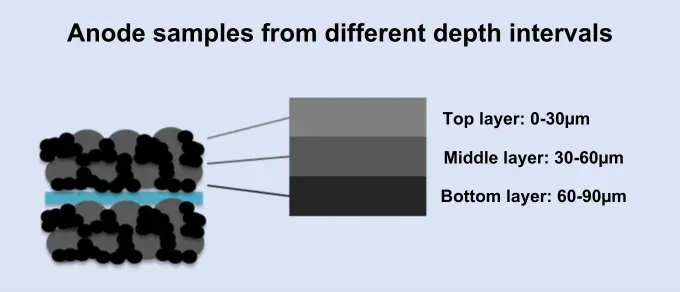
Figure 2. Schematic diagram of powder sampling at different depths on one side of a double-side coated anode
| Property | Instrument |
|---|---|
| Particle size distribution | Laser diffraction particle size analyzer (Topsizer, OMEC, Zhuhai) |
| Powder resistivity and compaction density | IEST Powder resistivity & compaction density tester (PRCD Series) |
| X-ray diffraction (XRD) | SmartLab SE (Rigaku, Japan) |
| Raman spectroscopy | XploRA (HORIBA) and RTS2 (Zolix, Beijing) |
Note: The data presented below reflect only the specific double-layer coated anode sample tested in this work. Repeatability was confirmed through parallel experiments. These results do not represent products from other manufacturers or batches but serve as a realistic physical characterization of this particular sample.
We used a wet dispersion mode with water as the dispersant. The laser diffraction results (Table 2) reveal a clear gradient in particle size across the three layers. The top-layer powder (rate-type graphite) exhibits the smallest D50 and a narrower size distribution — a feature that shortens the solid-state lithium diffusion path and enhances rate capability. In contrast, the bottom-layer powder (capacity-type graphite) shows larger particles and a broader distribution, which improves packing density and volumetric energy density. The middle layer displays intermediate values.
Table 2. Particle size distribution of top, middle, and bottom layer powders
| Layer | D(10) / μm | D(50) / μm | D(90) / μm | D[4,3] / μm | Span |
|---|---|---|---|---|---|
| Upper Layer | 5.911 | 11.656 | 20.676 | 12.527 | 1.267 |
| Middle Layer | 6.095 | 12.135 | 21.782 | 13.103 | 1.293 |
| Lower Layer | 6.227 | 13.394 | 24.701 | 14.522 | 1.379 |
We evaluated powder resistivity and compaction density using a IEST PRCD Series. Figure 3 shows the resistivity–pressure curves. At low to medium pressures (0–80 MPa), the three layers exhibit distinguishable resistivity values, with the top layer showing the highest resistivity (i.e., poorest electronic conductivity). At pressures above 80 MPa, the differences diminish. The higher resistivity of the top layer is consistent with its rate-optimized graphite, which typically contains more structural defects and higher disorder.
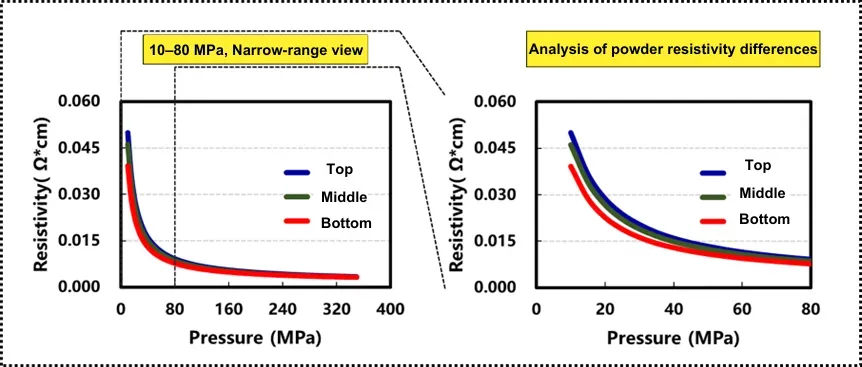
Figure 3. Powder resistivity vs. pressure curves for top, middle, and bottom layer samples.
For compaction density, the industry commonly uses two methods:
| Method | What It Captures | Result for Top-Layer Powder |
|---|---|---|
| Direct pressure method | Density measured under applied pressure (“under compression” state) | Similar compaction density to middle and bottom layers |
| Ten-point pressure-release method | Density of the pressed pellet after unloading (“after spring-back” state) | Significantly lower compaction density — a clear difference emerges |
This behavior suggests that the top-layer (rate-type) graphite may contain secondary particles or a soft-carbon composite structure, providing internal pores and interfacial buffer spaces that lead to pronounced elastic spring-back after unloading. In contrast, the bottom-layer (capacity-type) graphite is more dense and deforms plastically with minimal spring-back — an advantage for achieving high electrode compaction and structural stability.
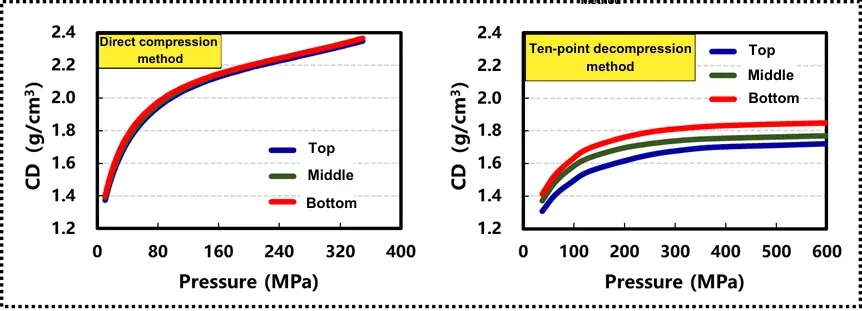
Figure 4. Powder compaction density of top, middle, and bottom layers: direct pressure method (left) vs. ten-point pressure-release method (right).
XRD patterns collected from 5° to 90° at 2°/min are shown in Figure 5. All three layers exhibit typical graphite (002) and (004) reflections.
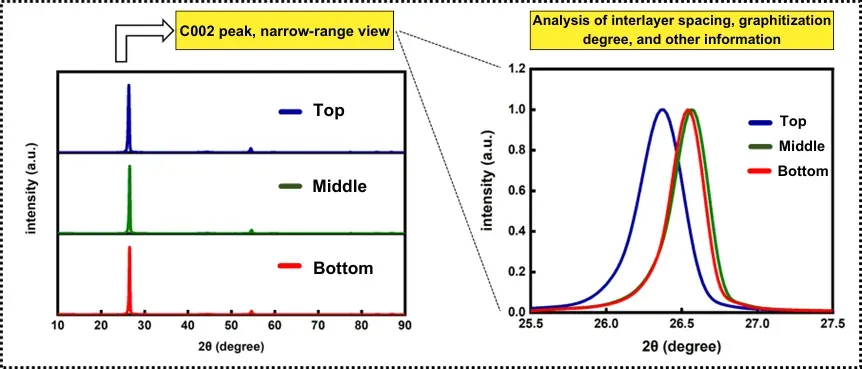
Figure 5. XRD patterns of top, middle, and bottom layer powders.
From the (002) peak, we calculated interlayer spacing, Scherrer width (crystallite thickness Lc), and graphitization degree.
The top-layer powder exhibits a slightly lower graphitization degree, while the middle and bottom layers have d002 values close to that of ideal graphite (0.3354 nm) and much higher graphitization degrees. As shown in Table 4:
Table 4. XRD parameters of top, middle, and bottom layer powders
| Parameter | Upper Layer | Middle Layer | Lower Layer |
|---|---|---|---|
| C002 Peak (°) | 26.380 | 26.560 | 26.540 |
| FWHM (°) | 0.340 | 0.260 | 0.260 |
| d₀₀₂ (nm) | 0.3376 | 0.3353 | 0.3356 |
| Lc (nm) | 23.9987 | 31.3945 | 31.3932 |
| Graphitization Degree (%) | 74.42 | 101.16 | 97.67 |
The narrower (002) peak FWHM and larger Lc in the middle and bottom layers indicate more perfect crystal integrity along the c-axis. We attribute the lower graphitization and higher disorder of the top layer to its rate-type design — moderate reduction in graphitization or introduction of a surface coating, which creates more channels for lithium intercalation/deintercalation at the expense of perfect stacking order. This trend aligns with the powder resistivity results: the middle and bottom layers, with higher crystal perfection and continuous sp² carbon networks, show superior electronic conductivity.
Raman spectroscopy is a powerful tool to probe defects in carbon materials. A higher ID/IG ratio indicates greater structural disorder or more defects.
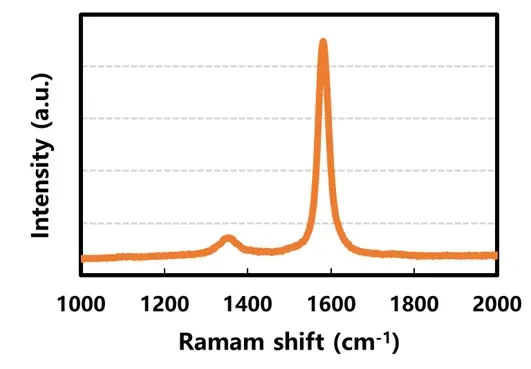
We used a 532 nm excitation laser and collected data from five points per sample; Table 3 summarizes the average values. Figure 6 shows a representative Raman spectrum measured from the bottom layer powder. The top-layer powder shows the highest ID/IG and a broader G-band FWHM, indicating more surface defects, abundant edge active sites, or an amorphous carbon coating — all hallmarks of rate-type graphite. Middle and bottom layers show lower ID/IG and higher structural order, consistent with the XRD graphitization results.
Table 5. Raman D and G band parameters of top, middle, and bottom layer powders
| Parameter | Upper Layer | Middle Layer | Lower Layer |
|---|---|---|---|
| G Peak FWHM (cm⁻¹) | 0.340 | 0.260 | 0.260 |
| ID/IG Ratio | 0.3376 | 0.3353 | 0.3356 |
*Note: The original manuscript’s Table 3 values are presented as above. The top layer shows higher ID/IG and broader G band FWHM, indicating more surface defects or amorphous carbon coating.*
The IEST LEPS automatic electrode powder scraping device enables precise, depth-controlled powder sampling from double-layer or multi-gradient coated electrodes — paired with the PRCD Series for resistivity and compaction density analysis at each depth.
Explore the Powder Resistivity & Compaction Density Tester →
By precisely scraping a double-layer coated graphite anode at controlled depths, we obtained powder samples from the top, middle, and bottom regions and analyzed their differences in particle size distribution, compression/spring-back behavior, and crystallographic characteristics. Our results confirm that for the analyzed double-layer coated graphite anode, the top (surface) layer is a rate-type graphite featuring surface defects or a coating layer, while the bottom layer consists of larger particles with higher graphitization degree and more perfect crystal structure — the capacity-type graphite. The IEST Automated Electrode Powder Sampling System(LEPS Series) proved essential for enabling this layer-resolved structural analysis, offering a robust sample preparation method for process optimization and performance traceability in double-layer and multi-gradient coated anodes.
Double-layer coating applies two functionally distinct graphite layers onto a single current collector: a top layer of small-particle, rate-capable graphite near the separator for fast lithium-ion intercalation, and a bottom layer of large-particle, high-compaction graphite near the current collector for higher specific capacity and packing density. Both layers use organic-compound-based slurries (binder and conductive additive) and are typically applied via single-pass co-extrusion.
Graphitization degree (GF) is calculated from the XRD (002) peak interlayer spacing using GF = (0.3440 − d₀₀₂) / (0.3440 − 0.3354), where 0.3440 nm represents fully disordered carbon and 0.3354 nm represents ideal single-crystal graphite. A GF closer to 100% indicates a more ordered graphite crystal structure with fewer structural defects.
In this study’s layer-resolved analysis of a commercial double-layer coated graphite anode, the top and bottom layers retained clearly distinguishable particle size, compaction density spring-back behavior, and graphitization degree after industrial coating, drying, and calendering — confirming the designed gradient was largely preserved. However, the middle-layer values fell between the top and bottom extremes, consistent with some degree of interlayer intermixing rather than a perfectly sharp boundary.
The top layer’s rate-optimized graphite is designed with smaller particles, more structural defects, and higher disorder to shorten the lithium-ion diffusion path — but this same disorder reduces the continuity of the sp² carbon conduction network, resulting in higher powder resistivity compared with the more crystallographically perfect bottom (capacity-type) layer.
Layer-resolved sampling uses a controlled-depth electrode powder scraping device — such as the IEST LEPS system — to sequentially remove powder from defined depth intervals (e.g., 0–30 μm, 30–60 μm, 60–90 μm) on a single side of the coating, rather than characterizing the whole electrode as a mixed bulk sample. This allows particle size, resistivity, compaction density, XRD, and Raman properties to be measured separately for the top, middle, and bottom regions.