
The silicon-carbon anode prepared by chemical vapor deposition (CVD), also known as vapor-deposited silicon anode, is a silicon-based anode material obtained through the CVD process. The core of this preparation method involves storing silicon within a porous carbon framework: silane gas is introduced into the pores of porous carbon particles, and high-temperature pyrolysis causes the gas to deposit, forming silicon nanoparticles dispersed within the carbon’s pore structure. This method enables molecular-scale control over the resulting nanomaterial, producing good product morphology with a uniform composition and a relatively dense structure. The internal voids of the porous carbon act as a buffer for volume expansion, leading to low expansion rates and excellent cycling performance.
In the industry today, the term “CVD silicon-carbon anode” usually refers to the technology developed by the American company Group14. In April 2021, Group14 announced that its flagship product, the silicon-carbon composite anode material SCC55™ (carbon-silicon ratio 55:45), had begun commercial production at the world’s first-of-its-kind BAM (Battery Active Materials) factory. SCC55™ is a stable silicon-carbon composite anode with a capacity five times that of graphite anode materials and can provide 50% higher energy density than traditional graphite. Its hard-carbon-based scaffold maintains silicon in its most favorable form — amorphous, nano-sized, and carbon-encapsulated. SCC55™ is also fully compatible with graphite blending, and even at a 20% blend ratio, can increase energy density by 30% over 1,000 cycles.
The carbon framework in CVD silicon-carbon anode materials offers a low production cost and good intrinsic lithium storage capacity. The framework’s low density and lightweight nature contribute to the material’s overall high energy density. The CVD process itself has a short production flow and requires minimal equipment, giving it theoretically low manufacturing cost. Performance testing shows that porous silicon-carbon anode powder prepared by CVD exhibits strong performance across specific capacity, initial efficiency, cycle life, and rate capability. In production, CVD-based porous silicon-carbon can reduce the need for prelithiation and premagnesiation, offering meaningful cost reduction potential compared to the silicon-oxygen route. Whether evaluated on current performance, cost, and product stability, or future technological potential, CVD silicon-carbon anode is considered the most advantageous of the three major silicon-anode technology routes.
Downstream battery manufacturers and automotive companies have shown strong interest in the porous silicon-carbon technology route, which theoretically offers significant cost reduction while maintaining performance advantages. Domestic companies with established experience in silicon-oxygen materials, along with leading milled-silicon-carbon producers, are transitioning to and investing in vapor-deposited silicon-carbon anode powder. Silicon-based anode startups are also shifting focus toward CVD silicon-carbon development.
In CVD silicon-carbon anode materials, the properties of the porous carbon directly determine the final product characteristics. Porous carbon materials — with their varied pore structures, high chemical stability, high conductivity, high specific surface area, and richly adjustable porosity — show strong potential across energy storage, conversion, catalysis, and adsorption separation, and their adoption in silicon-carbon anodes has driven significant growth in the porous carbon industry. The quality of the carbon framework directly affects the mass production capability of the final anode product. Different porous carbons must be matched with different graphites to achieve optimal cell-level performance, and pore size, pore volume, and porosity requirements vary substantially across application scenarios — creating a need for specialized mechanical and electrical evaluation techniques during material development.
Figure 1 shows the IEST Powder Resistivity & Compaction Density Instrument (PRCD3100). This device simultaneously measures the resistivity, conductivity, and compaction density of powder samples — including CVD silicon-carbon anode powder, milled silicon-carbon, and graphite — while applying pressures up to 5T. It enables researchers to systematically study how varying pressure affects the electrical and mechanical properties of powder samples.
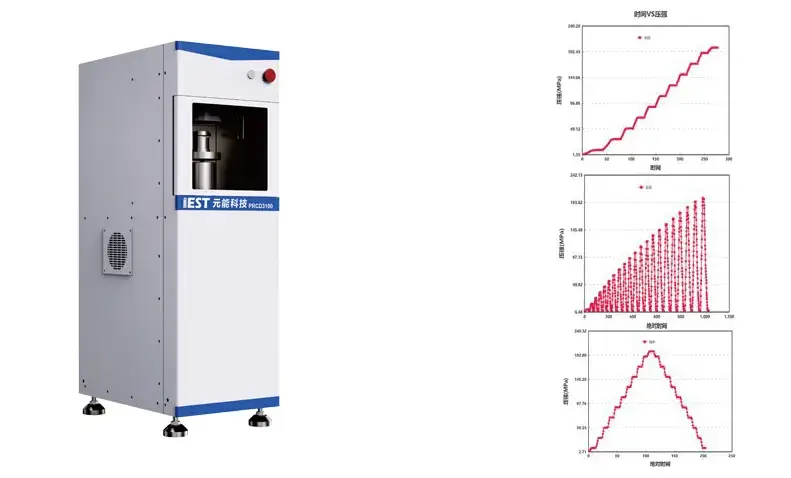
Figure 1. Schematic diagram of the IEST PRCD3100 Powder Resistivity & Compaction Density Instrument and its different mechanical performance testing modes, used to compare CVD silicon-carbon anode powder against milled silicon-carbon and graphite.
Figure 2 shows the IEST Electrode Resistivity Instrument (BER2500), independently developed by IEST. The electrode sample fixture accommodates a 14 mm diameter electrode and applies pressures from 5 to 60 MPa. This device simultaneously measures the resistance, resistivity, conductivity, and compaction density of electrode sheets — extending the powder-level compaction density analysis to actual calendared CVD silicon-carbon anode electrodes.
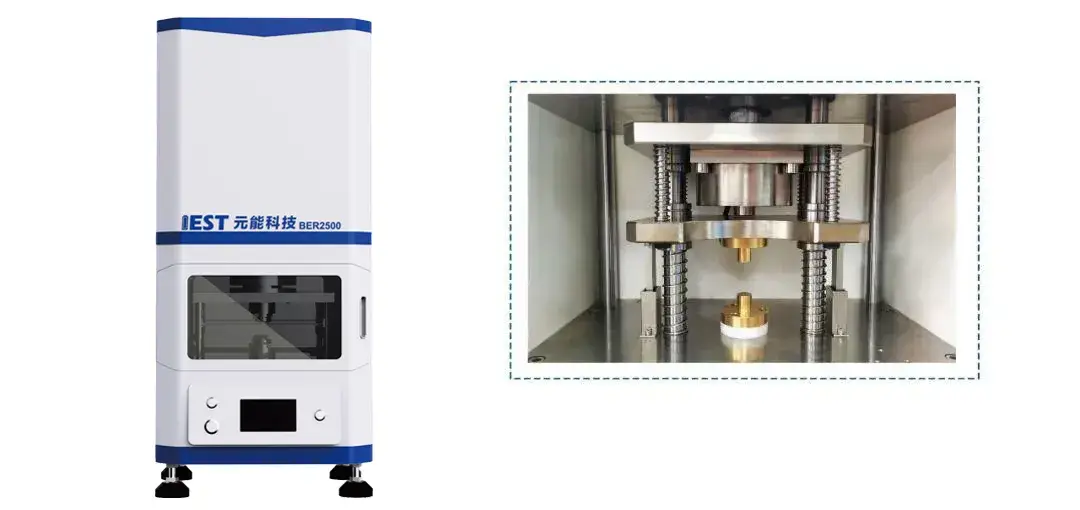
Figure 2. Appearance and structural diagram of the IEST BER2500 Electrode Resistivity Instrument, used to measure compaction density and rebound on calendared silicon-carbon anode electrode sheets.
This study compares the compaction density and rebound characteristics of vapor-deposited silicon-carbon (PSC), milled silicon-carbon (SiC), and conventional artificial graphite (GR) at the powder level. It also prepares CVD silicon-carbon anode materials with capacities of 450 mAh/g (PSC-450) and 550 mAh/g (PSC-550) from the same vapor-deposited silicon powder. Using identical process and formulation, the silicon-carbon and graphite materials are calendared into electrode sheets to study mechanical property differences between silicon-carbon and graphite electrodes.
Compaction density of CVD silicon-carbon anode powder (PSC), milled silicon-carbon powder (SiC), and artificial graphite powder (GR) was tested across 10–350 MPa applied pressure (Figure 3). At the same pressure, the compaction density of graphite was significantly higher than both silicon-based materials. Among the two silicon-based materials, the compaction density of CVD silicon-carbon anode powder was higher than that of milled silicon-carbon — a difference primarily attributable to microstructure.
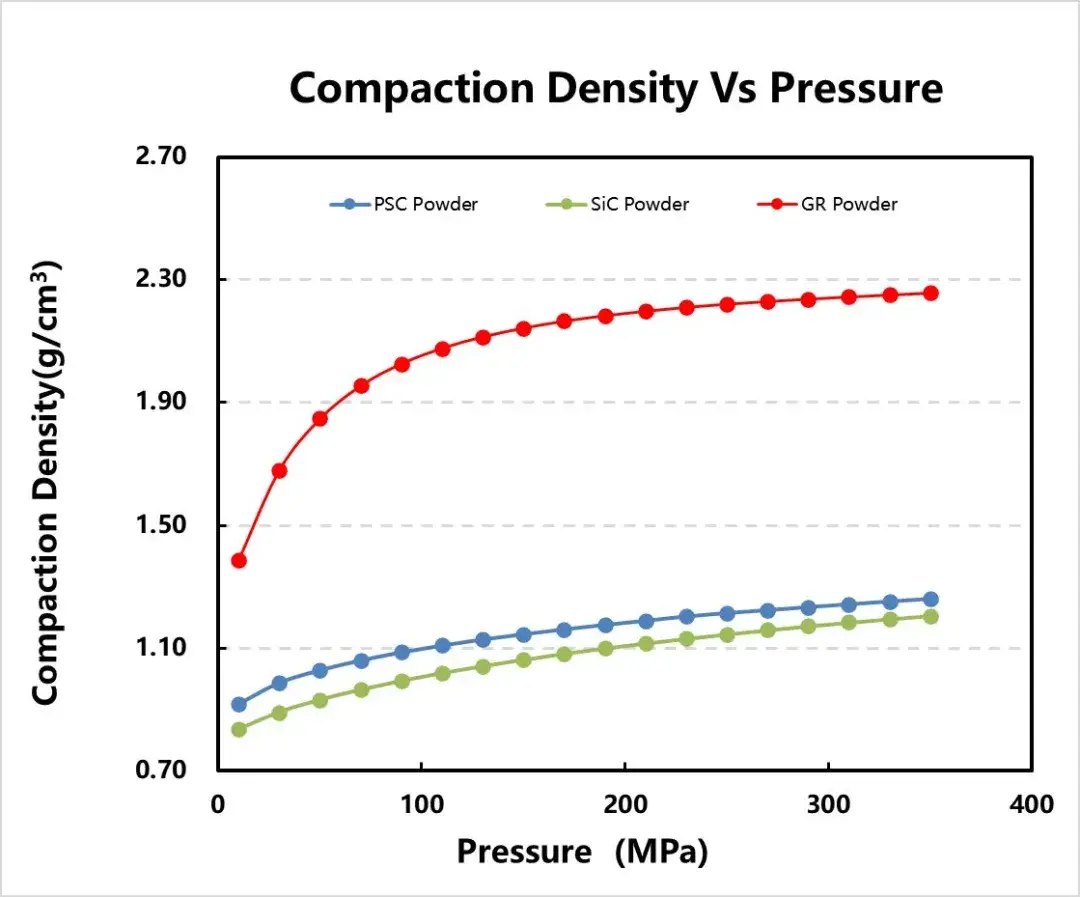
Figure 3. Compaction density vs applied pressure (10–350 MPa) for three powder samples: CVD silicon-carbon (PSC), milled silicon-carbon (SiC), and artificial graphite (GR). Graphite shows the highest compaction density; CVD silicon-carbon anode powder exceeds milled silicon-carbon.
In powder compression performance evaluation, the industry primarily focuses on thickness rebound after compression. At the same pressure or compaction density, a smaller thickness rebound indicates the material can deliver higher volumetric energy density and better forming ability during initial roll pressing. As shown in Figure 4, the thickness rebound of graphite is significantly higher than both silicon-based materials. Between the two silicon-based materials, CVD silicon-carbon anode powder exhibits a smaller rebound characteristic than milled silicon-carbon powder.
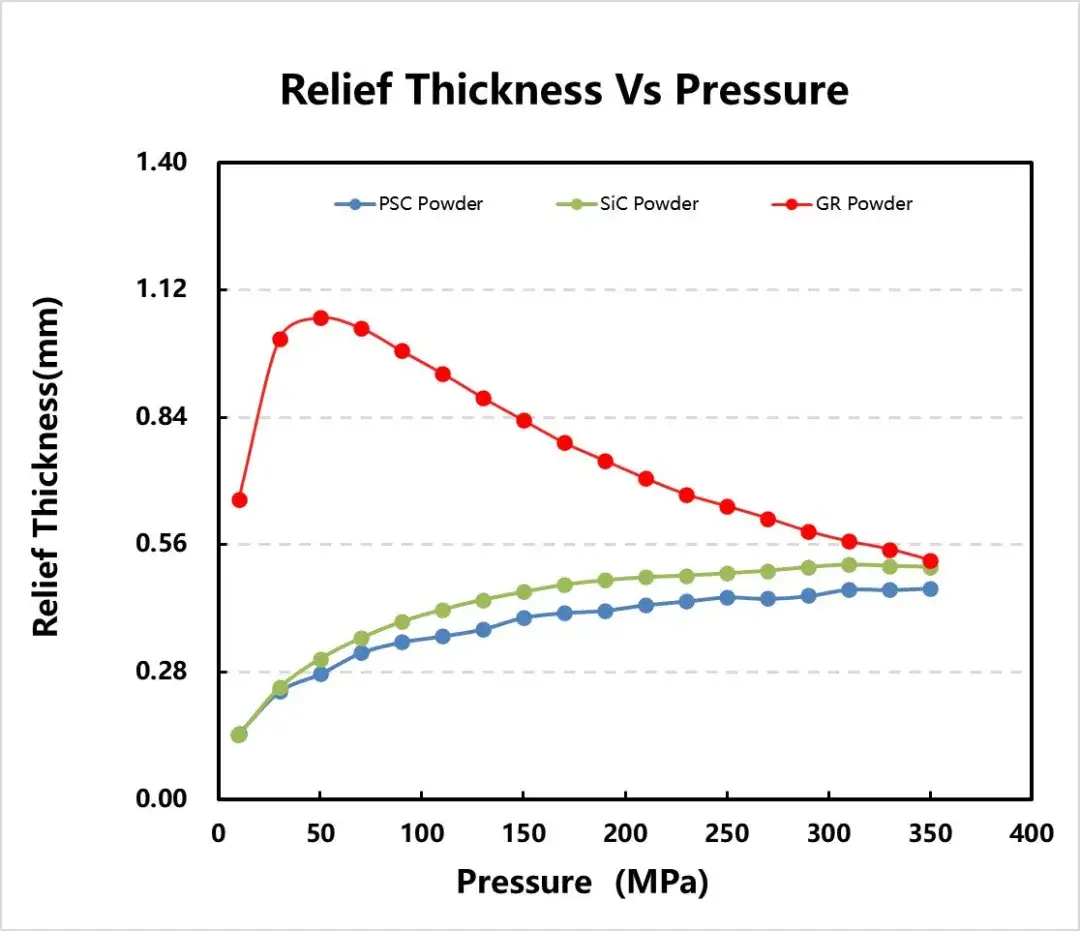
Figure 4. Thickness rebound curves for three powder samples — CVD silicon-carbon (PSC), milled silicon-carbon (SiC), and graphite (GR). Graphite shows the highest rebound; CVD silicon-carbon anode powder rebounds less than milled silicon-carbon.
| Material | Compaction Density (10–350 MPa) | Thickness Rebound | Microstructure | Mechanism |
|---|---|---|---|---|
| Graphite (GR) | Highest | Highest | Layered sp2 carbon | Interlayer sliding enables both high packing and large elastic recovery |
| CVD Silicon-Carbon (PSC) | Higher of the two Si-based materials | Lower of the two Si-based materials | Porous carbon framework with deposited Si nanoparticles | Pre-formed pores compress readily and resist springback |
| Milled Silicon-Carbon (SiC) | Lower of the two Si-based materials | Higher of the two Si-based materials | Mechanically milled Si-C composite particles | Irregular particle morphology limits packing and increases springback |
A comprehensive analysis of mechanical properties across CVD silicon-carbon (PSC), milled silicon-carbon (SiC), and conventional artificial graphite (GR) powders reveals that graphite exhibits both higher compaction density and greater thickness rebound. Among the two silicon-based materials, CVD silicon-carbon anode powder shows higher compaction density and smaller thickness rebound — a direct consequence of its microstructure. CVD silicon-carbon uses a porous carbon framework to host deposited silicon; during compression, the pores in this framework are more easily compressed and less likely to rebound after decompression, giving CVD silicon-carbon anode powder its characteristic combination of higher compaction density and lower thickness rebound compared to milled silicon-carbon.
Figure 5 shows the thickness rebound curves of electrode sheets made from graphite, and from CVD silicon-carbon anode materials with capacities of 450 mAh/g (PSC-450) and 550 mAh/g (PSC-550). Consistent with the powder-level results, the thickness rebound of graphite electrode sheets is significantly higher than that of the CVD silicon-carbon anode electrodes at the same pressure. Between PSC-450 and PSC-550, PSC-450 exhibits greater thickness rebound than PSC-550 — attributable to the higher proportion of graphite added during the mixing process for the lower-capacity formulation.
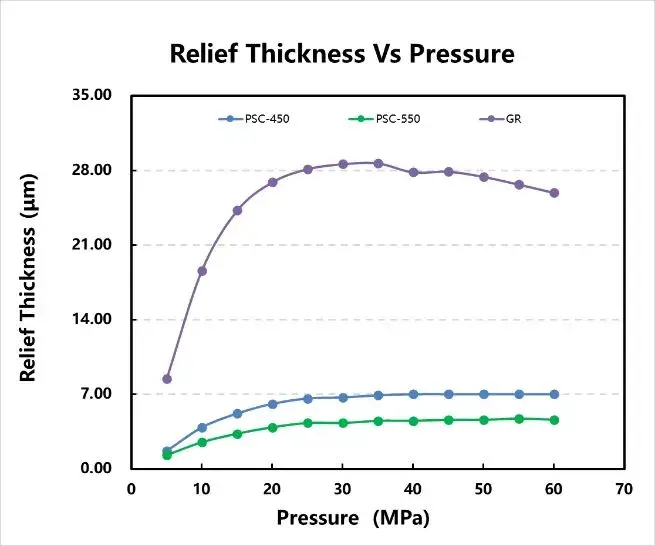
Figure 5. Thickness rebound curves for electrode sheets: graphite, CVD silicon-carbon anode PSC-450 (450 mAh/g), and PSC-550 (550 mAh/g). PSC-450 shows greater rebound than PSC-550 due to higher graphite blend ratio; both CVD silicon-carbon electrodes rebound less than graphite.
Among CVD silicon-carbon anode powder, milled silicon-carbon powder, and conventional artificial graphite, graphite consistently exhibits higher compaction density and greater thickness rebound across the tested pressure range. Among the two silicon-based materials, CVD silicon-carbon anode powder achieves higher compaction density and lower thickness rebound than milled silicon-carbon. This is primarily driven by the porous carbon framework in CVD silicon-carbon, where the pre-formed pores compress more readily and resist springback after decompression — yielding the characteristic combination of higher compaction density and lower thickness rebound for CVD silicon-carbon anode material.
The rebound performance of electrode sheets mirrors that of the powders, providing additional evidence that powder-level compaction density data reliably predicts electrode-level mechanical behavior. These experimental results offer new insight into improving the compaction density of CVD silicon-carbon anode materials, and provide a validated testing methodology for material companies developing and qualifying CVD silicon-carbon anode powder and electrodes.
CVD silicon-carbon anode (also called vapor-deposited silicon anode) is a silicon-based anode material made by storing silicon within a porous carbon framework. Silane gas is introduced into pre-formed pores of porous carbon particles, and high-temperature pyrolysis deposits silicon nanoparticles within those pores. This molecular-scale deposition control produces a uniform, relatively dense silicon-carbon composite where the porous carbon’s internal voids buffer silicon’s volume expansion during cycling. The term is most commonly associated with Group14’s SCC55™ product (55:45 carbon-silicon ratio), which entered commercial production in 2021 and offers roughly 5× the capacity of graphite with 50% higher energy density.
CVD silicon-carbon anode powder achieves higher compaction density than milled silicon-carbon because of its microstructure. In CVD silicon-carbon, silicon is deposited inside pre-formed pores of a porous carbon scaffold via silane gas pyrolysis — these pores compress readily under applied pressure during calendaring. Milled silicon-carbon, by contrast, is produced by mechanically grinding silicon and carbon into composite particles with irregular morphology, which packs less efficiently under the same pressure. Tested across 10–350 MPa using the IEST PRCD3100, CVD silicon-carbon anode powder consistently showed higher compaction density than milled silicon-carbon, though both remained below conventional artificial graphite.
Thickness rebound is the elastic springback of a calendared powder layer after compression pressure is released — the difference between thickness under load and thickness after pressure relief. A smaller thickness rebound indicates the material achieves higher volumetric energy density and better forming ability during the initial roll-pressing (calendaring) step, since the material retains more of its compressed density. For CVD silicon-carbon anode powder, the pre-formed pores in its carbon framework compress and largely stay compressed, producing lower rebound than milled silicon-carbon, whose irregular composite particle structure springs back more after decompression.
Yes. Electrode sheets calendared from graphite, CVD silicon-carbon at 450 mAh/g (PSC-450), and CVD silicon-carbon at 550 mAh/g (PSC-550) all showed thickness rebound trends consistent with the powder-level data: graphite electrodes rebounded significantly more than CVD silicon-carbon anode electrodes at the same pressure. Between the two CVD silicon-carbon formulations, PSC-450 showed greater rebound than PSC-550, attributable to its higher graphite blend ratio during mixing. This consistency between powder-level and electrode-level results validates that compaction density and rebound measurements on raw powder reliably predict the mechanical behavior of the final calendared electrode.
CVD silicon-carbon anode is considered more advantageous than the silicon-oxygen (SiOx) route on several fronts. The CVD process has a short production flow and requires minimal equipment, giving it theoretically lower manufacturing cost. CVD silicon-carbon anode material can also reduce the need for prelithiation and premagnesiation in production — both costly pretreatment steps commonly required for silicon-oxygen anodes to offset irreversible capacity loss. Combined with strong measured performance across specific capacity, initial efficiency, cycle life, and rate capability, and favorable mechanical properties including higher compaction density than milled silicon-carbon, CVD silicon-carbon is regarded as the most advantageous of the three major silicon-based anode technology routes — vapor-deposited (CVD), milled, and silicon-oxygen.