-
iestinstrument

Abstract
1. Why Coin Cell OCV Consistency Matters for Material Evaluation
Lithium-ion coin cells are commonly used for the preliminary electrochemical evaluation of new materials and new processes. By measuring specific capacity, median voltage, cycle life, and related indicators, researchers can quickly assess a material’s potential. However, small deviations introduced during assembly can cause the open-circuit voltage (OCV) to drop abnormally, which directly affects the resulting test conclusions. From the electrode (pole piece) to the separator, and from the electrolyte to the sealing step, an oversight at any stage can lead to an abnormal OCV. The following six categories of factors are worth checking in any laboratory.
Open-Circuit Voltage (OCV) refers to / is defined as the voltage measured across a battery’s terminals when no external current is flowing, typically recorded after an assembled cell has rested for a defined period; it is used as an early indicator of assembly quality and internal electrochemical state.
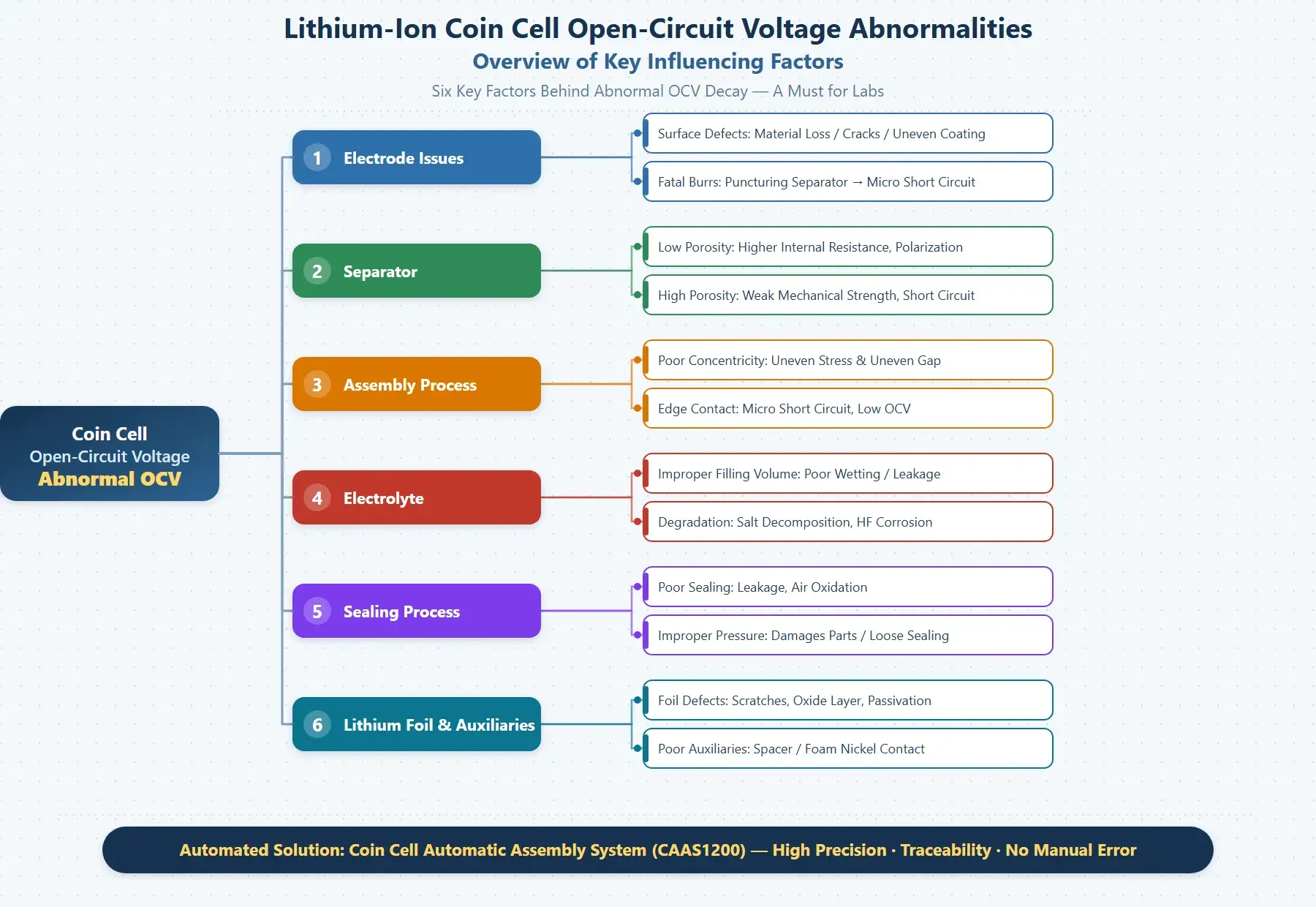
Figure 1. Overview of six coin cell assembly-related factors — electrode defects, separator porosity, assembly concentricity, electrolyte filling, sealing process, and lithium foil/auxiliary materials — that can cause open-circuit voltage (OCV) to drop in a lithium coin cell.
2. Six Key Factors Behind Abnormal OCV Drop
| FACTOR | ROOT CAUSE | EFFECT ON OCV |
|---|---|---|
| 1. Electrode (pole piece) defects | Surface flaking, cracking, uneven coating; die-cutting burrs | Uneven active material distribution; burrs can pierce the separator and cause a micro-short circuit |
| 2. Separator problems | Pore size too small or too large | Too small: higher internal resistance and polarization during resting. Too large: insufficient mechanical strength, prone to short circuits |
| 3. Assembly process (concentricity) | Poor concentricity between electrodes and casing; edge contact | Uneven electrode stress and inconsistent inter-electrode spacing; localized micro-short circuits and internal current loss |
| 4. Electrolyte problems | Insufficient or excessive filling volume; electrolyte degradation | Incomplete wetting/reaction, or leakage under sealing pressure; lithium salt decomposition and HF formation corrode electrodes |
| 5. Sealing process | Poor sealing tightness; excessive or insufficient sealing pressure | Electrolyte leakage or air ingress causing oxidation; excessive pressure damages electrodes/separator, causing micro-short circuits |
| 6. Lithium foil & auxiliary materials | Surface scratches, pits, oxide layer, uneven deposition; poor-quality gaskets or foam nickel | Increased internal resistance, reduced effective reaction area, poor contact |
2.1 Factor 1: Electrode Defects
Two distinct problems fall under this category. Visible surface defects — flaking, cracking, or uneven coating — create an uneven distribution of active material, which disrupts electrode integrity and hinders lithium-ion intercalation and deintercalation, lowering OCV. Separately, a dull die-cutting blade or poorly controlled cutting process can leave burrs on the electrode edge. During assembly or during the resting period that follows, these burrs can pierce the separator and create a micro-short circuit between the positive and negative electrodes, disrupting the cell’s internal potential balance.
Micro-Short Circuit refers to / is defined as a localized, low-current electrical contact between a coin cell’s positive and negative electrodes — commonly caused by an electrode burr piercing the separator or by edge contact during assembly — that discharges the cell internally and lowers its measured open-circuit voltage.
2.2 Factor 2: Separator Porosity
Separator pore size affects OCV in two opposing ways. When porosity is too small, lithium-ion transport is hindered and internal resistance increases; polarization that develops during the resting period gradually lowers OCV, and electrolyte wetting is also impaired. When porosity is too large, the separator’s mechanical strength is insufficient, making a short circuit more likely, which likewise affects OCV.
Separator Porosity refers to / is defined as the proportion of void volume within a battery separator available for electrolyte uptake and ion transport; porosity that is too low raises internal resistance and polarization, while porosity that is too high reduces the separator’s mechanical strength.
2.3 Factor 3: Assembly Concentricity and Alignment
When the cathode and anode electrodes are not well centered relative to the outer casing, the electrodes experience uneven mechanical stress and the inter-electrode spacing becomes inconsistent, producing an abnormal local electric field and an uneven lithium-ion distribution. Edge contact between electrodes arising from poor concentricity can also trigger micro-short circuits, causing part of the current to be lost internally and resulting in a lower OCV.
2.4 Factor 4: Electrolyte Filling Volume and Degradation
Electrolyte quantity must fall within a defined range. An insufficient filling volume leaves the electrode and separator inadequately wetted, so the electrode reaction is incomplete. An excessive filling volume raises internal pressure during sealing and makes leakage more likely. Electrolyte degradation is a separate but related concern: decomposition of the lithium salt reduces conductivity, and moisture reacting with the lithium salt generates hydrofluoric acid (HF), which corrodes the electrodes — both of which cause an abnormal OCV.
2.5 Factor 5: Sealing Process
Sealing quality affects OCV through two failure modes. Insufficient sealing tightness allows the electrolyte to leak and external air to enter, which oxidizes the electrolyte or the lithium metal anode and shifts the electrode potential. On the pressure side, excessive sealing pressure can damage the electrodes and separator, triggering micro-short circuits, while insufficient pressure results in inadequate sealing and poor internal contact — both of which lower OCV.
2.6 Factor 6: Lithium Foil and Auxiliary Materials
Surface scratches, pits, an oxide layer, or uneven lithium deposition on the lithium foil counter electrode increase internal resistance, reduce the effective reaction area, and allow a passivation layer to affect the electrode potential. Poor-quality auxiliary materials — gaskets, foam nickel, and similar components — can cause poor contact and increased internal resistance, both of which lower OCV.
Passivation Layer refers to / is defined as a surface oxide or reaction layer that forms on lithium foil on exposure to air or moisture, which reduces the foil’s effective reactive area and can alter the electrode potential of an assembled cell.
In summary, An abnormal drop in open-circuit voltage during the resting period after coin cell assembly is generally the result of several factors acting together, including the surface appearance and quality of internal materials, assembly concentricity, and sealing pressure. Reducing OCV drop during coin cell fabrication therefore requires optimization across material selection, electrode preparation, and assembly process, with strict control at every step to ensure the resulting cell’s quality and performance.
3. Addressing Assembly Variability: The IEST CAAS1200 Automated Coin Cell Assembly System
The IEST CAAS1200 replaces several of the manual assembly steps described above with robotic and vision-guided control, targeting the concentricity, sealing, and electrolyte-dosing factors identified in Sections 2.3–2.5.
- Controlled-atmosphere environment: water and oxygen content inside the glovebox is kept below 0.1 ppm, reducing environmental interference during assembly.
- High-Precision Assembly: Robotic arm ensures a concentricity of ±0.2 mm, with real-time visual inspection for immediate error correction.
- Advanced Sealing Technology: Dual-control mechanism for both crimping pressure and thickness, ensuring superior consistency.
- Curled Electrode Solution: Custom-designed suction pads securely handle curled electrodes — solving a long-standing industry challenge.
- Precise Electrolyte Dispensing: Achieves ±2 µL metering accuracy, eliminating manual uncertainties.
Additional system specifications and customization are available on request from IEST Instrument’s customer service team.
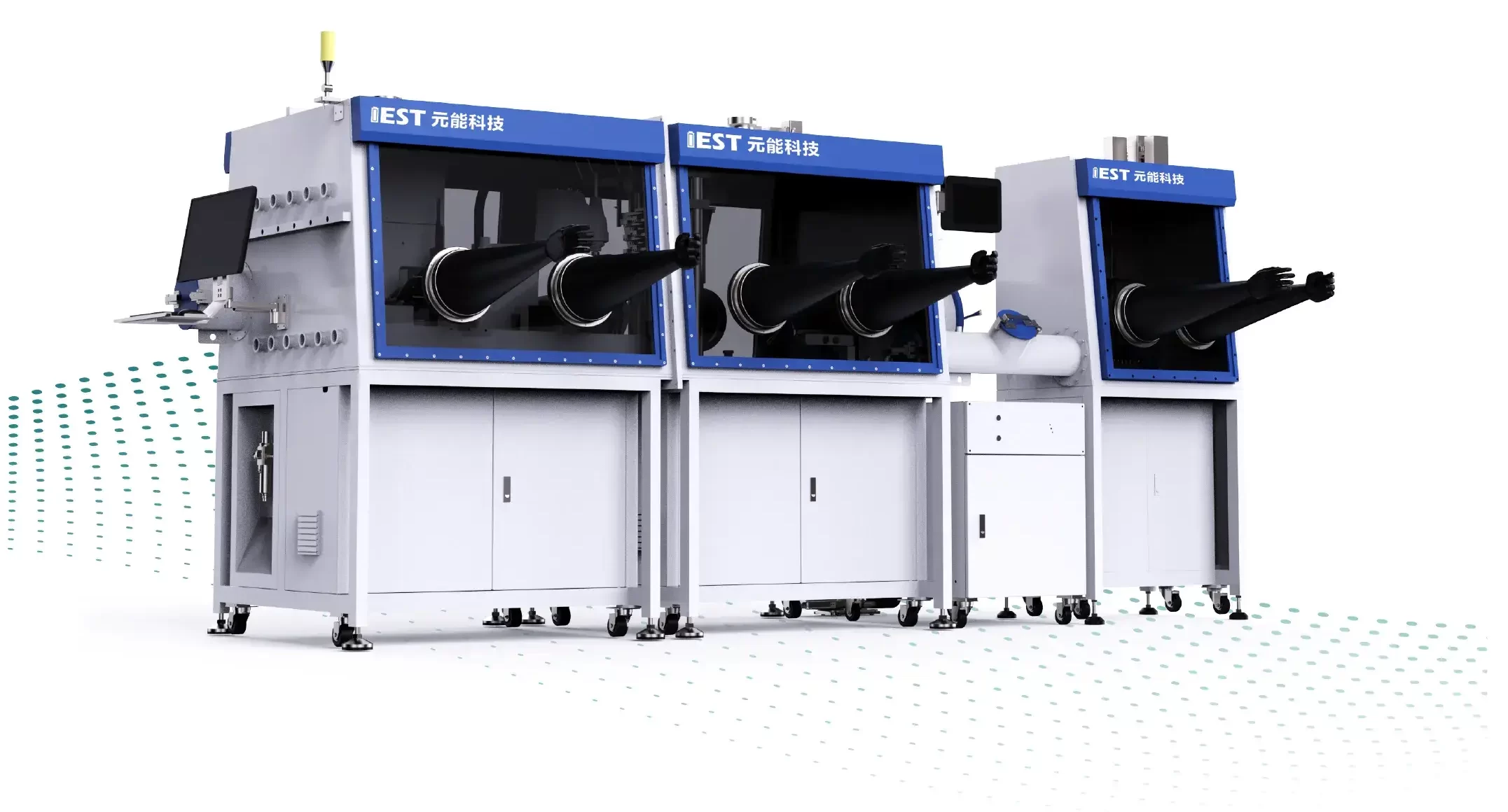
Figure 2. The IEST Automatic Coin Cell Assembly System (CAAS1200), integrating a controlled-atmosphere glovebox, robotic assembly arms, and vision-guided electrode alignment.
4. Validation: OCV Consistency Across 200 LFP Coin Half-Cells
LiFePO4 (LFP) coin half-cells assembled using the CAAS1200 automated coin cell assembly system were tested across 5 groups of 40 cells each (200 cells total). The resulting OCV values fell between 3.24 V and 3.28 V across all five groups, indicating that the open-circuit voltage results were consistent and stable across this sample set.
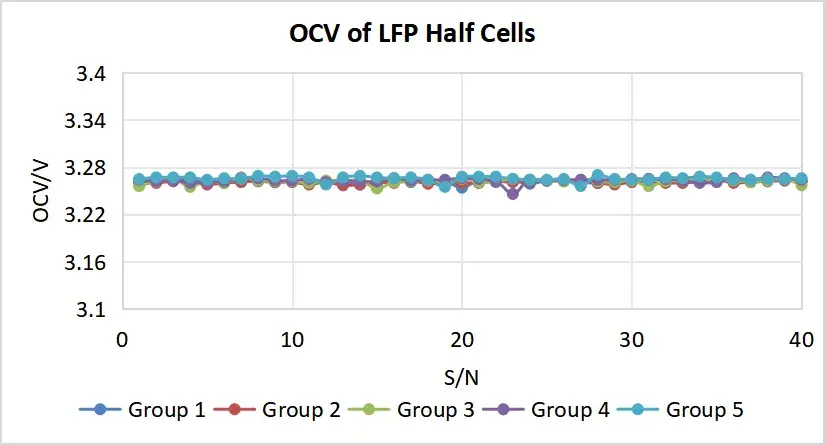
Figure 3. Open-circuit voltage (OCV) of LiFePO4 (LFP) coin half-cells assembled using the IEST CAAS1200 automated coin cell assembly machine, across 5 test groups of 40 cells each (200 cells total), with OCV values falling between 3.24 V and 3.28 V.
5. Summary
IEST Automatic Coin Cell Assembly Machine(CAAS1200) uses a high-precision robotic arm, a vision-based inspection system, and an automated sealing unit to perform automated, high-precision coin cell assembly with stable sealing pressure. The system addresses the industry-wide difficulty of handling curled electrodes, and provides real-time process monitoring along with material and process traceability. It is applicable to the systematic electrochemical evaluation of cathode and anode materials for the lithium (and sodium) battery industry.
🔬 Evaluating a Coin Cell Assembly Process for Consistent OCV?
The IEST CAAS1200 combines glovebox atmosphere control, robotic concentricity alignment, dual-parameter sealing, and precision electrolyte dosing in one automated system. Contact IEST Instrument’s engineering team for the full product specification sheet and to discuss your material or throughput requirements.
6. FAQs
6.1 What is open-circuit voltage (OCV) in a lithium-ion coin cell?
OCV is the voltage measured across a coin cell’s terminals with no current flowing, typically read after the cell has rested following assembly. It reflects the electrochemical state established during assembly, and an abnormally low OCV signals a defect in the electrodes, separator, electrolyte, or sealing.
6.2 What is the difference between electrode burrs and separator porosity as OCV drop causes?
An electrode burr is a physical defect from die-cutting that can pierce the separator and create a direct micro-short circuit between electrodes. Separator porosity that is too small or too large is a material property issue: it raises internal resistance and polarization, or lowers mechanical strength, without necessarily causing a direct short.
6.3 How do I choose between manual and automated coin cell assembly to control OCV consistency?
Manual assembly depends on operator skill for concentricity, sealing pressure, and electrolyte dosing, which can introduce batch-to-batch OCV variation. Automated coin cell assembly systems such as the IEST CAAS1200 hold concentricity to ±0.2 mm and electrolyte dosing to ±2 μL, which is better suited to laboratories that need repeatable OCV results across large sample sets.
6.4 What OCV range is acceptable for LFP coin half-cells?
In testing referenced in this article, 200 LFP coin half-cells assembled on the IEST CAAS1200 across 5 groups of 40 cells produced OCV values between 3.24 V and 3.28 V. Values falling well outside this kind of narrow band across a batch may indicate an assembly defect such as those described in Sections 2.1–2.6.
6.5 How does sealing pressure affect coin cell OCV stability?
Sealing pressure that is too high can damage the electrodes or separator and trigger a micro-short circuit, while pressure that is too low leaves the cell poorly sealed with inadequate internal contact. Both outcomes lower OCV, which is why dual control of pressure and casing thickness is used in automated sealing.