
Electrode tortuosity quantifies the geometric complexity of ion transport pathways within a battery electrode’s pore network—defined as the ratio of the actual lithium-ion migration distance through the pores to the straight-line electrode thickness. Higher tortuosity means longer, more convoluted pathways and greater resistance to ion transport. The MacMullin number (Nm = τ/ε, tortuosity divided by porosity) provides a directly measurable equivalent derived from EIS-measured electrode ionic resistance in a symmetric cell, without requiring separate porosity measurement. This study measures how electrode tortuosity and the MacMullin number of a graphite anode change from 25 °C to 80 °C using the IEST EIC2400M-T multi-channel ionic conductivity tester. Key finding: the MacMullin number decreases 27.3% from 25 °C (18.58) to 45 °C (13.50) as electrolyte viscosity drops, then plateaus at 60 °C and 80 °C because structural degradation—binder softening and differential thermal expansion—offsets the viscosity-driven transport improvement. This competing mechanism has direct implications for high-temperature electrode design and electrolyte optimization.
Electrode tortuosity is a key parameter that quantifies the complexity of internal ion transport pathways within an electrode. It characterizes the ratio of the actual migration path of lithium ions through the pore network to the theoretical straight-line distance. Research confirms a direct correlation between electrode tortuosity and battery rate performance and cycle life: lower tortuosity means more efficient ion transport, enhancing fast-charging capability. Conversely, excessively high or unstable tortuosity increases polarization, accelerates capacity fade, and degrades cycle stability.
Temperature is a critical environmental variable that affects electrode tortuosity through two competing mechanisms. First, rising temperature reduces electrolyte viscosity, which—per the Stokes–Einstein relation—lowers ionic resistance and improves ion mobility through the pore network. Second, elevated temperature can degrade electrode microstructure: polymer binder chains soften, pore geometry changes, and differential thermal expansion between the active material coating and the current collector can cause delamination. Understanding the temperature–tortuosity relationship therefore provides both theoretical guidance for electrolyte formulation and a practical method for rapidly assessing electrode thermal stability.
Electrode tortuosity was measured using the IEST multi-channel ionic conductivity test system (EIC2400M-T), shown in Figure 1. The system provides:
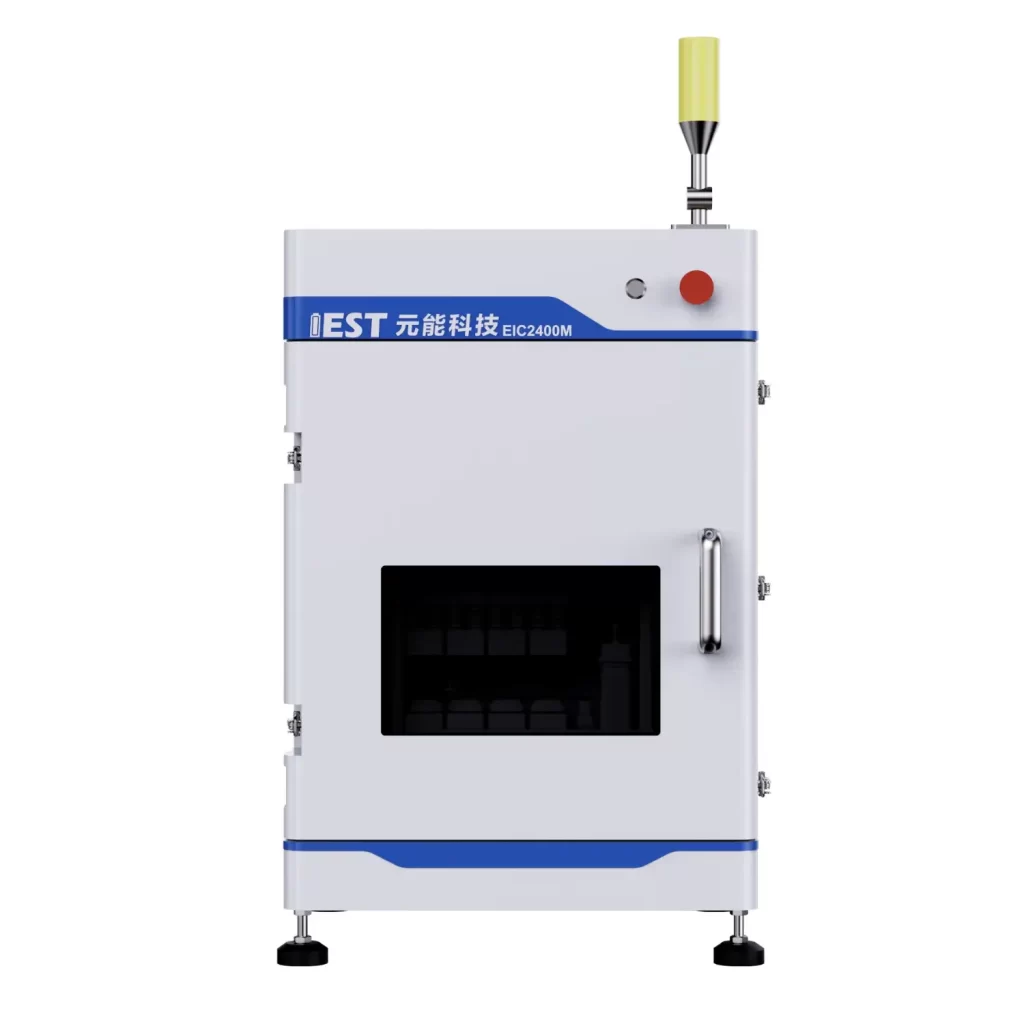
Figure 1. IEST EIC2400M-T multi-channel ionic conductivity and electrode tortuosity test system — four independent temperature-controlled channels (10–80 °C), simultaneous EIS, 100 kHz–0.01 Hz frequency range
Graphite negative electrode sheets (graphite anode).
Symmetric cells were assembled in the fixture sequence: electrode → separator → electrode → chamber sealed → quantitative electrolyte injected into each channel → wetting period completed → EIS data automatically collected by software → tortuosity derived by fitting and calculation.
MacMullin Number Calculation Method:
\[
\tau = \frac{R_{ion} \cdot A \cdot \varepsilon \cdot \sigma}{d} \tag{1}
\]
\[
N_m = \frac{\tau}{\varepsilon} = \frac{R_{ion} \cdot A \cdot \sigma}{d} \tag{2}
\]
Where: \(\tau\) = tortuosity; \(R_{ion}\) = ionic resistance (\(\Omega\)) from EIS; \(A\) = electrode area (cm²); \(\varepsilon\) = electrode porosity; \(\sigma\) = electrolyte conductivity (S/cm); \(d\) = electrode thickness (cm).
To extract \(R_{ion}\) from the Nyquist plot (Figure 2): extend the low-frequency segment until it intersects the real axis; subtract the high-frequency real-axis intercept; multiply by three. This difference—3× the separation of the two real-axis intercepts—equals the electrode ionic resistance of the coating. Substituting \(R_{ion}\) into the equation above yields the MacMullin number and thus characterizes electrode tortuosity at each temperature.
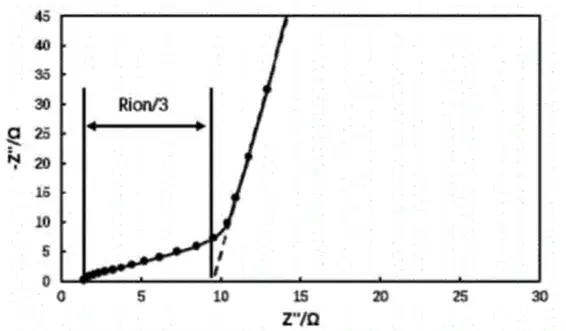
Figure 2. Nyquist plot of a symmetric cell EIS spectrum
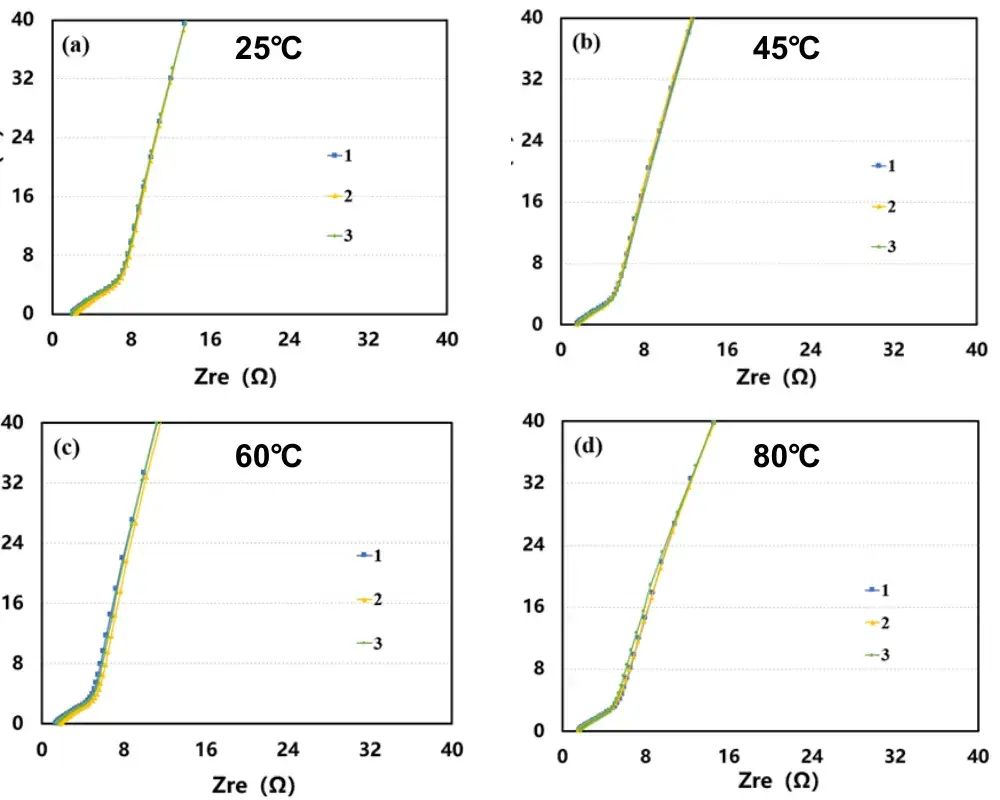
Figure 3. EIS spectra at (a) 25 °C, (b) 45 °C, (c) 60 °C, (d) 80 °C — arc compression reflects decreasing ionic resistance; MacMullin number derived from each spectrum
| Metric | 25°C | 45°C | 60°C | 80°C |
|---|---|---|---|---|
| Electrolyte conductivity / mS·mm-1 | 1.090 | 1.090 | 1.090 | 1.090 |
| Foil thickness / µm | 9.0 | 9.0 | 9.0 | 9.0 |
| Electrode total thickness / µm | 70 | 70 | 70 | 70 |
| Sample 1 (Rion) | 14.49 | 10.42 | 10.14 | 10.45 |
| Sample 1 (Nm) | 18.67 | 13.42 | 13.06 | 13.46 |
| Sample 2 (Rion) | 14.37 | 10.64 | 10.60 | 10.47 |
| Sample 2 (Nm) | 18.51 | 13.71 | 13.65 | 13.49 |
| Sample 3 (Rion) | 14.42 | 10.38 | 10.75 | 9.98 |
| Sample 3 (Nm) | 18.58 | 13.37 | 13.85 | 12.86 |
| Nm-Average | 18.58 | 13.50 | 13.52 | 13.27 |
| COV | 0.34% | 1.09% | 2.47% | 2.20% |
Fitting the EIS spectra at each temperature yields the ionic resistance values and corresponding MacMullin numbers shown in Table 1. Two clear regimes emerge:
25 °C → 45 °C: substantial improvement. The MacMullin number drops from 18.58 to 13.50—a decrease of 27.34%—reflecting a major reduction in electrode ionic resistance. The dominant mechanism is the temperature effect on electrolyte conductivity: as temperature rises, electrolyte viscosity decreases. Per the Stokes–Einstein relation, ion migration rate is inversely proportional to viscosity, so lower viscosity increases lithium-ion mobility and reduces the resistance of ion transport through the electrode pore network.
45 °C → 80 °C: near-plateau behavior. Further temperature increases produce almost no additional MacMullin number reduction (−0.14% at 60 °C; +1.7% at 80 °C). Despite continued electrolyte viscosity reduction at higher temperatures, two structural degradation mechanisms counteract the transport benefit:
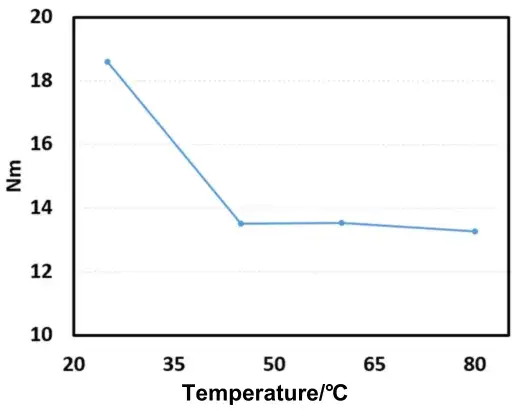
Figure 4. Line Chart of MacMullin Number Changes at Different Temperatures
This competing mechanism demonstrates that electrolyte viscosity optimization alone cannot overcome high-temperature performance limits. Electrode thermal stability— specifically binder thermal resistance and coating adhesion to the current collector—must be addressed in parallel.
Temperature significantly affects electrode ionic resistance and MacMullin number in graphite anodes, but the relationship is non-linear. The transition from a steep improvement regime (25–45 °C) to a plateau (45–80 °C) provides two actionable engineering insights:
Tortuosity testing across a temperature range provides a rapid, non-destructive method for ranking electrode thermal stability: materials whose MacMullin number continues to fall above 45 °C have better thermal structural stability than those that plateau or increase early.
Electrode tortuosity (τ) is a dimensionless parameter that describes how much longer the actual ion migration path through an electrode’s pore network is compared to the straight-line electrode thickness. A tortuosity of 1 would mean perfectly straight pores; real electrodes have tortuosity values typically ranging from 2 to 10 or higher. Higher tortuosity means lithium ions must travel farther to traverse the electrode, increasing ion transport resistance. This directly affects rate capability (high tortuosity limits fast-charge performance), internal resistance (higher polarization at all charge/discharge rates), and cycle life (higher polarization accelerates degradation mechanisms such as lithium plating). Electrode tortuosity is therefore a critical design parameter for high-energy-density and fast-charging battery applications.
The MacMullin number (Nm) is defined as the ratio of electrode tortuosity to porosity: Nm = τ/ε. It is used in preference to tortuosity alone because it can be calculated directly from experimentally measured ionic resistance (Rion) using EIS of a symmetric cell, without requiring a separate porosity measurement—which is experimentally complex. The MacMullin number is proportional to ionic resistance: a higher Nm indicates greater resistance to ion transport through the electrode. In this study, the graphite anode MacMullin number decreased from 18.58 at 25 °C to 13.50 at 45 °C (−27.3%), then plateaued at higher temperatures, reflecting the competing effects of improved electrolyte conductivity and structural electrode degradation.
Temperature affects electrode ionic resistance through two competing mechanisms. The beneficial effect: rising temperature reduces electrolyte viscosity (the Stokes–Einstein relation), increasing lithium-ion mobility and lowering ionic resistance through the electrode pore network. The detrimental effect: elevated temperature degrades electrode microstructure—PVDF binder softens above ~60 °C causing pore collapse, and differential thermal expansion between the coating and current collector causes delamination. In this study on graphite anodes, the temperature effect on electrolyte conductivity dominates from 25 °C to 45 °C (MacMullin number drops 27.3%), but structural degradation counteracts further improvement above 45 °C, producing near-plateau behavior at 60 °C and 80 °C.
Electrode tortuosity is determined from the ionic resistance extracted from EIS of a symmetric cell—two identical electrode pieces separated by a separator and saturated with electrolyte, with no intercalation reaction occurring. On the Nyquist plot, the ionic resistance Rion of the electrode coating is determined as three times the difference between the low-frequency real-axis intercept and the high-frequency real-axis intercept. This Rion value is then substituted into the MacMullin number formula (Nm = Rion · A · ε · σ / d) to calculate the tortuosity-to-porosity ratio. The IEST EIC2400M-T system automates this process across four channels simultaneously, with independent temperature control (10–80 °C), enabling temperature-dependent tortuosity characterization in a single test sequence.
The near-plateau in MacMullin number above 45 °C means that reducing electrolyte viscosity further—by raising temperature or by choosing lower-viscosity electrolyte solvents—does not continue to improve ion transport in the electrode. This indicates that the limiting factor above 45 °C is electrode structural degradation, not electrolyte properties. For high-temperature battery design, this finding prioritizes three improvements: (1) binders with higher softening temperatures than standard PVDF (e.g., polyimide or cross-linked variants); (2) electrode manufacturing processes that improve coating-to-collector adhesion and resist delamination under thermal cycling; and (3) electrolyte additives that stabilize the electrode–electrolyte interface at elevated temperatures without excessively increasing viscosity.