-
iestinstrument


Abstract
📄 Source Paper
Research Teams: Prof. Dongliang Peng & Prof. Qingshui Xie (Xiamen University); Prof. Jun Lu (Zhejiang University); Argonne National Laboratory, USA
DOI: 10.1021/acsnano.5c00630
| Journal: ACS Nano, 2025, 19, 15886–15895
| Institutions: Xiamen University; Zhejiang University; Argonne National Laboratory
✓ IEST Instrument acknowledged — IEST In-Situ Battery Gassing Volume Analyzer (GVM2200) used in this research
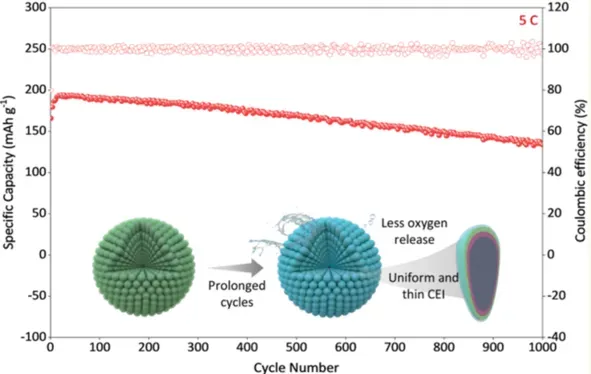
Figure 1. Surface anionic redox modulation strategy for stabilizing Li-rich cathodes and reducing oxygen loss.
1. Research Background: Why In-Situ Gas Evolution Monitoring Matters for Li-Rich Cathodes
Lithium-rich layered oxide (LLO) cathodes can deliver higher capacities than conventional commercial cathodes, making them important candidates for next-generation high-energy-density lithium-ion batteries. However, their additional capacity is enabled in part by anionic oxygen-redox reactions, which can also be accompanied by irreversible lattice oxygen release.
Particularly during the initial charge-discharge process, excessive oxidation can trigger O₂ release, electrolyte oxidative decomposition, non-uniform cathode-electrolyte interphase (CEI) formation, and structural degradation. These processes can reduce first-cycle Coulombic efficiency, and contribute to capacity fading and voltage decay. Beyond conventional electrochemical testing and structural characterization, in-situ and quantitative monitoring of the volume change caused by cell gassing is an important method for evaluating lattice oxygen stability and interfacial stability of Li-rich cathode materials.
2. The Role of GVM2200 in Quantifying Initial Gas Evolution
This study employed a dual-reductive-gas interfacial co-treatment to construct a composite surface structure on Li-Rich Cathode particles that combined protective and regulatory functions. The protective layer limited direct electrode/electrolyte contact, suppressing side reactions. In addition, the reversible SO₃²⁻/SO₄²⁻ redox couple participated in the electrochemical reaction, mitigating the oxygen-centered octahedral distortion and structural degradation caused by over-oxidation.
Differential Electrochemical Mass Spectrometry (DEMS) showed that the surface-modified AS-LLO cathode released significantly less O₂ during initial cycling than pristine LLO (Figure 2a). The IEST GVM2200 was used to record real-time volume-change curves for LLO and AS-LLO pouch cells during initial cycling (Figure 2b). The mass-normalized volume change of the AS-LLO pouch cell was significantly smaller than that of the pristine LLO cell. Together, the DEMS and GVM2200 measurements indicated reduced initial gas evolution in the AS-LLO system.
Compared with observing gas release or cycling performance alone, the GVM2200 more directly and intuitively reflected the impact of Li-rich cathode oxygen release and interfacial side reactions on cell-level volume evolution. It provided compelling evidence for evaluating the safety and practical viability of Li-Rich Cathodes.
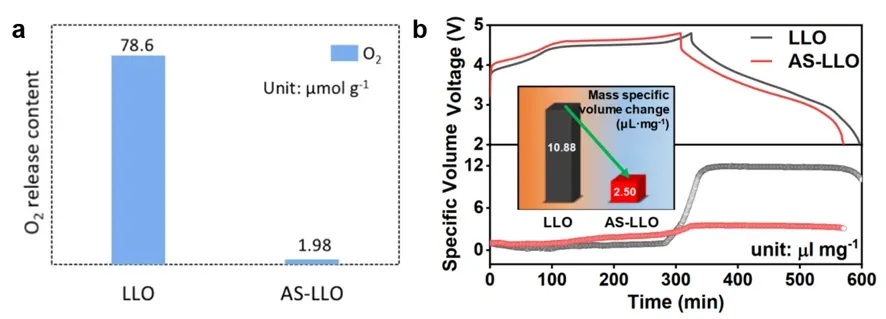
Figure 2. Surface modulation suppresses oxygen release and cell volume change in Li-rich cathodes.
3. IEST GVM2200: Applications in Li-Rich Cathode Research
The GVM2200 In-Situ Battery Gassing Volume Analyzer (Figure 3) is based on the Archimedes buoyancy principle and uses high-precision sensors to monitor cell volume change in real time. The volume-time data provided quantitative analysis of gassing behavior under various electrochemical and thermal conditions.
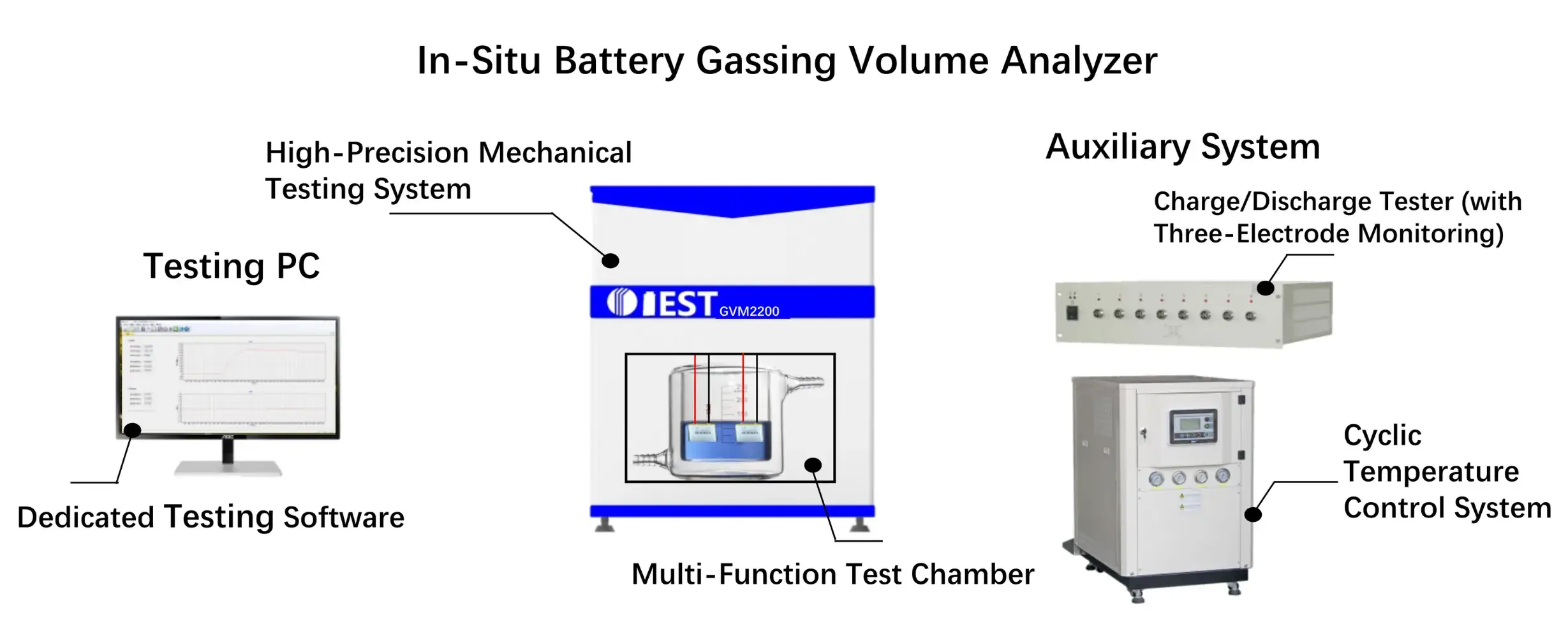
Figure 3. The IEST GVM2200 in-situ gas evolution volume monitoring instrument.
The GVM2200 is broadly applicable to gas evolution in batteries research across lithium-ion and emerging battery chemistries, including:
- Monitoring gassing-related volume change during initial activation of cathode materials.
- Evaluating interfacial side reactions and gassing behavior in high-voltage cathode systems.
- Comparing the gassing response of different surface coating, doping, or structural modification strategies.
- Investigating the effects of electrolyte formulations, additives, and interphase-forming systems on cell gassing.
- Monitoring cell-volume changes under high-temperature storage, overcharge, cycling aging, and other stress conditions.
- Supporting material screening, pouch-cell testing, and engineering validation.
4. Summary
This study demonstrated that a dual-reductive-gas interfacial co-treatment strategy can effectively regulate surface anionic redox chemistry in Li-Rich Cathodes, reducing irreversible oxygen release during initial cycling and improving cycling stability. The IEST GVM2200 continuously monitored and quantified the corresponding difference in pouch cell volume change between pristine LLO and surface-modified AS-LLO.
From “oxygen release mechanism analysis” to “cell-level volume change validation,” the GVM2200 provides a powerful in-situ characterization tool for gas evolution research, safety evaluation, and engineering development of high-energy-density cathode materials.
5. FAQs
5.1 What causes initial oxygen release during the first cycle of a Li-rich cathode?
Initial oxygen release during the first cycle of Li-rich cathodes occurs because the high capacity of lithium-rich layered oxide materials derives largely from anionic (lattice oxygen) redox reactions rather than transition-metal redox alone. During initial charging, over-oxidation of the lattice oxygen can trigger irreversible O₂ release, which in turn drives electrolyte oxidative decomposition, non-uniform CEI film growth, and structural collapse near the particle surface. This cascade of effects is the primary reason Li-rich cathodes typically show lower first-cycle Coulombic efficiency than conventional transition-metal-redox cathodes, and why controlling this initial gassing event is critical for practical cell safety and performance.
5.2 How does in-situ gas evolution monitoring for Li-rich cathodes work?
In-situ gas evolution monitoring for Li-rich cathodes, as performed with the IEST GVM2200, uses the Archimedes buoyancy principle combined with high-precision sensors to continuously track the volume of a pouch cell in real time as it cycles. As internal gas is generated from oxygen release and electrolyte side reactions, the cell’s measured volume increases proportionally, providing a direct, quantitative, mass-normalized readout of gassing severity without requiring cell disassembly. This complements gas-composition techniques such as DEMS (differential electrochemical mass spectrometry), which identifies which gases are produced, by directly quantifying the net physical consequence — cell swelling — that determines practical safety and pack-level design margins.
5.3 How does surface modification achieve oxygen release suppression in Li-rich layered oxides?
Oxygen release suppression in Li-rich layered oxides was achieved in this study through a dual-reductive-gas interfacial co-treatment that builds a composite surface structure on both the secondary particle exterior and internal primary particle surfaces. This structure combines an amorphous transition-metal sulfate/sulfite protective layer, an in-situ spinel transition layer, and engineered defect structures. The protective layer physically reduces direct electrode/electrolyte contact to suppress side reactions, while a reversible SO₃²⁻/SO₄²⁻ redox couple participates in the electrochemical reaction, buffering the oxygen-centered octahedral distortion that would otherwise drive lattice collapse under over-oxidation. Together, these mechanisms modulate the surface anionic redox chemistry to make oxygen redox substantially more reversible.
5.4 Why is pouch cell volume change a better safety indicator than DEMS gas composition data alone?
DEMS (differential electrochemical mass spectrometry) identifies which specific gas species — such as O₂ — are released and in what relative quantity, providing crucial mechanistic insight into the chemistry. However, DEMS alone does not directly quantify the physical consequence that matters most for practical cell safety and pack design: how much the cell swells. In-situ pouch cell volume change monitoring, such as with the IEST GVM2200, translates material-level chemistry improvements directly into a cell-level physical metric that engineers can use for safety margins, pack clamping design, and swelling-related failure prediction. In this study, combining DEMS (showing reduced O₂ release) with GVM2200 (showing reduced mass-normalized volume change) provided complementary mechanistic and practical evidence for the AS-LLO cathode’s improved interfacial stability.
6.5 What other applications does the GVM2200 support beyond Li-rich cathode research?
Beyond Li-rich cathode initial oxygen release studies, the GVM2200 in-situ gas evolution monitoring instrument supports a broad range of battery gassing research, including interfacial side-reaction and gassing evaluation for high-voltage cathode materials generally; comparative assessment of different surface coating, doping, or structural modification strategies for gassing suppression; analysis of how electrolyte formulations, additives, and SEI/CEI film-forming systems affect cell gassing behavior; in-situ volume-change monitoring under high-temperature storage, overcharge, and cycling aging conditions; and safety evaluation spanning material-level screening through pouch-cell-level and engineering-validation-stage testing.