-
iestinstrument

Abstract
1. Background: Why NCM Cathode Particles Crack at High Voltage
In lithium-ion batteries, the cathode active material undergoes cyclic volumetric changes during charge and discharge. For polycrystalline NCM (LiNixCoyMnzO₂) cathodes, lithium deintercalation induced lattice strain and particle fracture is a well-documented degradation pathway: as lithium ions are extracted during charging, the unit cell contracts anisotropically — the c-axis expands abruptly near full delithiation while the a-axis shrinks — creating grain-boundary stress mismatches within the polycrystalline aggregate. These stresses nucleate microcracks along grain boundaries and, over repeated cycles, coalesce into macroscopic cracks that electrically isolate grains, expose fresh surfaces to electrolyte, and accelerate capacity fade through continuous side-reaction consumption of active lithium[1].
Why NCM cathode particles crack at high voltage can be traced to three converging factors: (1) the magnitude of lattice strain peaks near full delithiation; (2) the anisotropy of strain creates shear stresses at grain boundaries that are not present at low SOC; and (3) the cumulative nature of the damage — each cycle nucleates new microcracks that do not heal. Cathode particle pulverization during high-voltage cycling is therefore not a single-event failure but a progressive degradation that accelerates as the crack network densifies.
Despite the central role of particle fracture in NCM cathode degradation, direct quantitative measurement of how particle strength varies with SOC has been limited. This study addresses that gap by systematically investigates the mechanical behavior of polycrystalline NCM cathode particles at different states of charge (SOC), revealing that the crushing strength decreases monotonically with increasing SOC, with a significant reduction in magnitude, and that the failure mode progressively transitions from brittle transgranular fracture to gradual intergranular damage.
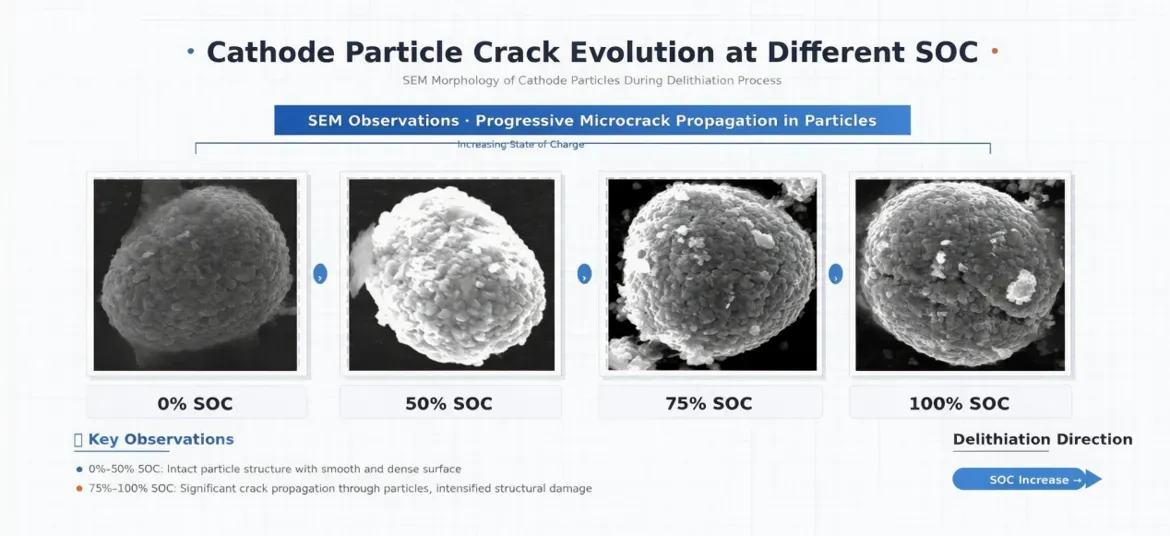
Figure 1. SEM images of NCM cathode particles at four SOC levels. Surface cracking becomes visually apparent above 50% SOC with extensive particle fragmentation visible at 100% SOC.
2. Experimental Equipment and Method
2.1 Test Equipment: IEST SPFT2000
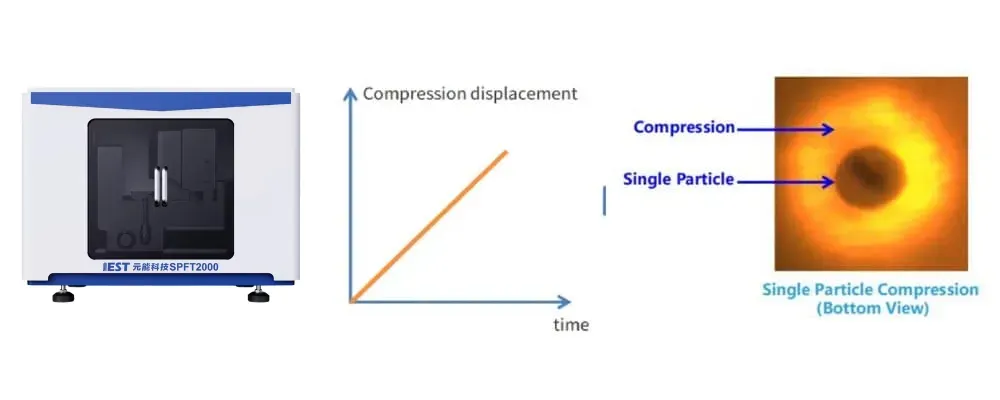
Figure 2. IEST SPFT2000 Single-Particle Mechanical Testing System: (a) instrument appearance, (b) compression test mode — particle positioned between flat indenters with force and displacement recorded simultaneously, (c) optical bottom-view imaging system (1200× magnification) for particle centering and diameter verification.
| Parameter | IEST SPFT2000 Specification | Relevance to This Study |
|---|---|---|
| Force Range (Dual) | 0–100 mN / 0–500 mN | Covers full NCM particle fracture force range (~0.1–20 mN) across all SOC levels |
| Force Accuracy | ±0.01 mN (low range) ±0.05 mN (high range) |
Enables reliable detection of the ~90% strength reduction from 0% to 100% SOC |
| Displacement Resolution | 10 nm | Captures subtle pre-fracture deformation differences between SOC levels |
| Optical Magnification | 1200× | Verifies particle morphology, surface integrity, and diameter (~10 μm) before each test |
| Test Mode | Displacement-controlled compression | Ensures consistent loading rate across all SOC groups for valid comparison |
| Standard Compliance | GB/T 43091-2023 | Provides standardized methodology for inter-laboratory reproducibility |
2.2 Test Method
- Cell preparation: Four cells from the same production batch were precisely adjusted to 0%, 50%, 75%, and 100% SOC respectively.
- Powder extraction: Cells were disassembled in a dry room; cathode active material was carefully removed from the electrode surface; powders were stored under inert atmosphere throughout.
- Testing protocol: For each SOC group, ≥10 intact particles of ~10 μm diameter were randomly selected. Each particle was individually compressed using the IEST SPFT2000 in displacement-controlled mode until fracture. Force-displacement curves were recorded and crushing strength was calculated.
3. Results and Analysis
3.1 Crushing Morphology: Transgranular → Intergranular → Pulverization
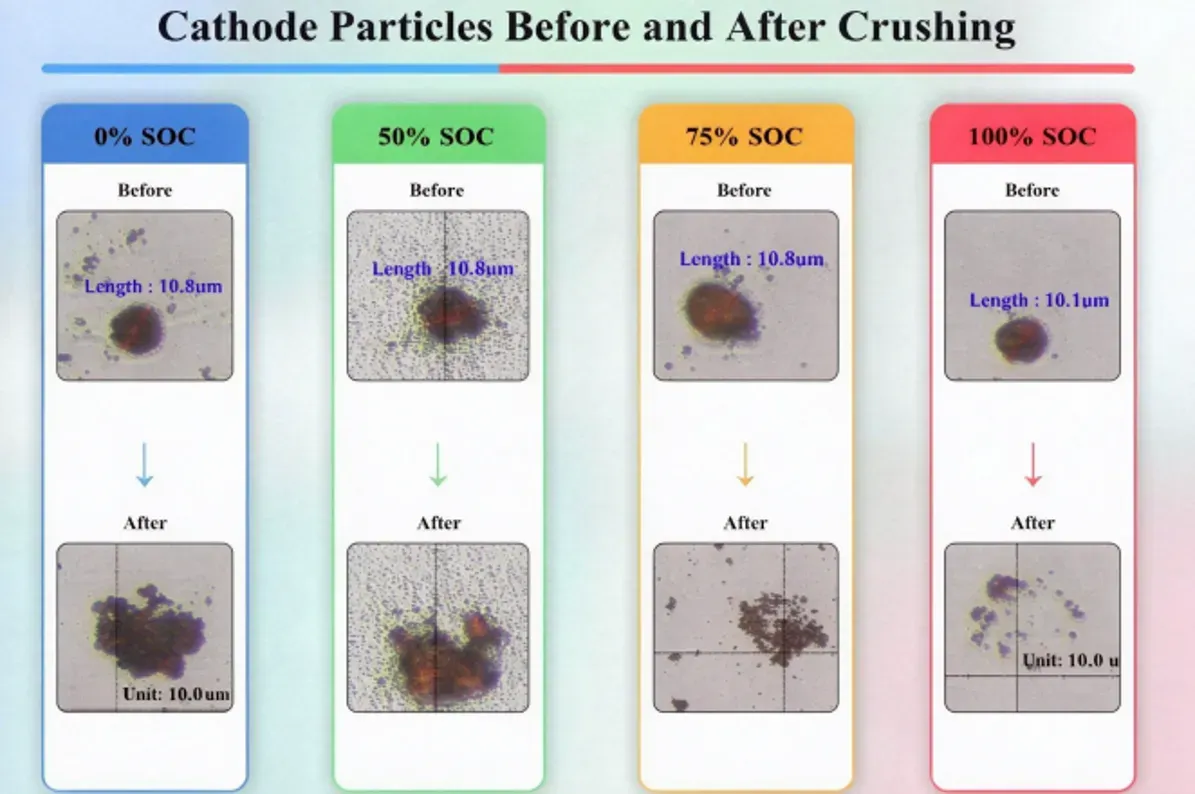
Figure 3. Pre- and post-crushing morphology across SOC levels. The fracture mode shifts systematically from clean transgranular cleavage (0% SOC) to grain-boundary-dominated intergranular fracture (50%–75% SOC) to complete pulverization (100% SOC).
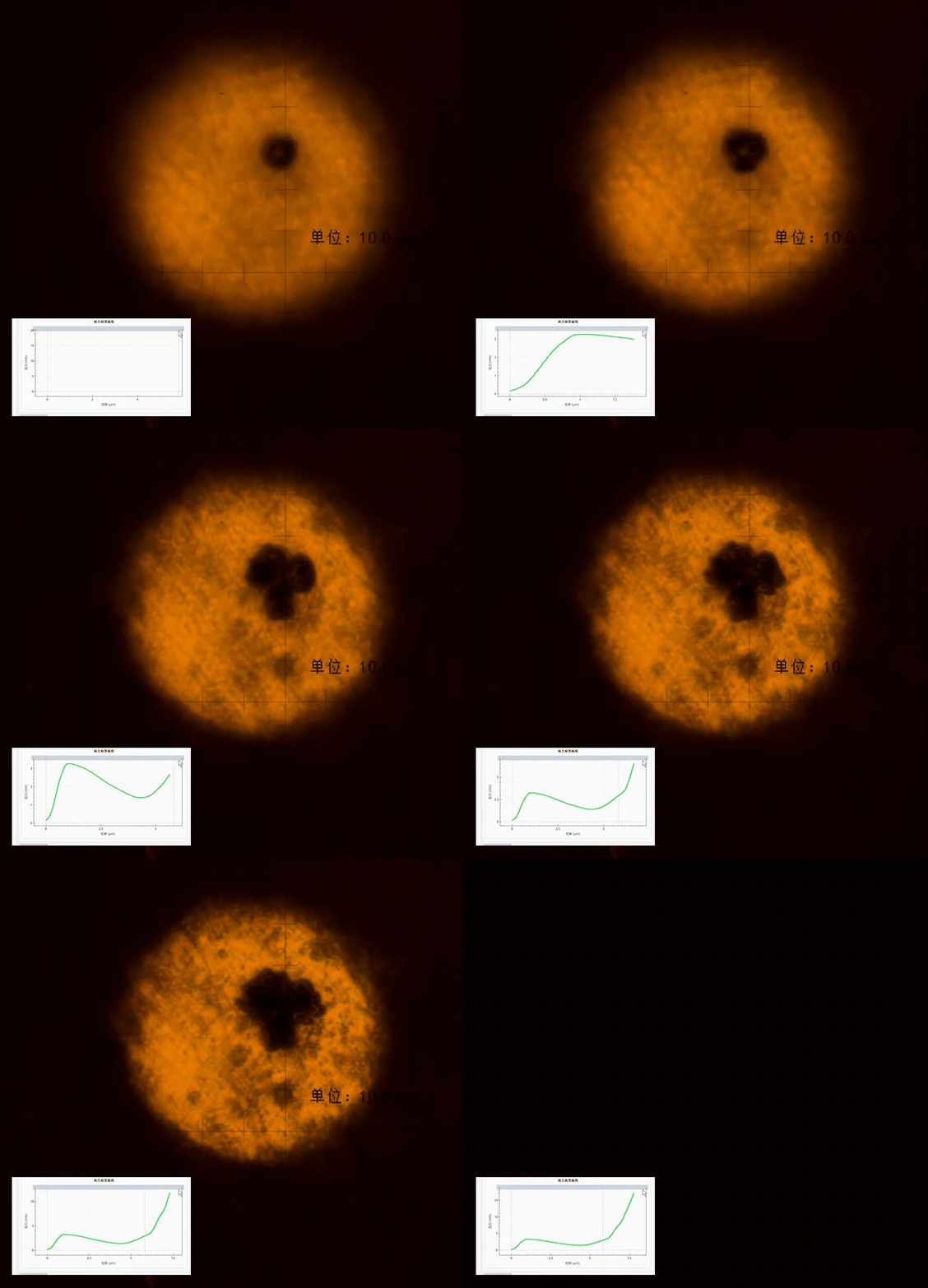
Video of instantaneous brittle fragmentation and crushing of particles
Post-crushing SEM analysis reveals a clear, SOC-dependent fracture mode transition:
| SOC Level | Fracture Mode | Fragment Characteristics | Underlying Mechanism |
|---|---|---|---|
| 0% SOC | Transgranular (brittle cleavage) |
Angular blocky fragments; sharp edges; minimal fines; no grain-boundary separation | Lattice fully lithiated — minimal internal stress; particle behaves as a monolithic brittle solid; fracture propagates through grains rather than along boundaries |
| 50% SOC | Mixed transgranular + intergranular | Combination of blocky fragments and finer debris; initial grain-boundary decohesion visible | Moderate anisotropic strain begins nucleating grain-boundary microcracks; fracture path now partially follows weakened boundaries |
| 75% SOC | Predominantly intergranular | Significantly refined fragment size; extensive grain-boundary separation; few intact grain clusters | High anisotropic strain; grain boundaries substantially weakened; crack propagation follows boundary network rather than transgranular paths |
| 100% SOC | Complete pulverization | Submicron to nano-scale powder; no recognizable grain structure; particle loses all mechanical integrity | Maximum lattice contraction; surface reconstruction layer creates severe lattice mismatch with interior; pre-existing cracks fully opened — particle offers negligible resistance to external compression |
3.2 Quantitative Crushing Strength: 40 MPa → 3.8 MPa
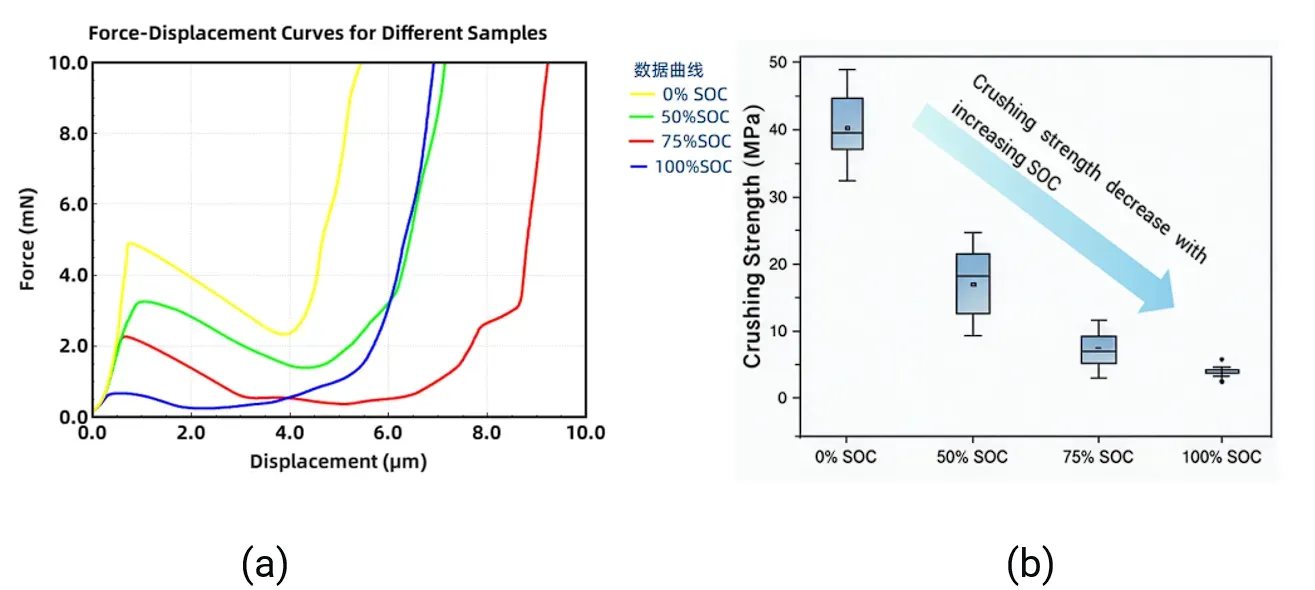
Figure 4. (a) Representative single-particle force-displacement curves at each SOC level — note the decreasing maximum force and displacement-to-failure with increasing SOC. (b) Crushing strength distribution: ~40 MPa (0%) → ~3.8 MPa (100%).
The particle strength drop from 40 MPa to 3.8 MPa at 100% SOC is the study’s central quantitative finding. The decrease follows a nonlinear trajectory:
| SOC | Mean Crushing Strength (MPa) | vs. 0% SOC Baseline | Strength Retention | Lattice State |
|---|---|---|---|---|
| 0% | ~40 | Baseline | 100% | Fully lithiated; minimal internal strain; grains tightly bonded |
| 50% | ~22 | -45% | ~55% | Moderate delithiation; incipient grain-boundary microcracks |
| 75% | ~9 | -77% | ~23% | High delithiation; extensive grain-boundary weakening; crack network formation |
| 100% | ~3.8 | -90.5% | ~9.5% | Near-complete delithiation; severe lattice mismatch; open crack network; particle structurally compromised |
Three features of the strength decay curve merit emphasis:
- Nonlinearity: The strength loss is not linear with SOC. From 0% to 50% SOC, the decrease is ~45%; from 50% to 75%, an additional ~32 percentage points; and the final 75%→100% step produces an additional ~13 percentage-point drop. This mirrors the well-known c-axis lattice parameter spike near full delithiation in layered oxides.
- Absolute values: At 100% SOC, the particle retains less than 10% of its fully lithiated strength. This means that a calendering pressure that safely densifies a discharged electrode may shatter particles if applied in a partially charged state — with direct implications for using single-particle crushing test to optimize formation protocols.
- Variance: The spread in crushing strength increases with SOC, indicating that damage accumulation is heterogeneous — some particles develop more extensive pre-cracking than others at the same nominal SOC, reflecting grain-to-grain orientation and size variations within the polycrystalline aggregate.
4. Discussion and Practical Implications
The SOC-dependent mechanical degradation of polycrystalline NCM documented here has direct implications for battery manufacturing, operation, and materials development:
4.1 Formation Protocol Optimization
During cell formation, the cathode experiences its first delithiation/lithiation cycle, and the initial crack network is established. The finding that particle strength drops by ~90% from 0% to 100% SOC suggests that formation protocols should be designed with the particle’s mechanical vulnerability window in mind. Specifically, high-rate charging during the first cycle — when the particle passes through the high-SOC regime where grain boundaries are maximally weakened — may nucleate more extensive initial cracking than a gentler, multi-step formation. Using single-particle crushing test to optimize formation protocols provides a direct, quantitative method to evaluate whether a given formation strategy minimizes initial particle damage.
4.2 BMS Strategy and Operational Voltage Limits
The nonlinear strength decay — with the most precipitous drop occurring above 75% SOC — supports the concept of a mechanical safe operating window for NCM cathodes. BMS strategies that restrict sustained high-SOC operation (e.g., limiting daily charge to 80–90% SOC) may extend cycle life not only through the well-known electrochemical stability advantage, but also by avoiding the SOC regime where particles lose >75% of their mechanical integrity. The correlation between particle strength and cycle life in NCM cathodes is thus a design parameter that BMS algorithms could actively manage.
4.3 Materials Engineering: Grain-Boundary Engineering vs. Single-Crystallization
The fracture-mode transition from transgranular (0% SOC) to intergranular (≥50% SOC) identifies grain boundaries as the primary weak link at high SOC. This suggests two materials-level mitigation strategies: (1) grain-boundary engineering — doping or coating grain boundaries to resist decohesion under anisotropic strain; (2) single-crystallization — eliminating grain boundaries entirely, as single-crystal NCM cathodes have no intergranular fracture pathway. The SPFT2000 provides the quantitative single-particle crushing strength test for cathode materials needed to compare these strategies objectively.
4.4 Rapid Screening for Material and Process Development
The full workflow — SOC adjustment, powder extraction, multi-particle SPFT2000 testing — can be completed in a single day, compared to weeks for full-cell cycling tests. This positions SPFT2000 single-particle mechanical testing for cathode screening as a practical gating tool in cathode material development: candidate formulations that show excessive strength loss at high SOC can be eliminated before committing to cell assembly. Furthermore, the method contributes to cathode particle integrity and battery safety assessment by quantifying the mechanical condition of cathode particles at any point in the cell’s life — a parameter directly relevant to thermal runaway risk, as fractured particles present higher surface area for exothermic side reactions.
🔬 Quantify Your NCM Cathode Particle Strength with IEST SPFT2000
Measure single-particle crushing strength at any SOC, evaluate fracture mode transitions, and screen cathode formulations before cell assembly. The IEST SPFT2000 delivers ±0.01 mN force accuracy, 10 nm displacement resolution, and GB/T 43091-2023 compliance.
Also explore Solid-State Battery Testing Solutions or our application library.
6. References
[1] J. Su, D. Li, J. Wang, et al. “ Multiscale Failure Mechanisms of Ternary Oxide Cathode Materials for Lithium-Ion Batteries.” Adv. Mater. 38, no. 5 (2026): e06063.
[2] A. Omirkhan, O. Gavalda-Diaz, S. Wang, I. E.L. Stephens, F. Giuliani and M. P. Ryan, Energy Environ. Sci., 2025, https://doi.org/10.1039/d5ee00976f
7. FAQs
7.1 What is the effect of SOC on NCM cathode particle crushing strength?
The effect of SOC on NCM cathode particle crushing strength is dramatic and nonlinear: from ~40 MPa at 0% SOC to ~22 MPa at 50% SOC (−45%), ~9 MPa at 75% SOC (−77%), and ~3.8 MPa at 100% SOC (−90.5%). This SOC-dependent mechanical degradation of polycrystalline NCM reflects the exponential increase in anisotropic lattice strain as lithium content approaches zero. All measurements performed using the IEST SPFT2000 (GB/T 43091-2023).
7.2 Why do NCM cathode particles crack at high voltage?
Why NCM cathode particles crack at high voltage results from three converging factors during lithium deintercalation: (1) anisotropic unit-cell contraction — the c-axis expands while the a-axis shrinks near full delithiation, creating shear stress at grain boundaries; (2) the magnitude of lattice strain peaks near 100% SOC; and (3) grain boundaries — already weakened — cannot transmit stress between grains, causing grain-boundary decohesion (intergranular fracture). Over repeated cycles, this cathode particle pulverization during high-voltage cycling accelerates capacity fade.
7.3 How is single-particle crushing strength measured for cathode materials?
The single-particle crushing strength test for cathode materials uses an instrument like the IEST SPFT2000: individual particles (5–50 μm) are compressed between flat indenters under displacement control while force and displacement are recorded. The crushing strength (MPa) = fracture force (N) / cross-sectional area (mm²). Optical imaging (1200×) verifies particle size before each test. The method is standardized under GB/T 43091-2023 and provides particle-level mechanical data that is complementary to bulk powder compaction measurements.
7.4 What is the correlation between particle strength and cycle life in NCM cathodes?
The correlation between particle strength and cycle life in NCM cathodes operates through a crack-propagation feedback loop: weaker particles (at high SOC) nucleate more microcracks per cycle → cracks expose fresh surface → electrolyte side reactions consume active lithium → impedance grows → localized overpotential drives further cracking. This study’s finding — that particles at 100% SOC retain <10% of their 0%-SOC strength — explains why high-voltage cycling accelerates degradation: each cycle passes through a high-SOC regime where particles are structurally compromised.
7.5 What is the difference between transgranular and intergranular fracture in NCM particles?
Transgranular vs intergranular fracture in NCM particles describes where the crack propagates: transgranular fracture (dominant at 0% SOC) cleaves through individual grains, producing angular, blocky fragments — typical of a monolithic brittle solid. Intergranular fracture (dominant ≥50% SOC) follows grain boundaries where anisotropic strain has weakened cohesion, producing finer debris as entire grains separate from the aggregate. At 100% SOC, the boundary between these modes blurs as the particle simply disintegrates into powder.
7.6 How can SPFT2000 single-particle testing be used for cathode screening and formation optimization?
SPFT2000 single-particle mechanical testing for cathode screening provides quantitative particle strength data in hours rather than the weeks required for full-cell cycling. For cathode material screening: test candidate formulations at multiple SOC levels — formulations with higher high-SOC strength are likely more cycle-stable. For using single-particle crushing test to optimize formation protocols: test particles after different formation strategies (C-rate profile, temperature) — protocols that minimize post-formation strength loss produce less initial crack damage and longer subsequent cycle life.
7.7 How does cathode particle integrity relate to battery safety?
Cathode particle integrity and battery safety assessment are linked because fractured particles present higher specific surface area for exothermic reactions with the electrolyte — a key contributor to thermal runaway risk. Particles at high SOC are not only electrochemically reactive (highly delithiated cathode releases oxygen more readily) but also mechanically compromised (90% strength loss). Quantifying particle strength at various SOC/aging states using the SPFT2000 provides a mechanical safety metric that complements traditional electrochemical safety testing such as DSC and ARC.