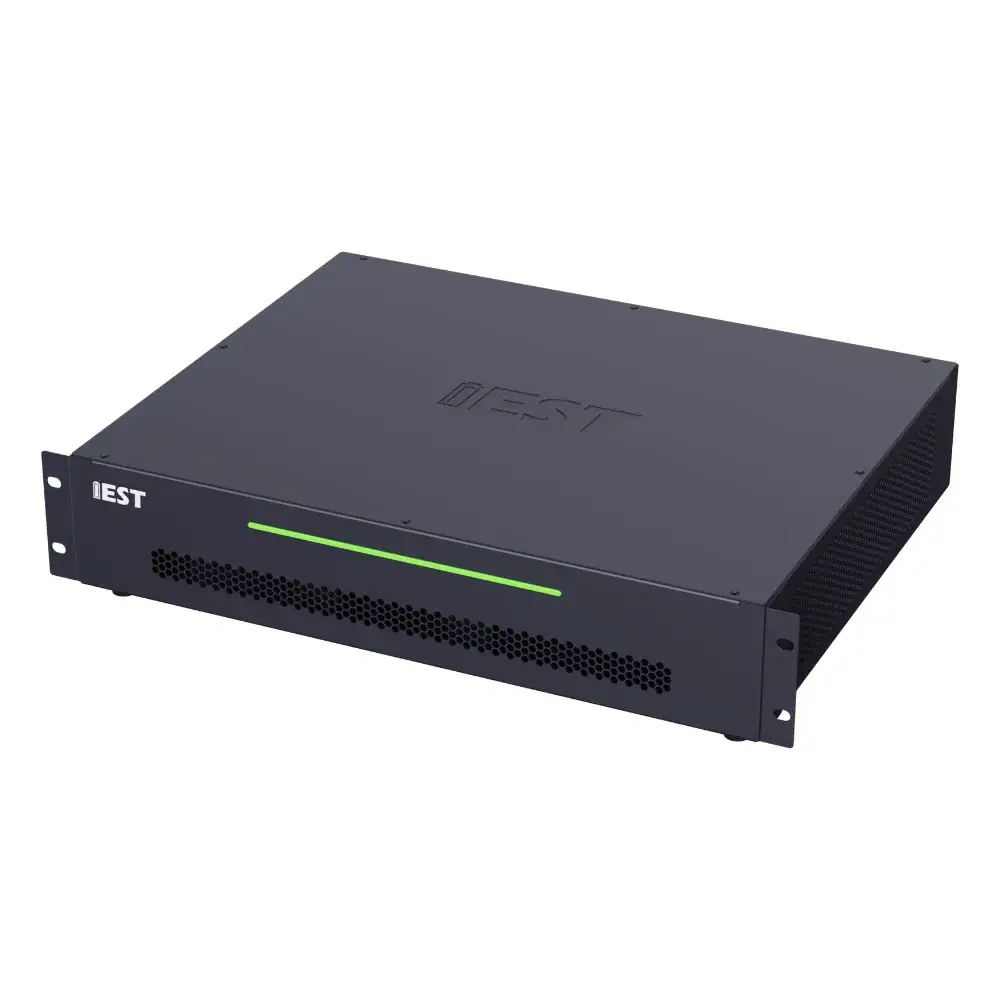
Description
1. Battery Cyclers System ERT Series: Comparison
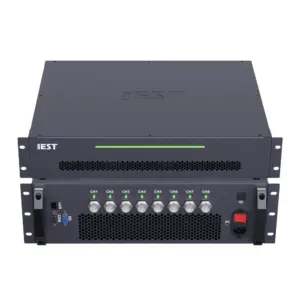
| Model / Series | ERT6008 Series | ERT7008 Series | ERT7008M Series |
|---|---|---|---|
| Photo | 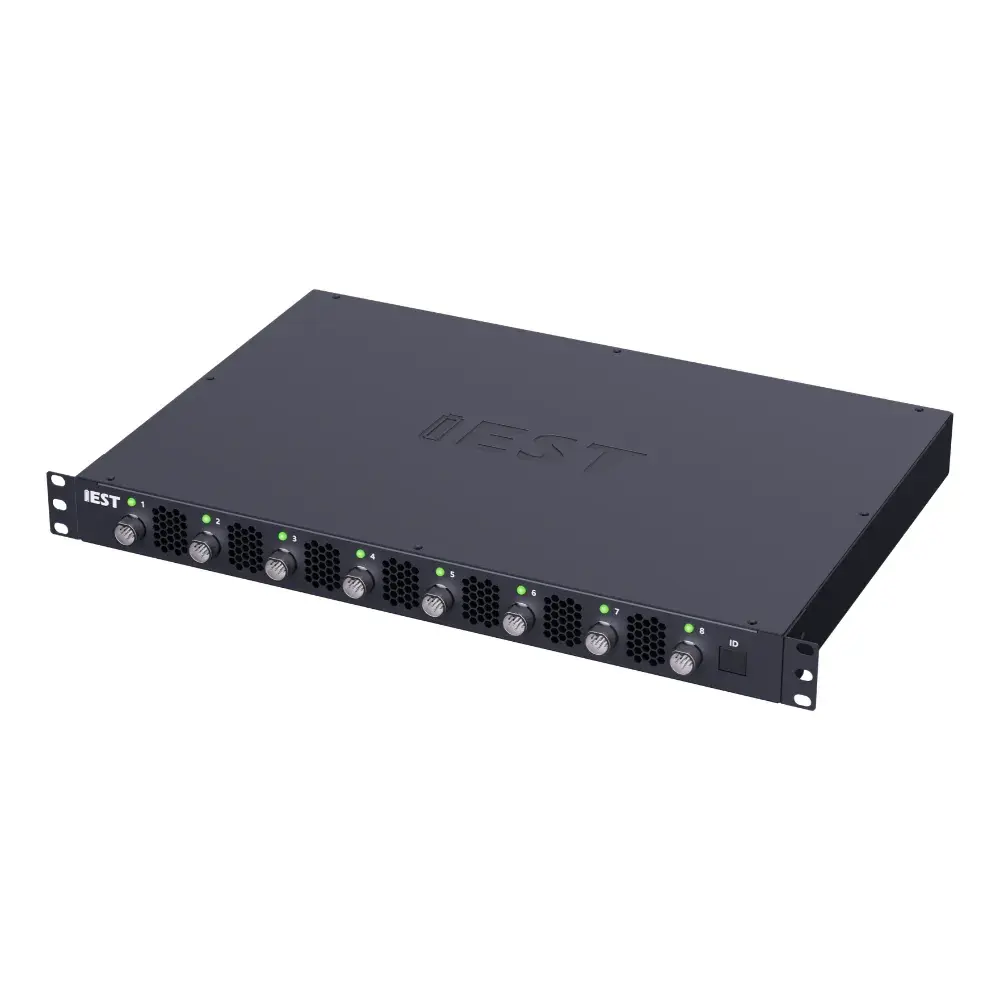 |
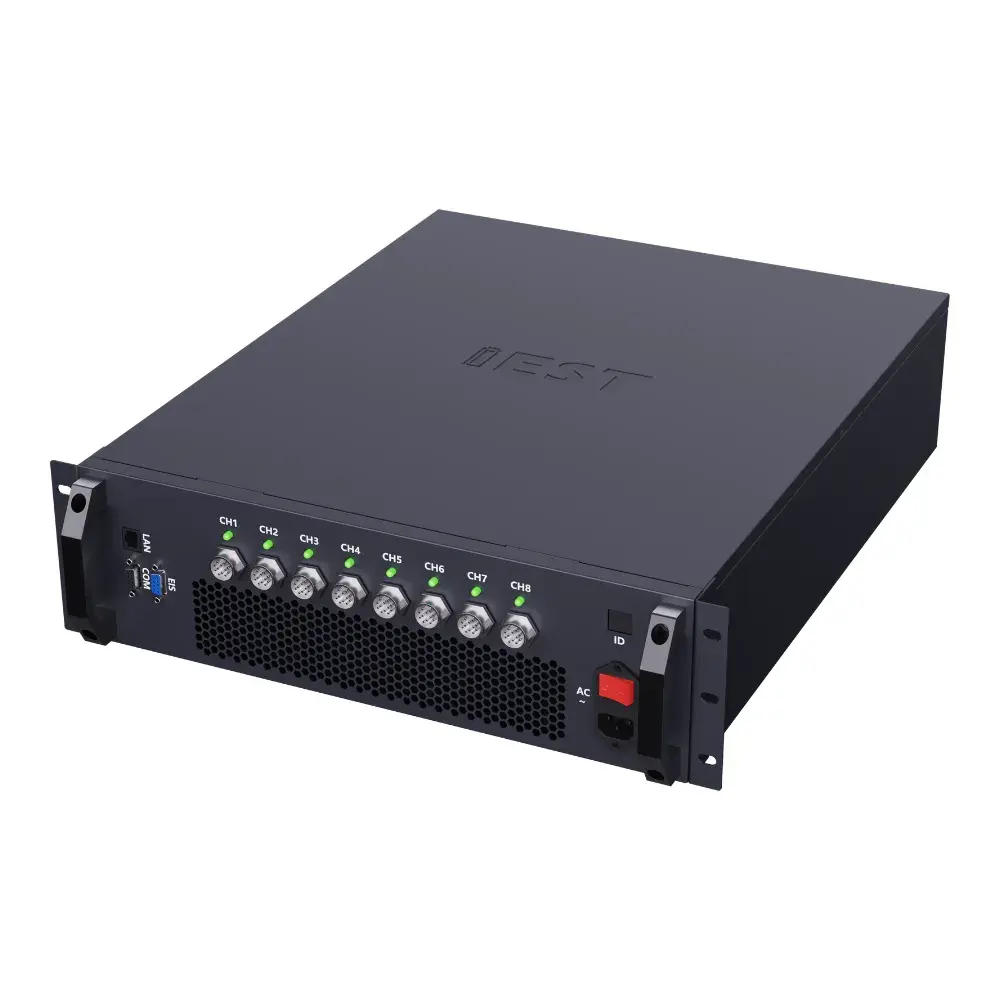 |
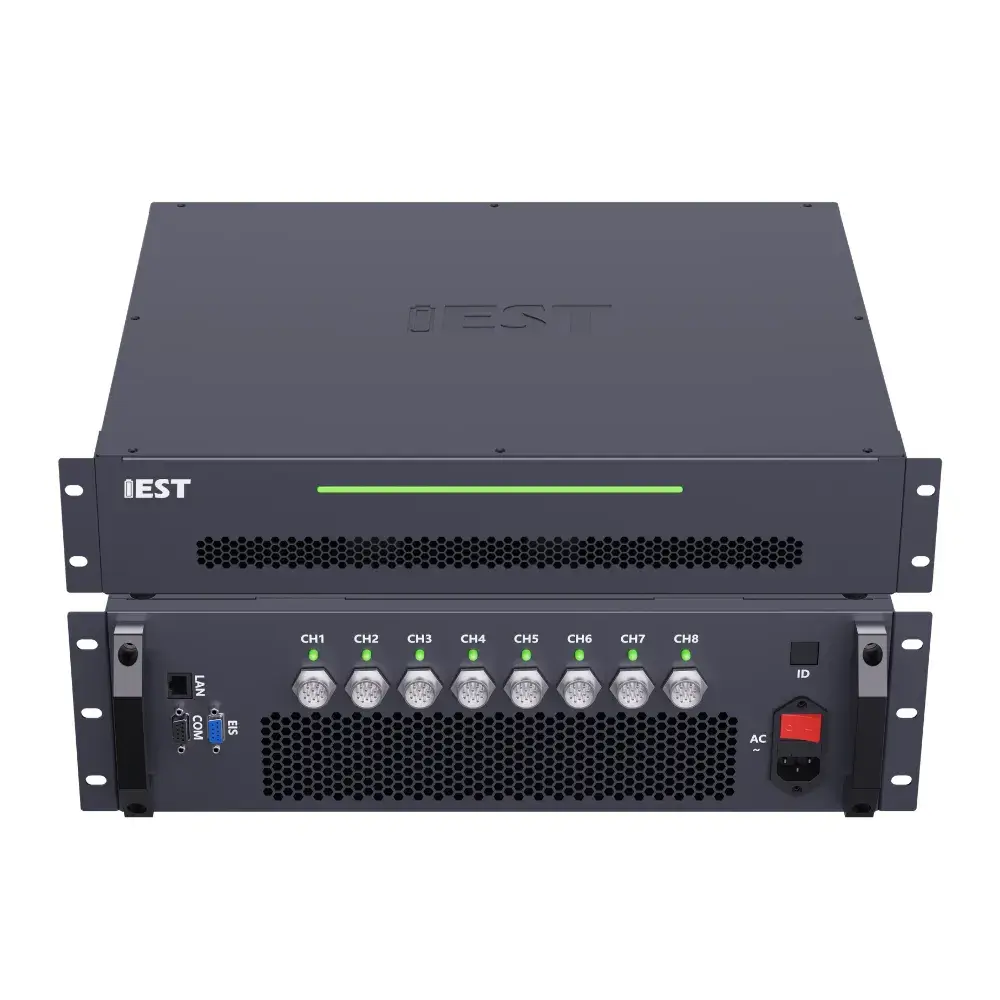 |
| System Type | High Precision Cyclic Voltammetry Analyzer | High Precision CV + EIS Test System | High Precision CV + High-Frequency EIS Test System |
| EIS Testing | × | 0.01 Hz ~ 100 kHz | 0.01 Hz ~ 2 MHz |
| Electrochemical Features | CV / LSV / GITT / PITT / CA / CP | EIS (100 kHz) + CV / LSV / GITT / PITT / CA / CP | EIS (2 MHz) + CV / LSV / GITT / PITT / CA / CP |
| Channels | 8 Channels | ||
| Accuracy (V & I) | ±0.01% F.S. | ||
| Voltage Range | ±5V (for 100mA & 6A models) | 0 ~ 5V (for 12A model) | ||
| Available Current Tiers | • 100mA Model: 10 nA ~ 100 mA (30W) • 6A Model: 0.6 μA ~ 6 A (500W) • 12A Model: 1.2 μA ~ 12 A (1000W) |
||
| Connector Type | Four-Electrode Aviation Connector (Supports three-electrode testing with auxiliary voltage) | ||
2. R&D Background
2.1 Traditional Solutions
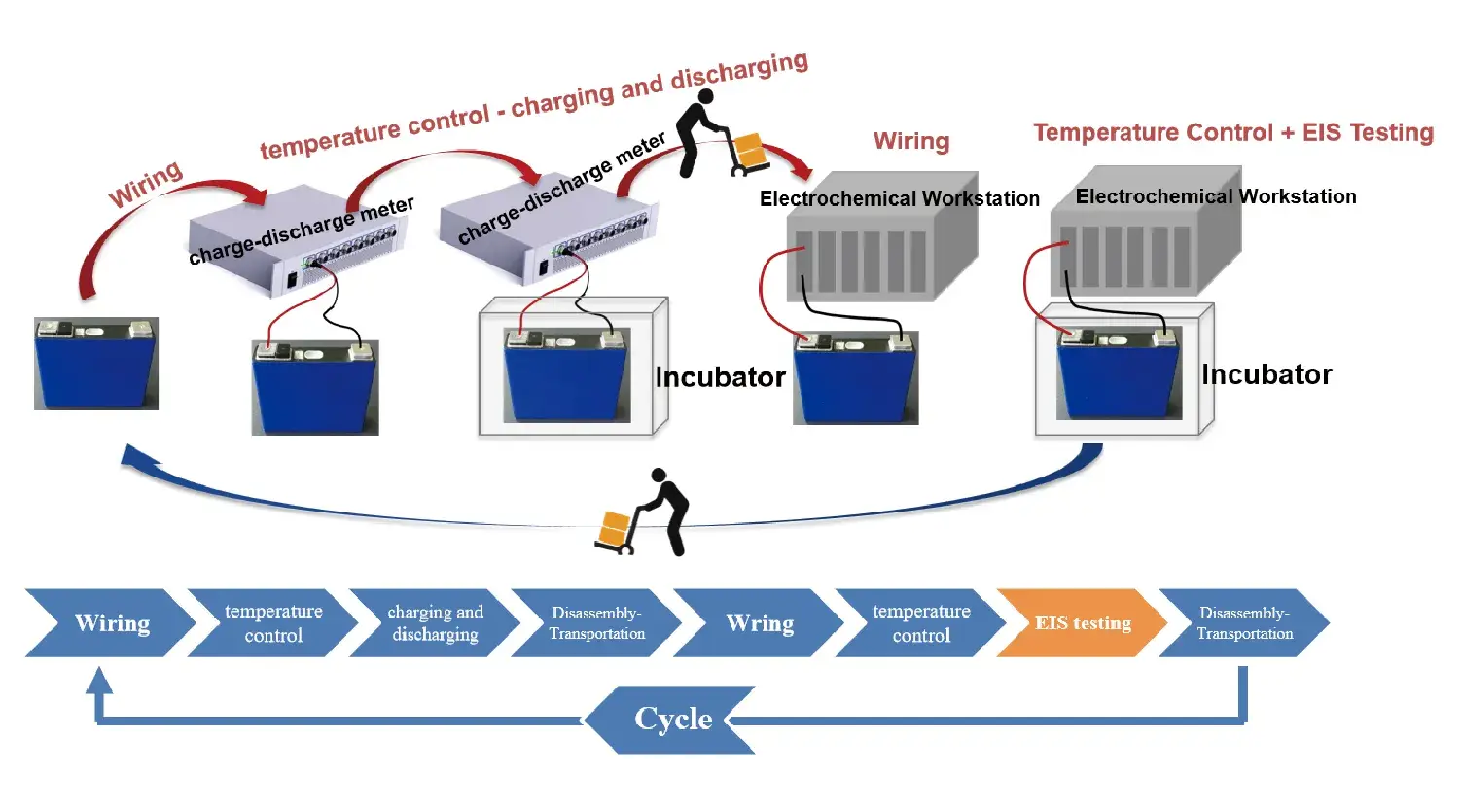
Disadvantages: Repeated transfer, time-consuming and labor-intensive, with excessive human interference
2.2 Innovative Solutions of IEST Battery Cycle Tester
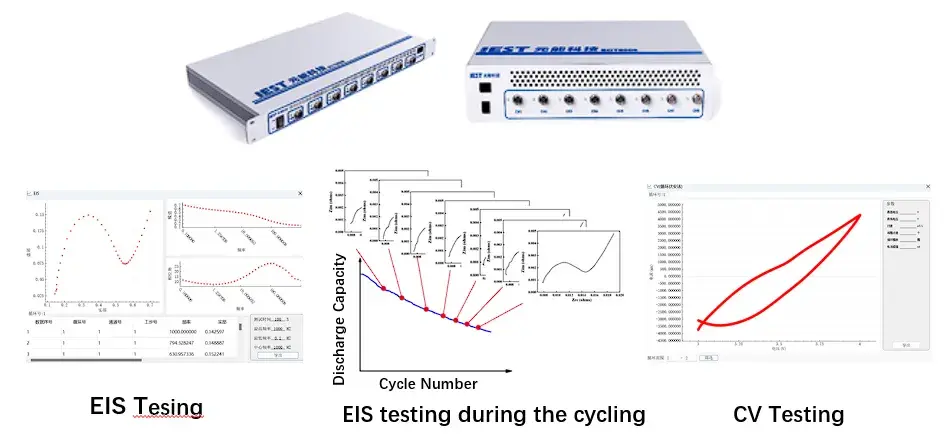
- Advantages: One-time wiring, one-click setup, no manual transfer required
- Saves Labor and Substantially Boosts Testing Efficiency
- Exceptional Precision & Control: Voltage and current measurement accuracy up to 0.01%, with current control down to the nanoampere (nA) level.
- Broad Sample & Material Compatibility: Supports research and testing on various battery cells, capacitor materials, half-cells, three-electrode systems, coin cells, and low-capacity pouch/cylindrical cells.
- Comprehensive Electrochemical Techniques: Supports EIS(ERT7008 available), multi-scan rate Cyclic Voltammetry (CV), Linear Sweep Voltammetry (LSV), GITT, PITT, Chronoamperometry (CA), and Chronopotentiometry (CP).
- Robust Safety & Reliability: Triple-layer protection across software, hardware, and firmware to ensure equipment and specimen safety; features one-click test step resumption and multi-redundant data backup.
- High-Precision Electrochemical Characterization: Generates benchmark data for calendar/cycle life prediction, ultra-high precision coulombic efficiency (HPC/CE), self-discharge analysis, and micro-parasitic side-reaction evaluation.
- Flexible auxiliary channel integration: temperature control, surface temperature monitoring, three-electrode setups, and pressure detection.
3. Application Scenario
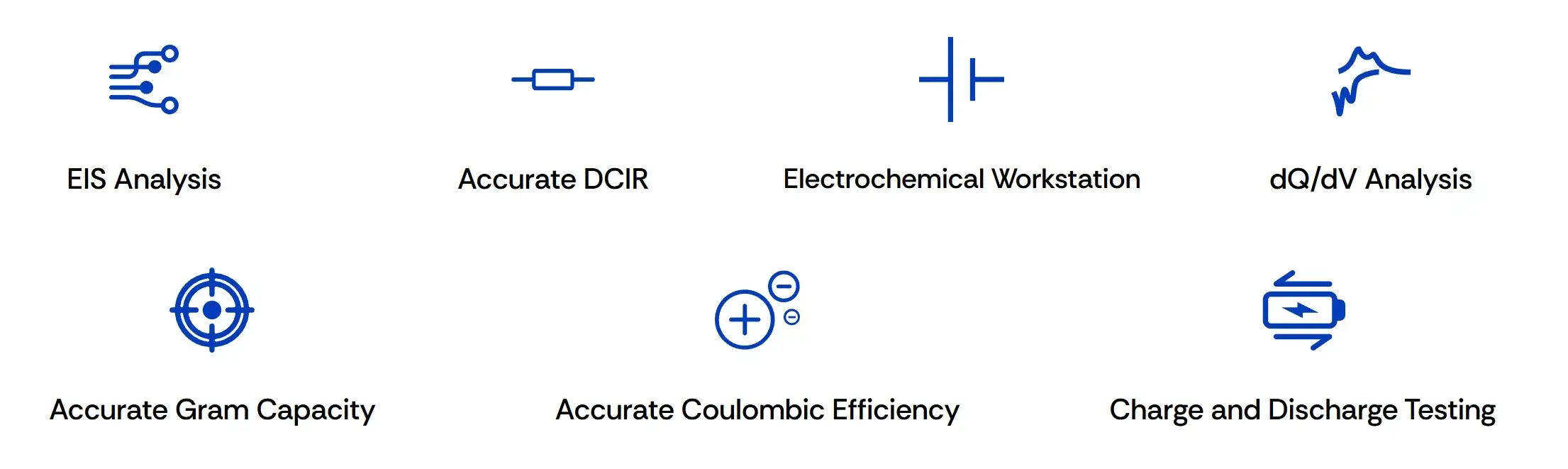
Applications
Case 1: EIS Analysis–Different Cell Impedance Analysis
High-frequency EIS impedance range: 0.01Hz~100kHz, meeting the high-frequency impedance test requirements of 10mΩ~1kΩ level batteries.
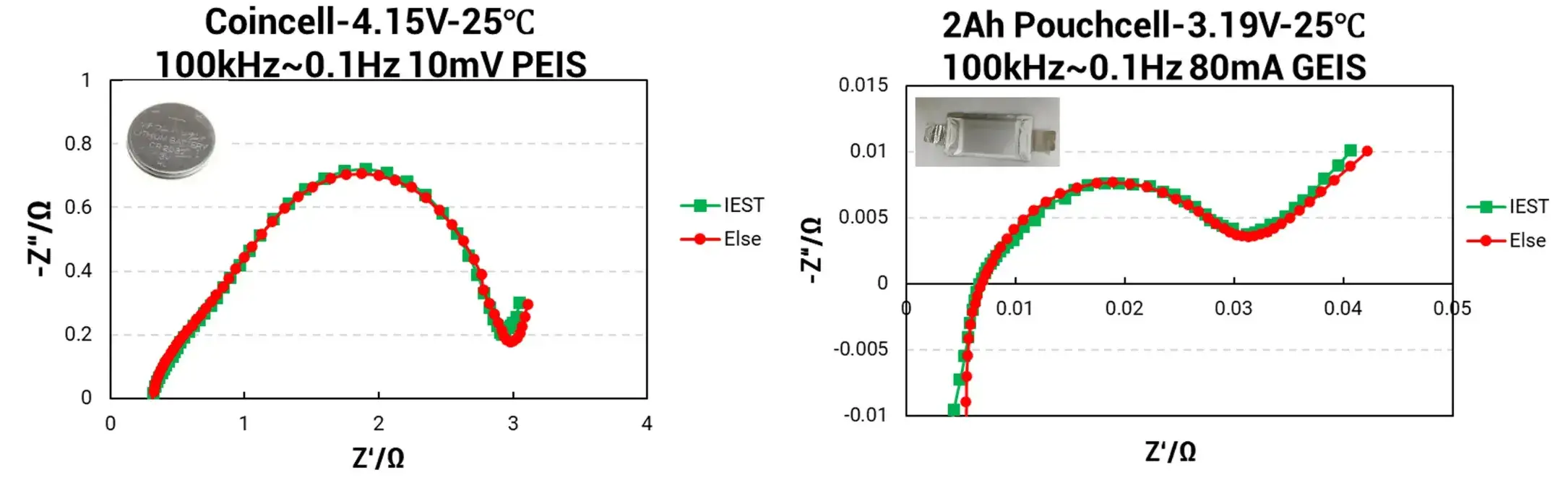
Compared with the EIS test results of well-known foreign electrochemical workstations, the error is within 5%
Case 2: Cell Cycle EIS Test
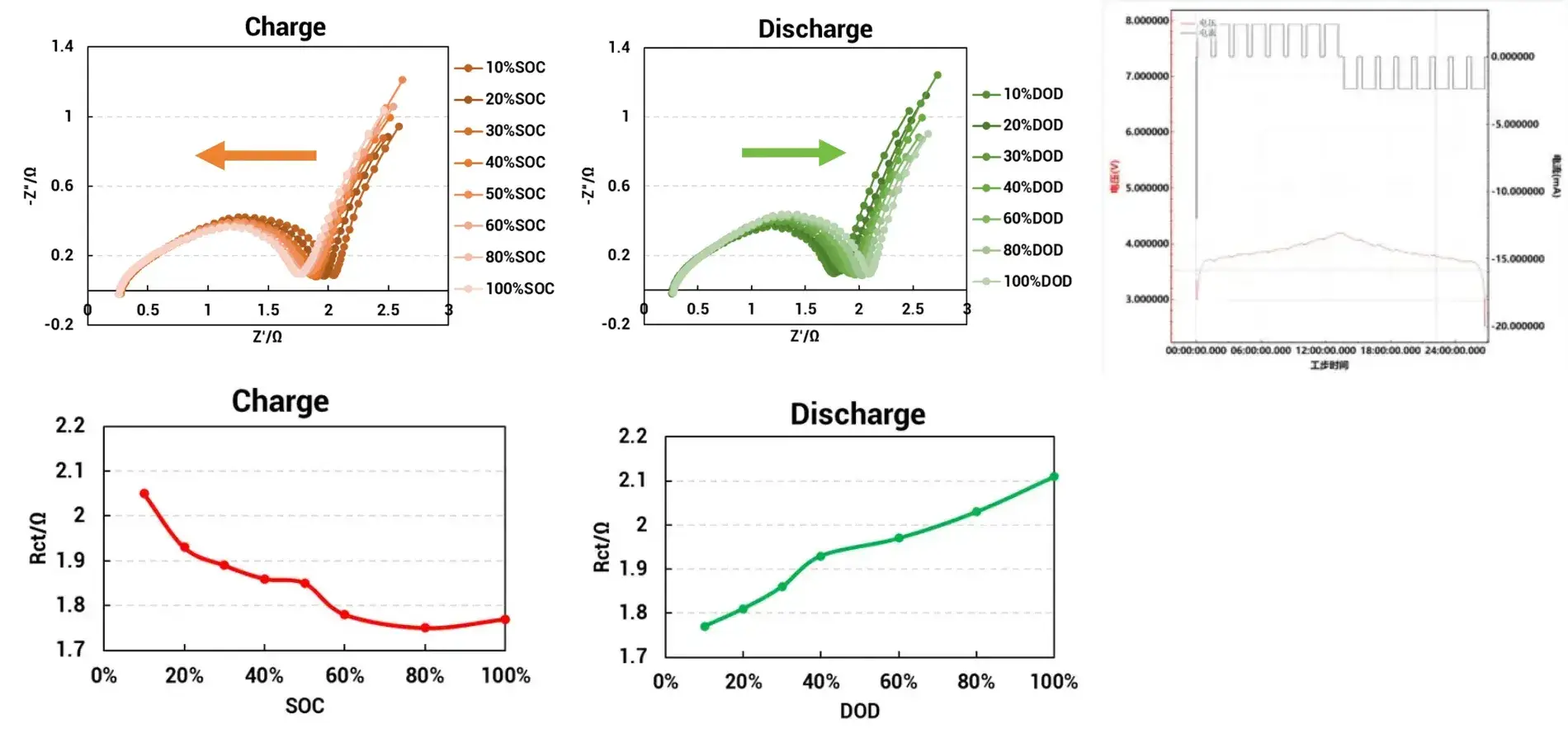
- Rct decreases as SOC increases.
- Rct increases as DOD increases.
Case 3: Accurate DCIR Performance
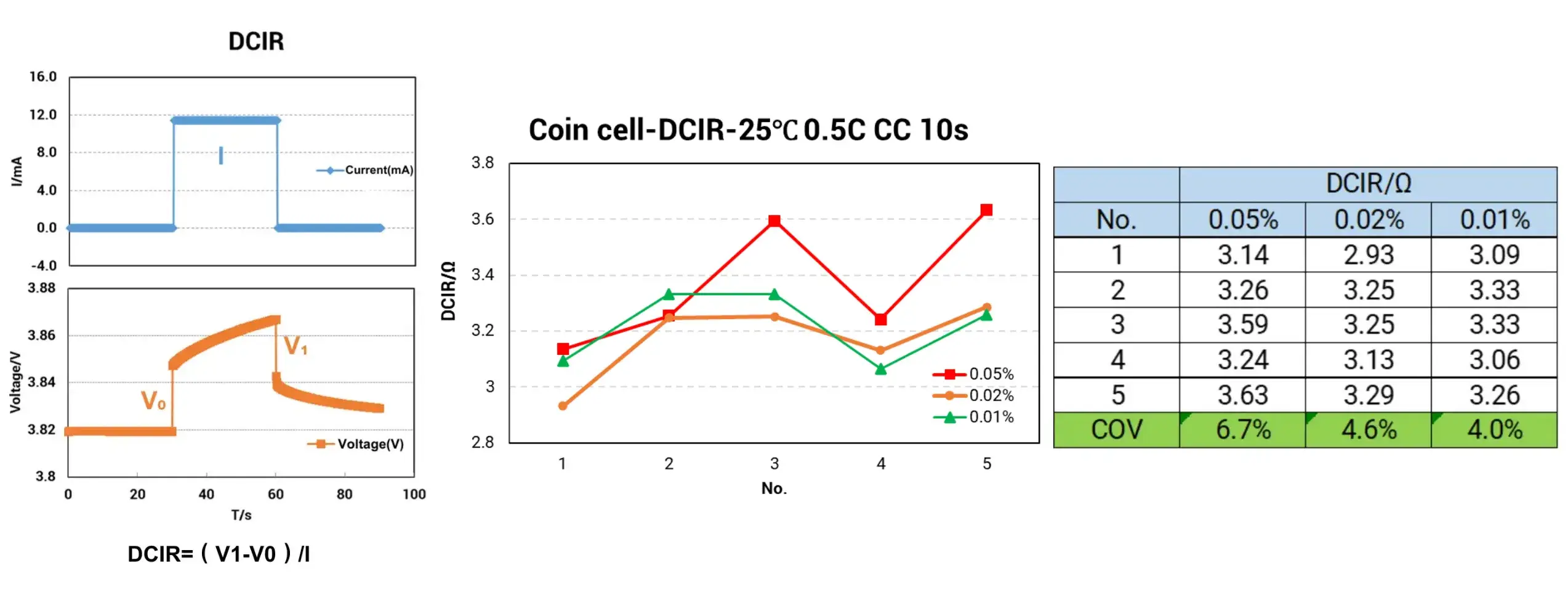
- DCIR testing was conducted on 6 sets of coin cells using instruments with three different voltage accuracy levels, with a 0.1 s sampling rate.
- Higher voltage accuracy yields significantly better consistency in coin cell DCIR measurements.
Case 4: Cyclic Voltammetry(CV) to Evaluate Materials Properties
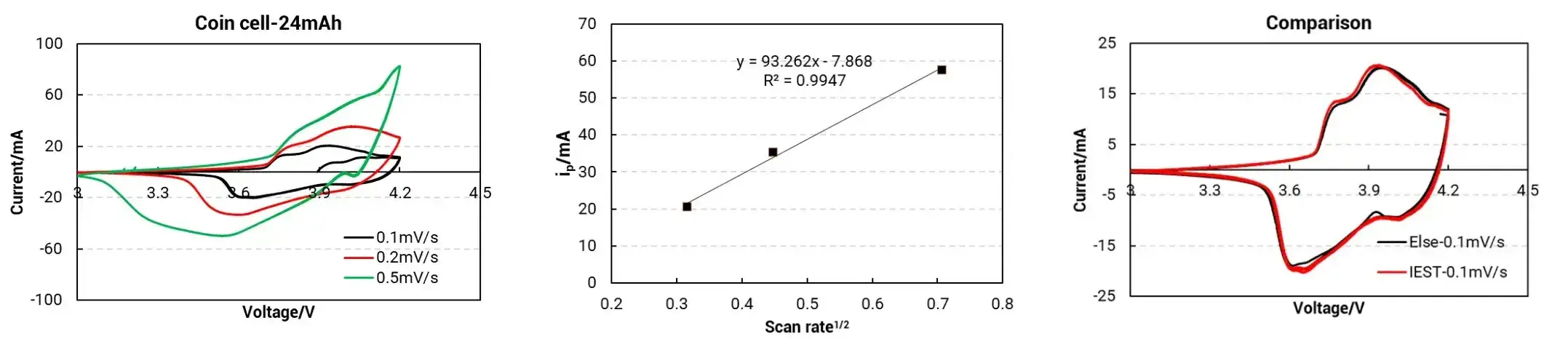
- The peak current of reversible reduction is proportional to the square root of the scan rate.
- Consistent with the CV(Cyclic Voltammetry) curves measured by electrochemical workstations.
Case 5: dQ/dV Curves to Evaluate Material Phase Changes
dQ/dV Curve Analysis:
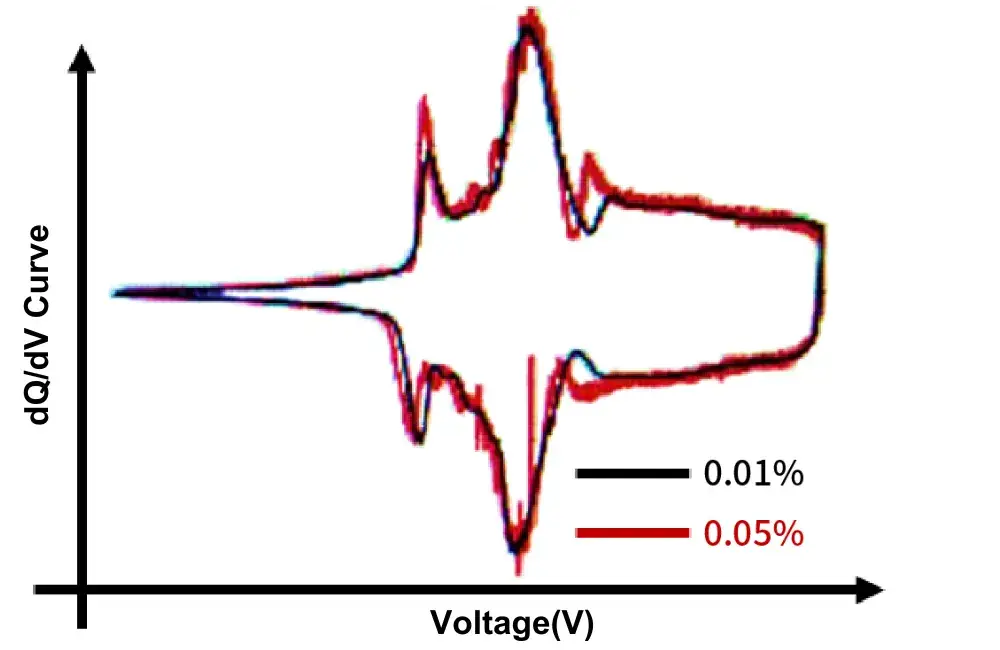
Curve Smoothness:
- High-precision equipment: dQ/dV curves are smooth and continuous, capable of capturing subtle electrochemical changes.
- Low-precision equipment: Curves exhibit noise or discontinuities, with difficulty in accurately identifying detailed features.
Electrochemical reaction characteristics:
- High-precision equipment: Clearly reveals characteristic peaks of multi-stage reactions in the battery, uncovering material phase transitions or side reactions.
- Low-precision equipment: Characteristic peaks are obscured by measurement noise, prone to missing critical information.
In dQ/dV curve analysis, high-precision equipment is crucial for studying electrochemical details, improving data reliability, and identifying material characteristics. Low-precision equipment can perform basic testing but may miss critical details, especially in high-demand research scenarios.
Case 6: Charge and discharge Evaluation of Material Specific Capacity
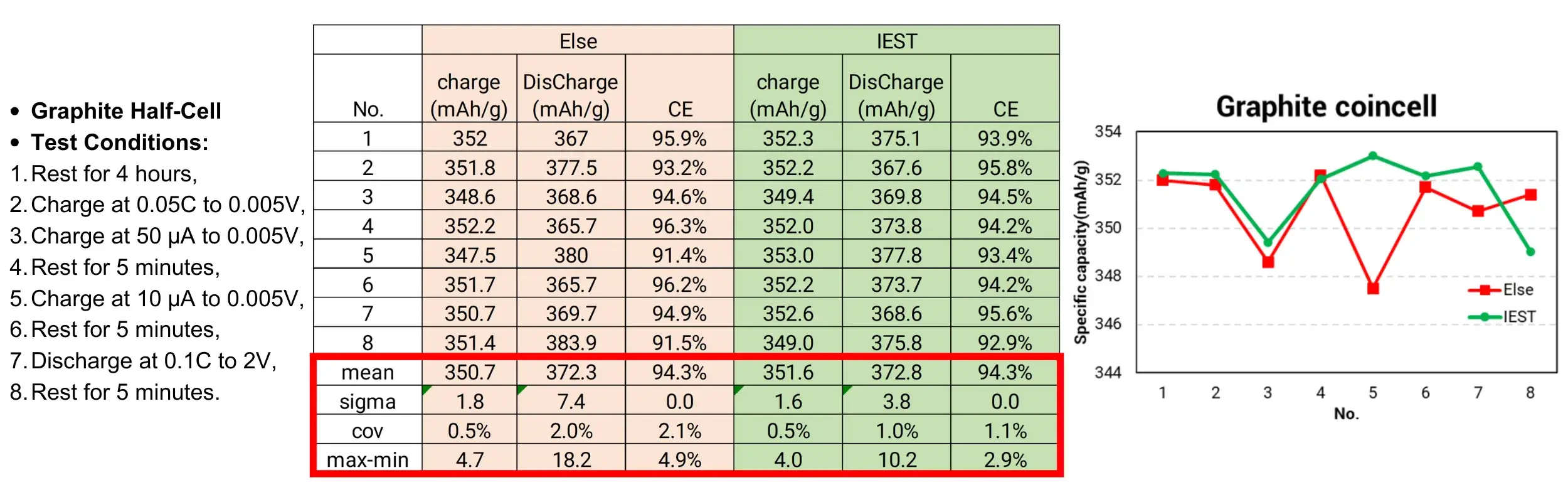
Specific capacity testing across 8 graphite half-cells demonstrates superior capacity consistency.
Case 7: Evaluation of Coulombic Efficiency in Cells via Charge and Discharge Testing
Coulombic Efficiency Testing:
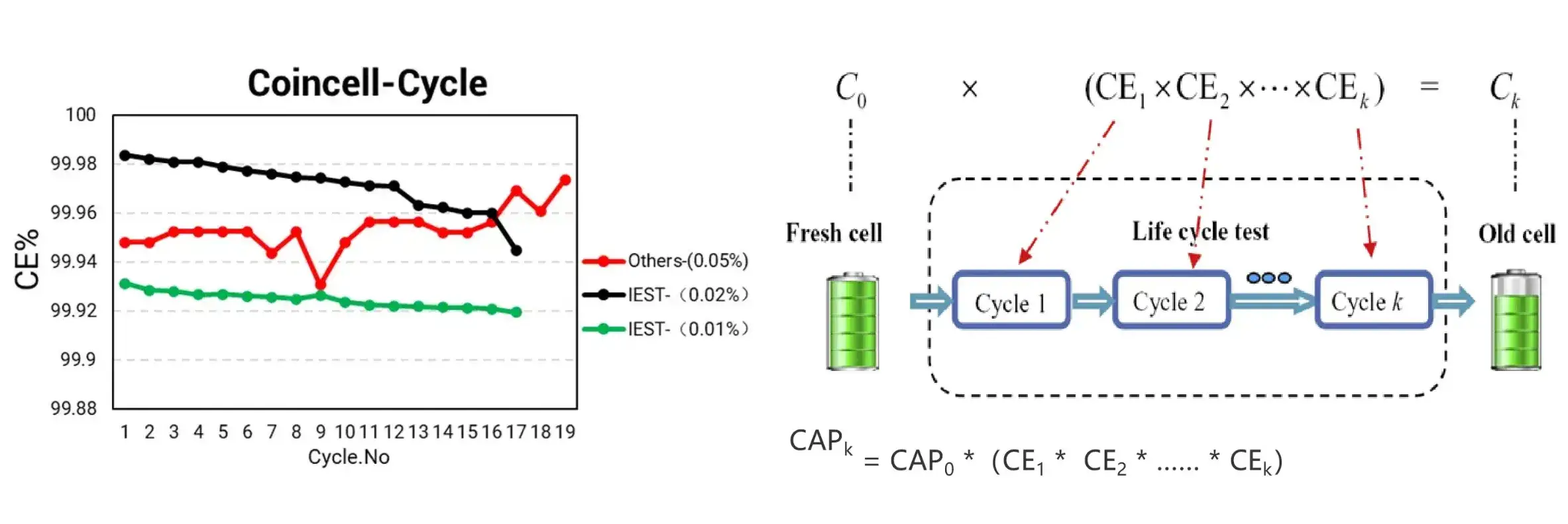
- Lifetime prediction models built on coulombic efficiency can accurately forecast battery capacity fade.
- For effective lifetime prediction, accuracy must be controlled to at least 1‰ (0.1%), with noise interference suppressed below 10 ppm!
Case 8: Evaluation of Cells Self-Discharge Under Constant Voltage Charging
- High precision supports leakage current testing of large capacity and low internal resistance cells
- Replace the time-consuming and labor-intensive solution of measuring K value, enabling faster and more accurate monitoring of battery cell self-discharge characteristics.
Coin Cell Leakage Current Test:
- Electrodes: NCM (ф14 mm) vs. Lithium (ф20 mm)
- Capacity: 2 mAh
- Equipment: ECT6008 High-Precision Device
- Test Procedure: Constant Current/Constant Voltage (CC/CV) Charging: 0.8 mA, 3.8 V, for 72 hours
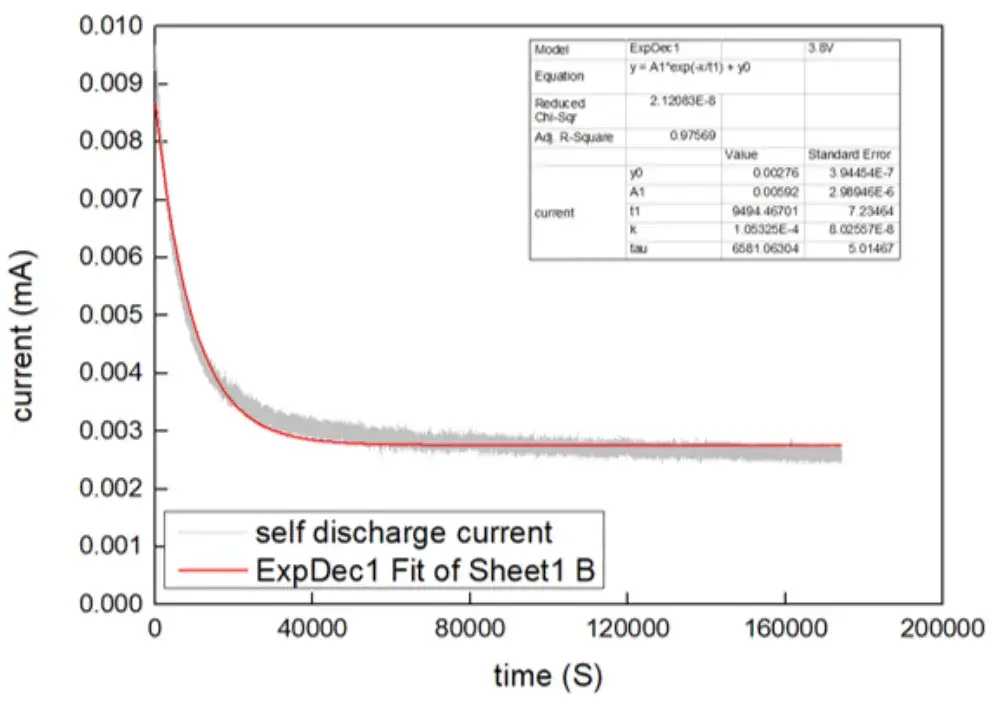
IEST High-Precision Battery Cycler System enable current monitoring down to the nanoampere (nA) level, supporting ultra-low leakage current measurement.
Video
Specifications
| ERT6008 Series (Cyclic Voltammetry Analyzer) |
|||
|---|---|---|---|
| Model | ERT6008-5V100mA | ERT6008-5V6A | ERT6008-5V12A |
| Product Photo | |
|
|
| Channels | 8 | ||
| Voltage | ±5V | ±5V | 0 ~ 5V |
| Current Range | 10nA ~ 0.1mA ~ 1mA ~ 10mA ~ 100mA | 0.6μA ~ 6mA ~ 60mA ~ 600mA ~ 6A | 1.2μA ~ 12mA ~ 120mA ~ 1.2A ~ 12A |
| Power | 30W | 500W | 1000W |
| V&I Accuracy | ±0.01% F.S. | ||
| Electrochemical Features | Cyclic Voltammetry (CV), Linear Sweep Voltammetry (LSV), GITT / PITT / CA / CP Testing | ||
| Dimensions (W×D×H) | 445 × 305 × 50 mm | 575 × 485 × 135 mm | |
| Weight | 4.5 kg | 20 kg | |
| Output Connector | Four-Electrode Aviation Connector (Supports three-electrode testing with auxiliary voltage integration) | ||
| Operating Modes | • Charge-Discharge Modes: CC, CV, CC-CV, CP, CR, DCIR, Rate Charge/Discharge • Electrochemical Modes: CV, LSV, GITT, PITT, CA, CP |
||
| Operating Temp | -20 ~ 80°C | ||
| ERT7008 Series (Cyclic Voltammetry + EIS Analyzer) |
|||
|---|---|---|---|
| Model | ERT7008-5V100mA | ERT7008-5V6A | ERT7008-5V12A |
| Product Photo | |
|
|
| Channels | 8 | ||
| Voltage | ±5V | ±5V | 0 ~ 5V |
| Current Range | 10nA ~ 0.1mA ~ 1mA ~ 10mA ~ 100mA | 0.6μA ~ 6mA ~ 60mA ~ 600mA ~ 6A | 1.2μA ~ 12mA ~ 120mA ~ 1.2A ~ 12A |
| Power | 30W | 500W | 1000W |
| V&I Accuracy | ±0.01% F.S. | ||
| Electrochemical Features | Cyclic Voltammetry (CV) + Electrochemical Impedance Spectroscopy (EIS): 0.01 Hz ~ 100 kHz |
||
| Dimensions (W×D×H) | 445 × 305 × 50 mm | 575 × 485 × 135 mm | |
| Weight | 4.5 kg | 20 kg | |
| Output Connector | Four-Electrode Aviation Connector (Supports three-electrode testing with auxiliary voltage integration) | ||
| Operating Modes | • Charge-Discharge Modes: CC, CV, CC-CV, CP, CR, DCIR, Rate Charge/Discharge • Electrochemical Modes: CV, LSV, GITT, PITT, CA, CP |
||
| Operating Temp | -20 ~ 80°C | ||
| ERT7008M Series (Cyclic Voltammetry + EIS Analyzer) |
|||
|---|---|---|---|
| Model | ERT7008M-5V100mA | ERT7008M-5V6A | ERT7008M-5V12A |
| Product Photo | 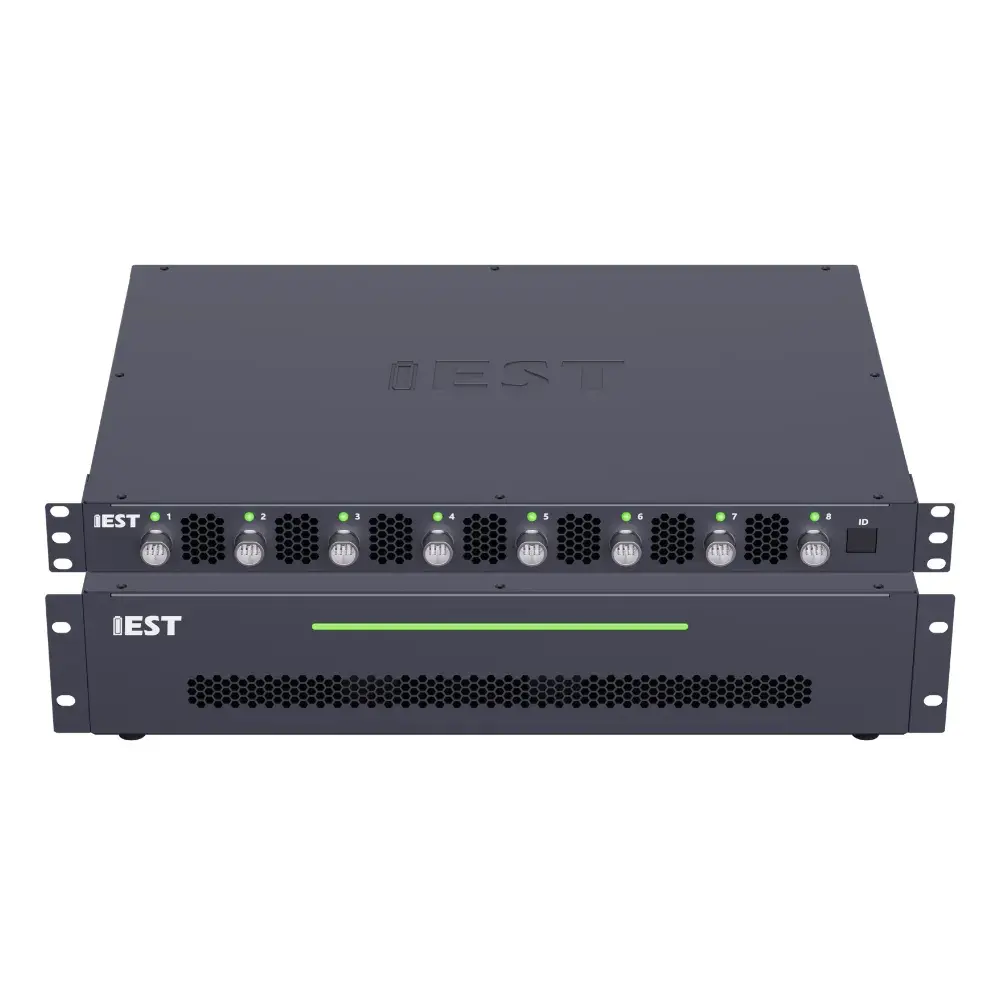 |
|
|
| Channels | 8 | ||
| Voltage | ±5V | ±5V | 0 ~ 5V |
| Current Range | 10nA ~ 0.1mA ~ 1mA ~ 10mA ~ 100mA | 0.6μA ~ 6mA ~ 60mA ~ 600mA ~ 6A | 1.2μA ~ 12mA ~ 120mA ~ 1.2A ~ 12A |
| Power | 30W | 500W | 1000W |
| V&I Accuracy | ±0.01% F.S. | ||
| Electrochemical Features | Cyclic Voltammetry (CV) + Electrochemical Impedance Spectroscopy (EIS): 0.01 Hz ~ 2 MHz |
||
| Dimensions (W×D×H) | 445 × 305 × 50 mm | 575 × 485 × 135 mm | |
| Weight | 4.5 kg | 20 kg | |
| Output Connector | Four-Electrode Aviation Connector (Supports three-electrode testing with auxiliary voltage integration) | ||
| Operating Modes | • Charge-Discharge Modes: CC, CV, CC-CV, CP, CR, DCIR, Rate Charge/Discharge • Electrochemical Modes: CV, LSV, GITT, PITT, CA, CP |
||
| Operating Temp | -20 ~ 80°C | ||