-
iestinstrument

Abstract
1. Why Are Symmetric Cells Important for Battery Electrode Characterization?
Lithium-ion battery technology is iterating quickly, and large-scale applications such as electric vehicles and grid energy storage place rising demands on performance, cost, and scalability. Researchers continuously develop new electrode and electrolyte materials. To verify the true performance of an electrode material, and to obtain key information on electrode reversibility, ion transport kinetics, and degradation mechanisms, they need reliable electrochemical characterization methods.
Common laboratory battery characterization systems include half cells, full cells, and symmetric cells:
- Half cells: Suitable for studying electrode potential and electrolyte stability, but rely on a lithium metal counter electrode.
- Full cells: Closer to practical battery operating conditions, but difficult to isolate the degradation behavior of a single electrode.
- Symmetric cells: Constructed with two identical working electrodes, symmetric cells are a powerful tool for electrode degradation diagnosis, ideal for analyzing electrode reversibility and ion/electron transport kinetics, and providing direct feedback for material modification.
2. What Are the Advantages of Symmetrical Cells Over Half Cells and Full Cells?
A symmetric cell uses two identical working electrodes. This makes the symmetric battery a diagnostic tool for electrode degradation: it suits the analysis of electrode reversibility and of ion and electron transport kinetics, and it gives direct feedback for material modification. Table 1 compares the three configurations.
| Cell Type | Electrode Configuration | Best-Suited Use | Documented Limitation | Implication for Electrode Diagnosis |
|---|---|---|---|---|
| Half cell | One working electrode versus a lithium metal counter electrode | Studying electrode potential and electrolyte stability | Depends on a lithium metal counter electrode | Suited to potential and electrolyte-stability studies rather than isolated electrode degradation |
| Full cell | Real positive electrode and real negative electrode | Approximating practical battery operating conditions | Difficult to resolve the degradation behavior of a single electrode | Reflects whole-cell behavior; single-electrode contributions are hard to separate |
| Symmetric cell | Two identical working electrodes | Electrode reversibility, ion/electron transport kinetics, degradation diagnosis | Requires consistent and reliable cell assembly | Isolates one electrode type and returns direct feedback for material modification |
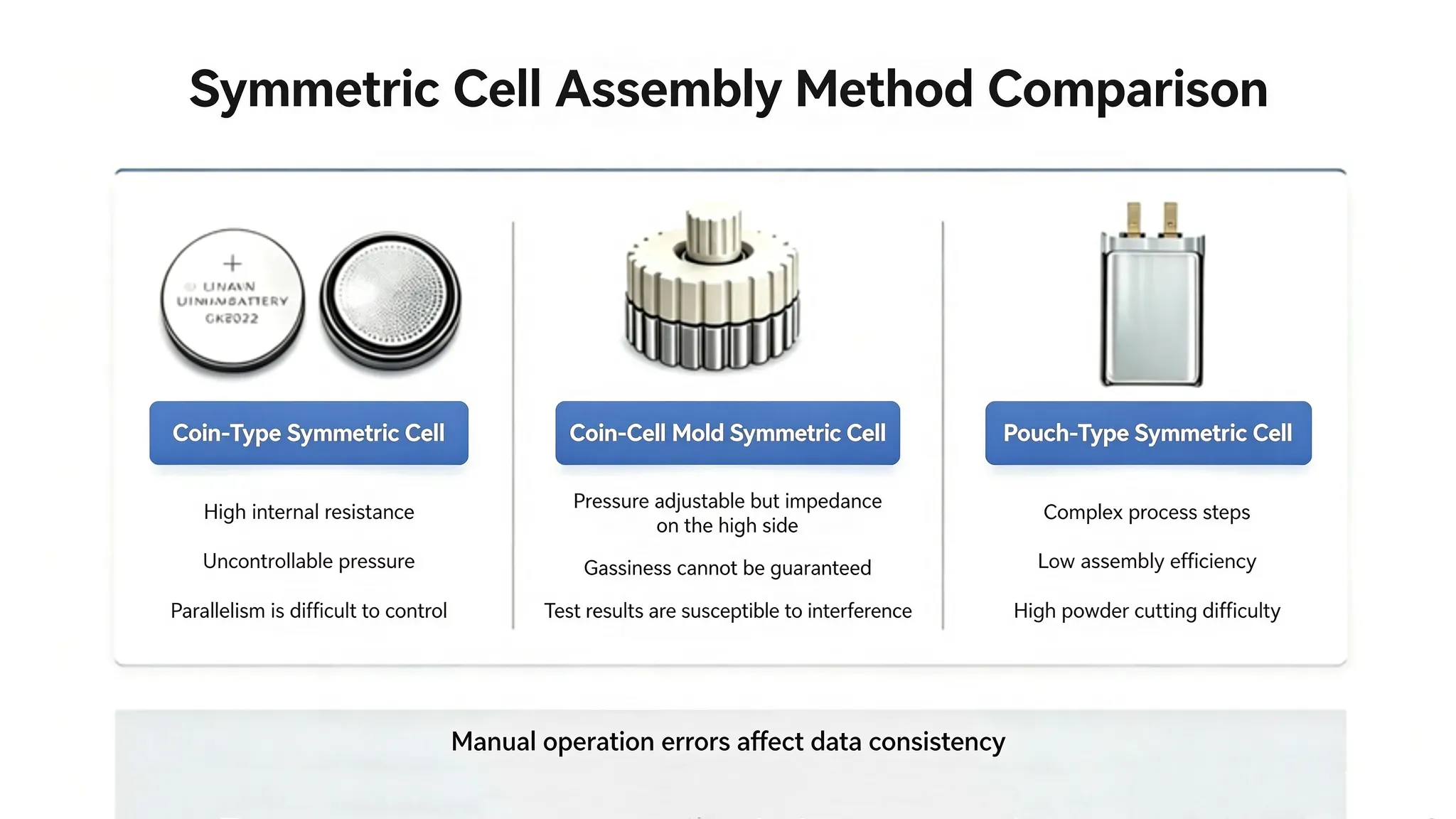
Figure 1. Comparison of manual symmetric cell assembly methods: coin cell (high impedance, uncontrolled pressure), coin cell mold (high impedance, poor sealing), and pouch cell (complex process, low efficiency).
3. Pouch Cell Symmetrical Battery Manual Assembly Challenges: Why Does Human Error Matter?
The pouch cell symmetrical battery requires the most preparation. Researchers must prepare aluminum-plastic film pouches in advance, cut the electrodes, and scrape the coating from the electrode sheets. Handling electrodes by hand is difficult, and assembly efficiency is low. Manual assembly consumes substantial laboratory time, and operator-dependent steps cause deviation between parallel samples, which interferes with electrode degradation analysis.
4. New Solution: Automated Symmetric Cell Assembly System SAAS
To address these industry pain points, IEST Instrument has launched the SAAS series automated symmetric cell assembly system, enabling automated symmetric cell preparation and reducing human error from the source. The system combines electrode processing and cell sealing in one workflow (Figure 2).
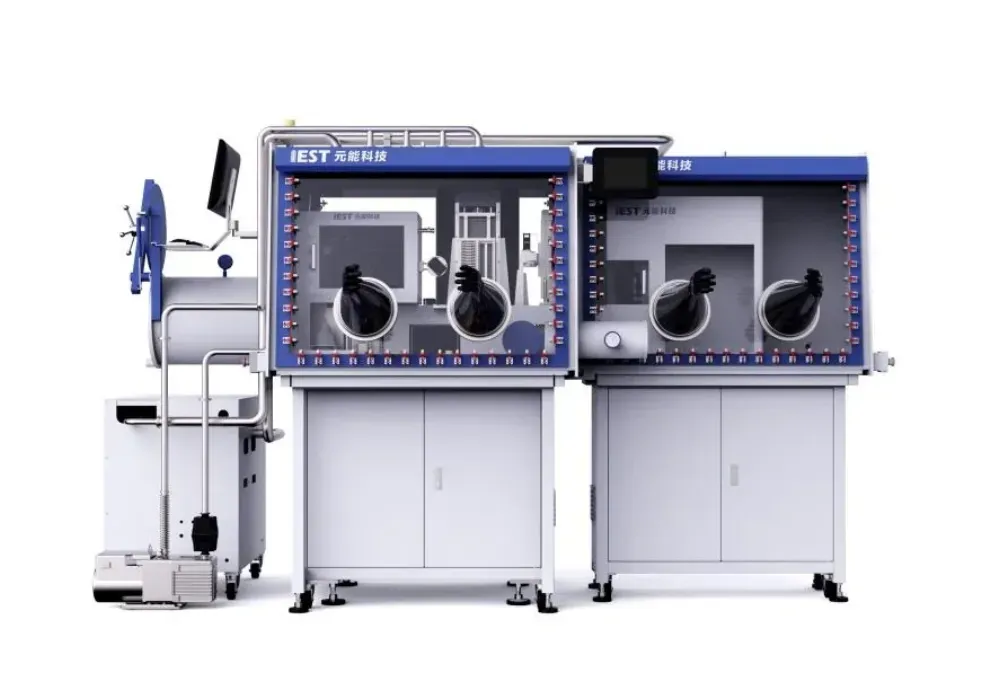
Figure 2. IEST SAAS automatic symmetric cell assembly system.
4.1 The System’s Specifications and Core Functions
The SAAS system performs four core functions, shown as a five-step workflow in Figure 3:
- Automated cutting of double-side coated electrodes, with precise powder scraping on the cathode to expose the current collector without damaging the electrode.
- Automated electrolyte filling with a high-precision pump ensuring uniform filling volume.
- Automated three-side hot sealing of the pouch cell.
- Full process traceability for easy experimental data review.
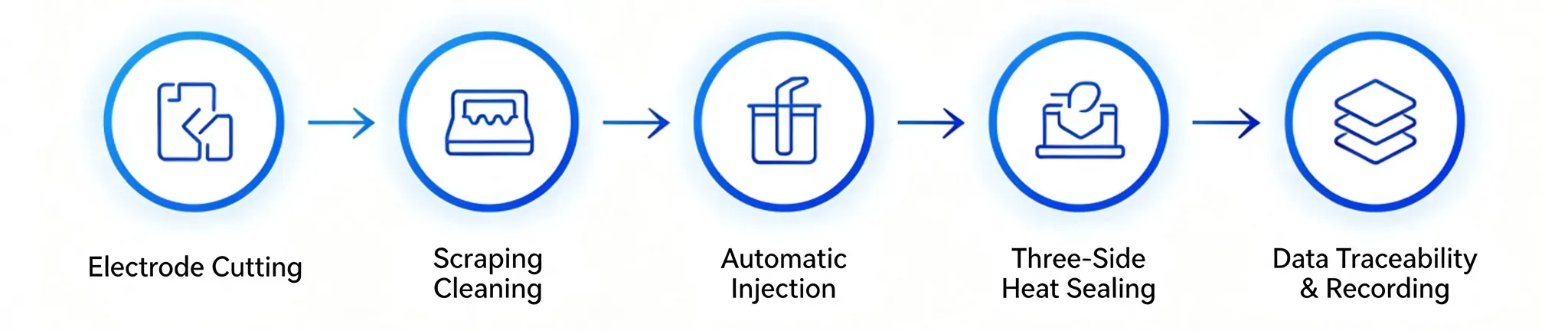
Figure 3. Five-step IEST SAAS workflow, demonstrating electrode cutting, powder scraping and cleaning, automatic electrolyte filling, three-side heat sealing, and data recording for traceability.
4.2 How Does Electrode Powder Scraping and Cutting Automation Work for Battery Testing?
Electrode powder scraping and cutting automation moves the electrode sheet on a sample tray to a laser cutting and scraping station. There, the system cuts the electrode and scrapes the coating from double-side-coated cathodes to expose the current collector. The scraping step is carried out precisely and with cleaning, so the electrode is not scratched through.
Electrode powder scraping refers to the removal of the active-material coating from a defined area of an electrode sheet so that the bare current collector is exposed for tab or contact connection.
Automating these two steps keeps electrode processing uniform between cells and improves sample preparation efficiency.
5. Experimental Validation: Automated Assembly Delivers Visible Consistency
5.1 Sample Preparation
Three parallel samples of fresh NCM cathode electrodes (10 cm × 10 cm), three parallel samples of fresh graphite anode electrodes (10 cm × 10 cm), and three parallel samples of aged NCM cathode electrodes (10 cm × 10 cm) were prepared.
5.2 Sample Processing and Battery Assembly
Samples were placed on the sample tray, and the system automatically moved to the laser cutting and powder scraping station (cathode double-side coating requires scraping). After electrode processing, manual pre-assembly was performed, and the cell was placed in the sealing fixture for automatic side sealing, electrolyte filling, and bottom sealing.
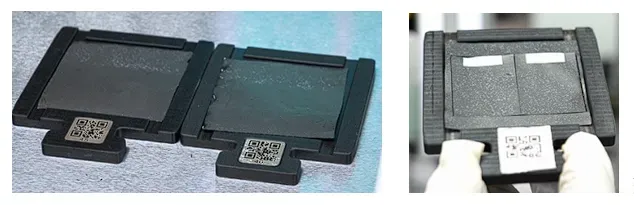
Figure 4. Electrode sheets on IEST SAAS sample trays with QR-coded plates, demonstrating sample identification for full-process traceability.
5.3 EIS Testing
The assembled cells were fixed with steel plates, pressurized, connected to an electrochemical workstation, and subjected to EIS testing. The data were processed and analyzed.
5.4 Results Analysis
Reproducibility of symmetrical cell EIS measurements improves when electrode processing, electrolyte filling, and sealing are automated, because these steps no longer depend on the operator. Figure 5 shows the EIS Nyquist plots for three parallel fresh NCM cathode symmetric cells and the EIS Nyquist plots for aged NCM cathode and fresh graphite anode symmetric cells. In both cases, the curves for three parallel samples exhibit excellent overlap, demonstrating that automated assembly effectively eliminates the data dispersion caused by manual operation and delivers superior parallel sample consistency.
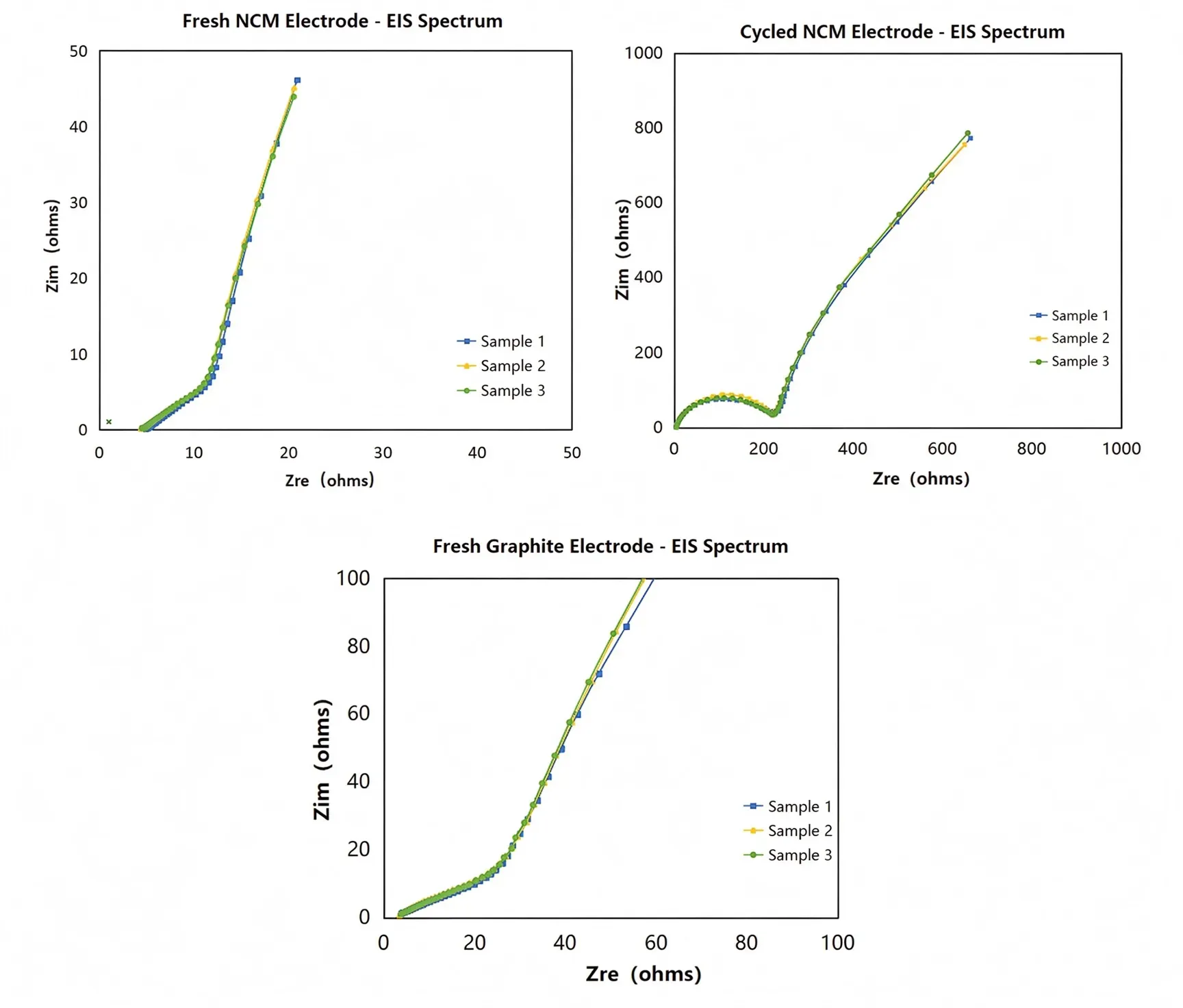
Figure 5. EIS Nyquist plots of three parallel symmetric cells assembled by IEST SAAS1000M for fresh NCM, cycled NCM, and fresh graphite electrodes.
6. Summary
The automated symmetric cell assembly system automates electrode cutting and powder scraping, ensuring uniform electrode processing and significantly improving sample preparation efficiency. Combined with high-precision electrolyte filling and automated hot sealing, it reduces experimental errors introduced by manual operation.
While manual symmetric battery assembly is time-consuming and prone to parallel sample failure, automated preparation provides a reliable experimental approach for battery electrochemical characterization. For researchers engaged in electrode degradation mechanisms, electrolyte studies, and electrode material research, the SAAS system delivers more consistent symmetric cell test data and shortens the R&D iteration cycle.
🔬 Upgrade Your Symmetric Cell Assembly with IEST SAAS
The IEST SAAS automated symmetric cell assembly system delivers consistent, reproducible symmetric cells for accurate electrode characterization. Automate cutting, scraping, filling, and sealing to eliminate human error and accelerate your battery R&D.
7. FAQs
7.1 What is a symmetric cell in battery electrode characterization?
A symmetric cell is an electrochemical test cell built from two identical working electrodes. Because both sides use the same electrode material and state, the measured response reflects one electrode type. Symmetric cells are used to analyze electrode reversibility, ion and electron transport kinetics, and electrode degradation.
7.2 What is the difference between a symmetric cell, a half cell, and a full cell?
A half cell pairs one working electrode with a lithium metal counter electrode and suits electrode potential and electrolyte stability studies. A full cell combines real positive and negative electrodes and approximates practical operation, but single-electrode degradation is hard to resolve. A symmetric cell uses two identical electrodes to diagnose one electrode directly.
7.3 What are the main challenges of coin cell and pouch cell symmetrical battery manual assembly?
Coin cell symmetrical batteries suffer from high impedance, uncontrolled pressure, and poor consistency. Pouch cell symmetrical batteries involve complex processes, difficult electrode cutting and scraping, and low assembly efficiency. Both are prone to human error, leading to unreliable data.
7.4 How does the IEST SAAS automatic symmetrical cell assembly system improve EIS reproducibility?
The SAAS system automates electrode cutting, powder scraping, high-precision electrolyte filling, and three-side hot sealing. This eliminates operator-dependent variables and ensures each symmetric cell is assembled identically, resulting in highly overlapping EIS Nyquist plots for parallel samples.
7.5 How do I choose a symmetric cell format and assembly method for electrode degradation analysis?
Coin cells show high impedance and uncontrolled pressure, coin-cell molds have high impedance and uncertain airtightness, and manual pouch cells are laborious. Selection therefore depends on parallel-sample consistency and assembly effort. IEST Instrument’s SAAS system automates pouch symmetric cell cutting, powder scraping, filling, and three-side heat sealing.
7.6 How does automated symmetric cell assembly work on the SAAS system?
Electrode sheets on a sample tray move to a laser cutting and scraping station. After manual pre-assembly, the cell sits in a sealing fixture, where the system performs side sealing, electrolyte filling, and bottom sealing automatically. The finished cell is then pressed between steel plates and tested by EIS.