
Core Methodology: The Arrhenius plot conductivity method is the standard approach for extracting activation energy (\(E_{\text{a}}\)). By plotting \(\ln(\sigma)\) vs. \(1/T\), the linear slope directly yields the energy barrier for charge transport.
Material Benchmarks: Experimental results demonstrate that graphite (\(0.025\ \text{eV}\)) exhibits the lowest activation energy, followed by NCM (\(0.041\ \text{eV}\)) and LFP (\(0.116\ \text{eV}\)), explaining their varying performance under low-temperature conditions.
Ionic vs. Electronic Transport: While DC methods are used for powder electronic conductivity, Electrochemical Impedance Spectroscopy (EIS) is essential for measuring the ionic activation energy of solid electrolytes like LATP (\(0.044\ \text{eV}\)) and polymer electrolyte systems.
Precision Matters: To ensure a reliable Arrhenius fit, maintaining constant pressure and using high-resolution temperature steps is mandatory to eliminate data artifacts.
Activation energy (\(E_{\text{a}}\)) refers to the energy barrier that must be overcome for a chemical reaction or transport process to proceed. First proposed by Swedish scientist S.A. Arrhenius in 1889, this concept is grounded in extensive experimental observations and formalized through the well-known Arrhenius equation. The activation energy represents the minimum energy required to initiate a reaction, and its magnitude directly governs the kinetics of ion diffusion, electron conduction, and phase transformations in materials. In lithium-ion batteries, it reflects the energy required for an atom or ion to migrate from its equilibrium position.
\(k = A e^{-E_a/(RT)}\)
Temperature significantly affects the performance and longevity of lithium-ion batteries. Studying the thermal behavior of battery materials — cathodes, anodes, separators, and electrolytes — is therefore essential for developing efficient, safe, and durable energy storage systems. Holistic battery-level testing reveals macroscopic trends but does not clarify underlying transport mechanisms. Evaluating the activation energy of individual material components provides the fundamental insights needed for targeted material optimization.
To extract Ea experimentally we commonly use the Arrhenius equation to relate a transport coefficient (rate constant, ionic conductivity or electronic conductivity) to temperature. Plotting ln(conductivity) vs 1/T — an Arrhenius plot (conductivity) — yields a straight line whose slope gives Ea. This Arrhenius plot conductivity method is widely used to compare temperature-dependent performance of cathode, anode and solid-electrolyte materials.
This article explains the experimental protocol using the PRCD3100 and EIS-based solid electrolyte measurement(SEMS Series), and demonstrates how combining temperature-dependent conductivity data with the Arrhenius equation enables a rigorous understanding of charge transport mechanisms in battery materials.
PRCD3100 Powder Resistivity & Compaction Density Tester (IEST) with temperature-raise module — measures powder electronic conductivity under controlled pressures (10–200 MPa) and temperatures.
Solid electrolyte testing rig + electrochemical workstation — measures ionic conductivity (via EIS) of pressed LATP pellets across a defined temperature range.
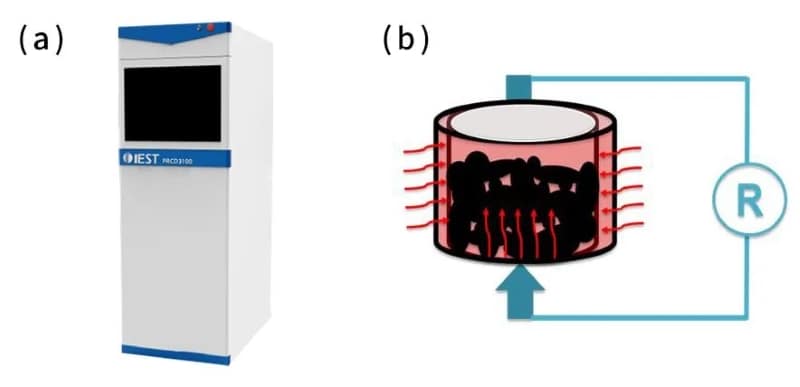
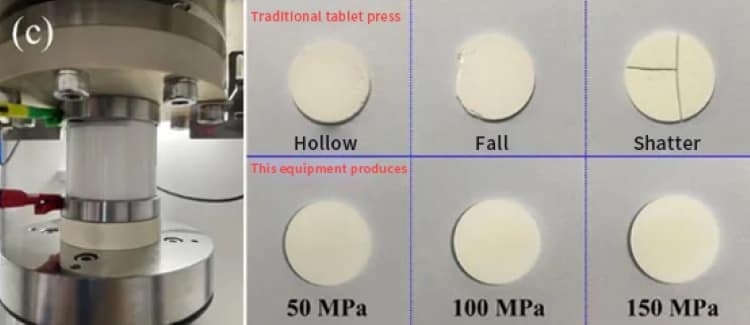
Figure 1. (a) PRCD3100; (b) temperature increasing device; (c) solid electrolyte testing system
Cathode materials: LiFePO₄ (LFP) and layered NCM (ternary) powders.
Anode material: Graphite.
Solid electrolyte: Oxide LATP (\(Li_{1+x}Al_{x}Ti_{2-x}(PO_4)_3\)).
Calculating activation energy from an Arrhenius plot follows a four-step procedure that converts temperature-dependent conductivity data into a linear regression from which Eₐ is directly extracted.
Measure conductivity σ(T) at multiple temperatures while holding compaction pressure constant (critical for powder samples). A minimum of 5–6 temperature points spanning a representative range establishes a reliable linear fit.
\(\sigma(T) = \sigma_0 \exp\left(-\frac{E_a}{k_B T}\right)\)
where \(\sigma\) is conductivity, \(\sigma_0\) is the pre-exponential factor, \(E_{\text{a}}\) is activation energy, \(k_{\text{B}}\) is Boltzmann’s constant, and \(T\) is absolute temperature (K). (Alternatively, for molar activation energies one may write \(\sigma = \sigma_0 \exp(-E_{\text{a}}/(RT))\) with the gas constant \(R\).)
\(\ln \sigma = \ln \sigma_0 – \frac{E_a}{k_B} \cdot \frac{1}{T}\)
To answer the critical question of how to determine activation energy, we utilize the Arrhenius equation. This mathematical framework relates the transport coefficient (conductivity) to temperature. By performing Arrhenius plot conductivity analysis—specifically plotting \(\ln \sigma\) versus \(1/T\)—we generate a linear regression where the slope equals \(-E_{\text{a}} / k_{\text{B}}\). This procedural accuracy is what allows for the precise extraction of \(E_{\text{a}}\) in electronvolts (\(\text{eV}\)).
For powder samples, pressure must remain constant throughout the temperature sweep; pressure drift introduces systematic error in \(\sigma(T)\) that distorts the Arrhenius slope and the extracted \(E_{\text{a}}\).
The resistivity of lithium iron phosphate (LFP) powder was measured under pressures ranging from 10 to 200 MPa and at various temperatures. As shown in Figure 2(a), resistivity decreases with rising temperature at all pressure levels.
Using the Arrhenius equation(which describes how reaction rates depend on temperature), we relate conductivity (σ) to temperature:
\(\sigma = A e^{-E_a/(kT)}\)
Taking the natural logarithm yields:
\(\ln(\sigma) = \ln(A) – \frac{E_a}{k} \cdot \frac{1}{T}\)
By plotting \(\ln(\sigma)\) against \(1/T\), we obtain a linear relationship where the slope corresponds to \(-E_{\text{a}} / k\), enabling the calculation of activation energy.
As illustrated in Figure 2(b), LFP, NCM, and graphite materials were evaluated using this method. Table 1 summarizes the calculated activation energies and pre-exponential factors. Graphite exhibited the lowest activation energy (0.025 eV), followed by NCM (0.041 eV), and LFP (0.116 eV). These results suggest that electron transfer is easiest in graphite and most challenging in LFP.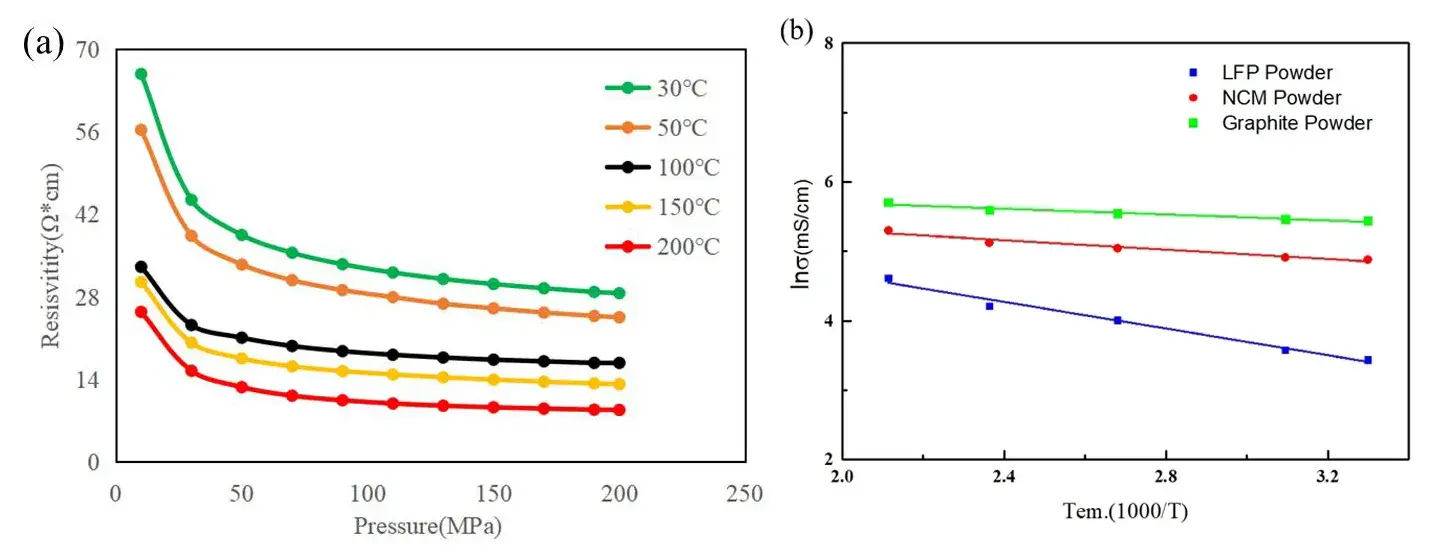
Figure 2. (a) Resistivity of LFP powder between 10 and 200MPa at different temperatures, (b) Arrhenius plot of conductivity versus temperature of different cathode and anode electrode materials.
| Parameter | LFP | NCM | Graphite |
|---|---|---|---|
| Ea (eV) | 0.116 | 0.041 | 0.025 |
| A (S/cm) | 0.713 | 0.392 | 0.450 |
Measuring activation energy in solid-state ionic conductors requires Electrochemical Impedance Spectroscopy (EIS) rather than DC methods, because EIS separates bulk ionic resistance from grain boundary and electrode contributions in the complex impedance spectrum. For LATP pellets, Nyquist plots were recorded via EIS at incremental temperature stages. The resulting Arrhenius plot conductivity curve provides a direct view of the ionic migration barrier.
Using the Arrhenius equation, ionic conductivity was plotted against inverse temperature (Figure 3(b)). The calculated activation energy for LATP is 0.044 eV — comparable to NCM’s electronic Eₐ but reflecting Li-ion migration through the oxide framework rather than electron transport.
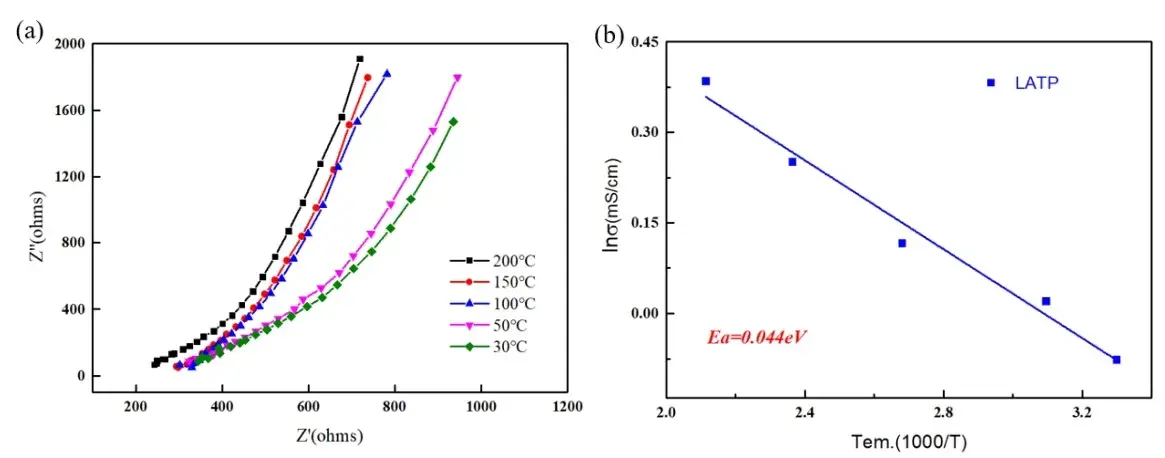
Figure 3. (a) Nyquist plots for LATP at different temperatures, (b) Arrhenius plot of ionic conductivity versus temperature for LATP materials
The same Arrhenius plot conductivity methodology applies directly to polymer electrolytes — including PEO-based, PVDF-based, and composite gel polymer systems. For polymer electrolyte activation energy calculation, ionic conductivity is measured via EIS across a temperature range (typically 20–80°C), and ln(σ) is plotted against 1/T to extract Eₐ for Li-ion migration through the polymer matrix. Polymer electrolytes generally exhibit higher activation energies than oxide ceramics like LATP because ionic transport in polymer hosts couples to chain-segmental motion, which requires additional thermal energy. The measurement of activation energy in polymer electrolytes follows the same four-step procedure described in Section 3.3, with EIS replacing DC conductivity measurement as the primary characterization tool.
During solid electrolyte testing, pellet density, surface roughness, and structural integrity directly affect measured conductivity values. Uniform, stable pressure throughout the measurement is essential for reliable EIS results. The solid electrolyte testing system developed by IEST Instrument applies continuous, standardized pressure to maintain consistent electrode-electrolyte contact — a prerequisite for accurate Arrhenius slope extraction.
Lower \(E_{\text{a}}\) → better temperature resilience: Materials with smaller activated barriers (e.g., graphite, NCM) maintain higher conductivity at low T and exhibit superior rate capability under cold conditions.
Higher \(E_{\text{a}}\) → require mitigation: LFP’s higher \(E_{\text{a}}\) explains its poorer intrinsic electronic conductivity and why electrode formulations include conductive carbon and optimized compaction to improve percolation networks.
Solid electrolytes: LATP’s moderate \(E_{\text{a}}\) (0.044 eV) indicates temperature sensitivity of ionic transport; reducing Ea via dopants or optimized crystal pathways improves room-temperature ionic conductivity.
Stable contact & pressure control: For powdered electrodes, conductivity depends strongly on compaction density. Pressure must remain constant during temperature sweeps to avoid contact resistance artifacts that distort the Arrhenius slope.
High-resolution temperature control: Use small temperature steps and allow thermal equilibration before recording σ(T). Transient artifacts from insufficient equilibration distort the slope.
Units & constants: When extracting \(E_{\text{a}}\) from slope, be consistent with units (if slope \(= -E_{\text{a}} / k_{\text{B}}\), with \(k_{\text{B}} = 8.617 \times 10^{-5}\ \text{eV·K}^{-1}\) yields \(E_{\text{a}}\) in eV).
Error analysis: Report uncertainty from linear regression and replicate measurements to ensure statistical confidence in the extracted \(E_{\text{a}}\) value.
A common obstacle in how to measure activation energy accurately is the instability of contact resistance under varying temperatures. Traditional setups often suffer from pressure drift, which distorts the Arrhenius slope. The IEST PRCD3100 solve this by providing:
High-Resolution Thermal Synchronization: Captures micro-level voltage transitions at each temperature step, providing high-fidelity \(\sigma(T)\) data for reliable \(E_{\text{a}}\) extraction.
Material screening: Compare \(E_{\text{a}}\) from Arrhenius plot conductivity to prioritize materials with low thermal activation barriers for low-temperature applications.
Process optimization: Use \(E_{\text{a}}\) together with σ₀ to distinguish whether temperature sensitivity (\(E_{\text{a}}\)) or intrinsic prefactor (σ₀, microstructure) limits performance.
Model inputs: \(E_{\text{a}}\) values provide critical parameters for physics-based battery models and thermal-electrochemical simulations.
Report both \(E_{\text{a}}\) and \(\sigma_0\) from Arrhenius fits — they convey complementary information: barrier height and intrinsic prefactor.
Standardize compaction/pressure for powder conductivity tests; log sample dimensions and contact geometry.
Validate linearity of the Arrhenius plot; curvature may indicate multiple conduction mechanisms or phase changes.
Use \(E_{\text{a}}\) in design trade-offs: for electrodes, balance composition (e.g., Ni content) with mechanical robustness and acceptable \(E_{\text{a}}\) to meet target rate and temperature performance.
Temperature-dependent conductivity measurements, interpreted through the Arrhenius equation and visualized as an Arrhenius plot, provide a rigorous and experimentally accessible method for quantifying charge transport barriers in battery materials. The derived activation energy (\(E_{\text{a}}\)) serves as a direct indicator of how easily electrons or ions migrate — a parameter that governs rate capability, low-temperature performance, and the effectiveness of electrode engineering strategies.
The pre-exponential factor \(\sigma_0\), which is material-specific and temperature-independent, provides complementary information about intrinsic transport properties and microstructural characteristics. Together, \(E_{\text{a}}\) and \(\sigma_0\) form the basis for reliable simulation inputs and targeted material design.
To determine activation energy from an Arrhenius plot: measure conductivity at a series of controlled temperatures, plot \(\ln(\sigma)\) versus \(1/T\), and extract \(E_{\text{a}}\) from the slope using \(k_2 = 8.617 \times 10^{-5}\ \text{eV·K}^{-1}\). For electrode powders, the IEST PRCD3100 ensures pressure-stable \(\sigma(T)\) data; for solid and polymer electrolytes, EIS-based impedance measurement at each temperature is the appropriate method. Benchmark values — graphite (\(0.025\ \text{eV}\)), NCM (\(0.041\ \text{eV}\)), LFP (\(0.116\ \text{eV}\)), LATP (\(0.044\ \text{eV}\)) — provide reference points for new material evaluation.
This methodology offers a reliable and scalable tool for battery material developers, providing essential kinetic data for simulation, optimization, and innovation in energy storage technologies.
[1] Wu Wenwei. Concise Inorganic Chemistry[M]. Chemical Industry Press, 2019.
[2] Weng S, Zhang X, Yang G, et al. Temperature-dependent interphase formation and Li+ transport in lithium metal batteries[J]. Nature communications, 2023, 14(1): 4474.
[3] Zhao Q, Liu X, Zheng J, et al. Designing electrolytes with polymerlike glass-forming properties and fast ion transport at low temperatures[J]. Proceedings of the National Academy of Sciences, 2020, 117(42): 26053-26060.
In battery materials, activation energy (Eₐ) is the minimum energy barrier that charge carriers — lithium ions or electrons — must overcome to migrate through a material, expressed in electronvolts (eV). It is a key intrinsic property that determines how easily a material conducts electricity and how sensitive its conductivity is to temperature. Lower Eₐ indicates more facile charge transport and less performance degradation at low temperatures — graphite (0.025 eV) outperforms LFP (0.116 eV) precisely because of this difference.
To calculate activation energy from an Arrhenius plot: (1) Measure the material’s conductivity (σ) at a minimum of 5–6 controlled temperatures. (2) Apply the Arrhenius equation: σ = σ₀ exp(−Eₐ/k₂T). (3) Plot ln(σ) versus 1/T to create the linearized Arrhenius plot. (4) Perform linear regression; the slope equals −Eₐ/k₂. Multiply the absolute slope by Boltzmann’s constant (k₂ = 8.617 × 10⁻⁵ eV·K⁻¹) to obtain Eₐ in electronvolts. For electrode powders, pressure must remain constant throughout the temperature sweep to avoid contact resistance artifacts that distort the slope.
Measuring activation energy in solid electrolytes (e.g., LATP, LLZO) and polymer electrolytes (e.g., PEO-based systems) requires Electrochemical Impedance Spectroscopy (EIS). EIS separates bulk ionic resistance from grain boundary contributions in the Nyquist plot. By recording EIS spectra at multiple controlled temperatures, extracting bulk ionic conductivity at each point, and plotting ln(σ) versus 1/T, the activation energy is calculated from the slope (Eₐ = −slope × k₂). LATP yields Eₐ = 0.044 eV via this method. Polymer electrolytes typically show higher Eₐ values (0.05–0.30 eV depending on composition) because Li-ion migration couples to chain-segmental motion in the polymer host.
An Arrhenius plot is a graph of ln(conductivity) versus 1/T (inverse absolute temperature). In battery research, it is the standard tool for determining activation energy and comparing the temperature dependence of electrode materials, solid electrolytes, and polymer electrolytes. The slope of the straight line equals −Eₐ/k₂, from which Eₐ is directly extracted. A steeper slope indicates higher Eₐ and more severe conductivity loss at low temperatures — as seen in LFP (0.116 eV) compared to graphite (0.025 eV).
Activation energy (Eₐ) determines how sharply a battery material’s conductivity drops with decreasing temperature. Materials with lower Eₐ — such as graphite (0.025 eV) — maintain higher conductivity in cold conditions, enabling fast charging and sustained high power in low-temperature environments. For electrode design, Eₐ informs decisions about conductive additive content and compaction density. For solid and polymer electrolyte selection, it is the primary metric for comparing ionic transport efficiency across different electrolyte chemistries.
Polymer electrolyte activation energy calculation follows the same Arrhenius plot methodology as for solid ceramics. Ionic conductivity is measured via EIS across the relevant temperature range (typically 20–80°C for polymer systems), and ln(σ) is plotted against 1/T. The slope yields −Eₐ/k₂, from which Eₐ is calculated. Polymer electrolytes generally show higher activation energies than oxide solid electrolytes because Li-ion migration in polymer hosts is coupled to chain-segmental motion. Reducing Eₐ through plasticizer addition, nanofiller incorporation, or optimized salt concentration is a key strategy for improving room-temperature ionic conductivity in polymer electrolyte systems.