-
iestinstrument

Abstract
1. What Is a Powder Compression Test in Lithium-Ion Battery Material Development?
In new energy battery R&D and manufacturing, mechanical property testing of powder electrode materials is a core step for evaluating material performance and optimizing processing parameters. Systematic powder mechanical testing quantifies the deformation behavior and structural load-bearing capacity of a material under different applied pressures, supplying data for electrode formulation design and compaction process parameters, and helping to avoid production defects and service risks caused by mismatched mechanical properties. Powder mechanical testing also reveals the structural failure mechanisms that occur during charge-discharge cycling, pointing toward design improvements for higher-performance, longer-life battery materials.
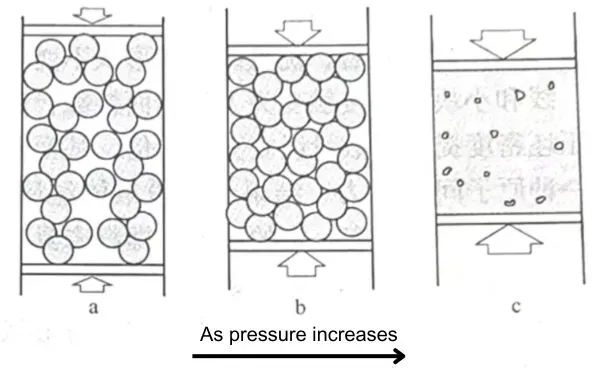
Figure 1. Schematic diagram of the powder compression process used to evaluate elastic and plastic deformation in electrode powder materials.
2. Why Does Elastic Recovery of Electrode Powder Materials Determine Battery Cycle Life?
Among the mechanical performance indicators of powder materials, elastic performance is a particularly decisive dimension for the real-world performance of new energy battery electrode materials. During lithium-ion battery charge-discharge cycling, host materials undergo substantial volume changes as lithium ions insert and extract — silicon-based materials, for example, can reach a volume expansion ratio above 300% [1]. This process causes continuous accumulation of internal particle stress, which can lead to structural degradation, cracking, and pulverization, ultimately producing rapid capacity fade, shortened cycle life, and safety concerns [2].
Research indicates that the elastic recovery capability of electrode powder materials is significantly and positively correlated with battery cycle life [3]. Strong elastic deformation performance relieves internal stress concentration through a stress-redistribution mechanism, reducing irreversible structural damage and preserving electrode structural integrity across repeated charge-discharge cycles [4]. Establishing precise, efficient powder elasticity testing methods — capable of extracting elastic modulus, reversible deformation ratio, and deformation energy ratio — is therefore a necessary prerequisite for optimizing electrode material design and improving overall battery performance [5].
3. What Equipment and Methods Are Used for Powder Mechanical Property Characterization?
3.1 Test Equipment
Figure 2 shows the compaction density and mechanical property tester (PRCD Series, IEST Instrument) used in this study. The system is configured to cover mechanical property testing needs across the full workflow of lithium battery material R&D, electrode process development, and production, enabling integrated, precise testing of mechanical parameters from powder, to electrode sheet, to cell, and to battery buffer-pad components. This links fundamental material-level testing to finished-battery service performance, so that powder mechanical test data can directly support electrode process optimization and cell structural design.
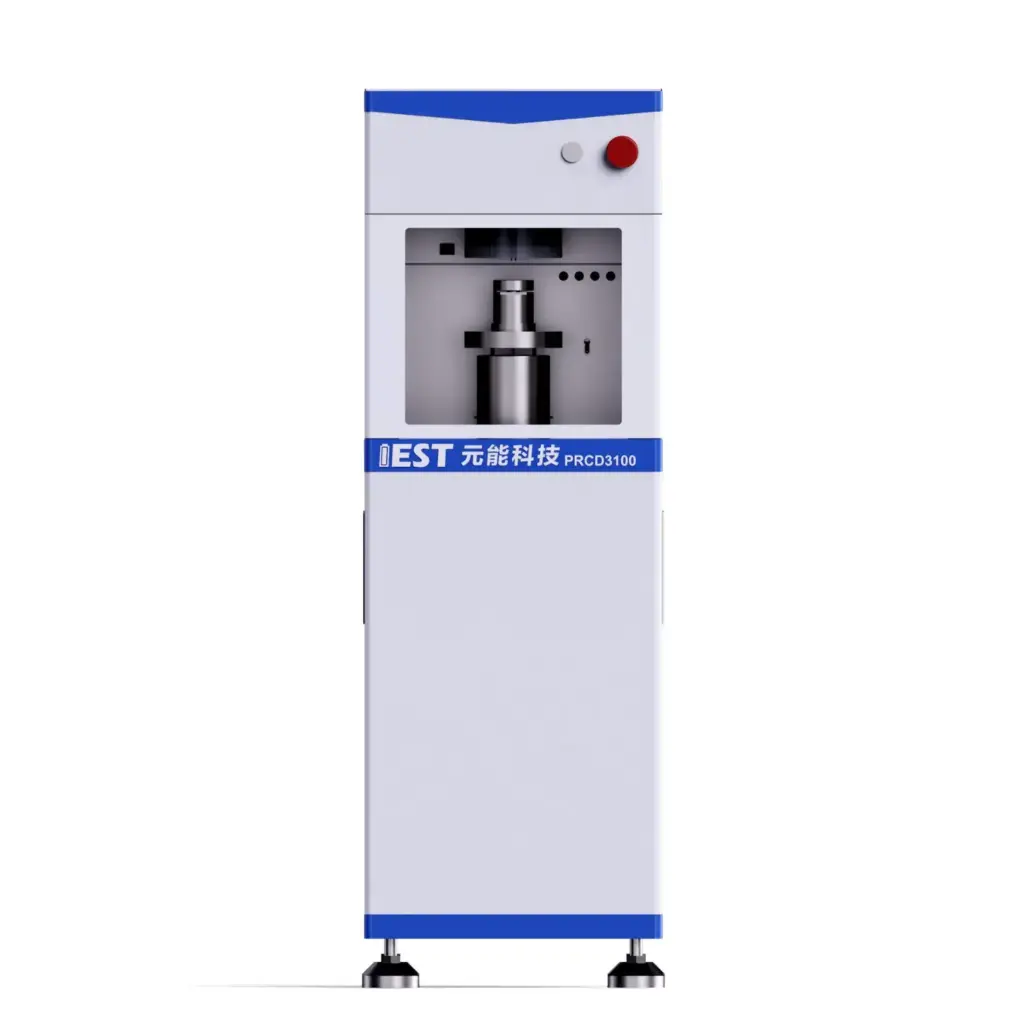
Figure 2. Powder compaction density and mechanical property tester (PRCD Series, IEST Instrument), covering testing needs from powder to electrode sheet, cell, and buffer-pad components.
3.2 Test and Analysis Methods
Three powder samples with different elastic characteristics were tested by applying quantified, stepwise pressure and analyzing each material’s deformation-recovery behavior. The following methods were combined for testing and analysis:
- Steady-state compression test: stepwise pressure (100 MPa to 200 MPa) is applied to the powder using PCD-series equipment while thickness change is recorded, distinguishing elastic (reversible) deformation from plastic (irreversible) deformation.
- Heckel equation analysis: the stress-density relationship curve is used to calculate the powder’s elastic parameters; a smaller Heckel coefficient ($k$ value) indicates that particles more readily fill pore space through elastic deformation rather than plastic deformation.
- Elastic deformation analysis: the ratio of reversible deformation to maximum deformation, derived from the Heckel curve, is used to evaluate overall material elasticity.
- Deformation energy calculation: the area under the pressure-displacement curve is integrated to quantify the proportion of energy consumed by elastic deformation.
3.3 Comparing Traditional Powder Compressibility Testing with the IEST Steady-State + Heckel Approach
Table 1. Comparison of traditional method and IEST PRCD Series method across testing parameters.
| Testing Matrix | Traditional Method | IEST PRCD Method | Scientific Value / Improvement |
|---|---|---|---|
| Pressure protocol | Single fixed pressure point (e.g., ASTM B331 compressibility test at one target pressure) | Stepwise steady-state pressure, 100 MPa to 200 MPa | Captures the full deformation path rather than a single density value |
| Deformation separation | Reports only overall compacted density; elastic and plastic components not separated | Reversible (elastic) vs. irreversible (plastic) deformation quantified separately | Enables direct linkage between elastic recovery ratio and expected cycle-life behavior |
| Mechanistic parameter | None (density value only) | Heckel coefficient (k value) and deformation energy ratio | Provides a mechanism-level indicator of elastic vs. plastic densification behavior |
4. How Do Reversible and Irreversible Deformation Ratios Reveal Powder Elasticity?
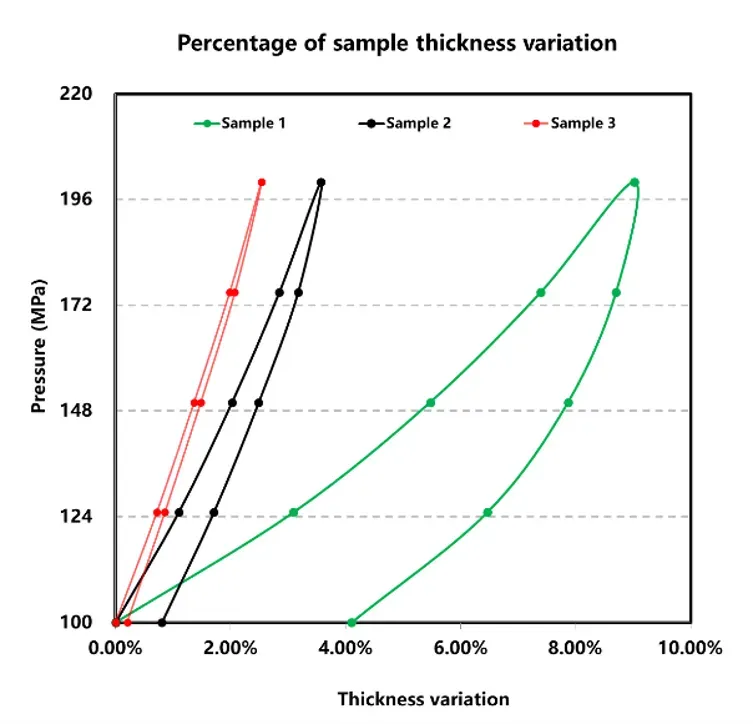
Figure 3. Steady-state compression performance curves for Samples 1-3, measured by IEST PRCD Series, showing thickness change under stepwise applied pressure of 100 MPa to 200 MPa.
Figure 3 shows the steady-state compression results for the three samples; the curves show clear differences among the three materials. Combining the curve data, the reversible deformation amount, irreversible deformation amount, maximum deformation amount, and the ratio of reversible to maximum deformation for each sample are summarized in Table 2. The reversible deformation ratio directly reflects a material’s ability to recover its original shape after the external load is removed: a higher ratio indicates better elastic performance, while a lower ratio indicates deformation dominated by plastic behavior.
Table 2. Reversible and irreversible deformation analysis across samples.
| Sample | Reversible Deformation | Irreversible Deformation | Maximum Deformation | Reversible / Maximum Ratio |
|---|---|---|---|---|
| Sample 1 | 4.91% | 4.11% | 9.02% | 54.47% |
| Sample 2 | 2.17% | 0.8% | 3.57% | 77.48% |
| Sample 3 | 2.33% | 0.20% | 2.53% | 92.14% |
Note: Sample 2’s irreversible and maximum deformation values are derived from its confirmed reversible deformation value and its stated 77.48% ratio, as the source figure’s absolute values could not be extracted with full confidence; the reversible deformation ratios (54.47% / 77.48% / 92.14%) are directly stated in the original data and carry no uncertainty.
The three samples were selected on the expectation that elasticity would increase sequentially, with Sample 3 expected to show very good elasticity. The test results confirmed this expectation:
- Sample 1’s reversible deformation ratio was 54.47%, meaning slightly more than half of the total deformation under compression was recoverable elastic deformation — a fairly significant elastic behavior.
- Sample 2’s reversible deformation ratio was 77.48%, indicating mechanical behavior dominated by elasticity.
- Sample 3’s reversible deformation ratio reached 92.14%, meaning deformation was almost entirely elastic — near-ideal elastic behavior with the strongest resistance to permanent deformation among the three samples.
5. Summary: What Does Powder Compression Testing Tell Battery Material Developers?
This application study examined the role of powder compression testing in evaluating mechanical performance for new energy and industrial materials. The elastic recovery capability of a material directly affects its structural stability, and quantitative evaluation of elastic performance — including reversible deformation ratio and elastic modulus — is a core basis for optimizing electrode material design. The steady-state test method on the IEST PRCD Series obtains mechanical and electrical performance parameters through stepwise steady-state pressure testing, combined with Heckel equation analysis of the stress-strain relationship and deformation-energy integration to quantify elastic recovery efficiency.
The reversible deformation ratio effectively characterizes a material’s elastic quality, providing a multi-dimensional basis for identifying failure mechanisms and guiding performance optimization. Translating this testing framework from laboratory to industrial application supports quality assessment across new energy material development and related manufacturing process optimization, contributing to more scientific and precise design of high-performance electrode materials.
Evaluate Powder Elasticity and Compaction Behavior with the IEST PRCD Series
Separating elastic recovery from plastic deformation requires a testing protocol that goes beyond a single compacted-density value. IEST Instrument’s PRCD Series supports stepwise steady-state compression testing, Heckel equation analysis, and deformation-energy integration across the same sample set — connecting powder-level mechanical data to electrode, cell, and buffer-pad level performance.
6. References
[1] Zhang W, Li M, Wang Q. Research progress on mechanical property testing methods for powder metallurgy materials. Materials Reports, 2020, 34(7): 1301-1308.
[2] CHEN Z, QIAN J, AI X, et al. Stress mitigation in anode materials for lithium-ion batteries[J]. Advanced Materials, 2022, 34(18): 2105716.
[3] LI J, DHAWALE D, CHEN R, et al. In situ measurement of mechanical property and stress evolution in silicon composite electrodes[J]. Journal of Power Sources, 2021, 485: 229327.
[4] ASTM International. ASTM B331-20 Standard test method for compressibility of metal powders[C]. West Conshohocken: ASTM, 2020.
[5] HECKEL R W. Density-pressure relationships in powder compaction[J]. Transactions of the Metallurgical Society of AIME, 1961, 221(4): 671-675.
7. FAQs
7.1 What is a powder compression test for lithium-ion battery materials?
A powder compression test for lithium-ion battery materials applies stepwise pressure to an electrode powder bed and records thickness change to separate reversible (elastic) deformation from irreversible (plastic) deformation. It supports evaluation of compaction density, elastic modulus, and deformation energy ratio, which relate to electrode structural stability during charge-discharge cycling.
7.2 What is the difference between reversible and irreversible deformation in powder materials?
Reversible (elastic) deformation is recovered once the applied pressure is removed, while irreversible (plastic) deformation remains as permanent structural change. A high reversible deformation ratio, such as the 92.14% measured for Sample 3, indicates deformation dominated by elastic recovery rather than permanent particle rearrangement.
7.3 How does the Heckel equation work in powder compaction analysis?
The Heckel equation relates powder density to applied pressure through the compaction coefficient, or k value, calculated from the stress-density relationship curve. A smaller Heckel k value indicates that particles densify mainly through elastic deformation rather than plastic deformation, supporting comparison of compaction behavior across different powder formulations.
7.4 How is powder compaction density related to elastic recovery?
Powder compaction density reflects how closely particles pack under applied pressure, while elastic recovery reflects how much of that packing deformation is reversible. A powder that reaches high compaction density mainly through elastic deformation, rather than plastic deformation, is expected to retain structural integrity better across repeated compression-release cycles.
7.5 How do I choose a powder compaction tester for battery electrode R&D?
Selecting a powder compaction tester for battery electrode R&D depends on whether stepwise steady-state pressure testing and separation of elastic/plastic deformation are required, in addition to a single compacted-density measurement. The IEST PRCD Series addresses these requirements by combining steady-state compression, Heckel equation analysis, and deformation-energy calculation, and by extending testing from powder to electrode sheet, cell, and buffer-pad components.
7.6 What reversible deformation ratio is considered good elastic performance for electrode powders?
In this study, a reversible deformation ratio above roughly 75-90% (as observed for Samples 2 and 3, at 77.48% and 92.14%) reflected deformation behavior dominated by elastic recovery. Ratios closer to 50-55%, as measured for Sample 1 at 54.47%, indicated a more balanced mix of elastic and plastic deformation. Acceptable ranges should be confirmed against the specific electrode formulation and cycle-life requirement.