-
iestinstrument

Abstract
Pouch cell swelling refers to the reversible and irreversible dimensional changes—in volume and thickness—that occur during lithium-ion intercalation and de-intercalation. Reversible swelling arises from lattice expansion during cycling and localized thermal effects; irreversible swelling originates from gas evolution and permanent structural phase changes that accumulate over repeated cycles. Two complementary in-situ methods quantify these effects: direct volume monitoring via the Archimedes principle (IEST GVM2200) and thickness-based swelling measurement under controlled mechanical load (IEST SWE2110). To measure pressure in a pouch cell indirectly, the SWE2110 operates in constant-gap mode, recording expansion force over a defined contact area and converting it to pressure. This article presents synchronized volume, thickness, and differential capacity data from a NCM811/graphite pouch cell (47 × 35 × 4 mm³, ~0.7 Ah) across two consecutive charge-discharge cycles.
1. Background: Why Pouch Cell Swelling Measurement Matters
For lithium-ion batteries encapsulated with aluminum-plastic film, internal volume changes during cycling impose mechanical stress on the cell casing, tabs, and seals. Unmanaged swelling degrades capacity, rate capability, and safety—and in extreme cases drives seam fatigue and electrolyte leakage. Pouch cell swelling is therefore a primary engineering constraint in battery pack design, directly influencing the specification of cell swelling management systems and the selection of swelling pads.
Cell expansion divides into two categories. Reversible swelling is defined here as the net dimensional change that fully recovers when the cell returns to its initial state of charge; it includes lattice volume changes during Li⁺ intercalation/de-intercalation and thermal swelling from electrochemical heat generation. Irreversible swelling refers to permanent dimensional growth caused by gas evolution (SEI decomposition, electrolyte oxidation) and irreversible structural phase changes in electrode materials—this component accumulates with cycle number and is a direct predictor of end-of-life.
Quantifying both components simultaneously—in real time, under controlled conditions—is the purpose of the in-situ swelling analysis described here.
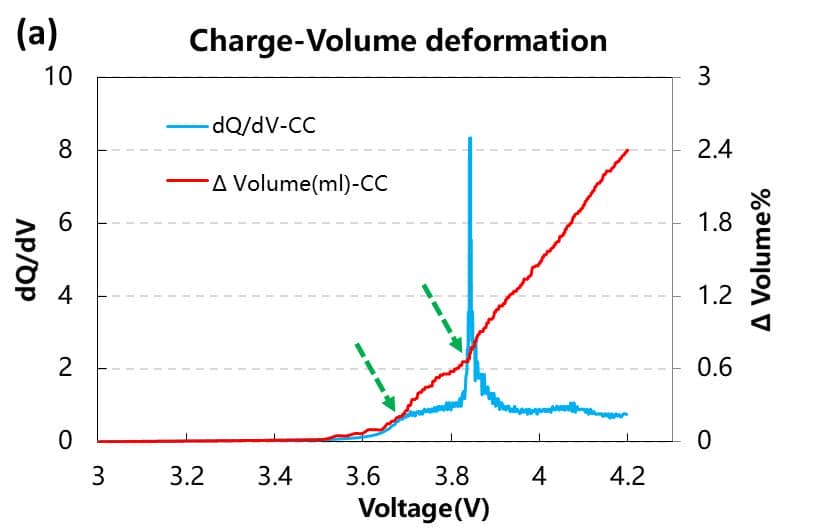
Figure 1. In-situ test schematics: (a) cell volume measurement via liquid displacement (GVM2200); (b) pouch thickness and expansion pressure measurement under mechanical constraint (SWE2110)
2. Experimental Equipment and Test Methods
2.1 Key Instruments
Accurate in-situ characterization of pouch cell swelling requires instruments that synchronize electrochemical data with mechanical measurements without interrupting the cell’s natural cycling behavior.
2.1.1 In-Situ Gas & Volume Monitor (IEST GVM2200)
- Temperature range: 20 °C – 85 °C
- Dual-channel synchronous testing (two pouch cells simultaneously)
- Continuously records cell volume, gas evolution, temperature, voltage, current, and capacity
The GVM2200 measures absolute volume change via the Archimedes displacement principle, making it the reference method for tracking total cell expansion including gas-driven irreversible growth.
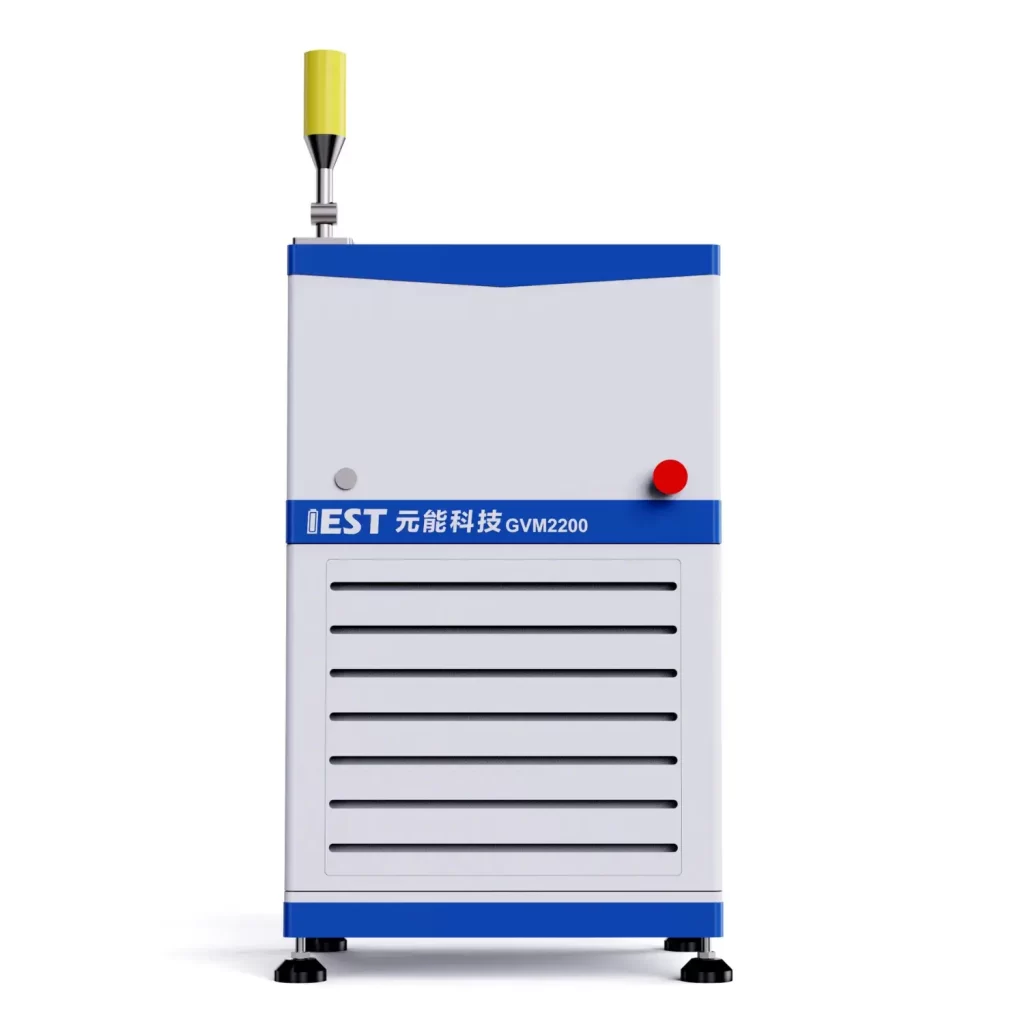
Figure 2. IEST GVM2200 in-situ gas & volume monitor — dual-channel logging of volume change, gas evolution, temperature, voltage, and current
2.1.2 In-situ Swelling Analyzer (SWE2110 – IEST)
The SWE2110 directly measures thickness change of a pouch cell under a defined applied pressure, enabling researchers to measure pressure in the pouch cell environment indirectly. Operating in constant-gap or controlled-compression mode, it records expansion force over a known contact area—the key method for measuring pouch thickness changes as a function of state of charge, C-rate, and cycle number. This simulates the mechanical constraints found in a real battery pack module.
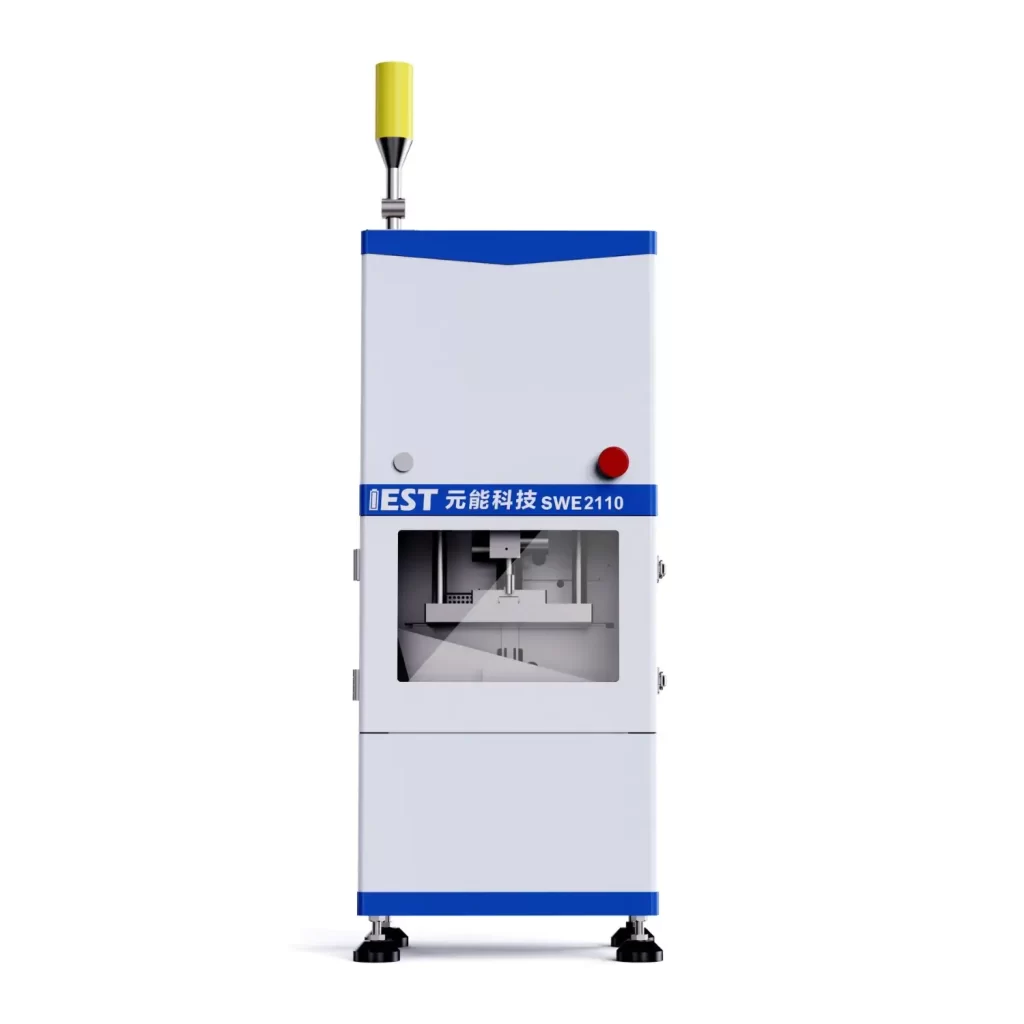
Figure 3. IEST SWE2110 in-situ swelling analyzer — pressure-dependent thickness measurement for comprehensive pouch cell swelling characterization
Together, the GVM2200 and SWE2110 provide a complete picture of pouch cell swelling: volume-based total expansion from the GVM and through-thickness local deformation with force data from the SWE. This dual approach distinguishes gas-driven irreversible growth from mechanically recoverable lattice expansion.
2.2 Test Protocols
-
Conditioning: 25 °C rest for 5 min.
-
Charge: 1C constant current (CC) to 4.2 V, then CV to 0.025C; rest 5 min.
-
Discharge: 1C constant discharge (DC) to 2.8 V.
-
Swelling is monitored across two adjacent cycles to capture repeatability and irreversible drift.
2.3 Measurement Workflows
-
Cell volume measurement (GVM2200): record initial cell mass (m₀), place cell in channel, set sampling interval and channel ID in software. The system logs real-time volume change and synchronizes electrochemical data automatically.
-
Cell thickness measurement (SWE2110): mount cell, define sampling frequency. The system records thickness, Δthickness, voltage, current, temperature, and capacity in real time—providing the primary data stream for measuring pouch thickness evolution during cycling.
-
How to measure pressure in a pouch cell: operate the SWE2110 in constant-gap mode to record the force exerted by the expanding cell against a fixed boundary. Dividing measured force by the contact area yields equivalent internal pressure. Alternatively, combine GVM2200 volume data with a mechanical stiffness model of the pouch package to infer pressure from measured dimensional change.
3. In-Situ Pouch Cell Swelling Analysis: Results
3.1 Overall Swelling Behavior During Full Charge-Discharge Cycles
In-situ swelling analysis was performed across two consecutive charge-discharge cycles on the same cell. Cell design and capacity data are summarized in Table 1.
| Cell Design | Cell Size (mm) | Cycle | CC (Ah) | CV (Ah) | DC (Ah) | Coulombic Efficiency |
|---|---|---|---|---|---|---|
| NCM811/Graphite | 47 × 35 × 4 | 1st cycle | 0.5615 | 0.7001 | 0.6282 | 89.7% |
| 2nd cycle | 0.5231 | 0.6802 | 0.6064 | 89.1% |
Figure 4(a) plots cell volume vs. time and voltage; Figure 4(b) shows thickness vs. time and voltage for the same cell across one full charge-discharge cycle. Key observations:
-
During CC charging, both volume and thickness increase monotonically as lithium intercalates into graphite and de-intercalates from the NCM cathode.
-
During the CV stage, both metrics decrease slightly as lithium concentration gradients within the anode relax.
-
During CC discharge, volume first rises briefly then falls; thickness remains nearly constant initially before decreasing.
-
Percentage changes in volume and thickness are broadly consistent, confirming that through-thickness deformation is the primary driver of macroscopic volume change—which validates measuring pouch thickness as a proxy for total cell expansion.
These synchronized signals demonstrate how pouch cell swelling is tied to electrochemical state: intercalation steps, phase transitions and thermal effects all produce measurable mechanical responses.
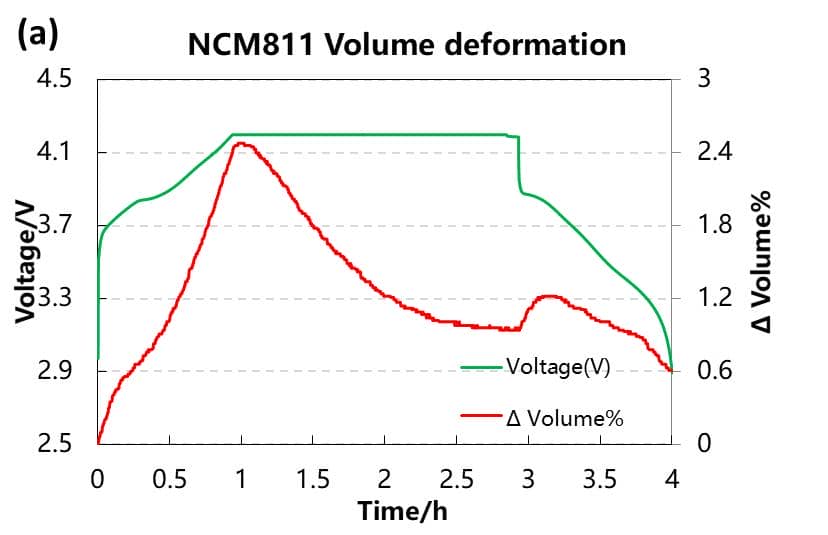
Figure 4(a). Voltage and volume change during charge-discharge — NCM811/Graphite pouch cell at 1C (GVM2200)
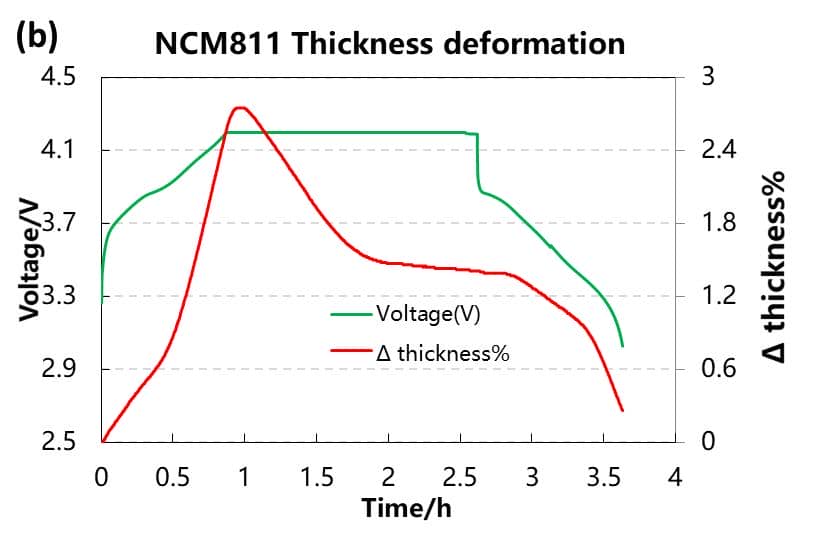
Figure 4(b). Voltage and pouch thickness change during charge-discharge — in-situ measurement (SWE2110)
3.2 Swelling During Constant Current Charging
Figure 5 (a) and (b) delve deeper by plotting the differential capacity (dQ/dV)—which identifies electrochemical phase transitions—against the swelling curves. The clear correlation is vital for understanding the root cause of pouch cell swelling. Each peak in the dQ/dV curve, signifying a phase change in the anode or cathode material, corresponds to a distinct change in the slope of the volume and thickness curves. This directly links mechanical expansion to electrochemical activity.
Figure 5(a). dQ/dV and volume change during CC charging — phase transitions drive incremental swelling
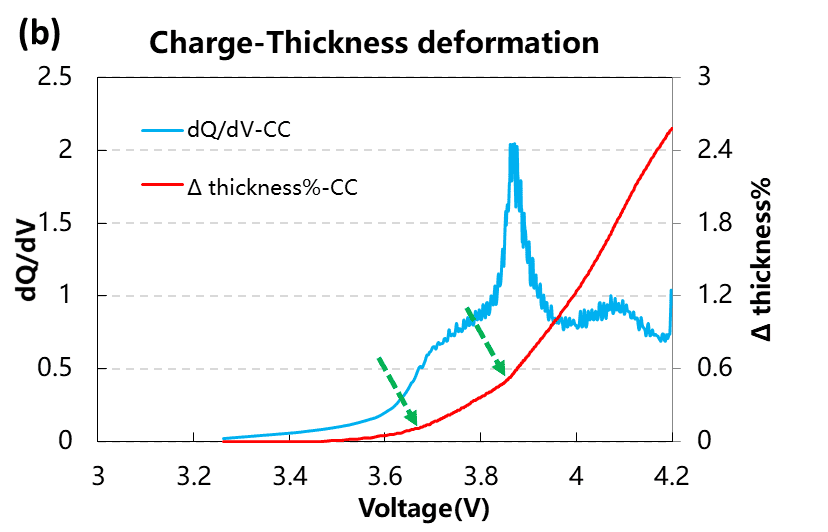
Figure 5(b). dQ/dV and thickness change during CC charging — correlation between electrode phase transitions and pouch cell swelling
3.3 Swelling Behavior During Constant Voltage Charging
During the CV hold phase (Figure 6a & b), current decreases exponentially. The lithium concentration gradient within the graphite anode relaxes, directly observable as a gradual decrease and stabilization of both volume and thickness.
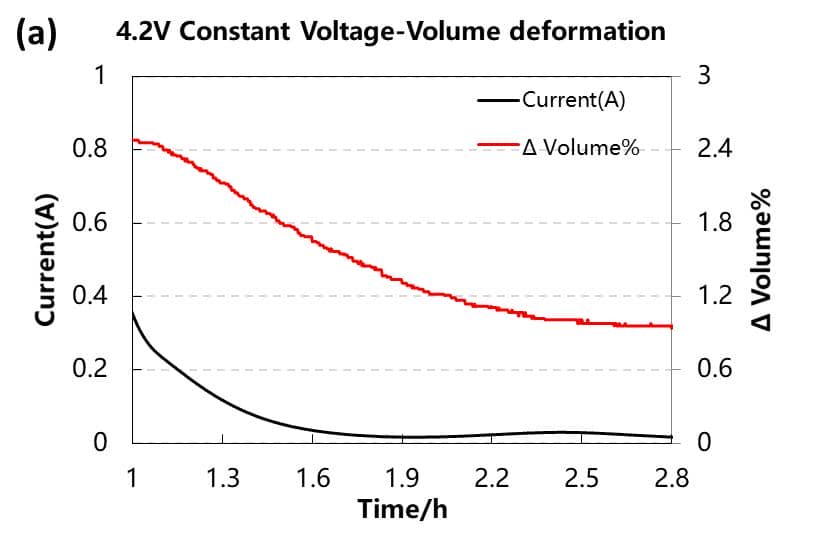
Figure 6(a). Current and volume changes during CV charging — swelling relaxation as concentration gradient dissipates
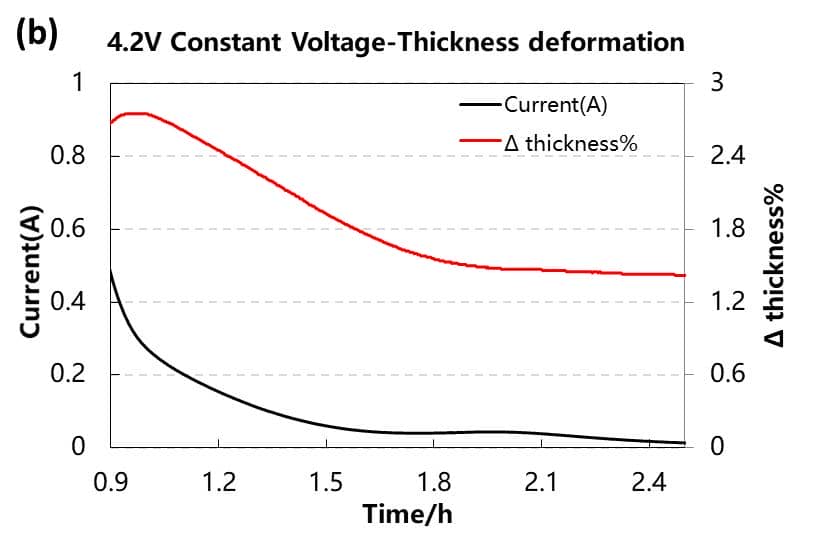
Figure 6(b). Current and pouch thickness changes during CV hold — thickness stabilization confirms gradient equalization
3.4 Asymmetric Swelling Behavior During Constant Current Discharge
The discharge process (Figure 7 a & b) reveals the non-equilibrium nature of pouch cell swelling. An initial volume expansion of ~0.3% is observed, potentially linked to a phase transition (Hexagonal 3→Hexagonal 2) in the NCM cathode material as lithium ions are re-inserted. Notably, this initial expansion is not clearly seen in the thickness data, highlighting the value of multi-dimensional analysis. Furthermore, the pouch cell swelling during charge and discharge is not perfectly symmetrical. This hysteresis is a key indicator of irreversible swelling, caused by incomplete structural recovery of the electrode materials 4, which accumulates over cycles and leads to performance degradation.
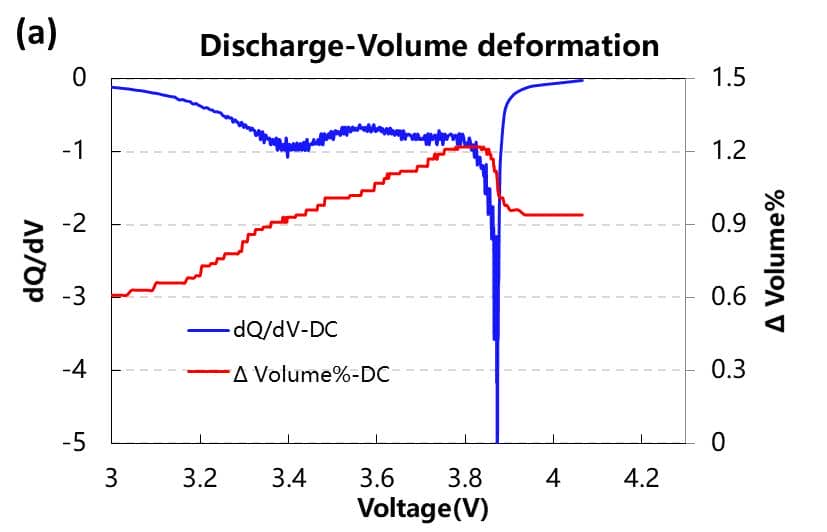
Figure 7(a). dQ/dV and volume change during CC discharge — ~0.3% initial expansion (H3→H2); swelling asymmetry indicates irreversible growth
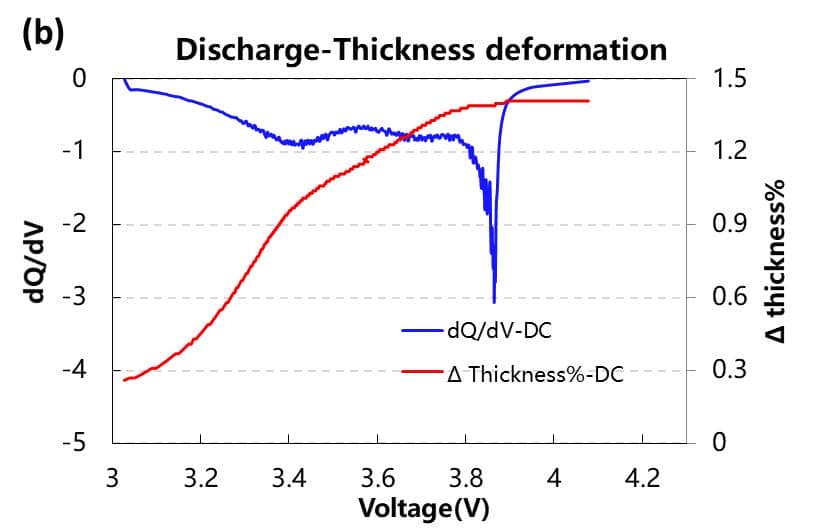
Figure 7(b). dQ/dV and pouch thickness change during CC discharge — hysteresis quantifies irreversible swelling per cycle
4. Summary
This study used the IEST GVM2200 and SWE2110 to perform comprehensive in-situ pouch cell swelling analysis on an NCM811/graphite cell across two consecutive 1C cycles. Key findings:
- Volume and thickness changes track closely throughout cycling.
- dQ/dV peaks correlate directly with inflection points in the swelling curves.
- The CV hold stage produces measurable swelling recovery via concentration gradient relaxation.
- An initial ~0.3% volume expansion at discharge onset is linked to an NCM cathode phase transition.
- Charge-discharge hysteresis quantifies irreversible swelling.
5. References
[1] Ruihe Li, Minggao Ouyang et al. Volume Deformation of Large-Format Lithium Ion Batteries under Different Degradation Paths. Journal of The Electrochemical Society, 2019, 166 (16) A4106-A4114
[2] Shiyao Zheng, Yong Yang et al. Correlation between long range and local structural changes in Ni-rich layered materials during charge and discharge process. J. Power Sources. 2019,412,336–343;
[3] Y. Reynier, R. Yazami, B. Fultz. The entropy and enthalpy of lithium intercalation into graphite. Journal of Power Sources .2003, 119–121 850–855
[4] Jan N. Reimers and J. R. Dahn. Electrochemical and In Situ X-Ray Diffraction Studies of Lithium Intercalation in LixCoO2. Journal of Electrochemical Society, 1992, 139, 8
[5] Haifeng Dai, Chenchen Yu, Xuezhe Wei, Zechang Sun. State of charge estimation for lithium-ion pouch batteries based on stress measurement. Energy, 2017,129, 16.
6. FAQs
6.1 How do you measure pressure in a pouch cell?
Pressure in a pouch cell is measured indirectly using one of two in-situ methods. The first uses a swelling analyzer such as the IEST SWE2110 in constant-gap mode: the cell is constrained between fixed plates and the expansion force it exerts is recorded; dividing this force by the contact area yields pressure in MPa or kPa. The second method combines absolute volume change data from the GVM2200 with a mechanical stiffness model of the aluminum-plastic pouch package to infer internal pressure from measured dimensional change. Both approaches allow real-time, non-destructive pressure monitoring during cycling.
6.2 What causes pouch cell swelling, and is it reversible?
Pouch cell swelling has two distinct causes. Reversible swelling arises from lattice volume changes during Li⁺ intercalation and de-intercalation (graphite anode expands ~10% in volume when fully lithiated) and from thermal expansion during electrochemical heat generation. Irreversible swelling is caused by gas evolution from electrolyte decomposition and SEI growth, and by permanent structural phase changes in electrode materials. Reversible swelling recovers each cycle; irreversible swelling accumulates cycle by cycle and is a primary driver of capacity fade and pack-level degradation.
6.3 What is the best method for measuring pouch cell thickness in real time?
The most reliable approach for measuring pouch thickness in real time is an in-situ swelling analyzer such as the IEST SWE2110. The instrument applies a defined preload pressure to the cell, then continuously records displacement (thickness change in µm or mm) synchronized with voltage, current, temperature, and capacity. This controlled-pressure setup simulates actual pack conditions and eliminates measurement artifacts from uncontrolled probe contact. Sampling frequencies can be set to capture fast transients during phase transitions in the dQ/dV profile.
6.4 What are pouch cell swelling pads, and when are they needed?
Swelling pads (also called compression pads or foam pads) are compliant elastic materials placed between cells in a battery module to absorb dimensional changes during cycling and accommodate irreversible swelling over the cell’s lifetime. They are a core component of cell swelling management systems in automotive and energy storage applications. In-situ swelling data—particularly the total irreversible growth per cycle and the peak swelling force—are required inputs for specifying the correct pad stiffness, thickness, and compression ratio to maintain controlled contact pressure throughout the battery’s service life.
6.5 What is the difference between volume measurement and thickness measurement for cell swelling analysis?
Volume measurement (GVM2200, Archimedes method) captures the total dimensional change of the cell including gas evolution, making it the more sensitive indicator of irreversible swelling from gassing. Thickness measurement (SWE2110) captures through-thickness deformation under a defined mechanical constraint, which more closely represents what a cell experiences inside a battery pack. The two methods complement each other: volume data quantifies absolute expansion including non-uniform bulging, while thickness data under controlled pressure provides the mechanical input for pack design. Running both in parallel, as in this study, allows researchers to separate elastic, plastic, and gas-driven swelling components.