
Tesla 4680 battery technology is reshaping the electric vehicle (EV) market, competing directly with the BYD Blade battery through fundamentally different design philosophies. A collaborative teardown study conducted by Fraunhofer IKTS, MEET at the University of Münster, and PEM of RWTH Aachen University—published in Cell Reports Physical Science—provides a detailed comparison of the BYD Blade battery vs Tesla 4680 battery, highlighting differences in design, materials, manufacturing methods, and market positioning.
Tesla leverages its 4680 battery cells to maximize energy density and overall performance, while BYD emphasizes cost efficiency and safety with its prismatic Blade cells. This divergence underscores the contrasting strategies between high-performance EVs and mass-market affordability, setting the stage for the growing EV battery market bifurcation.
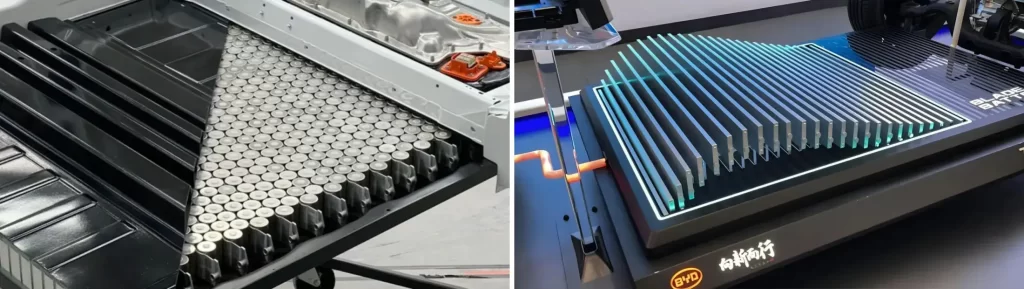
Figure 1. Visual comparison of the BYD Blade prismatic battery cell vs the Tesla 4680 cylindrical battery cell.
| Feature | Tesla 4680 Battery | BYD Blade Battery |
|---|---|---|
| Cell Format | Cylindrical (46 mm × 80 mm) | Prismatic (long, flat Blade) |
| Chemistry | NCM811 (Nickel-Cobalt-Manganese) | LFP (Lithium Iron Phosphate) |
| Gravimetric Energy Density | 241 Wh/kg | 160 Wh/kg |
| Volumetric Energy Density | 643.3 Wh/L | 355 Wh/L |
| Volume-Specific Heat Generation (1C) | 2.3× higher than Blade | Baseline (lower) |
| Material Cost Advantage | Benchmark | ~€10/kWh lower |
| Electrode Assembly | Tabless jelly-roll, laser welding | Stacked lamination, hybrid laser + ultrasonic welding |
| Anode Binder | PAA + PEO | CMC + SBR |
| Core Market | High-performance, long-range EVs | Mass-market, cost-sensitive EVs |
The Tesla 4680 battery employs a tabless design with NCM811 cathode chemistry, optimized for high energy density — 241 Wh/kg gravimetric and 643.3 Wh/L volumetric. Its jelly-roll electrode configuration, joined by laser welding for inter-electrode connections, minimizes internal resistance and enhances current collection efficiency by eliminating the conventional tab structure that typically limits current flow in large-format cylindrical cells.
The BYD Blade battery adopts LFP chemistry, prioritizing thermal stability and cost efficiency over peak energy density. Its elongated, flat prismatic design integrates stacked electrodes secured via hybrid laser and ultrasonic welding, achieving mechanical robustness and simplified thermal management. The Blade cell’s lower energy density — 160 Wh/kg, 355 Wh/L — is a deliberate engineering trade-off that enables a simpler pack architecture and eliminates the need for cobalt and nickel in the cathode, directly contributing to its material cost advantage.
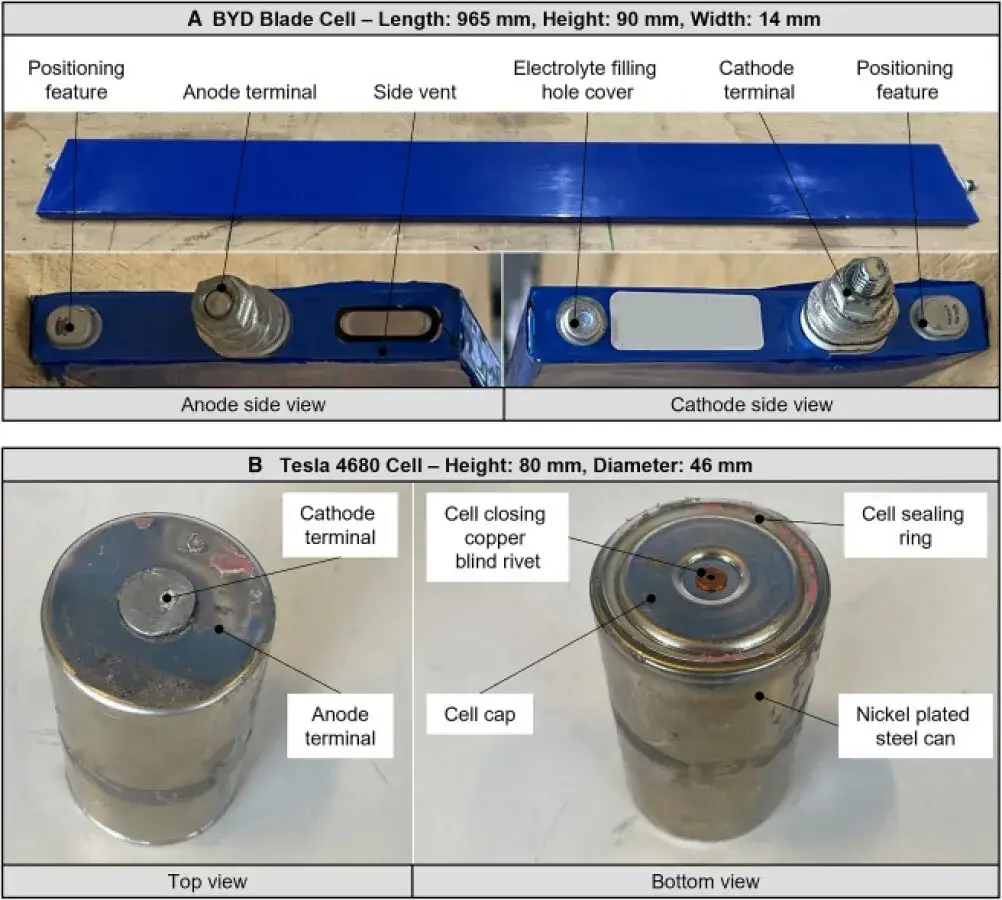
Figure 2. BYD Blade battery and Tesla 4680 cell outside features, dimensions, and format — from the collaborative teardown study published in Cell Reports Physical Science.
The superior energy storage of the Tesla 4680 battery cell — 241 Wh/kg vs the Blade’s 160 Wh/kg — comes with a significant thermal management challenge: volume-specific heat generation at 1C is 2.3× higher than the Blade cell. This drives the need for advanced cooling architecture in 4680-based packs. Tesla’s tabless design directly addresses part of this challenge by lowering DCIR (Direct Current Internal Resistance), which reduces resistive heat generation during high-power discharge. However, the NCM811 chemistry itself generates substantially more heat per unit volume than LFP under equivalent load conditions.
The BYD Blade battery, despite its lower energy density (160 Wh/kg, 355 Wh/L), offers exceptional thermal stability — an inherent property of LFP chemistry — and long cycle life. The flat prismatic format also enables cell-to-pack integration that simplifies heat dissipation. This BYD Blade battery vs Tesla 4680 battery thermal contrast directly reflects the two manufacturers’ market priorities: Tesla optimizes for energy density and range; BYD optimizes for safety, durability, and cost in mass-market applications.
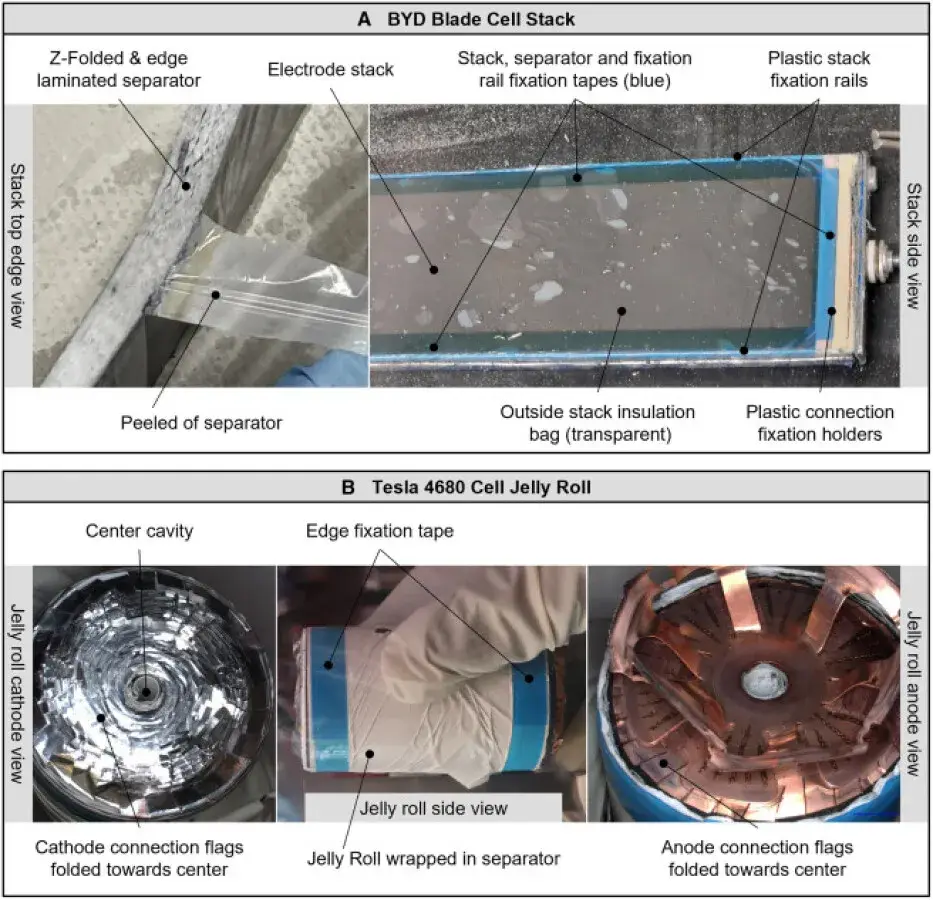
Figure 3. Internal electrode configurations and features: Tesla 4680 tabless jelly-roll cell (left) vs BYD Blade stacked electrode prismatic cell (right).
Beyond chemistry and energy density, the manufacturing methodologies exhibit distinct contrasts that directly affect production cost, scalability, and electrode performance.
Tesla employs a tabless electrode design to improve electrical flow and minimize resistance throughout the jelly-roll structure. The 4680 cell uses laser welding for electrode connections and a continuous coating process to enhance production throughput. Both graphite anode and NCM811 cathode electrodes are processed through a jelly-roll winding step, and the tabless current collection architecture is a key manufacturing innovation that differentiates the 4680 from earlier large-format cylindrical formats.
BYD leverages a proprietary lamination process to ensure precise electrode stacking, enabling the creation of the exceptionally large electrode assemblies that define the Blade format. The company adopts a hybrid laser and ultrasonic welding strategy that optimizes spatial efficiency for electrode-to-terminal connections within the flat prismatic housing. The material cost advantage of approximately €10/kWh — confirmed by the teardown study — stems from LFP cathode chemistry (eliminating cobalt and nickel), simplified structural components, and manufacturing processes optimized for high-volume production.
Both manufacturers use graphite anode electrodes, but differ in binder systems: Tesla uses polyacrylic acid (PAA) and polyethylene oxide (PEO), while BYD uses carboxymethyl cellulose (CMC) and styrene butadiene rubber (SBR). PAA and PEO are known for stronger adhesion to silicon-containing anodes and potential silicon compatibility, but their long-term stability under repeated volume changes requires ongoing characterization.
The choice of binders like PAA and PEO is critical for electrode integrity. However, their swelling or degradation over time can compromise the conductive network. Monitoring Electrode Resistance is the most direct way to evaluate these microscopic changes.
Recommended Solution:
IEST Battery Electrode Sheet Resistance Tester(BER Series) provides precise, in-situ measurement of through-thickness resistance, helping researchers quantify how binder formulations impact the long-term conductive stability of 4680 and Blade-style electrodes.
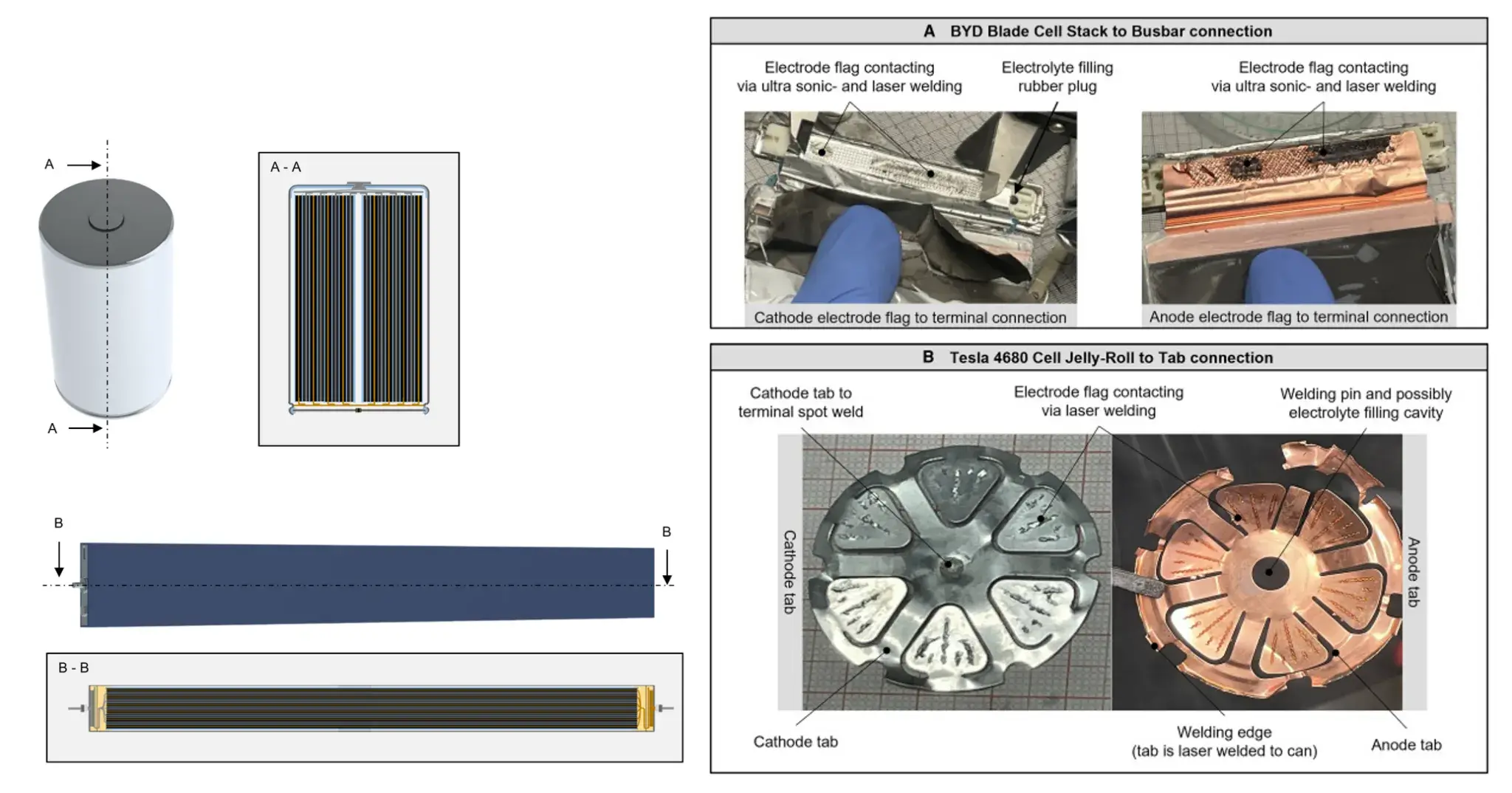
Figure 4. Internal electrical connection components and contacting technology: Tesla 4680 (laser welding) vs BYD Blade (hybrid laser and ultrasonic welding).
The Tesla 4680 battery continues to serve as a benchmark for premium EVs, targeting long-range applications with maximized energy density — 241 Wh/kg places it among the highest-density commercial lithium-ion cells currently in production. However, BYD’s Blade cell has propelled BYD to surpass Tesla in global EV sales volume, reflecting its alignment with mass-market demands for affordability and reliability over peak range. The Blade battery’s design — optimized for scalability, safety, and pack integration simplicity — positions LFP as a dominant choice for cost-conscious EV manufacturers globally.
The approximately €10/kWh material cost advantage of the BYD Blade battery over the Tesla 4680 — stemming from LFP chemistry’s cobalt- and nickel-free cathode — is not merely a cost metric; it determines the price point at which EVs can be sold profitably in markets where consumer price sensitivity is the primary adoption barrier.
The teardown study highlights a durable industry bifurcation: NCM-based systems for performance-driven segments requiring maximum range and power density, versus LFP for cost-sensitive markets where safety, longevity, and total cost of ownership dominate the purchasing decision. As EV adoption accelerates, next-generation cells must balance energy density improvements, thermal management efficiency, and manufacturing cost reduction simultaneously.
Tesla’s continued advances in 4680 cell production efficiency — reducing per-kWh manufacturing cost while maintaining the 241 Wh/kg energy density advantage — and BYD’s manufacturing scale innovations in the Blade format exemplify the two dominant paths through which the EV battery market is maturing. The 2026 EV landscape will not converge on a single chemistry or format but will sustain both pathways as they serve distinct market segments.
Contrasting a BYD Blade prismatic cell and Tesla 4680 cylindrical cell with a teardown analysis of design and performance. Cell Reports Physical Science, 2025.
IEST Instrument is a high-tech enterprise specializing in R&D and production of precision lithium-ion battery test instruments. Its product portfolio covers electrode resistance characterization, EIS testing, in-situ cell swelling measurement, single-particle electrochemical imaging, and battery cycler systems — addressing the full spectrum of characterization needs for both conventional and next-generation cell formats including 4680 cylindrical and Blade-format prismatic cells. IEST holds over 100 authorized patents and serves customers across more than 40 countries in Europe, North America, and Asia-Pacific.
The Tesla 4680 battery cell achieves a gravimetric energy density of 241 Wh/kg and a volumetric energy density of 643.3 Wh/L. This high energy density is primarily attributable to its NCM811 cathode chemistry and the optimized tabless cylindrical design that minimizes inactive material mass and reduces internal resistance.
The BYD Blade battery delivers approximately 160 Wh/kg (355 Wh/L) — about 34% lower gravimetric energy density than the Tesla 4680’s 241 Wh/kg. The Blade compensates with superior thermal stability, longer cycle life, and a material cost advantage of approximately €10/kWh relative to Tesla’s NCM811-based 4680 cells, making it better suited for cost-sensitive mass-market EV applications.
At a 1C discharge rate, the Tesla 4680 battery cell generates approximately 2.3× more heat per unit volume than the BYD Blade cell. This elevated heat generation is primarily due to NCM811 chemistry’s higher exothermic reactions under load compared to LFP, and to the cylindrical cell format’s inherently lower surface-to-volume ratio. Tesla’s tabless design lowers DCIR to partially mitigate this, but the chemistry-driven thermal output still requires more sophisticated cooling systems in 4680-based battery packs.
The core differences are cell format, chemistry, and electrode assembly. The Tesla 4680 uses a large cylindrical cell (46 mm × 80 mm) with a tabless jelly-roll design and NCM811 cathode — optimized for maximum energy density (241 Wh/kg) and power output. The BYD Blade uses a long, flat prismatic cell with stacked LFP electrodes — optimized for thermal stability, pack integration efficiency, long cycle life, and lower material cost. Both use graphite anodes but differ in binder systems: Tesla uses PAA + PEO; BYD uses CMC + SBR. difference between Tesla 4680 and BYD Blade battery designs?
The BYD Blade Battery’s material cost advantage of approximately €10/kWh over the Tesla 4680 stems from three factors: (1) LFP cathode chemistry eliminates expensive nickel and cobalt; (2) the prismatic cell-to-pack design reduces the number of structural components and cooling elements needed; and (3) BYD’s high-volume lamination and welding processes are optimized for mass-market scalability. This cost structure has enabled BYD to price EVs competitively enough to surpass Tesla in global unit sales.