-
iestinstrument

Abstract
1. Introduction
EIS functions as a non-destructive diagnostic tool for lithium-ion batteries: by decomposing the cell’s internal electrochemical and transport processes across different time scales, it reveals information that voltage or capacity measurements alone cannot provide. This report compares the performance of the IEST ERT7008 (ERT7 series) against a well-known international electrochemical workstation to evaluate how closely their EIS measurements agree across common cell formats and test modes. The evaluation covers static EIS battery testing in PEIS and GEIS modes, as well as dynamic EIS measurement during active cycling.
2. How EIS Frequency Regions Reveal Battery Internal Processes
EIS characterizes a battery’s AC impedance by applying a small-amplitude sinusoidal signal across a frequency spectrum, with results typically presented as a Nyquist plot (Z’ vs −Z”). Each frequency region of the EIS spectrum corresponds to a distinct electrochemical process within the cell, enabling quantitative assessment of SEI film stability, charge transfer efficiency, and lithium-ion diffusion rates.
2.1 Li⁺ Transport Pathway and Nyquist Plot Interpretation
Understanding the Li⁺ transport sequence within a cell enables direct mapping of each step to a specific feature on the Nyquist plot. The transport sequence proceeds as follows:
- External circuit: Electron conduction from Cu current collector into the graphite anode.
- Graphite anode: Li⁺ intercalation into graphite, passing through the SEI film.
- Electrolyte: Li⁺ solvation and migration through the porous separator.
- Cathode (e.g., LiCoO₂): Li⁺ de-solvation, passage through any surface film, and intercalation into the cathode active material.
- External circuit: Electron conduction via the Al current collector.
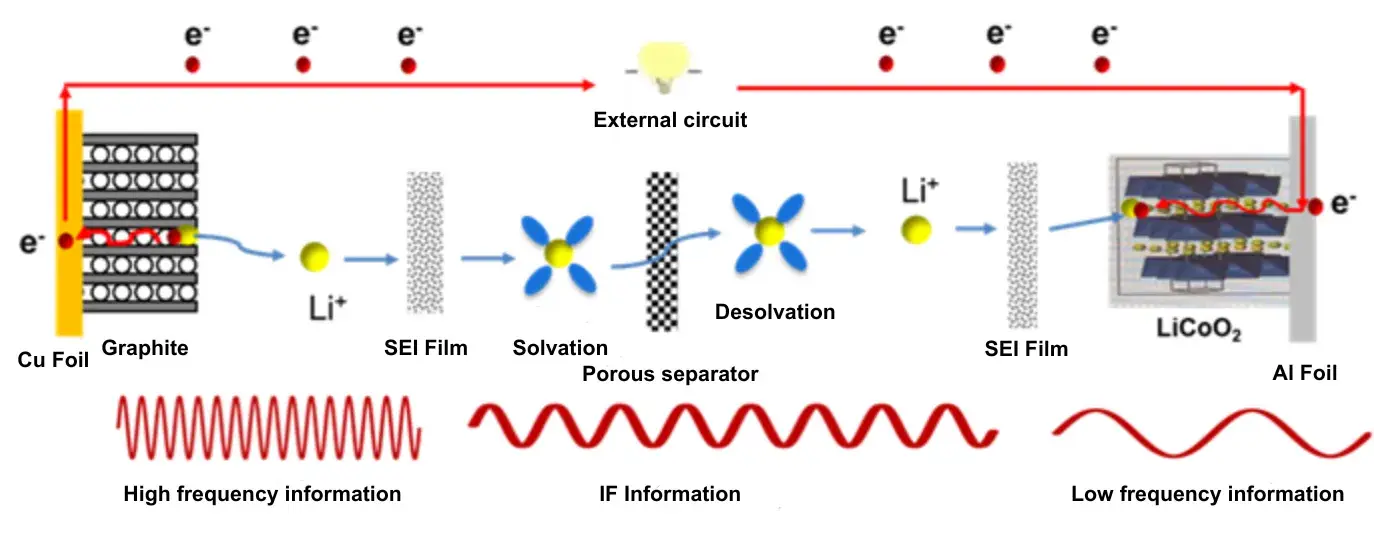
Figure 1. Li⁺ transport pathway in a lithium-ion battery and the corresponding electrochemical processes, each associated with a distinct time constant in the EIS spectrum.
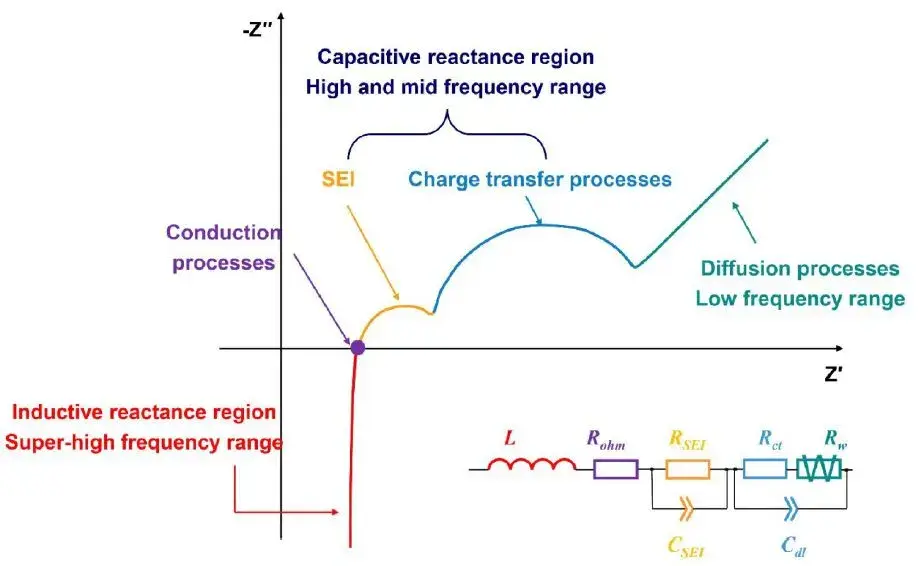
Figure 2. Typical EIS Nyquist plot for a lithium-ion battery with characteristic frequency regions identified: high-frequency SEI semicircle, mid-frequency charge transfer semicircle, and low-frequency Warburg diffusion tail.
By deconvoluting the impedance response across distinct EIS frequency domains, three key electrochemical parameters can be quantitatively resolved: SEI film resistance (\(R_{SEI}\)), charge transfer resistance (\(R_{ct}\)), and diffusion impedance (\(Z_W\)).
2.2 High-Frequency Region — SEI Film Resistance (\(R_{SEI}\))
- Process: Ionic transport impedance of Li⁺ through the SEI layer.
- \(R_{SEI}\): Resistance of the SEI film — increases with film thickening during aging.
- \(C_{SEI}\): Capacitance of the SEI layer, reflecting its double-layer characteristics.
2.3 Mid-Frequency Region — Charge Transfer Resistance (\(R_{ct}\))
- Process: Charge transfer reaction at the electrode/electrolyte interface — Li⁺ intercalation/deintercalation in graphite (anode) and LiCoO₂ (cathode).
- \(R_{ct}\): Charge transfer resistance, indicating the kinetics of the electrochemical reaction.
- (C_{dl}\): Double-layer capacitance at the electrode/electrolyte interface.
2.4 Low-Frequency Region — Solid-State Diffusion (Warburg Impedance \(Z_W\))
- Process: Solid-state diffusion of Li⁺ within the bulk electrode active material (inside graphite or LiCoO₂ particles).
- \(Z_W\)): Warburg diffusion impedance, inversely proportional to the square root of frequency, appearing as a 45° slope on the Nyquist plot.
3. PEIS vs GEIS: Choosing the Right EIS Mode for Battery Testing
The choice between PEIS and GEIS is the most critical EIS battery test configuration decision — selecting the wrong mode for a given cell format produces unreliable impedance data and can damage the cell. The two modes differ in how the AC excitation signal is applied and which parameter is controlled.
| Parameter | PEIS (Potentiostatic EIS) | GEIS (Galvanostatic EIS) |
|---|---|---|
| Excitation signal | Constant AC voltage amplitude (e.g., 10 mV) | Constant AC current amplitude (e.g., 80 mA) |
| Controlled parameter | Voltage (potential) | Current (galvanostatic) |
| Best suited for | Coin cells, lab-scale cells, high-impedance systems | Pouch cells, cylindrical cells, low-impedance systems |
| Typical cell impedance | High (kΩ range) | Low (mΩ range) |
| Risk with wrong mode | Current overdrive in low-impedance large cells | Voltage overdrive in high-impedance small cells |
| ERT7008 test example | Coin cell, 4.15 V, 25°C, 10 mV signal, 100 kHz–0.1 Hz | 2 Ah pouch cell, 3.19 V, 25°C, 80 mA AC, 100 kHz–0.1 Hz |
PEIS applies a fixed small-amplitude AC voltage across the cell and measures the resulting current response. Because the voltage amplitude is fixed regardless of cell impedance, PEIS is suited to high-impedance systems such as coin cells and small lab cells where a 10 mV excitation produces a well-defined, linearity-compliant current response. Applying PEIS to a large, low-impedance pouch cell risks driving excessive currents.
GEIS applies a fixed small-amplitude AC current and measures the voltage response. For large-format, low-impedance cells — where the impedance may be in the single-digit milliohm range — a controlled current amplitude of, for example, 80 mA produces a well-defined millivolt-scale voltage response that complies with linearity requirements. GEIS is therefore the appropriate mode for production-format pouch and cylindrical cells.
4. EIS Battery Test Validation: IEST ERT7008 vs International Electrochemical Workstation
Two cell formats were selected to evaluate EIS data agreement between the IEST ERT7008 and a well-known international electrochemical workstation across both PEIS and GEIS modes.
4.1 Coin Cell EIS — PEIS Mode (100 kHz–0.1 Hz, 10 mV, 4.15 V, 25°C)
EIS data for the coin cell in PEIS mode demonstrates exceptional congruence between the IEST ERT7008 (green curve) and the international workstation (red curve) across the full frequency range from 100 kHz to 0.1 Hz. The Nyquist plots overlay with a high degree of impedance data matching — the high-frequency SEI semicircle, mid-frequency charge transfer semicircle, and low-frequency Warburg diffusion tail are all faithfully reproduced by the ERT7008.
4.2 Pouch Cell EIS — GEIS Mode (100 kHz–0.1 Hz, 80 mA AC, 3.19 V, 25°C)
EIS results for the 2 Ah pouch cell in GEIS mode show only minor discrepancies between the IEST ERT7008 and the international electrochemical workstation, with deviations consistently below 5% across all impedance features. The low-impedance, large-format cell format represents the more demanding validation condition for an EIS analyzer — the sub-5% agreement confirms that the ERT7008’s galvanostatic signal control and current measurement precision are adequate for production-format cell characterization.
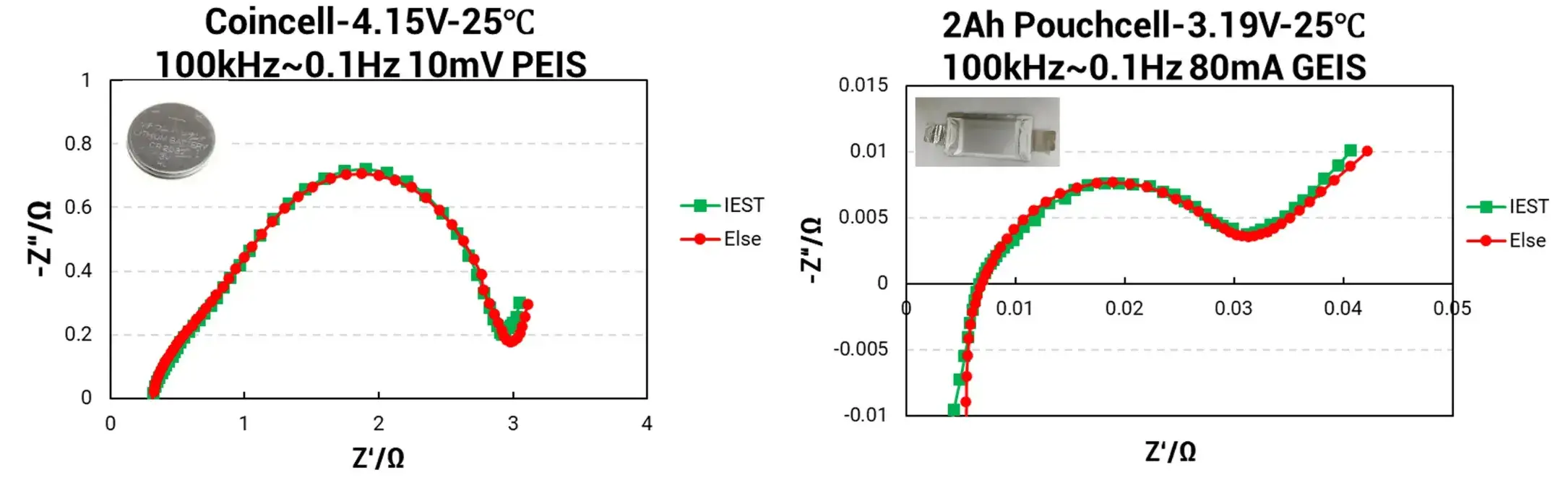
Figure 3. EIS Analysis–Different Cell Impedance Analysis
3.2 Results
The EIS data for the Coin Cell demonstrates exceptional congruence between the IEST ERT7008 (green curve) and the competitor equipment (red curve), indicating a very high degree of impedance data matching. Similarly, EIS results for the Pouch Cell show only minor discrepancies between the IEST system and the international electrochemical workstation, with deviations consistently below 5%.
5. IEST ERT7 Series EIS Analyzer: Key Specifications
5.1 Frequency Range: 0.01 Hz to 100 kHz
The low-frequency segment below 1 Hz probes solid-state diffusion processes (Warburg impedance), while the high-frequency segment above 10 kHz captures ohmic and contact resistance. The 0.01 Hz lower bound enables characterization of slow diffusion processes that would be invisible to analyzers with a 0.1 Hz floor — relevant for thick electrodes and solid electrolyte systems. The 100 kHz upper bound ensures accurate capture of the SEI semicircle in its entirety.
5.2 Impedance Range: 10 mΩ to kΩ
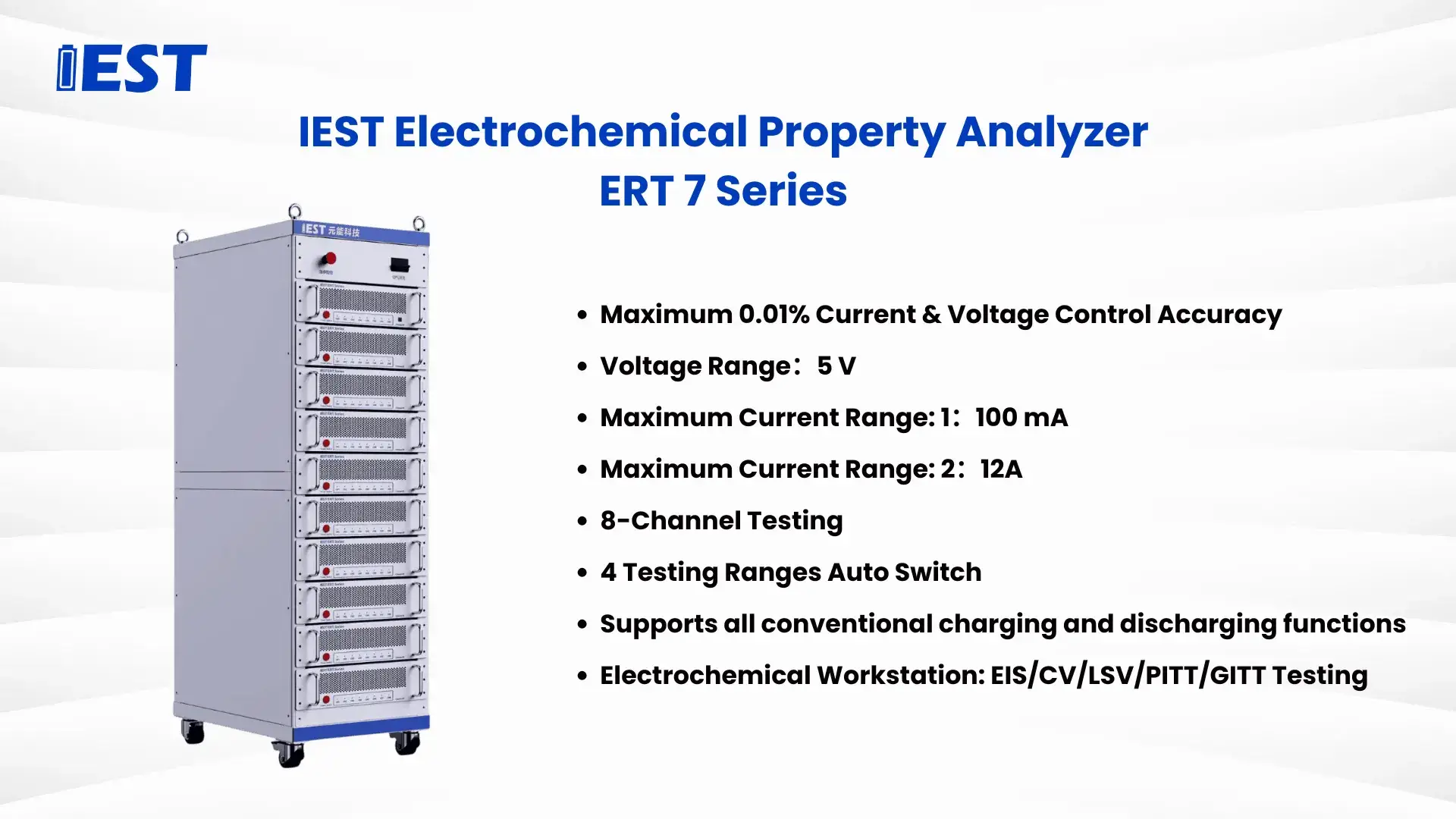
The ERT7008 accommodates cell impedances from 10 mΩ (production-format large pouch cells) to kΩ (lab-scale half-cells and coin cells) within a single instrument. A high-precision signal source and low-noise measurement architecture ensure accurate resolution of subtle impedance changes across this six-order-of-magnitude range — without requiring external boosters or switching between multiple measurement heads.
5.3 PEIS and GEIS Mode Support
The ERT7 series natively supports both PEIS (potentiostatic EIS) for high-impedance coin and lab cells, and GEIS (galvanostatic EIS) for low-impedance production-format cells, within the same instrument and software environment. This eliminates the need to maintain separate instruments for different cell formats or test protocols.
5.4 Comparison with Standalone Electrochemical Workstations
| Comparison Item | Standalone Electrochemical Workstation | IEST ERT7 Series EIS Analyzer |
|---|---|---|
| Price | Premium pricing tier | Significant cost reduction vs comparable workstations |
| Technical support | Email-based response cycles | Rapid technical support and after-sales service |
| Functional scope | Stand-alone EIS testing only | Integrated charge–discharge cycling + EIS battery test + dynamic EIS in one system |
| Dynamic EIS capability | Limited or unavailable | DC bias range from microamps to >10 A; full dynamic EIS and in-situ EIS support |
| EIS modes | PEIS or GEIS (often single mode) | Both PEIS and GEIS natively supported |
6. Application Cases
6.1 EIS Battery Testing at Different SOC and DOD States
Performing EIS battery tests at multiple States of Charge (SOC) and Depths of Discharge (DOD) provides a continuous picture of how internal electrochemical parameters evolve during operation. As SOC changes, \(R_{ct}\), \(R_{SEI}\), and \(Z_W\) each shift in ways that reflect Li\(^+\) migration rates, charge exchange kinetics, and interface film stability. Systematic SOC-dependent EIS measurements are therefore essential for cell performance assessment, degradation trend analysis, and electrochemical model parameterization for battery management systems.
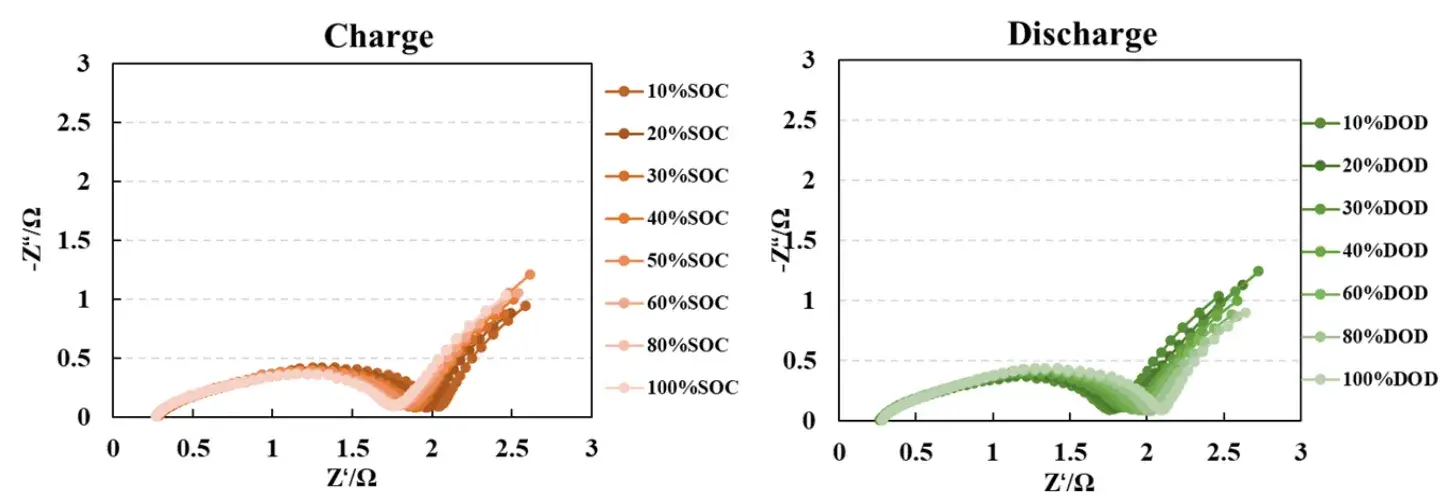
Figure 4. EIS battery test results at different SOC and DOD levels using the IEST ERT7 series. Shifts in the Nyquist plot across SOC reveal changes in charge transfer kinetics and SEI stability throughout the charge–discharge window.
6.2 Dynamic EIS — In-Situ EIS During Active Cycling
Dynamic EIS — also referred to as in-situ EIS — eliminates the rest periods required by conventional static EIS battery tests by acquiring impedance spectra continuously while the cell is charging or discharging. This enables real-time observation of how \(R_{SEI}\), \(R_{ct}\), and \(Z_W\) evolve as a function of SOC, current rate, and cycle number — capturing transient electrochemical states that equilibrium measurements systematically miss.
The IEST ERT7 series supports dynamic EIS with a DC bias current range extending from microamps to over 10 A, covering coin cell half-cell studies through production-format full cells. This range makes the ERT7008 applicable to both fundamental research — where very low currents are required to maintain pseudo-equilibrium — and applied testing of commercial cells under near-operational conditions.

Figure 5. Dynamic EIS (in-situ EIS) testing using the IEST ERT7 series: real-time impedance spectra acquired continuously during charge–discharge cycling, revealing SOC-dependent evolution of \(R_{ct}\), \(R_{SEI}\), and diffusion impedance.
7. Conclusion
The IEST ERT7008 demonstrates broad frequency coverage (0.01 Hz–100 kHz), wide impedance range (10 mΩ–kΩ), native PEIS and GEIS mode support, and continuous dynamic EIS capability — validated against a leading international electrochemical workstation with deviations below 5% on both coin and pouch cell formats. For battery R&D teams requiring accurate, versatile, and cost-effective EIS battery test capability — including in-situ EIS and dynamic EIS during cycling — the ERT7 series presents a fully integrated alternative to standalone electrochemical workstations that addresses the full PEIS-to-GEIS cell format range within a single platform.
8. FAQs
8.1 What is the difference between PEIS and GEIS in EIS battery testing?
PEIS (Potentiostatic EIS) applies a fixed small-amplitude AC voltage (e.g., 10 mV) and measures the resulting current response — suited to high-impedance systems such as coin cells and lab-scale half-cells. GEIS (Galvanostatic EIS) applies a fixed AC current amplitude (e.g., 80 mA) and measures the voltage response — suited to low-impedance, large-format cells such as 2 Ah pouch cells and cylindrical cells. Selecting the wrong mode for a given cell format risks violating linearity requirements and producing unreliable impedance data. The IEST ERT7 series natively supports both PEIS and GEIS within a single instrument.
8.2 What is dynamic EIS testing in lithium batteries?
Dynamic EIS (also called in-situ EIS) acquires electrochemical impedance spectra continuously while the battery is actively charging or discharging, without requiring a rest period. Unlike static EIS battery tests that measure impedance at equilibrium, dynamic EIS captures how internal parameters — SEI resistance (R_SEI), charge transfer resistance (R_ct), and Warburg diffusion impedance (Z_W) — evolve in real time as a function of SOC and applied current. The IEST ERT7 series supports dynamic EIS with DC bias currents from microamps to over 10 A, covering coin cell to production-format full cell applications.
8.3 What frequency range is required for a complete EIS battery test?
A complete EIS battery test should cover at minimum 0.01 Hz to 100 kHz to resolve all three principal impedance regions. The high-frequency region above 10 kHz captures ohmic resistance and the SEI semicircle (R_SEI). The mid-frequency region from 1 Hz to 10 kHz resolves the charge transfer semicircle (R_ct). The low-frequency region below 1 Hz — extending down to 0.01 Hz — characterizes solid-state Li-ion diffusion within the electrode (Warburg impedance Z_W). Instruments limited to 0.1 Hz as their low-frequency bound cannot fully characterize thick electrodes or solid electrolyte systems where diffusion processes extend to much lower frequencies.
8.4 How accurate is the IEST ERT7008 compared to an international electrochemical workstation?
In head-to-head EIS battery test validation on a coin cell (PEIS mode, 10 mV, 4.15 V, 25°C) and a 2 Ah pouch cell (GEIS mode, 80 mA AC, 3.19 V, 25°C), the IEST ERT7008 produced Nyquist plots with exceptional spectral overlay against a well-known international electrochemical workstation on the coin cell, and deviations consistently below 5% on the pouch cell across the full 100 kHz to 0.1 Hz frequency range. This level of agreement meets the accuracy requirements for battery R&D characterization and production-line EIS screening applications.
8.5 What EIS parameters can be extracted from battery impedance spectroscopy?
EIS battery testing with full frequency coverage resolves three primary sets of electrochemical parameters. In the high-frequency region: SEI film resistance (R_SEI) and SEI capacitance (C_SEI) — R_SEI increases as the SEI thickens during aging. In the mid-frequency region: charge transfer resistance (R_ct) and double-layer capacitance (C_dl) — R_ct reflects the kinetics of the intercalation reaction and is SOC-dependent. In the low-frequency region: Warburg diffusion impedance (Z_W) — related to solid-state Li-ion diffusion within electrode active material particles. Dynamic EIS adds a time dimension, enabling R_ct, R_SEI, and Z_W to be tracked continuously as SOC and cycle number evolve.