
Sudden capacity fading—commonly termed “cycling dive“(or “cycle life plunge” )—and unexpected catastrophic failure in lithium-ion batteries are rarely isolated electrochemical events. In high-energy-density cell chemistries, capacity loss is intricately coupled with physical degradation: active material particle pulverization, binder-matrix debonding, electrode delamination, and macro-scale pouch/prismatic cell swelling. As battery design advances toward higher nickel content (e.g., Ni90+ NCM), silicon-carbon composite anodes, and solid-state architectures, engineers frequently prioritize specific capacity, working voltage windows, and ionic conductivity. However, overlooking the mechanical properties of lithium-ion battery electrode materials across their operational lifespan inevitably leads to premature cell failure.
During repeated lithiation and delithiation cycles, concentration gradients generate substantial diffusion-induced stress. This stress drives microcrack propagation along grain boundaries, fractures the solid electrolyte interphase (SEI), exposes fresh active surfaces to parasitic side reactions, and isolates active particles from the conductive network. Statistical surveys of academic battery literature from 2024 to 2026 reveal that research focusing on chemo-mechanical coupling now constitutes nearly 50% of published degradation studies. Evaluating mechanical properties has rapidly transitioned from an optional auxiliary measurement to a mandatory core discipline in battery R&D and quality control.
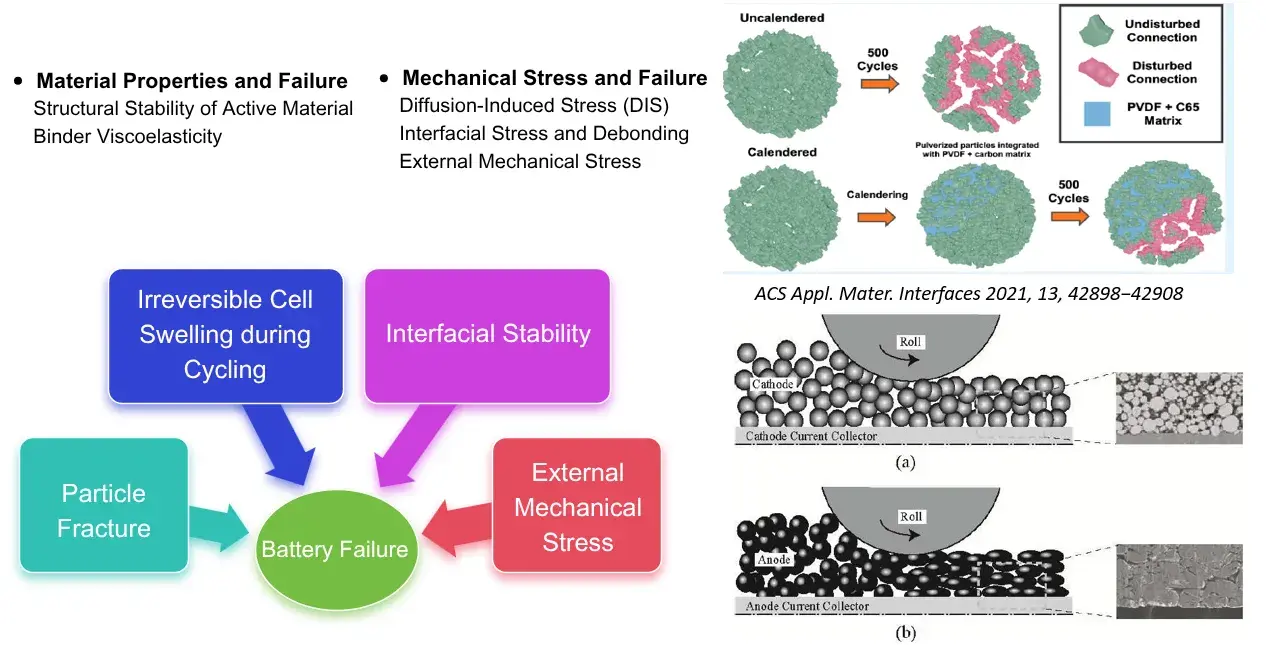
Figure 1. Multiscale failure mechanism analysis of lithium-ion batteries, illustrating the direct progression from microscale active material particle cracking and binder viscoelastic failure to mesoscale electrode delamination and macroscale irreversible cell swelling force accumulation.
Mechanical breakdown in lithium batteries operates across multiple spatial dimensions, originating at atomic lattice planes and culminating in module-level deformation. Figure 1 summarizes the primary pathways through which material attributes and external stresses couple to trigger irreversible cell failure.
Figure 1. Multiscale failure mechanism analysis of lithium-ion batteries, illustrating the direct progression from microscale active material particle cracking and binder viscoelastic failure to mesoscale electrode delamination and macroscale irreversible cell swelling force accumulation.
As delineated in Figure 1, the failure chain can be categorized into intrinsic material dependencies and mechanical stress vectors:
Active Material Structural Stability: Primary and secondary particle morphology dictates fracture toughness; anisotropic volume changes (~10% in graphite, >100% in silicon, ~2-8% in layered oxides) generate severe intergranular stress.
Viscoelasticity of the Polymeric Binder: Repeated cyclic expansion causes binder creep and scission, destroying electronic percolating networks between the active mass and the current collector.
Diffusion-Induced Stress: Phase transformations during fast charging establish steep lithium concentration gradients, generating localized shear stresses that surpass the ultimate tensile strength of polycrystalline particles.
External Constraint & Swelling Force: Rigid or semi-rigid module constraints convert internal volume expansion into massive compressive stress fields, accelerating localized lithium plating and separator pore collapse.
Comprehensive mechanical evaluation requires a closed-loop framework spanning two complementary tiers: powder/material-level mechanics and cell-level structural mechanics. Material-level metrics establish the baseline boundary conditions, while cell-level testing monitors dynamic in-situ evolution under actual electrochemical cycling.
| Dimension | Material-Level Mechanics | Cell-Level Mechanics |
|---|---|---|
| Research Scale | Microscale → Mesoscale (particles, coatings, binders, solid electrolytes) | Mesoscale → Macroscale (full cell, structural components, packaging, in-service operation) |
| Core Research Scope | Particle cracking, volume expansion, internal stress evolution, binder viscoelasticity, SEI mechanical properties, solid electrolyte fracture toughness/strength | Cyclic swelling force, initial internal stress (winding/stacking), non-uniform deformation, clamping preload optimization, mechanical abuse safety, CTP/CTC constraint adaptation |
| Key Failure Modes | Particle pulverization, intergranular debonding, coating delamination/cracking, SEI rupture, electrolyte microcracking | Cell swelling/gassing, delamination, active material shedding, mechanically induced internal short circuits, lithium plating (stress-gradient induced), structural distortion |
| Mainstream Characterization Methods | Nanoindentation, in-situ XRD/SEM/TEM, AFM, electrode tensile/peel testing, digital image correlation (DIC, surface strain) | Swelling force analyzer, CT/X-ray radiography, full-field DIC deformation mapping, cell crushing/nail penetration, pressure sensor arrays |
| Research Hotspots (2024–2026) |
Stress regulation in Si-based anodes, structural stability of Ni-rich cathode particles, chemo-mechanical-ionic coupling in solid electrolytes, self-healing binders | Evolution of cyclic swelling force, winding-induced internal stress relief, structural mechanics in CTP/CTC architectures, chemo-electro-thermal-mechanical degradation coupling |
| Primary Objectives | Mitigate microscopic structural failure, enhance electrode structural integrity, accommodate high-energy-density materials | Ensure life-cycle structural stability and consistency, balance safety with long cycle life, adapt to mass production processes |
| Manufacturing Process Relevance | Coupled with coating and calendering processes (coating thickness, compaction density) and material modification processes | Coupled with winding/stacking, hot pressing, formation, pack assembly (clamping force), and CTP/CTC integration |
The mechanical integrity of individual active material particles represents the foundational building block of electrode reliability. If primary or secondary particles fracture under electrode calendering or during cyclic lithiation, the newly formed crack facets deplete electrolyte through continuous SEI growth, resulting in irreversible Loss of Lithium Inventory (LLI).
In advanced single-particle testing, an individual micro-particle is positioned on a high-hardness diamond or tungsten carbide substrate under an optical microscope and loaded with a precision micro-indenter. Real-time force-displacement curves (μN-level force vs. nm-level displacement) capture the exact yield point, elastic modulus, and multi-stage fracture dynamics.
A benchmark study published in the Chemical Engineering Journal (Wenhao Qiu et al., 2026, 534, 175314) illustrates the critical link between single-particle mechanics and electrochemical performance. The researchers engineered a high-entropy P2/O3 mixed-phase sodium/lithium layered oxide cathode (termed NFMCT) utilizing thermal diffusion regulation.
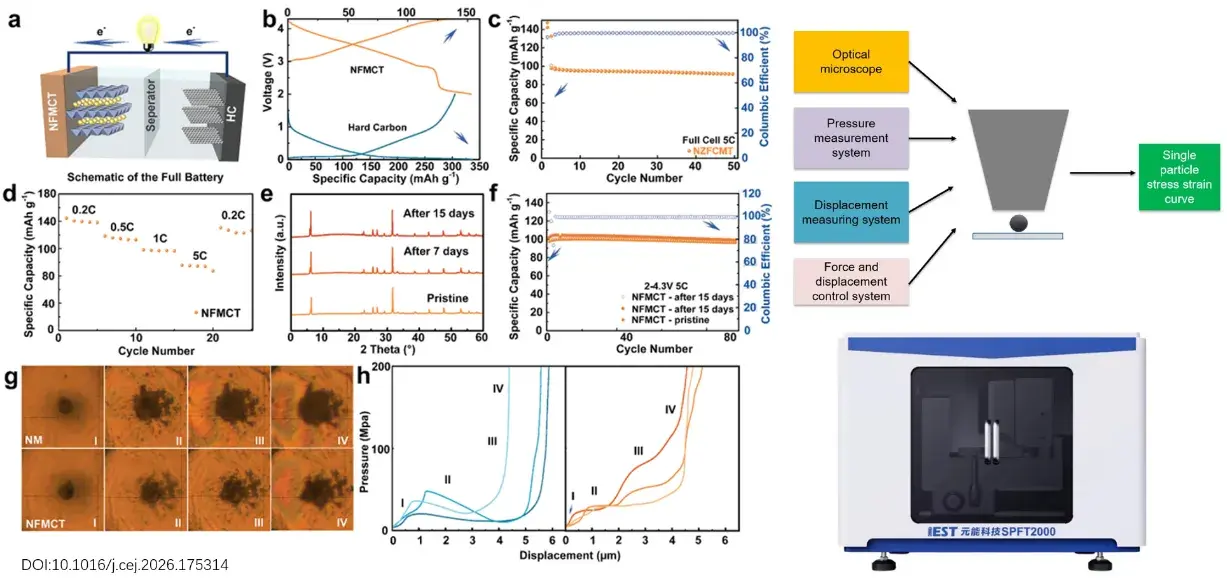
Figure 2. NFMCT cathode electrochemical and single-particle mechanical evaluation using the IEST SPFT2000, showing staged particle fracture behavior and pressure-displacement responses that complement cell-level performance data.
By utilizing the IEST SPFT2000 Single Particle Mechanical Properties Test System, the researchers acquired high-precision compressive force-displacement profiles of individual NFMCT particles. The experimental data revealed:
Multi-Stage Fracture Tolerance: Unlike standard unmodified samples (NM) which exhibited abrupt catastrophic brittle fracture at low compressive loads, NFMCT displayed distinct multi-stage yield plateaus.
Interlocking Energy Dissipation: The unique P2/O3 phase boundaries acted as mechanical interlocks, redistributing stress concentrations and significantly increasing the effective mechanical fracture energy.
Direct Cycling Correlation: When assembled into full cells against hard carbon (HC) anodes, the mechanically robust NFMCT cathode achieved remarkable 5C cycling stability with negligible capacity degradation over extended cycling, proving that microscale crushing resistance directly underpins macroscale electrochemical longevity.
While single-particle testing characterizes intrinsic grain toughness, industrial electrode manufacturing relies heavily on bulk powder behavior during roll-to-roll calendering. Calendering compresses loose particle assemblies into dense coatings with targeted porosities (20%–35%). However, excessive roll pressure causes particle pulverization, current collector foil wrinkling, and severe post-calendering elastic rebound.
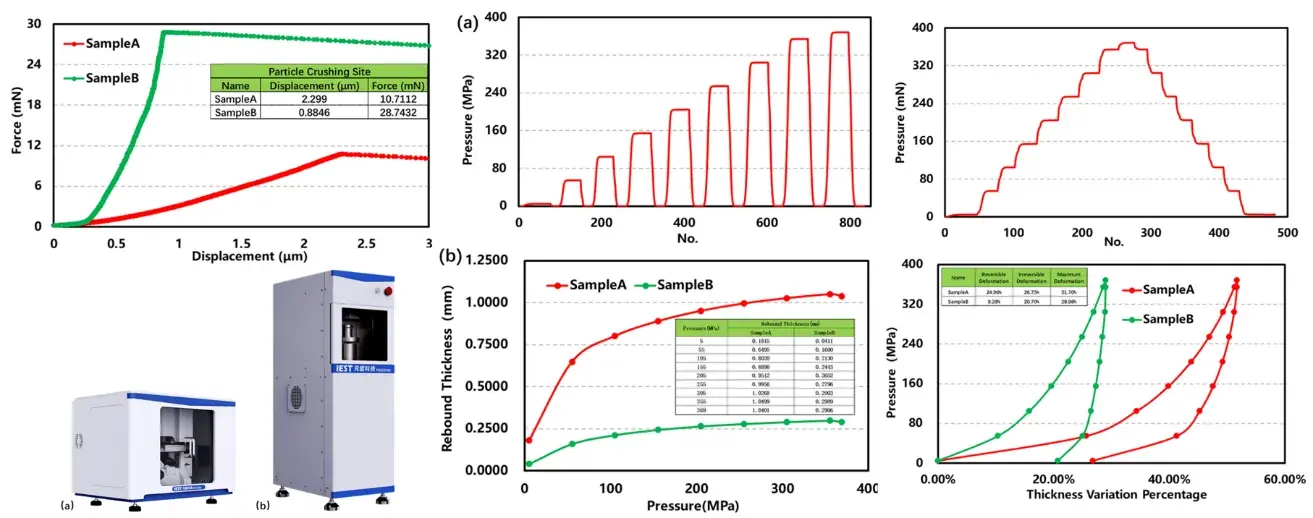
Figure 3. Correlation between single-particle mechanical properties and bulk powder compaction and rebound behavior for electrode calendering, tested under continuous pressure cycles (0–369 MPa) utilizing the IEST SPFT2000 and IEST PRCD3100 Powder Compaction System.
Integrating single-particle testing with bulk powder compaction diagnostics establishes a predictive framework for pilot manufacturing:
Sample A vs. Sample B Mechanical Divergence: Sample B exhibited a steep single-particle yield profile (Fmax = 28.74 mN at 0.88 μm displacement), whereas Sample A crushed prematurely (Fmax = 10.71 mN at 2.30 μm).
Bulk Rebound Mapping: Under cyclic pressurization up to 369 MPa, Sample A demonstrated an irreversible deformation of 51.70% and significant rebound thickness (1.04 mm), indicating extensive particle crushing and internal void collapse. Sample B maintained structural elasticity with only 28.98% irreversible deformation.
In all-solid-state lithium batteries (ASSLBs), mechanical pressure plays a dual role: it ensures conformal solid-solid physical contact between sulfide/oxide electrolyte particles and the active material, while simultaneously dictating ionic transport resistance. Solid electrolyte pellets undergo significant lattice and grain boundary strain under external stacks.
To decouple these phenomena, simultaneous in-situ measurement of pressure, thickness deformation, and electrochemical impedance spectroscopy (EIS) is mandatory. The bulk ionic conductivity (σ) of the compressed separator pellet is calculated in real time via:
Where:
$\sigma$ is the ionic conductivity ($\text{S}\cdot\text{cm}^{-1}$)
$d$ is the real-time separator pellet thickness ($\text{cm}$) tracked by high-precision displacement transducers
$R$ is the high-frequency bulk resistance ($\Omega$) extracted from EIS Nyquist intercepts
$S$ is the effective cross-sectional contact area ($\text{cm}^2$)
Using the IEST PRCD3100, researchers can establish precise “Pressure–Deformation–Ionic Conductivity” master curves, ensuring that solid-state pouch cells are operated within the optimum pressure window ($5\text{–}15\ \text{MPa}$) without causing internal short circuits through lithium dendrite penetration along compressed crack planes.
When materials are assembled into full cells, phase transition mechanics govern overall dimensions. During charging, lithium ions intercalate into the graphite host, forming staged intercalation compounds:
\[C \rightarrow LiC_{30} \rightarrow LiC_{18} \rightarrow LiC_{12} \rightarrow LiC_{6}\]
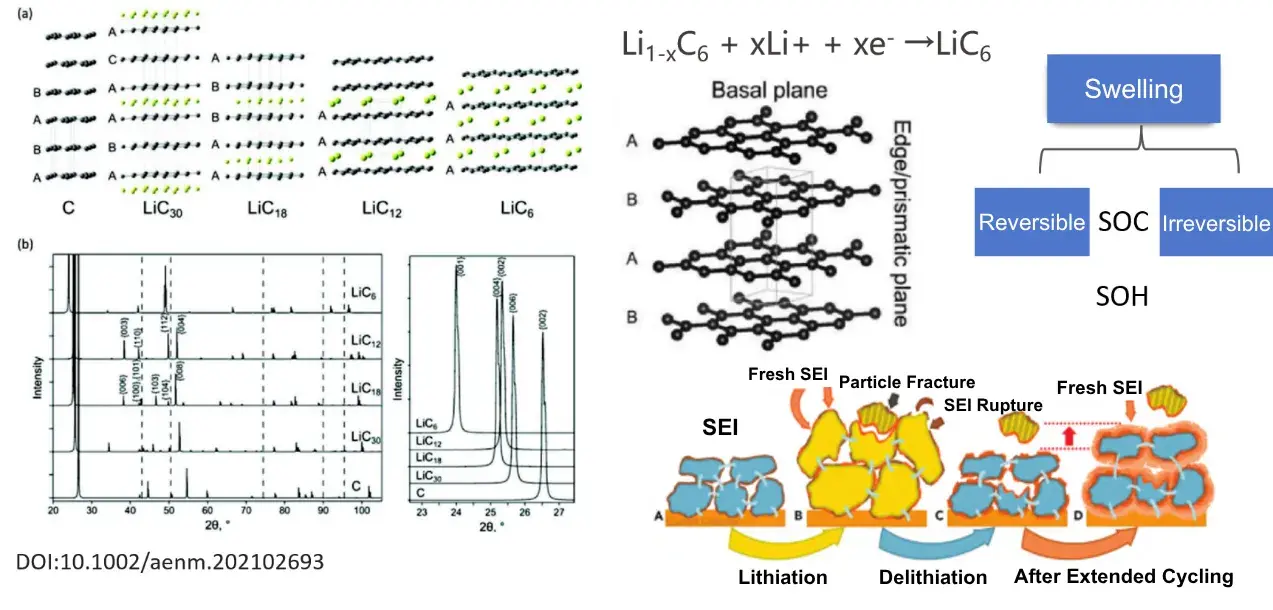
Figure 4. Stage-dependent graphite anode volume expansion during lithiation (Li₁₋xC₆ + xLi⁺ + xe⁻ → LiC₆), in-situ XRD phase transformation characterization, and the schematic decomposition into reversible SOC-dependent expansion and irreversible SOH-dependent degradation.
As highlighted in Figure 4, full lithiation to LiC₆ induces an intrinsic theoretical volume expansion of approximately 10% in graphite (and up to 300% in pure silicon particles). Inside a constrained cell enclosure, this expansion manifests as two distinct components:
Reversible Swelling: A dynamic, breathing strain directly proportional to the state of charge (SOC), which completely recovers upon delithiation.
Irreversible Swelling: A permanent, cumulative thickness and stress increase caused by repeated SEI rupture/re-passivation, particle micro-cracking, and dead lithium entrapment, serving as a direct physical proxy for State of Health (SOH) degradation.
To capture dynamic mechanical behavior during actual battery cycling, advanced laboratories deploy in-situ cell swelling measurement systems under tightly regulated boundary conditions: constant pressure (free expansion), constant gap (rigid constraint), or variable stiffness spring constraint.
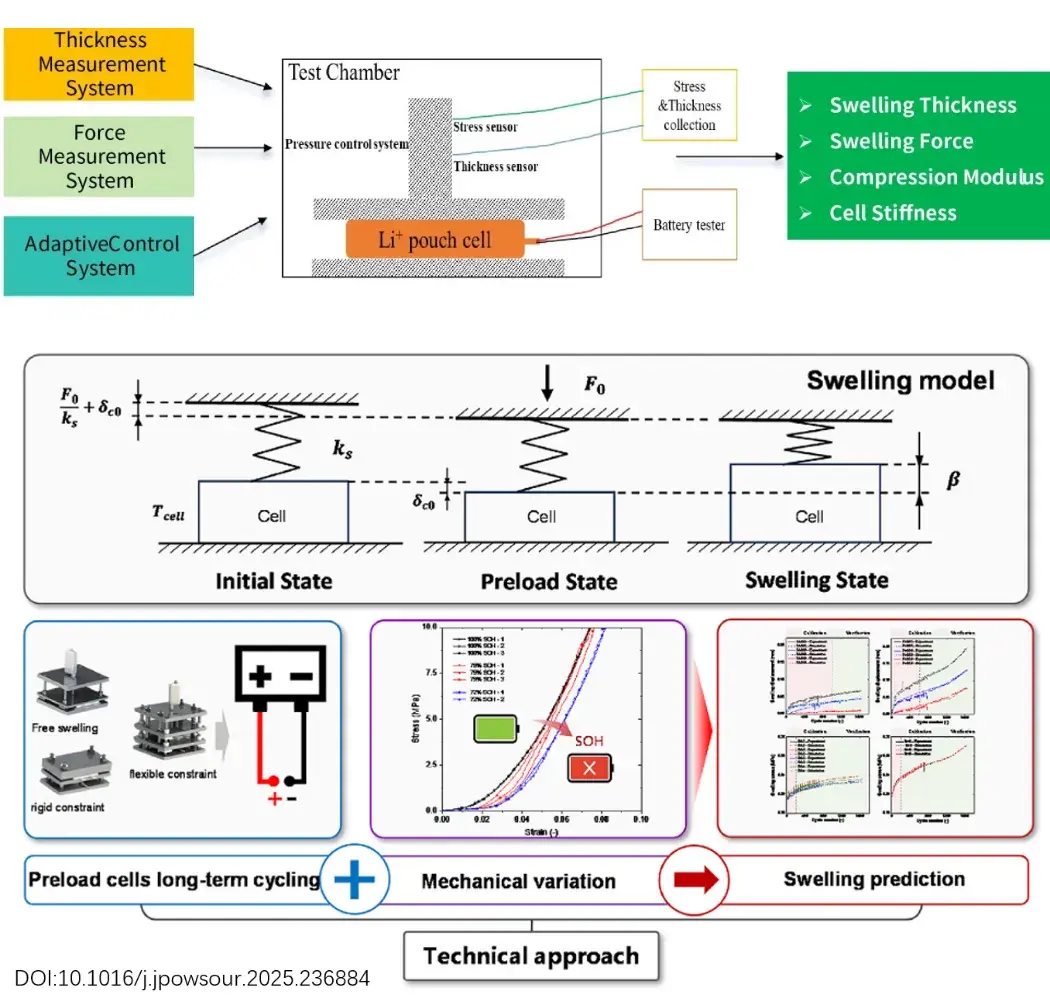
Figure 5. In-situ cell swelling analysis for battery cycle life prediction under various boundary constraints (rigid vs. flexible), showcasing the extraction of swelling thickness, swelling force, compressive modulus, and the correlation between irreversible swelling force and battery SOH (Journal of Power Sources, Niu et al., 2025, 641, 236884).
A recent study published in the Journal of Power Sources (Niu et al., 2025, 641, 236884) demonstrated that under rigid constraints, the swelling force of aged lithium iron phosphate (LiFePO₄)/graphite pouch cells escalates non-linearly with cycling. By monitoring the stress-strain curve of aged battery electrodes and fitting the dynamic compressive modulus, researchers developed high-fidelity prognostic models capable of predicting remaining useful cycle life (RUL) long before electrochemical voltage curves show noticeable divergence.
Cell-to-Pack (CTP) and Cell-to-Chassis (CTC) designs eliminate traditional module side plates and intermediate structures to maximize pack gravimetric energy density. In these tightly integrated architectures, battery cells serve as semi-structural components:
Preload Clamping Force Optimization: Applying an initial preload (0.1–0.3 MPa) maintains electrode interfacial contact and suppresses binder delamination. However, if the initial preload is improperly matched with cell swelling behavior, end-of-life (EOL) expansion forces can surpass 15 MPa, crushing separator micro-pores and precipitating localized lithium dendrite short circuits.
Mitigating Lithium Plating Induced by Uneven Expansion Force: When pressure distribution across large-format prismatic or pouch surfaces is non-uniform, regions under extreme local pressure suffer from restricted electrolyte wetting. This localized polarization induces premature lithium plating at moderate charging C-rates.
The lithium battery industry is witnessing a paradigm shift from passive structural accommodation toward proactive, full-lifecycle mechanical engineering. Figure 6 categorizes current and emerging R&D priorities across material-level synthesis and cell-level mechanical management.
Key industry imperatives for the 2025–2030 development cycle include:
Multi-Scale Coupling Characterization: Synchronizing particle-scale fracture mechanics with macroscopic in-situ swelling force data to establish validated multi-physics constitutive equations.
AI and Physics-Informed Numerical Simulation: Replacing traditional trial-and-error coating and calendering iterations with machine learning models trained on empirical single-particle crushing and compaction datasets.
Whole-Lifecycle Health Diagnostics: Integrating onboard fiber-optic or thin-film strain gauge sensors within CTP pack enclosures to monitor internal mechanical stress signatures for early thermal runaway warnings.