
📄 Source Paper
Chengkun Zhang, Hongfei Zheng, Liang Lin, Jiansen Wen, Shiyu Zhang, Xinchao Hu, Dongwei Zhou, Baisheng Sa, Laisen Wang, Jie Lin, Qingshui Xie, Dong-Liang Peng, Jun Lu
DOI: doi.org/10.1002/aenm.202401324
| Journal: Advanced Energy Materials 2024, 14, 2401324
| Institutions: Xiamen University, Zhejiang University
✓ IEST In-Situ Battery Gassing Volume Analyzer used in this research
In 2024, a research team led by Professors Dong-Liang Peng and Qingshui Xie from Xiamen University, in collaboration with Professor Jun Lu’s group from Zhejiang University, published a study in Advanced Energy Materials entitled “Deep Eutectic Solvent-Based Solid Polymer Electrolytes for High-Voltage and High-Safety Lithium Metal Batteries.” This work addresses the critical challenges of flammable electrolytes, unstable interfaces, and restricted ion transport in high‑voltage, high‑safety lithium metal batteries, and proposes a solid polymer electrolyte system based on deep eutectic solvents. The team in‑situ encapsulated a succinonitrile‑based deep eutectic solvent within an ETPTA polymer network, constructing a DES‑ETPTA solid polymer electrolyte that combines high ionic conductivity, favorable lithium metal interfacial stability, and excellent flame‑retardant properties. Further cyanoacrylate copolymerization modification enhanced its oxidative stability in high‑voltage LiCoO₂ cathode systems.
Notably, during the battery safety verification phase, the research team employed the IEST GVM2200 in-situ gas and volume monitor to perform in-situ, continuous, and quantitative monitoring of pouch cell volume changes under high-temperature conditions, providing key evidence for evaluating the solid polymer electrolyte’s ability to suppress thermally induced gas evolution and swelling behavior.
Lithium metal anodes offer compelling theoretical specific capacity (~3,860 mAh g⁻¹) and the lowest electrochemical potential (−3.04 V vs. SHE) of any anode material, making them a central target for next-generation high-energy-density batteries. However, conventional liquid electrolytes pose fundamental safety limitations: flammability, electrolyte decomposition at high temperatures, and gas evolution during thermal abuse or extended cycling all contribute to pouch cell swelling, internal pressure build-up, and potential safety failure.
Solid polymer electrolytes (SPEs) represent a promising pathway to address these safety concerns by replacing flammable liquid electrolytes with mechanically and thermally more stable alternatives. However, objectively characterizing the thermal stability improvement that SPEs provide — specifically, whether and to what degree they suppress thermal-induced gas generation — requires more than combustion tests or post-mortem cell disassembly.
The critical technical gap is clear: conventional observation approaches can only confirm whether a pouch cell has swollen — they cannot answer when gas generation began, at what rate gas accumulated, or how much total volume change occurred. Without this quantitative data, comparing thermal stability across different electrolyte systems remains largely qualitative. This gap is precisely where in-situ volume change measurement becomes indispensable.
The research team designed the DES-ETPTA solid polymer electrolyte by in-situ encapsulating a succinonitrile (SN)-based deep eutectic solvent within an ethoxylated trimethylolpropane triacrylate (ETPTA) polymer network. This dual-component architecture simultaneously addresses the three principal limitations of existing solid polymer electrolyte systems:
Deep eutectic solvent (DES) refers to a eutectic mixture of two or more components — typically a hydrogen bond donor and acceptor — that forms a liquid at room temperature with a melting point significantly below that of either individual component. In battery electrolyte applications, DES systems offer high ionic conductivity, low volatility, and non-flammability compared to conventional organic carbonate solvents.
DES-ETPTA solid polymer electrolyte is defined as the specific electrolyte architecture developed in AEM 2024 (Xiamen/Zhejiang Universities), in which a succinonitrile-based deep eutectic solvent is in-situ polymerized and encapsulated within an ETPTA (ethoxylated trimethylolpropane triacrylate) crosslinked polymer network, yielding a solid-state electrolyte with high ionic conductivity, stable lithium metal interface, and inherent flame-retardant properties.
To extend the DES-ETPTA electrolyte’s operational voltage window for compatibility with high-voltage LiCoO₂ cathodes (charging to 4.5 V vs. Li/Li⁺), the team incorporated cyanoacrylate copolymerization modification, improving the electrolyte’s oxidative stability at the cathode interface and enabling stable high-voltage LiCoO₂ solid-state battery cycling.
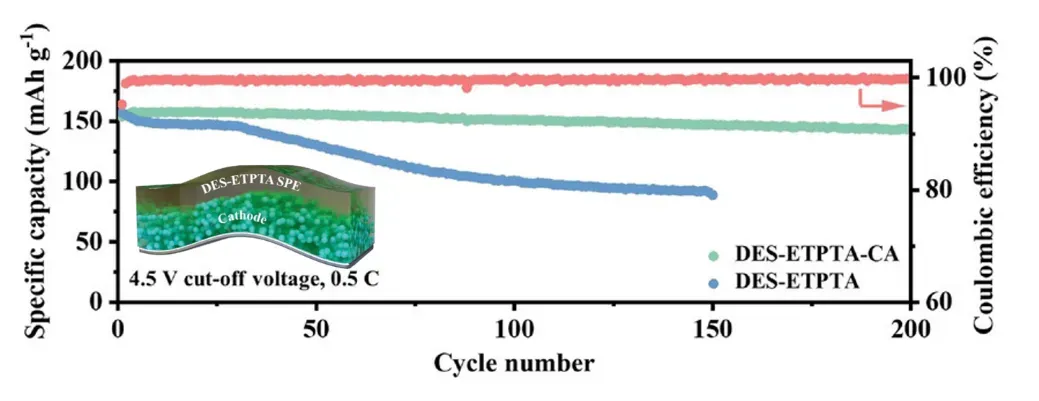
Figure 1. In-situ polymerization of DES-ETPTA solid polymer electrolyte forming stable electrode/electrolyte interfaces for high-voltage, high-safety lithium metal batteries (Xiamen & Zhejiang University, AEM 2024)
| Parameter | Conventional Liquid Electrolyte | Standard Solid Polymer Electrolyte (SPE) | DES-ETPTA Solid Polymer Electrolyte |
|---|---|---|---|
| Flammability | High — carbonate solvents combust readily | Low — polymer matrix reduces flammability | Very low — DES component is inherently non-flammable |
| Thermal gas evolution (high-temp pouch cell) | Significant volume increase — electrolyte decomposition releases CO₂, hydrocarbons | Reduced vs. liquid, but varies by polymer composition | Near-zero volume change — confirmed by IEST GVM2200 in-situ monitoring |
| Ionic conductivity | High at room temp (>10 mS cm⁻¹) | Often limited (<0.1 mS cm⁻¹) without plasticizer | Improved by DES channels within ETPTA network |
| Li metal interface stability | Poor — dendritic growth, continuous SEI reformation | Improved — polymer SEI more mechanically stable | Stable — ETPTA network suppresses dendrite growth |
| High-voltage LiCoO₂ compatibility (≥4.5 V) | Limited by oxidative decomposition of carbonate solvents | Often poor — polymer oxidation at high voltage | Enhanced by cyanoacrylate copolymerization modification |
| Pouch cell swelling (80°C, 1 h) | Progressive volume increase observed visually and by GVM2200 | Reduced swelling (material-dependent) | Volume nearly constant — quantitatively validated by IEST GVM2200 |
| Research characterization requirement | Visual observation sufficient for severe swelling | Quantitative volume monitoring needed to differentiate subtle improvements | In-situ GVM2200 monitoring essential to demonstrate near-zero gas evolution advantage |
The thermal stability validation phase of the study posed a measurement challenge that conventional characterization methods could not fully resolve. The research team assembled pouch cells using both conventional liquid electrolyte and DES-ETPTA solid polymer electrolyte, then subjected both to controlled high-temperature conditions. Visual observation of the pouch cell exterior (Figures 2a–d) confirmed that the liquid electrolyte cell swelled while the DES-ETPTA cell remained flat — but visual inspection could not answer the quantitative questions that determine scientific and practical value:
To convert these qualitative observations into quantitative, publishable evidence, the research team employed the IEST GVM2200 in-situ gas evolution monitor, which continuously records real-time volume-versus-time curves based on the Archimedes buoyancy principle. This approach transformed the binary question of “did the cell swell?” into a parametric volume change curve, enabling direct, numerical comparison of thermal stability between the liquid and solid electrolyte systems.
The GVM2200 measurement results (Figure 2e) showed clearly that the conventional liquid electrolyte pouch cell exhibited progressive volume increase under high-temperature conditions — consistent with electrolyte thermal decomposition and gas release. In contrast, the DES-ETPTA solid polymer electrolyte pouch cell maintained near-constant volume throughout the same thermal protocol, providing quantitative, instrument-validated evidence that the DES-ETPTA electrolyte effectively suppresses thermal-induced gas generation and cell swelling.
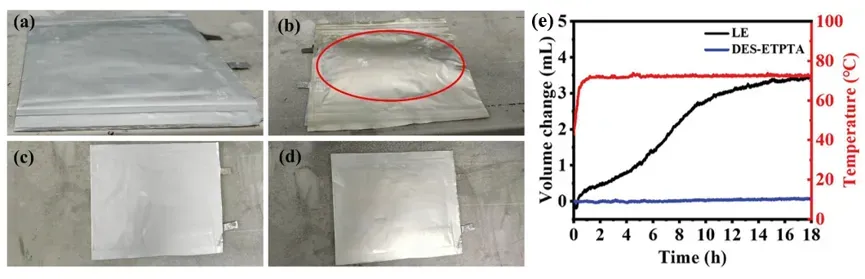
Figure 2. High-temperature pouch cell swelling comparison: liquid electrolyte vs. DES-ETPTA solid polymer electrolyte — visual observation (panels a–d) and in-situ volume change curves measured by IEST GVM2200 (panel e). The DES-ETPTA cell shows near-zero volume change throughout the thermal test.
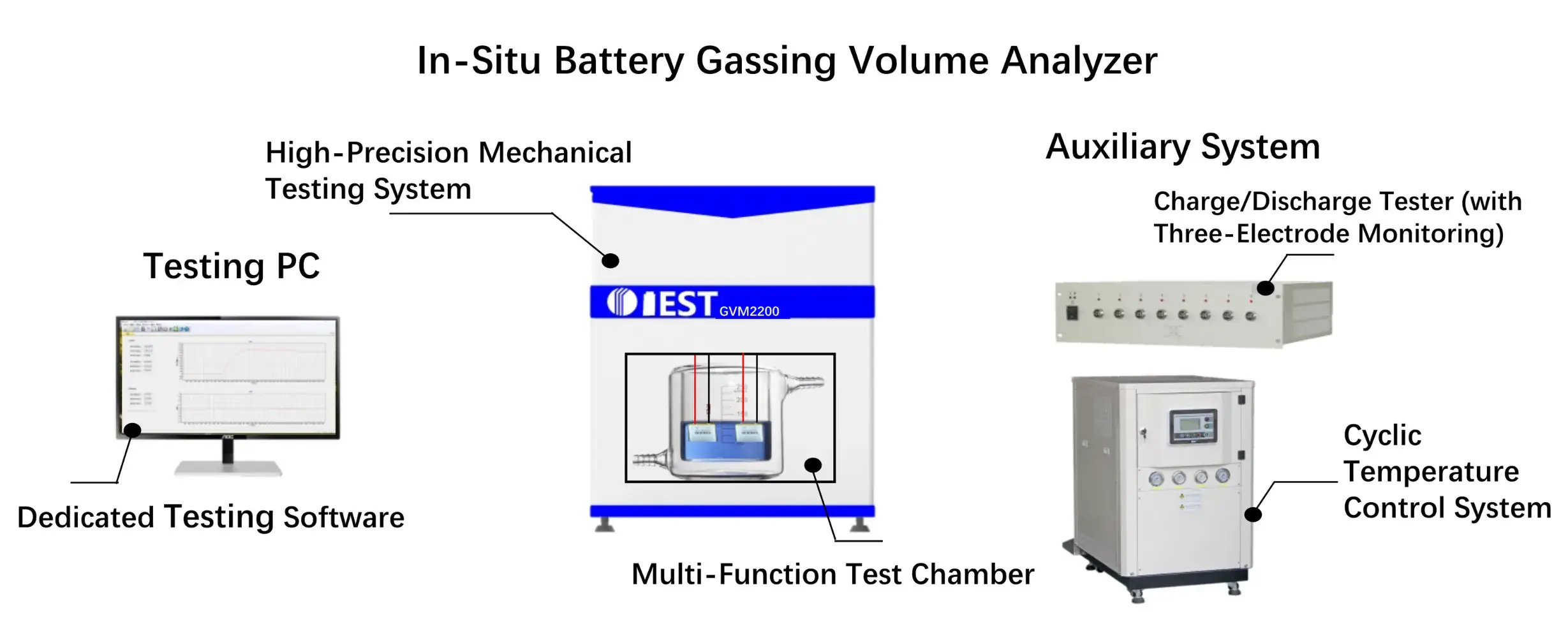
Figure 3. IEST GVM2200 in-situ gas evolution volume monitoring instrument — Archimedes buoyancy principle, continuous real-time pouch cell volume change measurement for battery safety research.
The GVM2200 addresses the measurement gap between “visual observation” and “quantitative safety data” that the Xiamen/Zhejiang University study exemplifies. Applicable test scenarios where the GVM2200 provides irreplaceable quantitative data include:
The IEST GVM2200 converts visual swelling observations into continuous, quantitative volume-time curves — providing the instrument-verifiable safety data required for publication-grade thermal stability comparisons across liquid, solid, and hybrid electrolyte systems.
The AEM 2024 study from Xiamen University and Zhejiang University demonstrates that deep eutectic solvent-based solid polymer electrolytes represent a credible pathway toward high-safety, high-voltage lithium metal batteries. The DES-ETPTA electrolyte system delivers simultaneous improvements across the critical safety dimensions: it suppresses thermal gas evolution, maintains stable lithium metal interfaces, reduces flammability, and extends operational voltage to 4.5 V for LiCoO₂ compatibility.
The IEST GVM2200 in-situ gas evolution monitoring instrument provided the quantitative experimental foundation for the thermal safety comparison in this study — converting the observation “DES-ETPTA does not swell” from a qualitative visual impression into a parametric volume-time curve with clear numerical differentiation from the liquid electrolyte baseline. As solid polymer electrolyte research advances and increasingly subtle safety improvements need to be distinguished between candidate materials, in-situ volume change monitoring with quantitative, continuous measurement capability becomes not a supplementary technique but a primary characterization method.
A deep eutectic solvent (DES)-based solid polymer electrolyte incorporates a DES — a non-flammable eutectic mixture of hydrogen bond donors and acceptors — within a crosslinked polymer matrix such as ETPTA, rather than relying on dry polymer chains alone. The DES component provides ionic transport channels that improve conductivity compared to dry solid polymer electrolytes, while the polymer network maintains solid-state mechanical properties and suppresses lithium dendrite growth. In the DES-ETPTA system published in AEM 2024, this design simultaneously achieves high ionic conductivity, flame retardancy, and stable lithium metal interface performance — properties that are difficult to combine in conventional solid polymer electrolytes.
Gas evolution in lithium metal battery pouch cells is primarily driven by thermal decomposition of the electrolyte at elevated temperatures, producing CO₂, hydrocarbons, and other gases that cause cell swelling. The DES-ETPTA solid polymer electrolyte suppresses gas evolution by replacing flammable carbonate-based liquid electrolytes with a non-volatile, thermally stable DES component encapsulated in a crosslinked ETPTA network. At high temperatures where conventional liquid electrolytes decompose and release gases, the DES-ETPTA system undergoes negligible thermal decomposition — as quantitatively demonstrated by near-zero volume change in IEST GVM2200 measurements, compared to progressive volume increase in liquid electrolyte cells under the same conditions.
In-situ gas evolution monitoring is the continuous, real-time measurement of battery cell volume change during testing, providing quantitative data on gas generation onset time, accumulation rate, and total volume. It is necessary for solid polymer electrolyte thermal stability evaluation because the improvements offered by solid electrolytes over liquids can be subtle — particularly for advanced DES-based systems that show only partial, not complete, gas suppression. Visual observation can only confirm the presence of severe swelling; it cannot quantify gas evolution onset temperature, differentiate between electrolyte systems with similar but not identical thermal stability, or provide reproducible numerical data for publication. The IEST GVM2200 addresses this gap by recording Archimedes buoyancy-based volume change with continuous, high-resolution time resolution.
The IEST GVM2200 measures pouch cell volume change in real time using the Archimedes buoyancy principle: the cell is submerged in a liquid medium, and high-precision force sensors continuously record the buoyancy force acting on the cell. As the cell generates gas and its volume increases, the buoyancy force changes proportionally — allowing the instrument to convert force measurements into continuous, high-resolution volume-versus-time curves. This approach requires no cell modification, operates non-destructively during thermal or cycling tests, and provides quantitative volume data from the earliest stages of gas evolution — including events too small to detect visually. In the AEM 2024 study, GVM2200 data provided the definitive numerical evidence comparing liquid electrolyte vs. DES-ETPTA solid polymer electrolyte thermal stability.
The IEST GVM2200 is suitable for any test protocol where battery or electrode cell volume change — whether from gas evolution, electrode expansion, or electrolyte swelling — is a relevant safety or performance indicator. Key applications include high-temperature storage and soak tests for pouch cell gas evolution onset characterization; overcharge abuse testing to monitor electrolyte decomposition-driven gas release; comparative thermal stability evaluation of different electrolyte formulations (liquid, gel polymer, solid polymer, DES-based); silicon anode volume expansion monitoring during cycling; and gas evolution characterization in all-solid-state cells, lithium metal batteries, and high-nickel cathode systems. The instrument provides continuous, non-destructive, real-time data across all these scenarios.
Conventional carbonate-based liquid electrolytes begin decomposing at temperatures between 60–80°C, releasing CO₂, CO, and flammable hydrocarbons that cause progressive pouch cell swelling and create internal pressure sufficient to rupture the cell casing. Solid polymer electrolytes — particularly DES-based systems — have substantially higher thermal decomposition thresholds and non-flammable compositions, resulting in negligible gas evolution under the same thermal conditions. This difference matters because high-temperature storage, fast charging, and thermal runaway events all expose battery cells to temperatures where liquid electrolyte decomposition becomes a primary failure driver. Quantifying the thermal stability gap between electrolyte systems using in-situ gas evolution monitoring (as in the AEM 2024 study) provides the objective, instrument-verified evidence needed to validate safety improvements in the design stage before full cell qualification testing.