-
iestinstrument

Abstract
1. Preface
This paper presents a rapid, practical method to evaluate lithium-ion electrolyte performance by linking electrolyte rate capability with electrode sheet tortuosity and the McMullin number. Combining symmetric-cell electrochemical impedance spectroscopy (EIS) with electrode tortuosity measurement enables quantification of how pore microstructure (pore size, throat diameter, connectivity) and electrolyte properties (viscosity, wettability) govern ion transport and battery rate behavior. The approach accelerates electrolyte R&D by providing an early screening metric that correlates with full-cell rate tests.
2. Introduction: Why Electrode Tortuosity Matters for Electrolyte Rate Performance
The electrolyte is the ionic highway inside a lithium-ion cell. Fast charge and discharge requires rapid Li\(^+\) transport through: (1) the bulk liquid phase, (2) desolvation and crossing the SEI membrane, and (3) porous electrode pathways to active particles. The microstructure of electrode coatings — especially pore connectivity and geometric complexity — determines the actual path Li\(^+\) must follow. This geometric impediment is captured by electrode tortuosity (\(\tau\)), commonly defined as the squared ratio of actual transport path length to straight-line coating thickness: \(\tau = (L’/L)^2\).
Because direct porosity measurement is often complex in production settings, the MacMullin number (\(N_m = \tau/\varepsilon\)) — the tortuosity-to-porosity ratio — is widely used as a convenient, physically meaningful descriptor of effective ion transport resistance inside porous electrodes. (Note: some literature variants spell it McMullin number or mcmullin number; all refer to the same concept, named after R. A. MacMullin.)
For a battery to achieve excellent rate performance, the electrolyte needs high lithium-ion transport capacity, and the speed of that transport is directly related to electrolyte performance.[1] As shown in Figure 1, the charging process involves four stages: (1) solvated lithium forms and diffuses under concentration and potential gradients; (2) at the SEI interface, solvated Li⁺ undergoes desolvation; (3) desolvated Li⁺ transports through the SEI membrane; and (4) Li⁺ diffuses through the active material body to form an intercalation compound.[2,3]
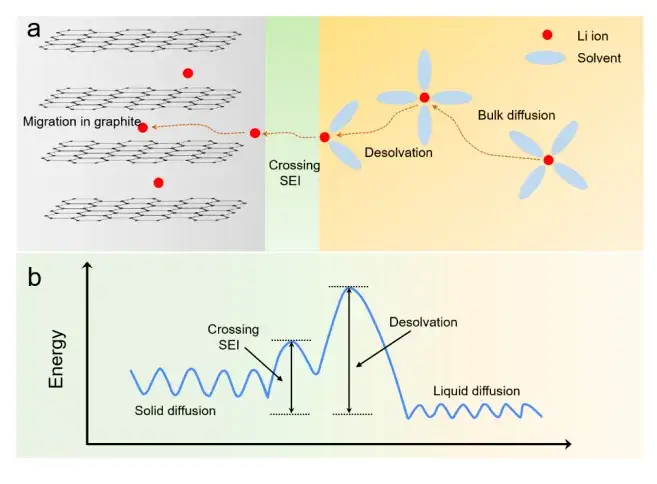
Fig. 1. (a) Schematic of lithium-ion battery charging process — four stages governing electrolyte rate performance: solvation/diffusion, SEI desolvation, SEI transport, active material intercalation; (b) Energy barrier profile at each stage[3,4]
3. Principle: From EIS to MacMullin Number
The effective ionic conductivity in a porous electrode, \(\sigma_{eff}\), links bulk electrolyte conductivity \(\sigma\), porosity \(\varepsilon\), and electrode tortuosity \(\tau\) through the Bruggeman-type relation that underpins the MacMullin number:
\(\sigma_{eff} = \sigma \frac{\varepsilon}{T}\)
Rearranged, the MacMullin number equals \(N_m = \tau/\varepsilon = \sigma/\sigma_{eff}\). Practically, \(\sigma_{eff}\) is obtained from EIS on a symmetric cell (two identical electrodes separated by the same porous coating):
-
Assemble a symmetric cell and run EIS (frequency sweep, e.g., 100 kHz to 0.01 Hz).
-
Fit the low-frequency intercepts to extract ionic resistance \(R_{ion}\) of the electrode coating from the Nyquist plot.
-
Compute \(\sigma_{eff}\) from geometry: \(\sigma_{eff} = d / (R_{ion} \cdot A)\), where \(d\) is coating thickness and \(A\) is electrode area.
-
Calculate MacMullin number: \(N_m = \sigma / \sigma_{eff}\) (with \(\sigma\) from bulk electrolyte conductivity measurement).
This electrochemical route captures not only electrode geometry but also real wetting and electrolyte microphysics (viscosity, surface tension, solvation effects), making Nm a robust predictor of in-cell rate behavior — and a faster alternative to full-cell rate cycle tests for initial electrolyte screening.
4. Test Conditions & Methods
4.1 Test Equipment
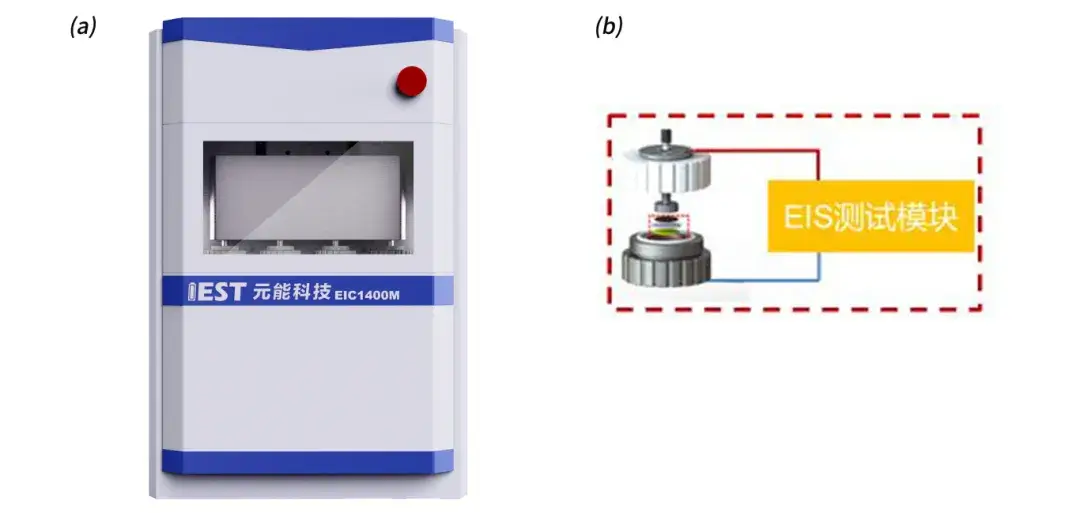
Symmetric cell assembly and EIS testing used the IEST EIC1400 Electrode Sheet Tortuosity Tester & Separator Ion Conductivity Tester (Figure 2), which integrates four battery assembly fixtures and provides four-channel simultaneous EIS testing. Specifications: pressure range 0–20 kg; frequency range 100 kHz–0.01 Hz.
Where: \(\tau\) = electrode tortuosity; \(R_{ion}\) = ionic resistance (\(\Omega\)) from EIS; \(A\) = electrode area (cm\(^2\)); \(\varepsilon\) = electrode porosity; \(\sigma\) = bulk electrolyte conductivity (S/cm); \(d\) = electrode coating thickness (cm). Because porosity measurement is complex, the McMullin number \(N_m = \tau/\varepsilon\) (combining tortuosity and porosity into a single, measurable parameter) is used as shown in Equation (2):
\[N_m = \tau / \varepsilon = \frac{R_{ion} \cdot A \cdot \sigma}{d} \tag{2}\]
From the symmetric-cell Nyquist plot (Figure 3), \(R_{ion}\) is determined as follows: extend the low-frequency line segment until it intersects the real (X) axis; the difference between this intersection and the high-frequency real-axis intercept, multiplied by three, equals the coating’s ionic resistance \(R_{ion}\). This \(R_{ion}\) is substituted into Equation (2) to obtain the electrode sheet McMullin number.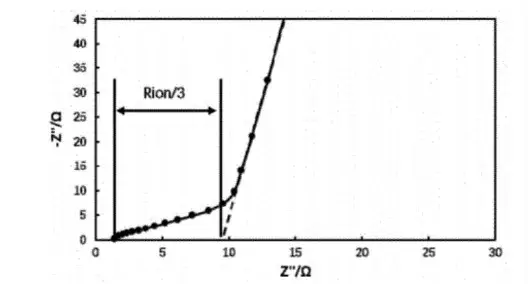
Fig. 3. Symmetric-cell EIS Nyquist plot — low-frequency intercept minus high-frequency intercept, multiplied by 3, gives ionic resistance Rion for MacMullin number calculation
5. Analysis Of Results
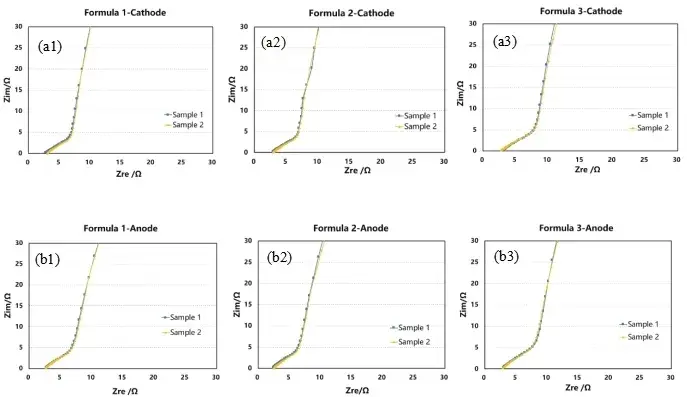
Fig. 4. EIS impedance profiles — cathode symmetric cells: formula 1 (a1), 2 (a2), 3 (a3); anode symmetric cells: formula 1 (b1), 2 (b2), 3 (b3). Fitted to extract Rion and calculate electrode sheet McMullin number
EIS was performed for each electrolyte formulation, using the same cathode or anode electrode sheet assembled into symmetric cells. The ionic resistance of each electrode was extracted by fitting the impedance profile, then Equation (2) was used to calculate the electrode McMullin number. Results are shown in Fig. 5.
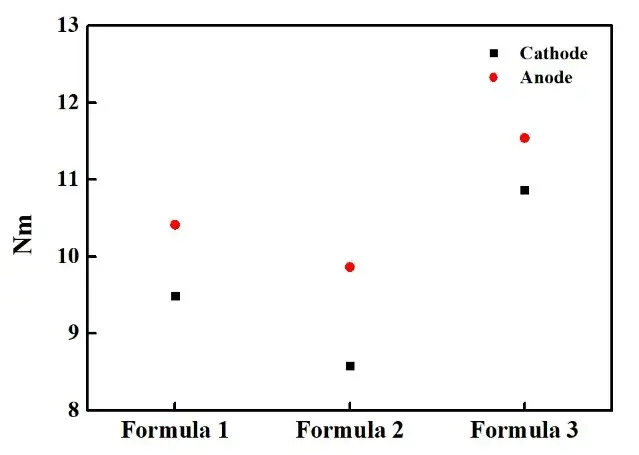
Fig. 5. McMullin number for cathode(LiCoO₂) and anode(graphite) electrode sheets in three electrolyte formulations — Nm rank: Formula 2 < Formula 1 < Formula 3
The McMullin numbers of both cathode and anode electrode sheets rank as Formula 2 < Formula 1 < Formula 3. This ordering reflects the combined effect of electrolyte physical properties on effective ionic transport — not just electrode geometry. When electrode tortuosity is measured electrochemically, the effective conductivity obtained reflects actual wetting conditions: viscosity and surface tension differences between formulations produce different wettability, and if electrolyte fails to penetrate into nanopore spaces, the effective ion transport path lengthens — increasing the apparent MacMullin number and hindering Li⁺ shuttle between electrodes, ultimately affecting rate performance, discharge capacity, and service life. The LiPF₆ salt concentration changes the electrolyte’s viscosity and surface tension, which in turn determines wettability. At 1.6M (Formula 3), the higher viscosity increases Nm; at 1.0M (Formula 2), the optimal concentration minimizes Nm and maximizes effective transport.
| Rate | Formula 1 | Formula 2 | Formula 3 | |||
|---|---|---|---|---|---|---|
| Charging capacity (Ah) |
Discharging capacity (Ah) |
Charging capacity (Ah) |
Discharging capacity (Ah) |
Charging capacity (Ah) |
Discharging capacity (Ah) |
|
| 0.5C | 1.2173 | 1.2142 | 1.2215 | 1.219 | 1.1844 | 1.1822 |
| 1C | 1.2133 | 1.2114 | 1.2176 | 1.2161 | 1.1807 | 1.1792 |
| 3C | 1.2035 | 1.2023 | 1.2099 | 1.2086 | 1.1728 | 1.1717 |
| 5C | 1.1999 | 1.1985 | 1.2075 | 1.2063 | 1.1611 | 1.1596 |
| 10C | 1.1042 | 1.0995 | 1.1521 | 1.1449 | 1.0585 | 1.0521 |
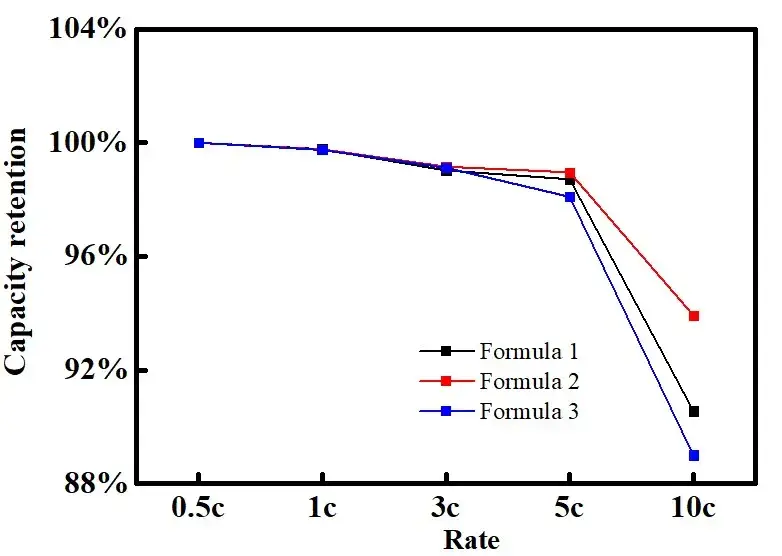
Fig. 6. Rate-capacity retention curves for three electrolyte formulations at 0.5C–10C — Formula 2 (lowest Nm) achieves best 10C retention (93.92%); Formula 3 (highest Nm) shows lowest retention (89%)
Figures 5 and 6 and Table 1 demonstrate that the MacMullin number rank directly correlates with the rate performance rank of soft-pack batteries assembled with the same electrode sheets but different electrolytes. At 10C, the capacity retention is 90.55% (Formula 1), 93.92% (Formula 2), and 89% (Formula 3) — exactly matching the Nm rank (F2 < F1 < F3). This confirms that the electrode sheet McMullin number, measured by EIS tortuosity testing, can predict battery rate performance — enabling rapid electrolyte formulation screening without full cycle testing for each candidate.
6. Practical Implications for Electrolyte and Electrode R&D
-
Rapid electrolyte screening: Measuring MacMullin number via symmetric-cell EIS provides a fast, low-material-consumption way to rank electrolyte candidates before committing to full-cell rate tests. This can shorten electrolyte development cycles significantly.
-
Process optimization — wetting issues: Differences in McMullin number across electrolyte concentrations or formulations can reveal wetting problems (e.g., poor penetration into electrode nanopores) that are addressable by adjusting electrolyte viscosity, adding wetting agents, or tuning liquid-fill process parameters.
-
Electrode design feedback: If MacMullin number remains high despite a well-optimized electrolyte, the bottleneck is electrode geometry — optimize electrode porosity, particle size distribution, or calendering pressure to reduce tortuosity.
- Battery simulation inputs: Nm serves as a compact, physically meaningful input parameter for porous-electrode models and multi-physics battery simulations to predict rate capability and internal resistance without full-cell experiments.
7. Limitations & best practices
-
Geometry accuracy: Accurate coating thickness (\(d\)) and electrode area (\(A\)) measurements are critical when computing \(\sigma_{eff}\); calibrate thickness measurement regularly.
-
Wetting interpretation: Electrochemical Nm reflects real wetting as well as geometry; a high McMullin number could result from incomplete electrolyte wetting into nanopores rather than from geometric tortuosity alone. Complement with FIB-SEM or X-ray CT imaging when geometric versus wetting contributions need to be separated.
-
Reproducibility conditions: Maintain consistent test temperature and assembly pressure across measurements; both influence ionic conductivity and therefore the calculated MacMullin number.
8. Summary
This study assembled symmetric cells and pouch cells with three LiPF\(_6\) electrolyte formulations and demonstrated a clear correlation between electrode sheet McMullin number (\(N_m\)) — measured by EIS-based tortuosity testing — and battery rate performance at 0.5C to 10C. The MacMullin number rank (Formula 2 < Formula 1 < Formula 3) matched the rate capacity retention rank, confirming that \(N_m\) from symmetric-cell EIS can serve as a reliable, fast, non-destructive screening metric for electrolyte development. Beyond electrolyte screening, the electrode tortuosity test can be applied to study the effects of electrode formulation, porosity, active material particle morphology, separator type, and manufacturing process parameters on lithium-ion battery performance.
9. References
[1] Li N, Chen Z P, Ren W C, et al. Flexible graphene-based lithium ion batteries with ultrafast charge and discharge rates[J]. Proceedings of the national academy of sciences of the United States of America, 2012, 109 (43): 17360-17365.
[2] Yamada Y, Furukawa K, Sodeyama K, et al. Unusual stability of acetonitrile-based superconcentrated electrolytes for fast-charging lithium-ion batteries [J]. Journal of the American chemical society, 2014, 136(13): 5039-5046.
[3] Caiwl, Yao Y X, Zhu G L, et al. A review on energy chemistry of fast-charging anodes [J]. Chemical society reviews, 2020, 49 (12): 3806-3833.
[4] Yin ZG, Wu NN, Cao MH, et al. Progress of electrolyte for fast-charging lithium-ion batteries[J]. New Energy Progress, 2024, 12(2): 216-226.
10. FAQs
10.1 What is the MacMullin number (McMullin number) and what does it measure?
The MacMullin number (also written McMullin number or mcmullin number in some literature; symbol Nm) is a dimensionless parameter that characterizes the effective ionic transport resistance inside a porous battery electrode. It is defined as Nm = τ/ε, where τ is the electrode tortuosity and ε is the porosity. Equivalently, Nm = σ/σeff, the ratio of bulk electrolyte conductivity to the effective ionic conductivity within the porous electrode coating. A lower MacMullin number means more direct, less impeded Li⁺ transport pathways — and directly predicts better battery rate performance. The parameter was named after R. A. MacMullin, and its combination of tortuosity and porosity into a single, EIS-measurable quantity makes it more practical for production and R&D settings than measuring tortuosity and porosity independently.
10.2 How is the MacMullin number calculated from EIS?
The MacMullin number formula is: Nm = Rion·A·ε·σ/d, where Rion is the ionic resistance (Ω) of the electrode coating, A is electrode area (cm²), ε is electrode porosity, σ is bulk electrolyte conductivity (S/cm), and d is coating thickness (cm). Rion is extracted from a symmetric-cell EIS Nyquist plot: extend the low-frequency line segment to its real-axis intercept; subtract the high-frequency real-axis intercept; multiply this difference by 3. This gives Rion. In practice, instruments such as the IEST EIC1400 tortuosity tester automate this calculation after EIS acquisition, fitting the impedance spectra and computing Nm directly. The symmetric-cell configuration (two identical electrode sheets separated by electrolyte-filled separator, no electrochemical reaction) produces a clean Nyquist plot from which Rion is unambiguously extracted.
10.3 How does electrode tortuosity affect electrolyte rate performance?
Electrode tortuosity (τ) is the geometric complexity of the ion transport pathway through the electrode pore network. Higher tortuosity means Li⁺ must travel a longer, more convoluted path through the electrode to reach active particles, increasing the effective ionic resistance and slowing the ion transport that rate performance depends on. The effect is captured by the MacMullin number (Nm = τ/ε): at the same porosity, a more tortuous electrode has a higher Nm and poorer rate performance. Tortuosity is controlled by electrode manufacturing — particle morphology, particle size distribution, and calendering pressure all influence the pore network geometry. However, electrolyte properties also affect the apparent Nm by determining how completely the electrolyte wets and penetrates into the pore network: an electrolyte with high viscosity (like the 1.6M LiPF₆ formula in this study) wets nanopores less effectively, increasing the apparent McMullin number and degrading rate performance beyond what electrode geometry alone would predict.
10.4 How can the MacMullin number be used to screen electrolyte formulations?
The MacMullin number enables rapid electrolyte screening by replacing long-duration rate cycle tests with a fast EIS measurement. The workflow: prepare symmetric cells with the candidate electrolyte formulations and the same electrode sheet; run EIS (takes minutes per cell, with four-channel systems like the IEST EIC1400 testing four cells simultaneously); extract Nm from the Nyquist plot for each formulation. The Nm ranking directly predicts the rate performance ranking — a lower Nm indicates the electrolyte wets and penetrates the electrode more effectively, enabling faster Li⁺ transport at high current rates. In this study, three LiPF₆ concentrations (0.8M, 1.0M, 1.6M) were screened: Nm ranked F2 (1.0M) < F1 (0.8M) < F3 (1.6M), matching the 10C battery capacity retention order exactly. This correlation means Nm measurements can direct electrolyte formulation optimization before pouch cell assembly.
10.5 What is the difference between MacMullin number and electrode tortuosity?
Electrode tortuosity (τ) is a purely geometric property — it describes the ratio of the actual ion migration path length to the straight-line electrode thickness, reflecting only the shape complexity of the pore network. The MacMullin number (Nm = τ/ε) combines tortuosity with porosity into a single parameter, and when measured electrochemically via symmetric-cell EIS, it reflects both geometry and real electrolyte microphysics (wettability, viscosity, solvation structure). This is a key advantage: the electrochemically measured Nm captures the effect of incomplete pore wetting (e.g., electrolyte not penetrating nanopores due to high surface tension), which a purely geometric tortuosity measurement would miss. In practice, a cell with good geometric tortuosity but poor electrolyte wetting will show a high Nm and poor rate performance — making the electrochemical MacMullin number a more comprehensive and more practically predictive metric than geometric tortuosity alone.