-
iestinstrument

Abstract
1. Why Does Solid-State Battery Testing Require Specialized Instruments?
Solid-state batteries introduce testing challenges that extend beyond those encountered with conventional liquid-electrolyte lithium-ion cells. The solid electrolyte must maintain effective physical contact with both electrodes, while the interfaces and brittle material components can respond sensitively to pressure, surface irregularities, and cycling-induced dimensional changes.
Three coupled factors are particularly important:
- Solid–solid interfacial contact: Unlike liquid electrolytes, solid electrolytes cannot readily flow into surface irregularities. Poor contact, interfacial voids, or delamination can increase interfacial resistance and reduce the electrochemically accessible area.
- Mechanical constraints: Applied stack pressure can influence contact quality, electrolyte densification, electrode deformation, and interfacial evolution. Researchers therefore need to distinguish the effects of material properties from those introduced by the test fixture and pressure boundary conditions.
- Atmospheric sensitivity: Many sulfide-based solid electrolytes are sensitive to moisture and oxygen. Depending on the chemistry, powder preparation, pellet pressing, sample transfer, and cell assembly may require controlled inert-atmosphere handling.
These factors mean that a useful solid-state battery testing setup must do more than cycle a cell. It must establish reproducible sample conditions, control mechanical loading, quantify ionic and electronic transport, and provide measurements that help explain degradation.
2. Essential Instruments for Advanced Solid-State Battery Testing
The appropriate equipment depends on whether the research objective is to characterize a material, investigate an interface, evaluate an electrode, or validate a complete cell.
| Testing objective | Instrument or system | Primary measurement | Research value |
|---|---|---|---|
| Solid-electrolyte powder characterization | IEST SEMS3200 | Compaction density, thickness response, pressure-dependent electrochemical behavior, and ionic-conductivity analysis | Connects powder compaction with electrochemical performance |
| Solid-electrolyte conductivity and pressure-controlled cell testing | Solid-State Battery Mold & Fixture | Controlled sample compression and mold-cell testing under defined conditions | Improves consistency of mechanical boundary conditions |
| Electrode electronic transport | IEST BER Series | Through-thickness electrode resistance under controlled measurement pressure | Evaluates conductive-network uniformity and resistance contributions |
| Particle-level mechanical behavior | Glovebox-integrated single-particle force testing system | Particle deformation, force–displacement response, and crushing behavior | Investigates the mechanical response of electrodes and electrolyte particles |
| Pressure-dependent electrochemical evaluation | High-throughput Pressure & Electric Coupling Test System | Pressure-controlled electrochemical testing over a defined temperature range | Supports parallel evaluation of pressure–performance relationships |
| Full-cell dimensional and mechanical response | IEST SWE Series in-situ swelling analyzer | Cell thickness change and force response during cycling | Connects electrode expansion and cell swelling with electrochemical aging |
These measurement categories are complementary rather than interchangeable. For example, electrode resistance measurements cannot replace solid-electrolyte ionic-conductivity measurements, while particle compression cannot independently establish full-cell cycle life.
3. How are Solid Electrolyte Powders and Pellets Characterized?
Solid electrolytes are characterized by measuring compaction density and ionic conductivity on powder or pellet samples while pressure and atmosphere are controlled. Both values change with pressure, so they must be recorded together.
The IEST SEMS3200 combines an atmosphere protection system, a pressurization system, pressure and thickness measurement, a pressing and lock system and an electrochemical testing system under one software platform. It monitors compaction density and electrochemical performance in situ under adjustable pressure and atmosphere. Motor-servo pressure control, ±10 µm thickness accuracy, internationally certified electrochemical workstations and automatic ionic conductivity calculation with one-click export are part of the configuration.

Figure 1. The IEST SEMS3200 multi-dimensional solid-state electrolyte testing system, combining atmosphere protection, servo pressurization, thickness measurement and an electrochemical workstation for in-situ compaction density and ionic conductivity measurement.
Silicon-based all-solid-state batteries operating free from external pressure
1000 cycles · 14.5% volume expansion · Zero external pressure | Zhang, Z., Zhang, X., Liu, Y. et al. Nat Commun 16, 1013 (2025).
To achieve this breakthrough, the research team systematically characterized the bilayer Li₂₁Si₅/Si–Li₂₁Si₅ anode using multi-scale, multi-modal methods.
The IEST SEMS3200 played a key role in evaluating powder‑level compaction density and in‑situ electrochemical performance under controlled atmospheres — delivering critical data that validated the design’s mechanical and ionic transport stability without external pressure.
DOI: 10.1038/s41467-025-56366-z | The research team acknowledged IEST Instrument in the article’s acknowledgements section.
Before the powder is pressed, particle strength matters. The IEST SPFT3000 measures crushing force on individual 5–50 µm particles with an optical subsystem, pressure module and displacement monitoring (0–75 µm range). A glovebox-integrated version allows cathode, anode and electrolyte particles to be tested under inert atmosphere.
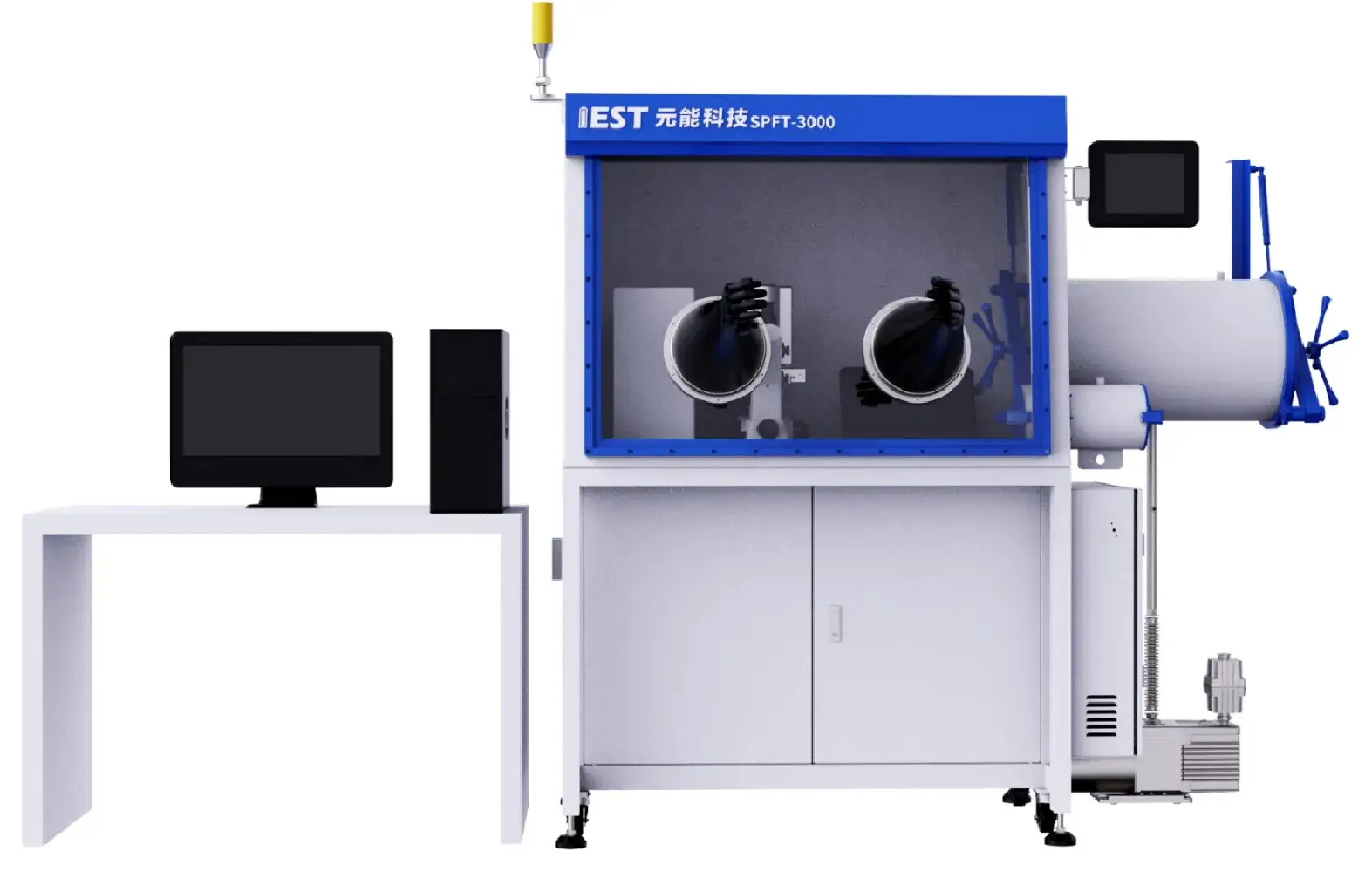
Figure 2. The IEST SPFT3000 single particle crushing force tester, available in a glovebox-integrated configuration for inert-atmosphere mechanical testing of particles of 5 to 50 µm.
4. What Mold Cells and Fixtures are Used for Solid-State Battery Research?
A solid-state battery test mold is not merely a sample holder. Its geometry, sealing arrangement, electrical insulation, pressure distribution, and dimensional stability can affect measurement reproducibility.
The IEST Solid-State Battery Mold & Fixture portfolio includes gas-tight molds for solid-electrolyte ionic-conductivity testing and mold-cell electrochemical evaluation.
The supplied solution information identifies a ceramic inner liner designed to withstand pressures of up to 600 MPa, together with an insulating cover designed to maintain structural stability during testing at 60°C. These are component-level specifications; the permissible operating conditions for a particular test must be established for the selected mold configuration.
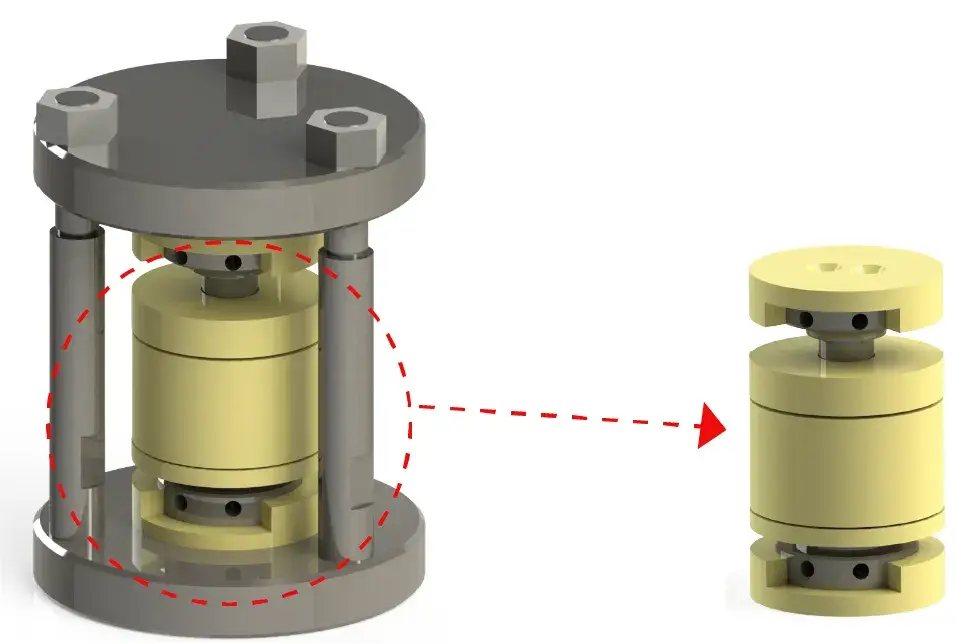
Figure 3. The IEST solid-state battery mold and fixture, with a ceramic inner liner rated for pressures up to 600 MPa and an insulating cover designed to stay undeformed at 60°C.
4.1 Why do fixture design and pressure control matter?
- Mechanical stability: Deformation of the fixture or its fastening components can change the load applied to a sample. Such changes can complicate comparisons between cells or between successive measurements.
- Pressure uniformity: Uneven loading can create local differences in pellet density and electrode–electrolyte contact. A reproducible mechanical boundary condition is therefore essential when investigating pressure-dependent electrochemical behavior.
- Electrical insulation and sealing: The fixture must support the intended electrical measurement while maintaining the required containment and insulation conditions.
- Temperature compatibility: When testing at elevated temperatures, the fixture must retain its required mechanical and electrical properties throughout the specified operating range.
For experiments that require more explicit control of the applied load, the IEST Mold Cell Pressure Control Testing System uses a three-plate steel structure intended to reduce pressure changes associated with bolt deformation during testing.
The complementary Mold Cell Automatic Pressing & Locking Machine (APLM) provides an adjustable pressing force, with a listed maximum force of 10,000 kg and a stated pressure range of 0–10 tons, customizable according to mold dimensions. Its simultaneous three-axis screw-tightening mechanism is designed to improve loading balance during pressure application and locking.
These components address different parts of the workflow: the mold establishes the sample environment, the pressure-control structure supports mechanical stability, and the pressing-and-locking system helps standardize the application of force.
5. How can Many Solid-State Cells be Tested under Pressure at the Same Time?
Electrochemical impedance spectroscopy is essential for investigating resistance contributions in solid-state battery systems. However, EIS results must be interpreted in relation to the sample geometry, test-cell configuration, applied pressure, temperature, and equivalent-circuit assumptions.
Electrochemical impedance spectroscopy (EIS) refers to measuring an electrochemical system’s frequency-dependent electrical response to investigate processes such as bulk transport, grain-boundary transport, and interfacial charge transfer.
For solid electrolytes, researchers may use impedance measurements to investigate:
- Bulk and grain-boundary contributions to the measured resistance.
- Electrode–electrolyte interfacial impedance.
- The effect of pressure on physical contact and measured electrochemical response.
- Changes in resistance during temperature-dependent or time-dependent testing.
The measured contributions do not always separate automatically. Researchers must select appropriate frequency ranges, sample geometries, electrical contacts, and equivalent-circuit models based on the system under investigation.
5.1 High-throughput pressure and electrochemical testing
When an experimental programme requires multiple samples or pressure conditions, a high-throughput pressure–electrochemical platform can improve testing efficiency.
The IEST High-throughput Pressure & Electric Coupling Test System combines temperature control, pressure testing, and electrochemical evaluation. The supplied solution page lists an operating temperature range from room temperature to 80°C, support for up to 80 mold cells or 80 pouch cells in the stated configurations, and voltage/current control accuracy of 0.01% F.S.
The listed electrochemical methods include EIS, linear sweep voltammetry (LSV), cyclic voltammetry (CV), potentiostatic intermittent titration technique (PITT), and galvanostatic intermittent titration technique (GITT).
The combination is useful when researchers need to compare electrochemical response under defined pressure and temperature conditions. Actual throughput and compatible test configurations depend on the selected system setup.
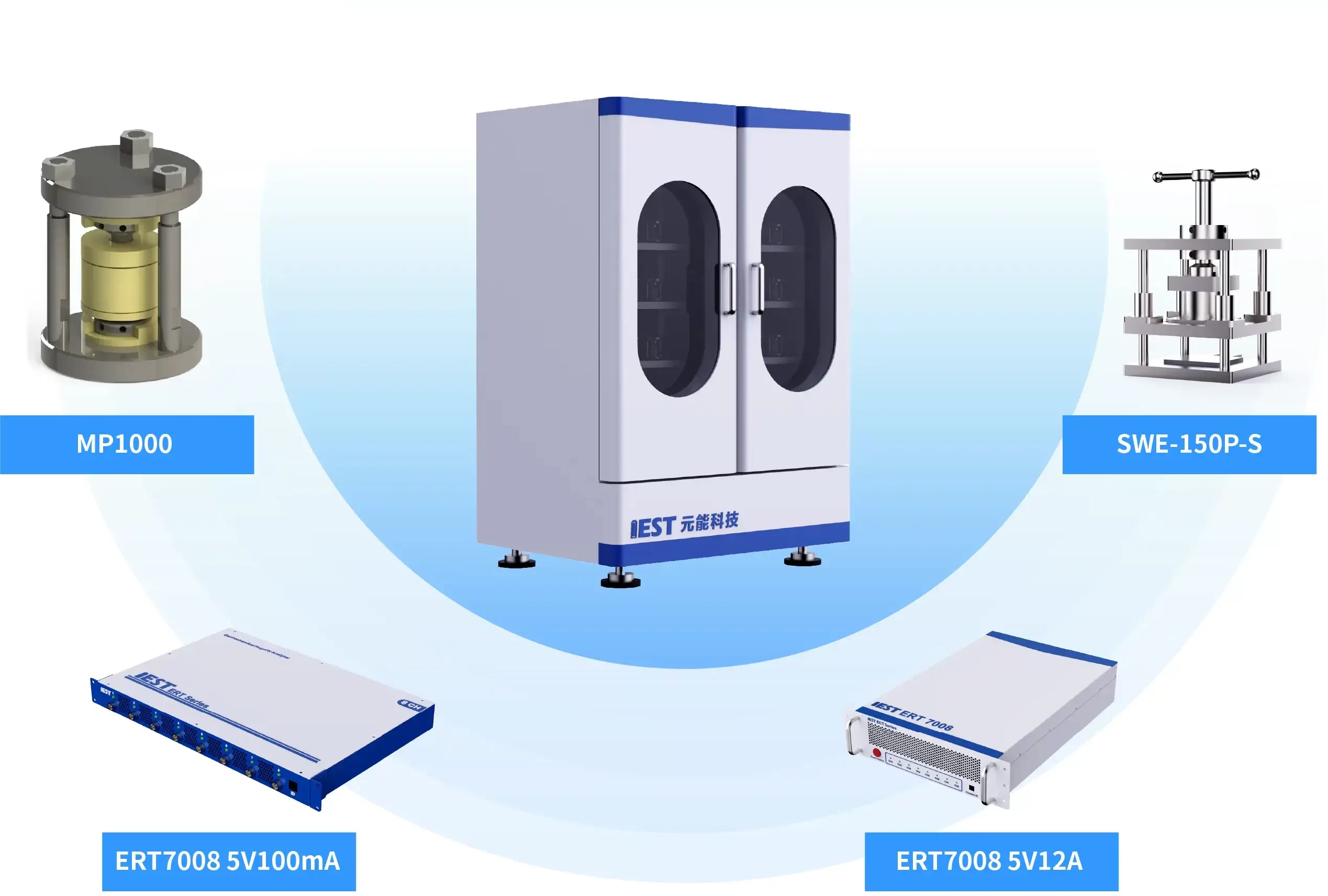
Figure 4. The IEST high-throughput pressure and electric coupling test system, with a 5-layer drawer-type carrier for up to 80 mold cells or 80 pouch cells from room temperature to 80°C.
6. How is Electrode Uniformity Evaluated for Solid-State Composite Electrodes?
Solid-state battery research often emphasizes ionic conductivity, but the electronic conduction network of the electrode remains equally important. Poor electronic connectivity can contribute to polarization and non-uniform current distribution, while an excessively simplified resistance measurement may hide the contribution of the current collector or its contact with the coating.
The IEST BER Series Battery Electrode Resistance Analyzer uses a double-sided, controllable-pressure disc-electrode method to measure the overall through-thickness resistance of practical electrodes.
The measured resistance can include:
- Electrode coating resistance.
- Coating–current collector contact resistance.
- Current collector resistance.
The BER Series also uses separate voltage and current terminals to reduce inductive interference in voltage sensing. Its supplied specifications identify reference resistance blocks and thickness standards certified by third-party metrology institutes.
6.1 Why is electrode resistance relevant to solid-state battery development?
Electrode formulations and manufacturing processes determine how conductive materials are distributed throughout the coating. Mixing, coating, drying, and compaction can all influence the resulting conductive network.
For composite electrodes used in solid-state batteries, resistance mapping can help researchers compare samples, identify spatial variation, and evaluate whether processing changes produce a more or less uniform electronic-conduction network.
However, BER electrode resistance is not a substitute for solid-electrolyte ionic-conductivity testing or EIS analysis. The tests measure different properties and should be interpreted together when diagnosing transport limitations.
A practical workflow is to combine electrode resistance with electrochemical measurements and, where appropriate, solid-electrolyte conductivity and pressure-dependent characterization.
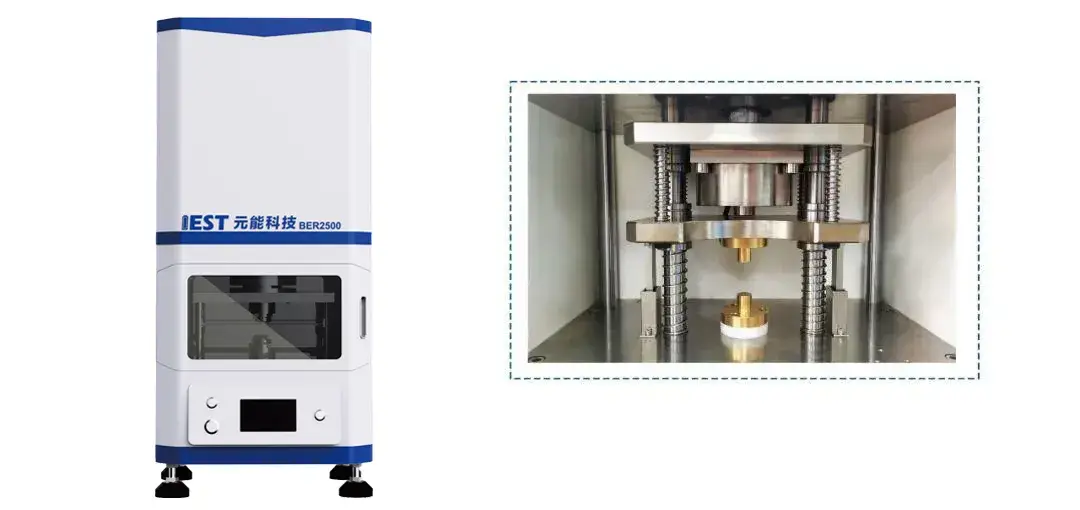
Figure 5. The IEST BER series electrode resistance analyzer, measuring the through-thickness resistance of practical electrodes with a double-sided controllable-pressure disc electrode method.
7. In-Situ Cell Swelling and Pressure Measurement
Solid-state battery degradation can occur at several scales. Particle damage and interface disruption occur locally, but the assembled cell also experiences changes in thickness and mechanical force during cycling.
In-situ cell swelling analysis refers to monitoring a cell’s dimensional change during electrochemical operation, often alongside force or applied pressure, to characterize its coupled electrochemical and mechanical response.
The IEST SWE Series in-situ swelling analyzers integrate thickness monitoring, pressure control, and charge–discharge measurement for cell-level force and thickness analysis.
Such measurements can help researchers investigate:
- Reversible thickness changes associated with charge and discharge.
- Accumulating irreversible expansion during aging.
- The relationship between applied constraint and cell expansion.
- Changes in mechanical response that accompany electrochemical degradation.
For experiments involving non-uniform pressure distributions, the IEST BPD Series pressure-mapping solution can provide additional information about pressure distribution and temperature, depending on the selected configuration.
These measurements complement SEMS3200 and single-particle testing rather than replacing them. The SEMS3200 addresses powder-level compaction and electrochemical behavior; single-particle testing examines individual-particle mechanics; and in-situ swelling analysis evaluates the response of the assembled cell.
8. Building a Multi-Scale Solid-State Battery Testing Workflow
A robust solid-state battery testing programme connects measurements across material, electrode, interface, and cell levels:
- Stage 1 — Material characterization: Evaluate solid-electrolyte powder compaction and electrochemical response using pressure- and atmosphere-controlled testing. Determine whether the material’s measured behavior changes with densification or loading conditions.
- Stage 2 — Test-cell preparation: Use compatible molds and fixtures to establish reproducible sample geometry, sealing, electrical contact, and mechanical constraints.
- Stage 3 — Transport characterization: Use ionic-conductivity and impedance measurements to investigate electrolyte and interfacial resistance. Interpret the results with the appropriate geometrical and electrical models.
- Stage 4 — Electrode characterization: Measure through-thickness electrode resistance to evaluate the electronic-conduction network and identify spatial or process-related variation.
- Stage 5 — Mechanical characterization: Use single-particle compression to investigate particle-level fracture behavior and in-situ swelling analysis to characterize cell-level dimensional and force responses.
- Stage 6 — Integrated electrochemical evaluation: Compare electrochemical performance under defined pressure, temperature, and cycling conditions. Relate changes in capacity or impedance to the material, electrode, interface, and mechanical evidence obtained earlier.
This workflow helps researchers distinguish among different sources of performance loss. Increased impedance, for example, may reflect electrolyte transport limitations, poor interfacial contact, electrode resistance, or evolving mechanical damage. No single instrument can independently distinguish every mechanism.
9. How IEST Instrument Supports Advanced Solid-State Battery Testing
- Pressure as a controlled variable: servo or hydraulic pressure, with force and thickness recorded.
- Inert-atmosphere compatibility: glovebox-ready instruments for sulfide and other moisture-sensitive materials.
- EIS on the same platform: ionic conductivity and interfacial impedance measured under the same pressure as cycling.
- Throughput: parallel testing of many mold or pouch cells with temperature control.
- Traceability: reference standards and unified software for data export.
- Compatibility: pressing tools, molds and test systems designed to work together.
IEST Instrument states in its company profile that it has supplied more than 6,000 instruments to over 1,300 clients worldwide since 2018. Its solid-state range covers every item above; see the full IEST solid-state battery testing solutions page or the brochure.
🔬 Planning a solid-state battery test lab or upgrading one?
Tell IEST Instrument your material system (sulfide, oxide or polymer), cell format and pressure range, and the application engineering team will recommend a matching configuration. Email info@iesttech.com or send an inquiry.
10. FAQs
Which instruments are essential for advanced solid-state battery testing?
The core setup typically includes pressure-controlled test molds, solid-electrolyte characterization equipment, impedance measurement capability, and appropriate sample-preparation tools. Electrode resistance, single-particle mechanics, and in-situ swelling instruments become important when the research also examines electronic transport or mechanical degradation.
What does the IEST SEMS3200 measure in solid-state battery research?
The SEMS3200 supports powder-level compaction-density and electrochemical characterization under adjustable pressure and atmospheric conditions. Its integrated measurement functions help researchers examine the relationship between powder compaction, thickness response, and electrochemical behavior.
Why must solid-state batteries be tested under controlled pressure?
Solid electrolytes cannot flow into electrode surfaces like liquid electrolytes, so stack pressure sets the quality of interfacial contact. Uncontrolled pressure changes alter interfacial resistance and swelling behavior, which makes cycling data hard to compare between cells or laboratories.
Which instrument measures swelling force in solid-state cells?
In-situ swelling analyzers measure cell thickness and force during charge and discharge. IEST’s 20T SWE analyzer operates from −20°C to 85°C, and the 60T analyzer from 35°C to 85°C with constant-pressure and constant-gap modes. IEST mold cell fixtures also support swelling force monitoring.
How should a laboratory choose equipment for solid-state battery testing?
Selection should begin with the research objective and the variables that must be controlled, including atmosphere, pressure, temperature, sample geometry, and electrochemical measurement requirements. A combination of SEMS3200, compatible solid-state molds, BER electrode resistance testing, and mechanical or swelling analysis can be configured according to the material and cell format.
Why is stack pressure critical in solid-state battery testing?
Stack pressure maintains intimate contact between solid electrolyte and electrodes. Without adequate and uniform pressure, interfacial resistance increases dramatically, leading to unreliable data and premature cell failure. IEST’s solid-state battery mold sustains up to 600 MPa with a ceramic liner to ensure stable pressure during cycling.