
IEST Application Engineering Team

IEST Application Engineering Team

Expansion Decomposition and Comparison of Cathode and Anode Electrode for Lithium-ion Batteries

Expansion Decomposition and Comparison of Cathode and Anode Electrode for Lithium-ion Batteries

Abstract Graphite anode volume expansion during lithiation in lithium-ion batteries is typically 10–15% by thickness, while silicon-based anodes can undergo up to 300% volume expansion at full lithiation. Cathode materials expand in the opposite direction from what might be expected: NCM and LCO cathodes also expand during…
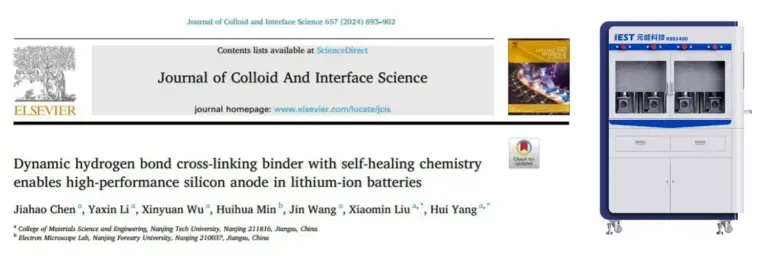
Dynamic Hydrogen Bonding Binder with Self-Healing Capability Enables Development of High-Performance Silicon Anode Lithium-Ion Batteries

Dynamic hydrogen bond cross-linking silicon anode binder (TA-c-PAA) with self-healing chemistry - Journal ofColloid and Interface Science 2024 study on high-performance silicon anode for lithium-ion batteries

Abstract A silicon anode binder with dynamic, reversible cross-links can directly address the structural failure mode that limits silicon anodes: repeated particle fracture from ~300% volume expansion during lithiation. Researchers at Nanjing University of Technology developed TA-c-PAA—a self-healing binder formed by in-situ polymerization…

A Quasi-intercalation Reaction For Fast Sulfur Redox Kinetics In Solid-state Lithium-sulfur Battery

A Quasi-intercalation Reaction For Fast Sulfur Redox Kinetics In solid-state Lithium-sulfur Battery

1. Article Abstract In 2022, Dr. Li Chuang’s team from the Tsinghua Shenzhen International Graduate School developed a novel solid-state lithium sulfur battery (Li-SPAN) employing a salt-in-polymer solid electrolyte. This innovative design confines sulfur within a polyacrylonitrile (PAN) matrix during cycling.…

Solid-state Electrolytes Testing Method for Electrochemical Properties

Battery material testing instruments

Abstract Solid-state electrolyte testing is the systematic evaluation of a solid electrolyte’s ionic conductivity, electronic conductivity, compaction density, and electrochemical stability under controlled mechanical pressure. Electrolyte measurement in this context requires stable, quantifiable pressure application, because the physical characteristics of a solid electrolyte…

A Systematic Guide to Lithium-Ion Battery Failure Analysis: Methods and Instrumentation

Lithium-ion battery material analysis

Abstract Battery failure analysis is the systematic process of identifying and characterizing the root causes of performance degradation and safety incidents in lithium-ion cells. Two categories are distinguished: performance failure—including capacity attenuation, abnormal rate performance, poor cycle consistency, and temperature anomalies—and safety failure,…

IEST Wechat QR code

Contact Us

Please fill out the form below and we will contact you asap!