IEST Application Engineering Team

IEST Application Engineering Team

IEST SPEC1000 Powers JACS Breakthrough: NJU & CATL Jointly Unveil Graphite Anode Fast-Charging Bottlenecks, Reshaping the Understanding of Graphite Lithiation Kinetics.

IEST SPECT1000 Powers JACS Breakthrough NJU & CATL Jointly Unveil Graphite Anode Fast-Charging Bottlenecks, Reshaping the Understanding of Graphite Lithiation Kinetics.

Abstract Graphite lithiation, the intercalation of lithium ions into graphite during battery charging, proceeds through multiple ordered staging transitions that strongly influence the rate and safety of fast charging. In a 2026 JACS study, researchers at Nanjing University and CATL’s…
How to Accelerate Battery R&D and Quality Control with Powder Resistivity and Compaction Density Measurement

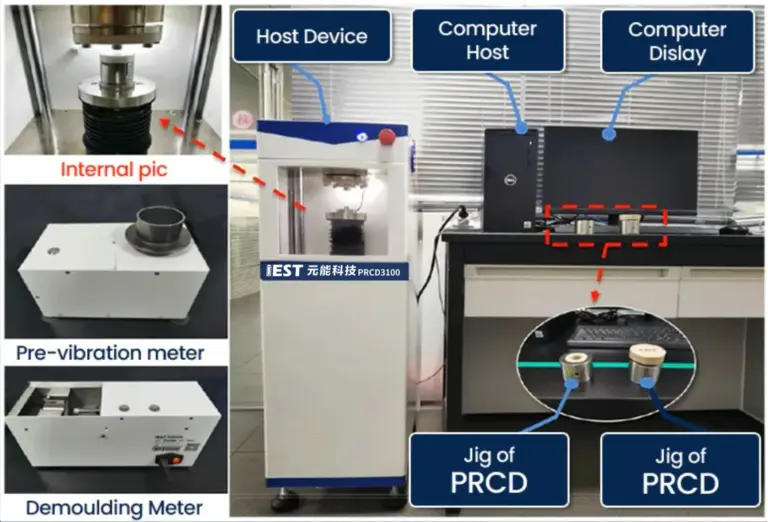
IEST PRCD3100 powder resistivity measurement system and powder density tester setup, featuring the main testing host, customized testing jigs, pre-vibration meter, and demoulding meter for advanced battery material analysis.

Abstract Powder resistivity measurement systems and powder compaction density testers (collectively referred to as Powder Resistivity and Compaction Density, PRCD systems) characterize the electrical conductivity, compaction behavior, and mechanical deformation of battery active materials under controlled pressure. These measurements serve…

Multi-Level Testing for Sodium-Ion Batteries: A Characterization Framework from Particle to Cell

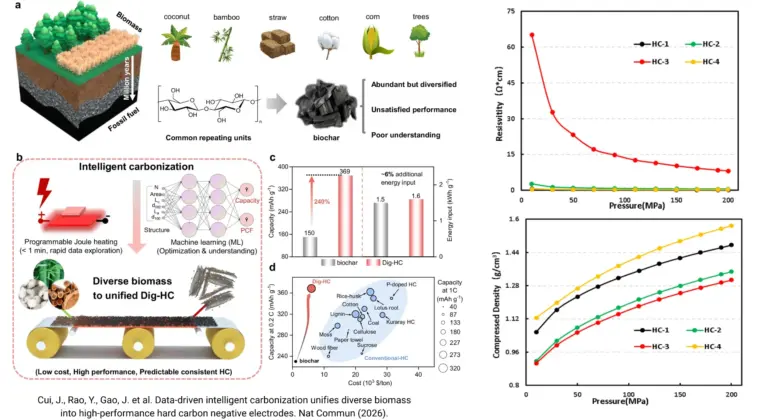
Powder resistivity and compaction density measurement comparison for multiple hard carbon anode materials forsodium-ion batteries using PRCD series - showing pressure-dependent resistivity curves and compaction densitycurves for different hard carbon samples, enabling differentiation of material quality and carbonization uniformity between batches and suppliers

Abstract Sodium-ion battery testing requires characterization at four levels: particle, powder, electrode, and cell. Limitations introduced at each level can ultimately affect cell performance and reliability. At the particle level, single-particle crushing strength differentiates the mechanical response of layered oxide…

Nano Materials Science: Mechanical Pressure Regulates Interfacial Stability in LFP/Graphite Batteries— Characterized with IEST PRCD3100

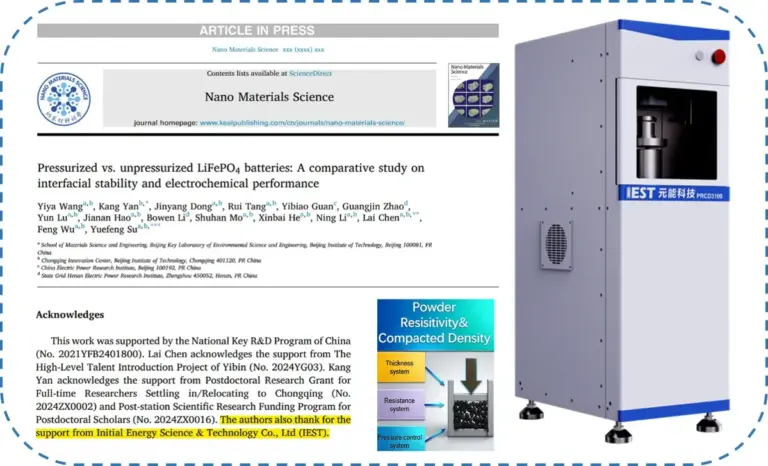
Composite image showing the Nano Materials Science journal article header titled "Pressurized vs. unpressurized LiFePO4 batteries" by Wang, Yan et al., the acknowledgments section thanking IEST Instrument (Initial Energy Science & Technology Co., Ltd) for support, a schematic diagram of the powder resistivity and compaction density measurement setup, and a product photo of the IEST PRCD3100 system

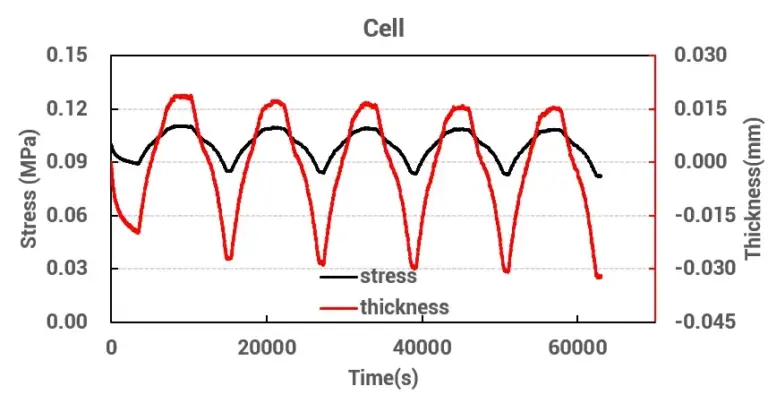
Abstract A recent study published in Nano Materials Science by researchers at Beijing Institute of Technology systematically investigated how external mechanical pressure influences interfacial stability and failure mechanisms in LFP/graphite battery. The researchers compared cells cycled without applied pressure (0…

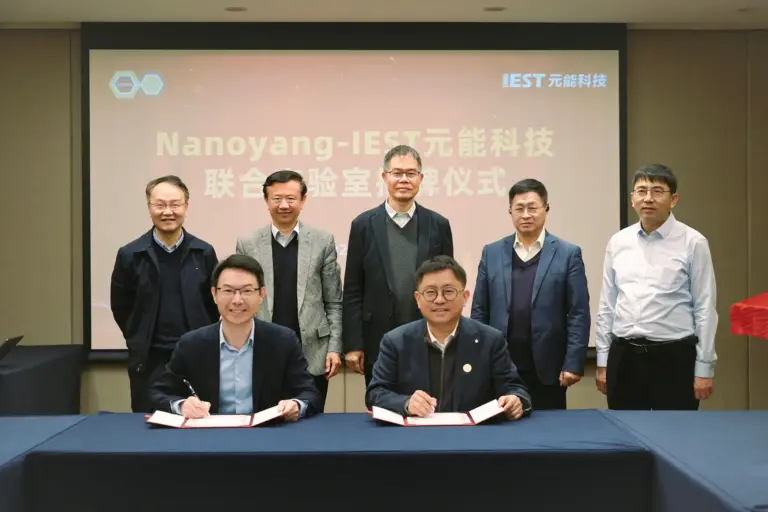
IEST Instrument and Tianjin University’s Nanoyang Group Establish Joint Laboratory for Advanced Battery Research

IEST Instrument and Tianjin University’s Nanoyang Group Establish Joint Laboratory for Advanced Battery Research

Abstract Tianjin, March 23, 2026 — The Nanoyang research group at Tianjin University and IEST Instrument (Xiamen) jointly announced the official launch of their Joint Laboratory at a ceremony held on the Tianjin University campus. The event brought together leading experts in China’s new energy materials field, including Academician…

IEST Wechat QR code

Contact Us

Please fill out the form below and we will contact you asap!